
Amazon affiliate links - we earn a commission.Affiliate disclosure

Buying guide · 12 min read · Updated 2026-11-09

Best 1000 Watt RV Solar Panel Kits (2026)

Six 1000 watt RV solar panel kits compared by panel count, cell type, controller size, flexible versus rigid build and real daily output on a camper roof.

James MillerBy James MillerLead Machine Editor6 machines comparedSpec-sheet verified
Best 1000 Watt RV Solar Panel Kits

At a glance

Our top picks

Side by side

Spec comparison

MachineArrayCellsEfficiency
1000W TUV Certified Solar Kit, 5 x 200W N-Type PanelsBest Overall1000W TUV Certified Solar Kit, 5 x 200W N-Type PanelsFive 200W panels, 1000W totalN-type monocrystalline, 16BBUp to 25.8%
1000W TUV Certified Solar Kit, 10 x 100W N-Type PanelsBest Layout Flexibility1000W TUV Certified Solar Kit, 10 x 100W N-Type PanelsTen 100W panels, 1000W totalN-type monocrystalline, 16BBUp to 25.8%
DOKIO 1000W Flexible Solar Panels, 10 x 100W ETFE, 18VBest Value FlexibleDOKIO 1000W Flexible Solar Panels, 10 x 100W ETFE, 18VTen 100W semi-flexible panelsn/an/a
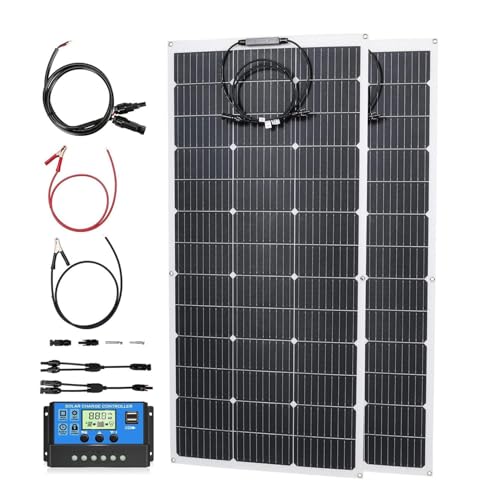
1000W Flexible Solar Kit, 2 x 500W Panels, Controller IncludedBest Kit With Controller1000W Flexible Solar Kit, 2 x 500W Panels, Controller IncludedTwo 500W flexible panelsMonocrystalline23% quoted
1000W Flexible Solar Kit, 2 x 500W, 3 mm Thin, 28.5VThinnest Panel1000W Flexible Solar Kit, 2 x 500W, 3 mm Thin, 28.5VTwo 500W flexible panelsMonocrystallinen/a
1000W Flexible Solar Kit, 2 x 500W, 40A Controller, 25%Best Controller Capacity1000W Flexible Solar Kit, 2 x 500W, 40A Controller, 25%Two 500W flexible panelsn/aUp to 25% quoted

A kilowatt of panels is a serious RV array. It can run a roof air conditioner for part of the day, keep a large lithium bank full and support a long stay in a spot with no hookups. It is also more than most small rigs have room for.

The label number is a laboratory rating, not a daily output. Real roofs lose watts to heat, angle and shade, and the charge controller sets how much of the array you can use. This guide ranks kits by how well each pairs panel type with a usable controller.

Before you buy

6 Criteria to Look For Before Buying a 1000 Watt RV Solar Panel Kit

  1. 01

    Real daily output

    A 1000W label is laboratory output. In the field panels produce about 60 to 80 percent of the label because of heat, angle and dust. Using four to five sun hours, a kilowatt array yields about 3 to 4 kWh a day. The TUV N-type kits hold output better in heat than flexible panels.

  2. 02

    Controller size matters

    A 40A controller on a 12V bank handles roughly 500 watts, so a full kilowatt needs 24V wiring or a larger controller. The 2 x 500W kits include 40A controllers. MPPT harvests 20 to 30 percent more than PWM, and PWM is a poor fit above about 150W of panels. Always match the controller to the array.

  3. 03

    Rigid versus flexible panels

    Rigid panels cost less per watt, run cooler and last longer. Flexible panels suit curved roofs and weight limits but trap heat and age faster. The TUV N-type kits are rigid; the DOKIO and 500W kits are flexible. Choose flexible only when weight or curvature requires it.

  4. 04

    Series versus parallel wiring

    Series wiring raises voltage, allows thinner wire and handles partial shade better, but it needs a controller with enough input voltage. Parallel adds current and suits small PWM systems. The DOKIO ten-pack supports either. Check open-circuit voltage against the controller limit, since cold raises it.

  5. 05

    Panel count and install effort

    Five 200W panels need fewer connectors than ten 100W panels, and two 500W panels need the fewest of all. Fewer connections mean fewer leaks and fault points. Larger panels need a clear roof area. Count your free roof length before you buy.

  6. 06

    Certification and cell type

    Independent certification to IEC 61215, IEC 61730 and UL 61730, as on the two TUV kits, shows the panel passed standard tests for durability and safety. N-type cells degrade more slowly than P-type. Busbar count matters less than cell type.

Detailed reviews

The 6 best 1000 watt rv solar panel kits, explained

01
1000W TUV Certified Solar Kit, 5 x 200W N-Type Panels
5 x 200WN-type 16BB25.8% cellsIP68
Check price on Amazon
Best for: RV owners with a flat roof who want certified rigid panels and the fewest connections.

This kit is built from five 200W panels using N-type monocrystalline cells with 16 busbars, with a quoted peak cell efficiency of 25.8 percent. N-type cells degrade more slowly and tolerate heat better than older P-type PERC cells, which matters on a hot RV roof where panel temperature climbs well past 140 degrees. The listing also states certification to IEC 61215, IEC 61730 and UL 61730, an independent test record that most budget kits do not offer.

The series-parallel cell-string layout lets unshaded sections keep producing when a vent or antenna shades part of a panel. Compared with the ten-panel 100W set, five panels mean fewer connectors, fewer roof penetrations and less wiring to trace. The tradeoff is that each 200W panel is larger and harder to place around vents and skylights.

Ownership is simple: wash the glass with water and a soft cloth, check connectors and mounting hardware each season, and reseal roof penetrations annually. Pair it with an MPPT controller sized for the array voltage, because the kit's headline watts mean little if the controller throttles the output.

What works

  • Independent certification to IEC and UL panel standards
  • N-type cells handle heat better than older P-type
  • Five panels mean fewer connectors than ten
  • Cell-string layout keeps shaded panels producing

Watch out for

  • Large 200W panels are harder to fit around roof vents
  • Controller and mounts may be sold separately

Spec sheet

Array
Five 200W panels, 1000W total
Cells
N-type monocrystalline, 16BB
Efficiency
Up to 25.8%
Certification
IEC 61215, IEC 61730, UL 61730
Sealing
IP68
02
1000W TUV Certified Solar Kit, 10 x 100W N-Type Panels
10 x 100WN-type 16BB25.8% cellsTUV certified
Check price on Amazon
Best for: RVs with cluttered roofs where 200W panels will not fit.

The ten-panel version uses the same N-type 16BB cells and the same certification as the five-panel kit, but splits the kilowatt into 100W building blocks. Small panels slot around skylights, vents and curved roof edges that a 200W panel cannot clear. That layout freedom is the main reason to buy it over the five-panel set.

The cost is complexity. Ten panels need roughly twice the connections of five, and each connector is a potential fault point that needs to stay dry and tight. Series wiring raises voltage and tolerates shade better than parallel wiring, but a long series string must stay under the controller's input voltage limit. Check the open-circuit voltage against the controller, allowing for cold mornings raising it.

Expect more mounting hardware and a longer install day than the five-panel kit. Keep wire runs short and use heavier gauge on longer runs to avoid voltage drop, and inspect sealant on every roof penetration each year. For a complex roof it is worth the extra effort.

What works

  • Small panels fit around vents, skylights and antennas
  • Same N-type 16BB cells and certification as the 200W set
  • Failure of one panel costs only 100W
  • Easier to lift on a roof than larger panels

Watch out for

  • Ten panels mean twice the connectors to seal and inspect
  • Longer install time and more mounting hardware

Spec sheet

Array
Ten 100W panels, 1000W total
Cells
N-type monocrystalline, 16BB
Efficiency
Up to 25.8%
Certification
IEC 61215, IEC 61730, UL 61730
Layout
Small panels fit around roof obstacles
03
DOKIO 1000W Flexible Solar Panels, 10 x 100W ETFE, 18V
10 x 100WSemi-flexible ETFE18V, 12V systemsSeries or parallel
Check price on Amazon
Best for: Vans and curved-roof campers where rigid glass will not fit or exceeds weight limits.

DOKIO's ten 100W panels are semi-flexible with an ETFE surface, built for 12V systems at 18V per panel. Slim and light, they suit curved RV roofs, van roofs and places where rigid glass is too heavy. That flexibility is the reason to pick them over the TUV N-type sets.

The tradeoff is heat. Flexible panels bonded flat to a roof trap warmth behind the cells and age faster than glass panels that let air pass underneath. The maker itself says to leave ventilation space so heat can escape, and not to mount directly on combustible materials. Series wiring raises voltage and parallel wiring adds current; either way the controller must match.

In year three, the flexible laminate is the part to watch for lifting edges and discoloration. Use marine-grade adhesive or a mounting method that keeps a gap, and plan on replacing panels sooner than rigid glass. If weight and curved roofs are the priority, this is the lowest-risk flexible option here.

What works

  • Slim ETFE panels bend to curved roof surfaces
  • Series or parallel wiring suits different controllers
  • Light enough for roofs with strict weight limits
  • Individual panels can be replaced one at a time

Watch out for

  • Flexible panels trap heat and age faster than glass
  • Needs ventilation space and careful adhesive choice

Spec sheet

Array
Ten 100W semi-flexible panels
Surface
ETFE
Voltage
18V panels for 12V systems
Wiring
Series or parallel
Mounting note
Needs ventilation space behind
04
1000W Flexible Solar Kit, 2 x 500W Panels, Controller Included
2 x 500WFlexible mono23% efficiencyController incl.
Check price on Amazon
Best for: Owners with a long clear roof who want the fewest panels and a controller in the box.

Two 500W panels deliver the full kilowatt from just two units, so the install has minimal wiring. The monocrystalline cells carry a quoted 23 percent conversion rate, and the flexible panels bend up to about 30 degrees, enough for a gently curved roof or boat deck. A charge controller comes with the kit, which is rare in this class.

Size is the catch. Each 500W panel is physically large, so you need a long, clear roof section. A shadow across one panel hits half the array, which is worse than the ten-panel layouts. Flexible panels of this length also bridge roof ribs, so the adhesive and support matter.

Before buying, confirm the included controller type and its amp rating against the array. A 40A controller on a 12V system handles roughly 500 watts, so a full kilowatt needs 24V wiring or a bigger controller. For the owner who wants the simplest two-panel kit with a controller already in the box, it is a good fit.

What works

  • Only two panels to mount and wire
  • Controller is included in the kit
  • Bends to follow a gently curved roof
  • Quoted 23 percent cell efficiency

Watch out for

  • Large panels need a long clear roof
  • Shade on one panel affects half the array

Spec sheet

Array
Two 500W flexible panels
Cells
Monocrystalline
Efficiency
23% quoted
Flex
Bends up to about 30 degrees
Included
Charge controller
05
1000W Flexible Solar Kit, 2 x 500W, 3 mm Thin, 28.5V
2 x 500W3 mm thick28.5V / 18.81AFlexible mono
Check price on Amazon
Best for: Weight-limited rigs that need a thin, bendable two-panel array.

This kit is the thinnest of the two-panel options at about 3 millimeters, with a stated output of 28.5V and 18.81A per panel. The thin build keeps weight low and lets the panel follow curves. The numbers also show what you must plan for: two panels in series reach about 57V, which must fit under the controller's input voltage limit.

Compared with the GXZ7MBMC kit above, it gives similar size and watts and leans on its thin laminate as the selling point. A thin laminate has less insulation between cells and the roof, so heat builds quickly in summer sun and cell output drops as temperature rises. Rated watts at standard test conditions overstate what it produces on a hot roof.

Treat it as a lighter-weight option, not a longer-lived one. Plan on regular inspection of the edges and adhesive, avoid mounting it flush on bare metal, and expect to replace it sooner than glass panels. Keep wire runs short to reduce loss on a 20 amp circuit.

What works

  • About 3 mm thickness keeps weight low
  • Stated 28.5V and 18.81A makes system matching clear
  • Only two panels to wire
  • Flexible build follows curved roofs

Watch out for

  • Thin laminate runs hot and loses output in summer sun
  • Likely shorter service life than glass panels

Spec sheet

Array
Two 500W flexible panels
Thickness
About 3 mm
Output rating
28.5V, 18.81A
Cells
Monocrystalline
Use
Remote, continuous power
06
1000W Flexible Solar Kit, 2 x 500W, 40A Controller, 25%
2 x 500W40A controllerUp to 25%Lightweight
Check price on Amazon
Best for: 24V system builders who want a 40A controller in the kit.

This kit includes two 500W panels and a 40A charge controller, with a quoted conversion rate of up to 25 percent. That makes it the highest efficiency claim among the flexible kits, though a quoted peak figure is a lab number, not field output. The kit is built for RV, camping, boat and small off-grid use.

A 40A controller is the limit. On a 12V battery bank it handles roughly 500 to 560 watts of panel output, so half the kilowatt is wasted unless the system runs at 24V. At 24V the same controller can pass about 1000 watts. Read the voltage plan before you buy, because a mismatch sends a large share of the array's output to waste.

Ownership is the same as with other flexible kits: watch edges and adhesive, keep a gap behind the panel where possible and clean dust off the surface. If you are building a 24V system and want a controller in the box, it fits. If you have 12V, budget for a bigger controller.

What works

  • Highest quoted efficiency among the flexible kits
  • 40A controller included in the box
  • Light compared with rigid glass panels
  • Suits RV, boat and off-grid use

Watch out for

  • A 40A controller limits a 12V system to roughly half the array
  • Quoted peak efficiency is not field output

Spec sheet

Array
Two 500W flexible panels
Controller
40A charge controller
Efficiency
Up to 25% quoted
Weight
Light compared with rigid glass
Fit
RV, boat, off-grid

Spec sheet decoder

What the numbers on the box really mean

The specs manufacturers lead with, translated into what they tell you about real-world performance.

Watts (array rating)

The combined label output under laboratory test conditions. Field output is lower.

Watch forAll six kits reach 1000W on paper, but heat and angle change the result.

N-type vs P-type cells

N-type cells degrade more slowly and handle heat better. They are the newer technology.

Watch forThe two TUV kits list N-type; the flexible kits give monocrystalline only.

16BB

Sixteen busbars per cell, which helps shade and crack tolerance. Cell type matters more than the busbar count.

Watch forOnly the two TUV kits quote 16BB.

Controller amps

The maximum charge current the controller can pass to the battery. Amps times battery voltage gives the usable array watts.

Watch forThe 40A controllers in the 500W kits cap a 12V system at about 500 watts.

IP rating

Ingress protection against dust and water. IP68 means sealed against continuous immersion.

Watch forThe five-panel TUV kit lists IP68.

Methodology

How We Evaluated These 1000 Watt RV Solar Panel Kits

Cell and panel quality

We compared cell type, busbar count and efficiency claims from the spec sheets. The two TUV kits list N-type 16BB cells with a 25.8 percent claim. The flexible kits quote 23 to 25 percent.

Certification and safety

We checked which kits cite IEC 61215, IEC 61730 and UL 61730. Only the two TUV kits do. We treated independent certification as a durability signal.

Controller match

We compared included controllers against the array. A 40A controller on a 12V bank cannot use the full kilowatt. We favored kits that explain their voltage plan.

Roof fit and install

We weighed panel count, panel size and mounting method against typical RV roofs. Five panels beat ten for wiring effort, and two 500W panels beat both. Layout fit decided the badges.

Ownership durability

We judged heat behavior and adhesive reliance based on the spec sheet and owner feedback patterns. Glass panels sit highest, flexible laminates lower. Expect flexible panels to be replaced sooner.

Decision guide

How to Choose the Right 1000 Watt RV Solar Panel Kits

By Roof Type

SituationPickWhy
Flat roof with space for large panels1000W TUV 5 x 200WFewest rigid panels, certified
Cluttered roof with vents and skylights1000W TUV 10 x 100WSmall panels fit around obstacles
Curved van roofDOKIO 10 x 100WFlexible ETFE panels
Long clear roof, minimal wiring2 x 500W flexible kitTwo panels to mount
Strict weight limit3 mm 2 x 500W kitThinnest build

By Budget

SituationPickWhy
Lowest tierDOKIO 10 x 100WCheapest flexible option
Lower middle2 x 500W kit with controllerController is included
Middle3 mm 2 x 500W kitMid tier thin panel
Upper middle1000W TUV 10 x 100WCertified and flexible layout
Top1000W TUV 5 x 200WCertified rigid panels, fewest connectors

Rigid vs Flexible

Rigid glass

The two TUV kits run cooler, last longer and cost less per watt. They are heavier and need a flat roof. The five-panel set has the fewest connections.

Flexible

The DOKIO and the three 500W kits bend to curved roofs and weigh less. They run hotter and age faster. Leave ventilation space behind them.

Choose rigid when your roof is flat; choose flexible only when weight or curvature requires it.

By System Voltage

SituationPickWhy
12V bank with a large controller1000W TUV 5 x 200WAdd an MPPT controller sized for the array
24V bank with a 40A controller1000W flexible kit, 40A controller40A at 24V handles about 1000W
12V bank, flexible, parallel wiringDOKIO 10 x 100W18V panels for 12V systems
Series wiring and shade tolerance1000W TUV 10 x 100WSeries string with a high-voltage MPPT
Plug-and-go small bank2 x 500W kit with controllerController is included

For Long Stays Specifically

Look for

Check the daily watt-hours you use, divide by four to five sun hours and by about 0.7 for losses. A 1000W array covers roughly 3 to 4 kWh a day. Look for N-type cells and certified panels for hot summers.

In this comparison

The 1000W TUV 5 x 200W and 10 x 100W kits hold up best in heat. The flexible kits suit a lighter build but need replacement sooner.

When to Spend More

Spend more if

You will live in the RV for long stretches, run an air conditioner or need decades of service. Spend on the certified rigid kits and an MPPT controller sized for the array.

Save if

You camp occasionally or need only a smaller bank. The DOKIO or a 500W kit works. Consider a smaller array before paying for a kilowatt you will not use.

Ownership

Maintenance schedule

The upkeep that decides whether this machine lasts two seasons or ten.

TaskIntervalWhy it matters
Clean panel surfaceMonthly in useDust and pollen cut output. Use water and a soft cloth, not abrasives.
Check connectorsEvery seasonLoose or corroded connectors cause heat and power loss. Reseat and inspect them.
Inspect roof sealantYearlyRoof penetrations crack with heat cycles. Reseal with a roof-rated sealant.
Check adhesive and edgesEvery season for flexible panelsEdge lift lets moisture in. Fix it early before cells are damaged.
Verify controller profileAt install and after battery changesA lead-acid profile on a lithium bank under or over charges it.

FAQ

Frequently Asked Questions

Is 1000 watts of solar enough to run an RV air conditioner?

Only for part of the day. A kilowatt array produces about 3 to 4 kWh in typical sun, while a rooftop air conditioner uses over a kilowatt while running. It will help, not replace shore power or a generator.

Do I need an MPPT controller?

Yes for arrays above about 150W. MPPT harvests 20 to 30 percent more than PWM, especially in cold or low light. A 40A controller on 12V still caps the array near 500 watts.

Which is better, flexible or rigid?

Rigid panels cost less per watt and last longer. Flexible panels suit curved roofs and weight limits but run hotter and age faster.

How many solar panels is a 1000W kit?

It depends on the panel size. The kits here use two 500W, five 200W or ten 100W panels. Fewer panels mean fewer connections but need more roof length.

Can I use these with a lithium battery?

Yes, but the controller must have a lithium profile. A lead-acid profile will undercharge or overcharge the bank.

How long will these panels last?

Rigid glass panels typically last many years with slow output loss. Flexible laminates age faster in heat. Clean and inspect them each season.

Bottom line

The short version

Browse more 1000 watt rv solar panel kitson Amazon →
James Miller, Lead Machine Editor

About the author

James Miller

Lead Machine Editor, MachineFanatic

James Miller leads MachineFanatic's buying guides, turning spec sheets, manuals and owner feedback into clear verdicts on power tools, outdoor power equipment, shop machines and kitchen machines.

More from James →

Keep reading

Related guides