
Amazon affiliate links - we earn a commission.Affiliate disclosure

Buying guide · 12 min read · Updated 2026-11-09

Best 100W Foldable Solar Panels (2026)

Six 100W foldable solar panels for power stations compared on weight, folded size, connectors, USB ports, waterproofing and honest field output.

James MillerBy James MillerLead Machine Editor5 machines comparedSpec-sheet verified
Best 100W Foldable Solar Panels

At a glance

Our top picks

Side by side

Spec comparison

A foldable panel is the simplest way to add solar to a power station. It unfolds in a minute, sits on the ground or a tailgate and plugs into the station through a cable. There is no controller to wire and nothing to mount.

Output is the thing to keep honest. A label rated at standard test conditions delivers far less in real sun, and the connector on the end decides whether the panel works with your station at all. This guide ranks panels on weight, build, ports and fit.

Before you buy

6 Criteria to Look For Before Buying a 100W Foldable Solar Panel

  1. 01

    Rated watts versus field output

    A 100W panel earns its label in laboratory conditions. In the field, expect 60 to 80 percent of the label, or about 60 to 80 watts in good sun. Over four to five sun hours that is roughly 250 to 400 watt-hours. A 1000Wh power station will not refill in a day from one panel. Plan the whole trip around the lower end of that range, since cloud and a low winter sun can push output well below 60 percent.

  2. 02

    Connector compatibility

    Panels use MC4, DC5521, DC7909, XT60 or Anderson plugs, and stations use different ones. The Twelseavan includes a five-in-one cable plus three DC adapters, the Sokiovola a four-in-one cable. A mismatch means buying an adapter. Check your station's input port before you order. Adapters cost little, but a loose plug that fits poorly can overheat, so confirm a firm click on every connection.

  3. 03

    Weight and folded size

    The FlexSolar weighs 4.1 pounds and the Renogy 8.86. That is a doubling of weight for the same label watts. Folded size ranges from about 13 by 10.4 inches to 20.6 by 24.6 inches. If you carry on foot, weight beats cell efficiency. A panel you leave at home because it is awkward to carry produces nothing, so honest weight matters more than a tiny gain in watts.

  4. 04

    Cell type and durability

    N-type cells, found in the Renogy, degrade more slowly and handle heat better than older P-type. A one-point difference in efficiency between 24 and 25 percent is small. Cell type and fold construction matter more than the headline number. Heat is the hidden variable, because cell output falls as the panel warms in direct summer sun.

  5. 05

    Waterproof rating

    IP67 means dust-tight and survives brief immersion, IP68 means sealed against longer immersion. The Sokiovola claims IP68, the Renogy and FlexSolar IP67. For camping, either rating handles rain and splashes. The connector is the weak point, not the panel. Water rarely kills a panel; a tugged or kinked cable at the junction box does.

  6. 06

    Built-in USB ports

    The FlexSolar, Twelseavan and 6 pound panel include USB ports, with the Twelseavan reaching 60W on USB-C. These are convenient for phones and tablets. The primary job is feeding a station through DC, so do not pay extra for ports you will not use. Anything over a laptop in power draw should come from the DC cable into the station instead.

Detailed reviews

The 5 best 100w foldable solar panels, explained

01
FlexSolar 100W Portable Solar Panel, 4.1 lb, IP67, QC3.0
4.1 lb24% cellsIP67USB-C + DC
Check price on Amazon
Best for: Backpackers, vanlifers and anyone who carries the panel often.

The FlexSolar is the lightest panel in the guide at 4.1 pounds and folds to about 13 by 10.4 inches, roughly the size of a laptop. That is less than half the weight of the 8.86 pound Renogy 100W, which matters when the panel travels in a pack or a van locker. A 2 meter four-in-one cable lets it feed most power stations, and a QC3.0 USB-A and USB-C output allows direct phone charging.

Its quoted cell efficiency is up to 24 percent with IP67 sealing, a dust-tight and splash-resistant rating. The tradeoff is rigidity: a very light panel has thinner backing and a lighter kickstand, so it benefits from being weighted down in wind. Compared with the Renogy at 25 percent efficiency, the cell gain is small and the weight saving is large.

In year three, the places to inspect are the fold seams and the connector strain relief. Wipe the surface with a damp cloth, store it folded and dry, and keep the cable from kinking. For a pack-it-anywhere panel it is the one to beat. In practice the light weight also makes it easy to reposition through the day, which matters because tracking the sun by even a few degrees recovers a meaningful share of output. Pair it with a small stake or a rock on the corners and it stays put in a breeze.

What works

  • At 4.1 pounds it is the lightest 100W panel in the lineup
  • IP67 sealing handles dust and splashes
  • USB-A, USB-C and DC outputs cover phones and stations
  • Folds to about the size of a laptop

Watch out for

  • Light backing needs weighting in wind
  • Cell efficiency is a point lower than the Renogy

Spec sheet

Weight
4.1 lb (1.85 kg)
Folded size
12.99 x 10.43 x 2.17 in
Cell efficiency
Up to 24%
Sealing
IP67
Outputs
USB-A, USB-C and DC
02
Renogy 100W Portable Solar Panel, N-Type 16BB, IP67
8.86 lbN-type 16BB25% cellsIP67 ETFE
Check price on Amazon
Best for: RV and camp users who value long-term build quality over carry weight.

The Renogy uses N-type cells with 16 busbars and quotes about 25 percent efficiency. N-type cells degrade more slowly and handle heat better than older P-type PERC, so output holds up after seasons of sun. An ETFE coating and an IP67 rating protect the surface against hail and rain, and the operating range is stated to reach -40 degrees Fahrenheit.

The cost is bulk. At 8.86 pounds and a folded 20.6 by 24.6 inches it is twice the weight of the FlexSolar and takes a suitcase-sized spot. It also folds thicker at 1.6 inches. If you carry the panel to the campsite from the vehicle, that is fine. If you carry it on foot, it is heavy.

The Renogy brand has wide parts and support, and the build feels like gear for years of use. Clean it with water, keep the cable coil loose and check the connector for corrosion each season. For fixed camp and RV use where weight is secondary, it is the best-built panel here.

What works

  • N-type 16BB cells hold output better with heat and age
  • ETFE coating and IP67 sealing shrug off hail and rain
  • Operating range reaches -40 degrees Fahrenheit
  • Established brand with wide support

Watch out for

  • 8.86 pounds is twice the FlexSolar's weight
  • Bulky folded size takes real storage space

Spec sheet

Weight
8.86 lb
Folded size
20.6 x 24.6 x 1.6 in
Cells
N-type, 16BB, 25%
Sealing
IP67, ETFE coating
Operating range
Down to -40F
03
Twelseavan 100W Portable Solar Panel, 24%, ETFE, USB-C PD
24% cellsETFE5-in-1 MC4USB-C PD 60W
Check price on Amazon
Best for: Owners with multiple power stations or an unusual input connector.

The Twelseavan bundles a five-in-one MC4 cable with three DC adapters, which covers the largest range of power station inputs in the lineup. Connector mismatch is the top reason a panel does not work with a station, so the adapter set is the main selling point. A USB-C port delivers up to 60W, plus a QC3.0 USB-A at 18W and a 5V/3A port.

Its quoted 24 percent efficiency matches the FlexSolar, and the ETFE surface resists scratches and UV. Compared with the Sokiovola's four-in-one cable it adds a fifth connector type and extra adapters. The built-in USB ports are convenient, though the main job is feeding a station through the DC cable.

In ownership, the adapters are the loose parts that go missing, so keep them in a labeled pouch. Check that the connector you need matches your station before you leave. For a household with more than one brand of power station, it is the most flexible panel. If you are unsure which station you will buy next year, this is the panel that keeps working through the change, since adapters cost far less than a replacement panel.

What works

  • Five-in-one MC4 cable plus three DC adapters
  • USB-C delivers up to 60W for laptops
  • ETFE surface resists UV and scratches
  • Quoted 24 percent cell efficiency

Watch out for

  • Loose adapters are easy to lose in the field
  • Heavier than the FlexSolar for similar output

Spec sheet

Cell efficiency
Up to 24%
Surface
ETFE
Connectors
5-in-1 MC4 cable plus 3 DC adapters
USB-C
PD 60W max
USB-A
QC3.0 18W max
04
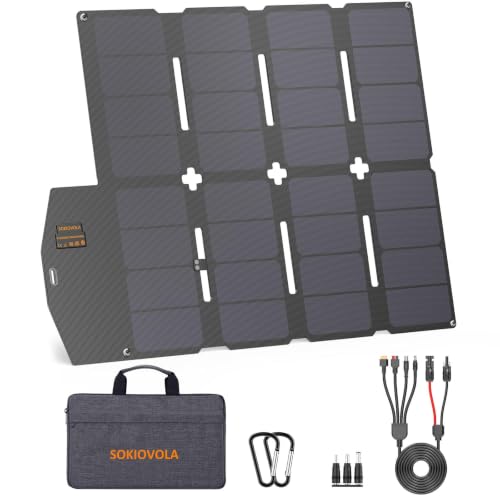
SOKIOVOLA 100W Foldable Solar Panel, IP68, 4-in-1 MC4
IP6818V4-in-1 cableCompact fold
Check price on Amazon
Best for: First-time buyers and backup-panel shoppers who want an IP68 rating at a low price.

The Sokiovola is the lowest-priced panel in the lineup that still carries an IP68 rating, a higher dust and water rating than the IP67 panels. It folds to 14.69 by 8.67 inches and 1.78 inches thick, and a four-in-one cable covers XT60, DC5521, DC8MM and Anderson connectors. For a basic power station that uses one of those plugs, it is enough.

The tradeoff is detail. The listing is lighter on stated efficiency and weight than the Renogy or FlexSolar, so you are trusting the listing less. It also lacks the USB ports that the FlexSolar and Twelseavan include. If you only need DC charging, that is not a problem.

Ownership is simple. Wipe the surface, store it folded and dry and check the connector pins for corrosion. It makes sense as a first panel or a backup, and the price lets you buy a second one for double the output. Two of these on a power station that accepts the combined input will outproduce a single higher-priced panel, which is the strongest argument for the budget route.

What works

  • IP68 rating is the highest sealing claim in the lineup
  • Four-in-one cable covers common DC plugs
  • Folds to a compact 14.7 by 8.7 inches
  • Lowest price tier in the lineup

Watch out for

  • Listing gives less detail on efficiency and weight
  • No built-in USB ports

Spec sheet

Folded size
14.69 x 8.67 x 1.78 in
Voltage
18V
Sealing
IP68
Cable
4-in-1 MC4 with XT60, DC5521, DC8MM, Anderson
Build
Lightweight foldable
05
100W Foldable Solar Panel, USB-C PD3.0, 20V DC XT60, 6 lb
6 lbPD3.0 45WQC3.0 24W20V DC XT60
Check price on Amazon
Best for: Users who want direct USB charging and a middle weight.

At 6 pounds it sits between the FlexSolar's 4.1 and the Renogy's 8.86, and folds to roughly the size of a laptop bag. A 45W PD3.0 USB-C port and a 24W QC3.0 USB-A port charge devices directly, while a 20V DC output with an XT60 connector feeds stations. The upgraded cable connectors are meant to fit more station inputs.

Its Grade A+ silicon cells are described as better than older polycrystalline panels, though the listing gives less on cell type than the N-type Renogy. Against the Twelseavan it offers a lower USB-C limit at 45W versus 60W. It is a balanced panel where weight and ports both matter.

Storage and upkeep are the same as other foldables: keep it dry, avoid creasing the fold line and check the cable. The mid-weight frame carries a stand and handle without feeling flimsy. Buy it if you want USB ports and a lighter carry than the Renogy. A direct USB-C port is handy when the power station is full and you only want to top up a phone or tablet in the sun without running a cable through a station.

What works

  • PD3.0 USB-C up to 45W charges small laptops
  • QC3.0 USB-A up to 24W for phones
  • 20V DC with XT60 connector feeds stations
  • Weighs 6 pounds, between the lightest and heaviest

Watch out for

  • Less cell detail than the N-type Renogy
  • USB-C power limit is below the Twelseavan

Spec sheet

Weight
6 lb (2.75 kg)
USB-C
PD3.0, up to 45W
USB-A
QC3.0, up to 24W
DC output
20V DC with XT60
Cells
Grade A+ silicon

Spec sheet decoder

What the numbers on the box really mean

The specs manufacturers lead with, translated into what they tell you about real-world performance.

Watt rating

The output under standard test conditions of full sun and a controlled cell temperature. Field output is lower.

Watch forAll six are 100W panels, but real output depends on angle and heat.

Cell efficiency

The share of sunlight converted to electricity. It decides how much panel area you need.

Watch forThe Renogy claims 25 percent while the FlexSolar and Twelseavan claim 24.

IP rating

Dust and water protection. The second digit is the water level.

Watch forThe Sokiovola lists IP68 and the Renogy and FlexSolar list IP67.

Connector type

The plug on the output cable. It must match your power station input.

Watch forThe Twelseavan includes the most adapters.

PD wattage

The USB-C power delivery limit for charging laptops and tablets directly.

Watch forThe Twelseavan reaches 60W and the 6 pound panel reaches 45W.

Methodology

How We Evaluated These 100W Foldable Solar Panels

Portability

We compared stated weight and folded size from each listing. The FlexSolar at 4.1 pounds and the Renogy at 8.86 set the range. We rated lighter panels higher for carry use.

Cell and build quality

We looked at cell type, efficiency claims and build features. The Renogy lists N-type cells. We treated cell type as more important than a one-point efficiency gap.

Connector coverage

We counted the connectors and adapters each panel includes. The Twelseavan's five-in-one cable and three adapters led. A panel that does not fit your station is useless.

Weather protection

We compared IP ratings and coatings from the spec sheets. The Sokiovola's IP68 and the Renogy's ETFE with IP67 stood out. We evaluated the connector as the likely weak point.

Value and ownership

We used relative price tiers and judged ownership based on the spec sheet and owner feedback patterns. The Sokiovola ranked cheapest. The Renogy sat at the top of the tier.

Decision guide

How to Choose the Right 100W Foldable Solar Panels

By How You Carry It

SituationPickWhy
Backpacking or hikingFlexSolar 100WLightest at 4.1 pounds
Van or RV locker, occasional carry100W 6 lb USB-C panelMid weight with ports
Fixed camp, weight no issueRenogy 100WBest build and N-type cells
Daily folding and unfoldingRenogy 100WETFE surface and sturdy fold seams
Tailgate and car campingSokiovola 100WCompact fold at a low price

By Budget

SituationPickWhy
Lowest tierSokiovola 100WIP68 and a four-in-one cable
Lower middle100W 6 lb USB-C panelUSB ports and XT60 output
MiddleTwelseavan 100WMost adapters and USB-C PD
Upper middleFlexSolar 100WLightest with IP67
TopRenogy 100WN-type 16BB and ETFE build

N-Type vs Standard Monocrystalline

N-type

The Renogy uses N-type cells. They degrade more slowly and tolerate heat better. That helps in hot climates and after years of use.

Standard monocrystalline

The FlexSolar, Twelseavan and 6 pound panel use high-efficiency monocrystalline cells at 24 percent or similar. They perform well and cost less. The difference shows up over seasons, not days.

Pick N-type for long-term use and heat; pick standard monocrystalline for low cost and light weight.

By Power Station Connector

SituationPickWhy
Unknown or multiple station brandsTwelseavan 100WFive-in-one cable plus three DC adapters
XT60 input100W 6 lb USB-C panel20V DC with XT60
Anderson or DC5521Sokiovola 100WFour-in-one cable covers both
DC7909 inputTwelseavan 100WIncludes DC adapters
Common station brandsFlexSolar 100WFour-in-one cable fits most

For Charging a Power Station Specifically

Look for

Match the connector, then check the station's maximum solar input. A 100W panel adds about 250 to 400 Wh in a good day. For larger stations plan on multiple panels.

In this comparison

The Twelseavan covers the most connectors, the Renogy delivers the most durable build and the FlexSolar carries easiest. Two Sokiovola panels cost less than one Renogy.

When to Spend More

Spend more if

You will use the panel for years, in heat or for daily folding. The Renogy offers N-type cells and a stronger build. Spend more if weight matters and pick the FlexSolar.

Save if

You camp a few weekends a year. The Sokiovola covers basic needs. Spend the saved money on a second panel.

Ownership

Maintenance schedule

The upkeep that decides whether this machine lasts two seasons or ten.

TaskIntervalWhy it matters
Wipe the surfaceAfter each tripDust and pollen cut output. Use water and a soft cloth. A clean surface can recover several percent of lost output.
Inspect fold seamsEvery seasonRepeated folding stresses the seams. Look for cracks or lifting edges. A crack caught early costs nothing; a cracked cell string costs the panel.
Check connectorsEvery seasonCorroded pins cause heat and loss. Clean them and store the cable loosely. A green crust on a pin means resistance and heat at the exact point that carries all the current.
Store dry and foldedBetween tripsMoisture and heat shorten life. Keep it in its pouch away from sun. A wet panel folded into a bag grows mildew between layers and fogs the surface.
Test outputYearlyA drop in watts compared with last year signals cell damage. Comparing against last year is the only way to spot slow cell damage.

FAQ

Frequently Asked Questions

How much power does a 100W foldable panel really make?

In good sun expect 60 to 80 watts. Over four to five sun hours that is roughly 250 to 400 watt-hours. Angle, heat and shade lower it. Plan sizing around the low figure so a cloudy day does not leave the station empty.

Will it charge my power station?

If the connector matches and the panel voltage fits the input range, yes. The Twelseavan includes the most adapters. Check the station manual for its maximum solar input. If it does not fit, an adapter cable is a cheap fix, but check the voltage range first.

Is N-type worth the extra cost?

For heavy use, yes. N-type cells degrade more slowly and handle heat better. For casual use, standard monocrystalline cells are fine. The difference shows up over years, not on a single weekend.

Can I connect two panels together?

Often yes, in parallel or series, if the station's input limits allow it. Check the voltage and current limits first. Check the station manual for its maximum solar input before you wire two panels together.

Is IP68 better than IP67?

Slightly, since IP68 allows longer immersion. For camping, both handle rain. The connector is the weak point either way. Rain is rarely the problem; a tugged cable is.

How should I position it?

Tilt it toward the sun and avoid partial shade. A shadow across one cell row can cut output a lot. Re-angle it every couple of hours. A small stake or weight on the corners keeps the panel from sliding.

Bottom line

The short version

Browse more 100w foldable solar panelson Amazon →
James Miller, Lead Machine Editor

About the author

James Miller

Lead Machine Editor, MachineFanatic

James Miller leads MachineFanatic's buying guides, turning spec sheets, manuals and owner feedback into clear verdicts on power tools, outdoor power equipment, shop machines and kitchen machines.

More from James →

Keep reading

Related guides