
Amazon affiliate links - we earn a commission.Affiliate disclosure

Buying guide · 13 min read · Updated 2026-11-07

Best 3.5 GPM RV Water Pumps (2026)

Six 3.5 GPM 12V diaphragm water pumps compared on chamber count, adjustable pressure range, copper motors, strainers and how each handles RV plumbing.

James MillerBy James MillerLead Machine Editor6 machines comparedSpec-sheet verified
Best 3.5 GPM RV Water Pumps

At a glance

Our top picks

Side by side

Spec comparison

This pump size sits just above the traditional three-gallon class. It moves noticeably more water, which shows when two taps are open at once, while still staying within a normal fused battery circuit.

The category is dominated by value brands that share a common multi-chamber diaphragm design. What separates them is the pressure range, the included hardware and how well the mounting dampens vibration.

Before you buy

6 Criteria to Look For Before Buying a 3.5 GPM RV Water Pump

  1. 01

    Why 3.5 GPM at all

    A 3.5 GPM pump moves roughly 17 percent more water than a 3.0 GPM unit. That helps when two taps are open, such as a shower and a kitchen faucet. It rarely matters for a single tap. If you only wash dishes and brush teeth, 3 GPM is enough. Real delivery depends on pressure, hose size and fixtures, so the label is a ceiling. In practice, the extra half gallon per minute shortens the time to fill a bucket or pot, which is the most noticeable benefit at a camp kitchen.

  2. 02

    Chamber count

    The DC HOUSE, VEVOR and Deccasa use three chambers while the ECO-WORTHY 55 PSI uses four. More chambers mean smaller pressure pulses and a smoother, quieter flow. The difference is audible in a quiet cabin. Pulsation also shows up as a rattle in thin plumbing. A four-chamber pump costs a little more but is the quietest option in this guide.

  3. 03

    Pressure setting

    Most picks ship at 45 PSI, the ECO-WORTHY at 55 PSI. Adjustable switches go up to 80 PSI on the Deccasa and 100 PSI on the VEVOR. RV plumbing is happiest at 40 to 55 PSI, so treat the upper range as a trap. A cheap inline gauge shows the real cut-off. A small adjustment of 5 PSI changes the shower noticeably, so make changes in small steps and test each time.

  4. 04

    Included hardware

    The ECO-WORTHY 55 PSI includes two half-inch barb adapters and an inline strainer. Others may need separate parts. A strainer is the cheapest insurance against check valve failure. Hose clamps and thread tape are the other small parts to buy. Without a strainer, one grain of sand lodged in a check valve can make a pump leak back and cycle endlessly.

  5. 05

    Priming and lift

    YOUNGTREE and Deccasa list 9.8 feet of self-priming. If the pump sits above the tank, extra lift avoids dry-start frustration. Keep suction lines short and airtight. Lift falls at altitude and with long hoses. Altitude and long hoses cut priming ability, so do not rely on the full 9.8 feet at a mountain campsite.

  6. 06

    Certifications

    None of these listings state NSF drinking-water certification. If you drink from the tank, consider a certified SEAFLO or Shurflo instead. Always sanitize the system regardless. Flush with a sanitizing solution each season. If you filter your drinking water at the tap, the pump certification matters less than the filter.

Detailed reviews

The 6 best 3.5 gpm rv water pumps, explained

01
DC HOUSE 33 Series 12V 3.5 GPM, 45 PSI three-chamber pump
3.5 GPM45 PSI3 chambersRubber base
Check price on Amazon
Best for: Most RVs that want a smooth, quiet 3.5 GPM replacement at a gentle pressure.

DC HOUSE builds this pump around a three-chamber diaphragm that delivers a smooth flow up to 3.5 gallons per minute and shuts off at 45 PSI. A noise-dampening rubber mounting base is included, which tackles the single biggest complaint about RV pumps: the buzz that travels through the floor. The built-in pressure switch is adjustable, so you can tune it once the plumbing is proven.

As with all adjustable switches, the freedom comes with a risk. Setting the cut-off too high can stress fittings, so keep it near the factory 45 to 55 PSI and verify with a gauge. The pump sits in the second-lowest price tier of the group, which makes it an easy recommendation. Compared with the ECO-WORTHY 55 PSI model, it runs at lower pressure and fewer chambers; compared with the VEVOR, it has a narrower adjustment range.

Ownership is routine. Clean the strainer each season, use flexible hose on the ports and check the fittings for weeping. If you winterize, run RV antifreeze through the pump rather than leaving water in the head. The rubber base is a small detail, but it is the first thing most owners end up buying separately for other pumps.

What works

  • Three-chamber smooth flow
  • Noise-dampening rubber base
  • Gentle 45 PSI default
  • Adjustable built-in switch

Watch out for

  • No stated drinking-water certification
  • Adjustable switch can be set wrong
  • Short brand history

Spec sheet

Flow
3.5 GPM
Shut-off
45 PSI
Design
3-chamber diaphragm
Mount
Noise-dampening rubber base
Switch
Adjustable, built in
02
ECO-WORTHY 12V 3.5 GPM, 55 PSI four-chamber pump
3.5 GPM55 PSI4 chambersStrainer included
Check price on Amazon
Best for: Owners who want a firmer shower and a strainer in the box.

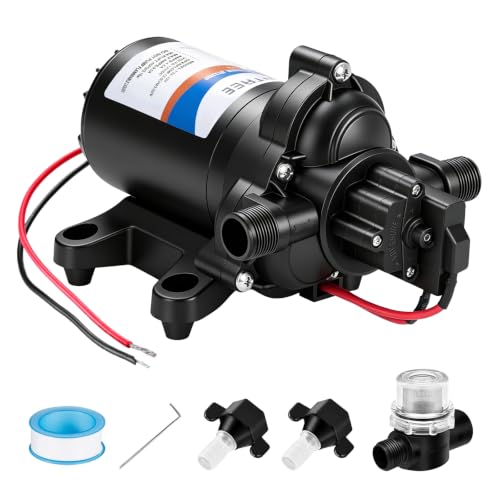
This ECO-WORTHY uses a four-chamber diaphragm design with a 55 PSI preset, two half-inch hose barb adapters and an integrated inline strainer. Four chambers smooth the pulsing flow more than three, and the strainer in the kit protects the check valves from the debris that kills pumps. Fifty-five PSI delivers a firmer shower than the 45 PSI pumps.

The cost of higher pressure is stress on older plumbing, so this is a better match for PEX systems than for aging PVC. It sits in the upper-middle tier. Compared with the DC HOUSE, you gain pressure, chambers and strainer, but lose the rubber base. Compared with the other ECO-WORTHY listing in this guide, the main difference is pressure and chamber count.

Ownership requires mounting on rubber feet and keeping the strainer clean. The adjustable switch lets you drop pressure to 45 PSI if needed. Both barb adapters match standard half-inch hose.

What works

  • Four-chamber smoother flow
  • Inline strainer included
  • Two barb adapters included
  • 55 PSI for firmer showers

Watch out for

  • 55 PSI is hard on old plumbing
  • No rubber base listed
  • Upper-middle price tier

Spec sheet

Flow
3.5 GPM open flow
Shut-off
55 PSI preset
Design
4-chamber diaphragm
Included
Two 1/2 in barb adapters, inline strainer
Switch
Adjustable
03
VEVOR 12V 3.5 GPM three-chamber pump, 40-100 PSI switch
3.5 GPM40-100 PSI3 chambersCopper motor
Check price on Amazon
Best for: Mixed-use installs that need a wide pressure range.

VEVOR offers the widest adjustment range here: a pressure switch adjustable from 40 to 100 PSI on a three-chamber, 3.5 GPM pump with a pure copper motor. That range lets you adapt to unusual installs, such as irrigation or washdown, as well as RV plumbing. The copper motor aims for smooth, quiet running.

A 100 PSI ceiling is far beyond what RV plumbing can handle, so treat the upper half of the range as off limits for a camper. The pump sits in the middle tier. Compared with the DC HOUSE, it gives you more adjustability but no stated rubber base; compared with the YOUNGTREE, it offers a larger range.

Ownership requires a pressure gauge during setup and a regulator if you ever push the range. Clean the strainer and keep the pump on isolation mounts. A copper motor generally runs cooler than aluminum windings.

What works

  • 40 to 100 PSI adjustment range
  • Pure copper motor
  • Three-chamber smoother flow
  • 3.5 GPM open flow

Watch out for

  • Range tempts unsafe settings
  • No rubber base listed
  • Thin brand history

Spec sheet

Flow
3.5 GPM (13.25 L/min)
Pressure
Adjustable 40 to 100 PSI
Design
3-chamber diaphragm
Motor
Pure copper
Switch
Automatic on demand
04
ECO-WORTHY 12V 3.5 GPM, 45 PSI pump with thermal overload
3.5 GPM45 PSIThermal overloadRun dry short
Check price on Amazon
Best for: Owners who want gentle pressure with motor protection.

This ECO-WORTHY runs 3.5 GPM at a 45 PSI cut-off with an on-demand switch designed to reject rapid cycling and built-in thermal overload protection. The listing says it can run dry for short periods, which helps during winterizing or when a tank empties.

Thermal protection stops the motor before it cooks itself, a practical safeguard if the strainer clogs or a valve is closed. The pump sits in the lower-middle price tier. Compared with the 55 PSI ECO-WORTHY, it is gentler on plumbing but has fewer chambers listed and no strainer mentioned; compared with the DC HOUSE, it lacks the rubber base.

Ownership is routine. Clean the strainer, mount on rubber feet and add a short flexible hose to each port. Thermal protection resets itself after cooling. It is a good fit for a rig whose tank lives in a tight bay, where a stalled pump cooks itself quickly.

What works

  • Thermal overload protection
  • Short dry-run tolerance
  • Gentle 45 PSI
  • Anti rapid-cycling switch

Watch out for

  • No strainer or base mentioned
  • Fewer chambers listed
  • Middle-tier brand history

Spec sheet

Flow
3.5 GPM
Shut-off
45 PSI
Protection
Thermal overload built in
Dry run
Short periods tolerated
Switch
On-demand, anti rapid-cycling
05
YOUNGTREE 12V 3.5 GPM, 45 PSI pump, 131 ft lift
3.5 GPM45 PSI9.8 ft prime131 ft lift
Check price on Amazon
Best for: Installs where the pump sits above the water source.

YOUNGTREE specifies 3.5 GPM, a 45 PSI cut-off, self-priming up to 9.8 vertical feet and a lift of up to 131 feet. Those prime and lift figures make it handy when the pump sits above the tank or when you draw from a remote source such as a rain barrel.

It is a straightforward pump with an automatic pressure switch and little else to differentiate it from the other 45 PSI units. It sits in the lower-middle price tier. Compared with the DC HOUSE, it offers more stated lift but no rubber base; compared with the Deccasa, it lacks adjustability.

Ownership is routine. Clean the strainer, keep the suction line short and airtight, and mount on rubber feet. A long suction lift also increases the chance of air leaks. The 131 foot lift number is mostly irrelevant to an RV, since the tank is a few feet away.

What works

  • Self-primes up to 9.8 feet
  • 131 ft lift stated
  • Gentle 45 PSI
  • Automatic pressure switch

Watch out for

  • Few differentiating features
  • No rubber base listed
  • Short brand history

Spec sheet

Flow
3.5 GPM
Shut-off
45 PSI
Self-prime
Up to 9.8 vertical feet
Lift
Up to 131 feet
Power
12V DC battery or supply
06
Deccasa 12V 3.5 GPM diaphragm pump, 40-80 PSI adjustable
3.5 GPM40-80 PSI adj.Copper motor9.8 ft prime
Check price on Amazon
Best for: Budget buyers who want a copper motor and a sensible adjustable range.

Deccasa pairs a 3.5 GPM flow with a pure copper-core motor, 9.8 feet of self-priming and 100 feet of head. The pressure switch is factory set at 45 PSI and adjustable from 40 to 80 PSI, a more sensible range for RV use than 100 PSI. Safety protection is built into the motor.

The lowest price tier is the draw. Compared with the VEVOR, it limits the top pressure to 80 PSI, which is still high for an RV, so keep it near the factory setting. Compared with the DC HOUSE, it lacks the rubber base but adds a copper motor claim.

Ownership requires a gauge for setup, a strainer and rubber mounts. A short flexible hose reduces buzzing. It is the pump to pick when the pressure range matters more than included extras.

What works

  • Pure copper-core motor
  • 45 PSI factory setting
  • 40 to 80 PSI adjustable
  • Lowest price tier

Watch out for

  • 80 PSI ceiling still high for RV
  • No rubber base listed
  • Short brand history

Spec sheet

Flow
3.5 GPM
Pressure
45 PSI factory, 40 to 80 adjustable
Motor
Pure copper core
Self-prime
9.8 vertical feet
Head
100 ft

Spec sheet decoder

What the numbers on the box really mean

The specs manufacturers lead with, translated into what they tell you about real-world performance.

Open flow

Maximum flow with no back pressure. Use it to compare, not to promise.

Watch forReal flow falls as pressure rises.

Chambers

More chambers mean smoother output.

Watch for4 on ECO-WORTHY 55 PSI, 3 on most.

Adjustable range

Span of cut-off pressures you can set. Wider is not safer.

Watch forVEVOR 40 to 100, Deccasa 40 to 80.

Self-prime lift

Vertical suction ability.

Watch for9.8 ft on YOUNGTREE and Deccasa. Do not expect the full number in practice.

Thermal overload

Motor cutout against overheating.

Watch forListed on ECO-WORTHY 45 PSI.

Methodology

How We Evaluated These 3.5 GPM RV Water Pumps

Pressure fit

We compared 45 and 55 PSI defaults with adjustment ranges up to 100 PSI. A gentle default scored better for older rigs. We assumed a 40 to 55 PSI design range.

Smoothness

We favored four- and three-chamber designs and rubber mounts. Smoothness is audible in quiet cabins. We also noted that rubber feet and soft hose do more for noise than a fourth chamber.

Hardware

We credited included strainers and fittings. Missing parts cost time and money. Included fittings save a trip to the store, which matters on a remote repair.

Protection

We noted thermal overload and dry-run claims. Protection claims are maker statements.

Value

We judged tiers from Deccasa to the 55 PSI ECO-WORTHY. The DC HOUSE wins on balance.

Decision guide

How to Choose the Right 3.5 GPM RV Water Pumps

By Plumbing Age

The age and material of your plumbing is the best predictor of the right pressure setting.

SituationPickWhy
Old PVC or fittingsDC HOUSE 33 Series45 PSI default
Modern PEXECO-WORTHY 55 PSIFirm shower
Mixed or unknownDeccasa45 PSI factory
Need wide tuningVEVOR40 to 100 PSI
Pump above tankYOUNGTREE131 ft lift

By Budget

These tiers are relative and shift with sales. The extra spend mostly buys included hardware and chamber count.

TierPickWhy
LowestDeccasaCopper motor
LowDC HOUSERubber base
Lower-midECO-WORTHY 45 PSIThermal protection
MiddleVEVORWide range
Upper-midECO-WORTHY 55 PSIStrainer included

Tiers shift quickly, so confirm current listings.

Fixed Gentle vs Adjustable Wide

Gentle default

DC HOUSE, YOUNGTREE and the 45 PSI ECO-WORTHY ship low and are safe out of the box.

Wide range

VEVOR and Deccasa let you tune up, which needs a gauge and care.

If you do not own a gauge, choose a gentle fixed pump. A gauge costs little and removes the guesswork entirely.

By Noise Sensitivity

PreferencePickWhy
QuietestDC HOUSERubber base
Smoothest flowECO-WORTHY 55 PSI4 chambers
Budget quietDeccasaCopper motor
AnyAdd accumulatorCuts cycling

For Two-Tap Use Specifically

Look for

Enough flow for a shower plus a sink and smooth delivery.

In this comparison

The ECO-WORTHY 55 PSI and DC HOUSE give 3.5 GPM with smoother flow. Both pumps also tolerate short dry spells, which helps if a tank runs low.

When to Spend More

Spend more if

You want a strainer in the kit and a firmer shower, pointing to the ECO-WORTHY 55 PSI. That also buys a firmer shower on a modern PEX system.

Save if

You have gentle plumbing, pointing to the Deccasa. Add a small accumulator to any budget pump to cut cycling.

Ownership

Maintenance schedule

The upkeep that decides whether this machine lasts two seasons or ten.

TaskIntervalWhy it matters
Clean strainerSeasonalDebris damages check valves and reduces flow. Remove and rinse it under running water. A clean strainer also keeps flow steady and lowers pump noise.
Check fittingsSeasonalVibration loosens ports. A leaking barb often shows first as a damp spot under the pump.
Test the switchYearlyA sticky switch causes cycling. Replace a failing switch only after ruling out leaks.
Inspect wiringYearlyVoltage drop slows the motor. Clean terminals and check the fuse holder for heat marks.
WinterizeBefore winterIce cracks the pump head. Drain and run antifreeze through the pump.

FAQ

Frequently Asked Questions

Is 3.5 GPM worth it over 3 GPM?

It helps when two taps run together. For one tap, the difference is small. Single-tap users rarely notice. A family of four sharing a short shower window will notice it most.

Are these certified for drinking water?

None of these listings state it. Consider SEAFLO or Shurflo if that matters. Sanitize the tank either way. A carbon filter at the tap is a practical complement.

What is the price range?

Tiers run from Deccasa to the 55 PSI ECO-WORTHY. Prices change, so check listings. Spending more buys hardware and smoothness, not more flow.

What pressure should I set?

Around 45 to 55 PSI for RV plumbing. A gauge confirms it.

Can it run dry?

Only briefly. Winterizing is the usual moment it happens.

Do I need an accumulator?

It reduces cycling. A small one is enough. Pre-charge it about 2 PSI below cut-in.

Bottom line

The short version

Browse more 3.5 gpm rv water pumpson Amazon →
James Miller, Lead Machine Editor

About the author

James Miller

Lead Machine Editor, MachineFanatic

James Miller leads MachineFanatic's buying guides, turning spec sheets, manuals and owner feedback into clear verdicts on power tools, outdoor power equipment, shop machines and kitchen machines.

More from James →

Keep reading

Related guides