
Amazon affiliate links - we earn a commission.Affiliate disclosure

Buying guide · 14 min read · Updated 2026-11-13

Best 3000 Watt RV Inverters (2026)

Five 3000W 12V RV inverters compared on hardwire terminals, transfer switches, idle draw and what a house battery can really feed at roughly 280A.

James MillerBy James MillerLead Machine Editor5 machines comparedSpec-sheet verified
Best 3000 Watt RV Inverters

At a glance

Our top picks

Side by side

Spec comparison

A 3000W inverter is the size where an RV starts to look like a small house. It can run a microwave, a coffee maker and a laptop together, and it is also the size where the electrical installation, not the inverter, becomes the hard part.

The key questions are practical: whether the unit has a transfer switch so shore power and battery power never collide, how much it burns at idle, and whether the house bank and cable can actually deliver the current. The best unit is the one that fits all three.

Before you buy

6 Criteria to Look For Before Buying a 3000 Watt RV Inverter

  1. 01

    Transfer switch

    An RV inverter must never feed a campground pedestal. A built-in transfer switch, as on the Renogy PUH 3000W and the 3000W inverter charger, prevents that and lets the coach flip between shore power and the battery automatically. Without one, wire an external switch. This is the most important safety decision at this size, because a back-fed pedestal can injure a campground neighbor or a lineman.

  2. 02

    Battery current at 3000W

    At 12V, 3000W draws about 280A once losses are counted. That requires very heavy cable, a fuse rated for the current and a lithium bank of several hundred amp-hours. A pair of 100Ah batteries would be flat in under ten minutes. Many serious builders use 24V at this size to halve the current. A short, fat cable between battery and inverter matters more than anything else you can buy.

  3. 03

    Idle draw

    A big inverter burns power with nothing plugged in. The Renogy PUH states consumption under 18W, which is about 430Wh a day. The ALLWEI claims ultra-low no-load loss but gives no figure. Switch the unit off when idle if it is not a transfer-switch model. Over a week of boondocking, a few watts of idle draw adds up to a full battery's worth of waste.

  4. 04

    Outlets and hardwire

    The ALLWEI offers dual 20A sockets and a 30A hardwire output. The 4-outlet unit has a hardwire terminal and four sockets, and the Renogy P2 has plug and terminal outputs. Decide whether you will plug in loads or feed coach circuits, because the layout changes the install. A wrong choice means extension cords across the coach or an electrician's bill.

  5. 05

    Waveform

    All five units here state pure sine. That suits a microwave, a TV and a residential fridge. At 3000W the extra cost of pure sine is small relative to the total install, so there is little reason to settle for less. Modified sine units can make a microwave hum and a residential fridge run warm.

  6. 06

    Monitoring and control

    A remote or Bluetooth app tells you the load and voltage without opening a hot bay. The Renogy PUH has both, the 4-outlet unit has an LCD remote and the inverter charger has a remote. The Renogy P2 offers only LED fault lights. Knowing your load in real time is how you learn which appliance is eating the battery.

Detailed reviews

The 5 best 3000 watt rv inverters, explained

01
Renogy PUH 3000W pure sine inverter, transfer switch, Bluetooth
3000W continuousPure sine waveTransfer switchBluetooth and remote
Check price on Amazon
Best for: RV owners who move between shore power and boondocking and want a safe, automatic switch.

A built-in transfer switch is the feature that sets the Renogy PUH apart for an RV. It lets the coach switch between shore power and battery power without a manual change, which removes the most dangerous wiring mistake in RV electrical work, the inverter back-feeding a pedestal. The listing describes seamless switching between on-grid AC and off-grid DC.

The output is pure sine with efficiency stated above 92 percent, and the listing says consumption is less than 18W. That idle figure is an important one: a 3000W inverter that burns 18W while doing nothing wastes about 430Wh a day. Built-in Bluetooth and a wired remote switch let you monitor and control the unit from a phone or from inside the coach.

It sits near the top of the price tiers, and the price buys installation convenience and monitoring, not extra power. At full load it still draws about 280A, so cable and bank sizing apply as for any 3000W unit. Fuse the battery cable close to the battery, and check the terminals after the first few trips. For a coach that moves between campgrounds and boondocking, this is the cleanest answer.

What works

  • Built-in transfer switch prevents back-feeding
  • Pure sine output with efficiency above 92 percent
  • Idle consumption stated below 18W
  • Bluetooth and wired remote for monitoring

Watch out for

  • Near the top of the price tiers
  • Full load still draws about 280A at 12V
  • Needs a proper wiring plan for the switch

Spec sheet

Continuous output
3000W
Waveform
Pure sine
Transfer switch
Built-in on-grid switch
Control
Bluetooth and wired remote
Efficiency
Above 92 percent
02
Renogy P2 3000W pure sine inverter, 6000W surge, LED indicators
3000W continuous6000W surgePure sine waveLED indicators
Check price on Amazon
Best for: RV and cabin owners with a simple setup or an existing transfer switch.

Straightforward is the word for the Renogy P2. It provides 3000W continuous pure sine power with 6000W of surge during startup, and LED indicators for under-voltage, over-voltage, over-temperature and overload. There is no transfer switch and no Bluetooth, which is why it costs less than the PUH.

The pure sine output is described as equal to grid power, which protects and extends the life of connected electronics. For an RV owner with a simple setup, such as a coach that rarely sees shore power or an external transfer switch already installed, it does the job. It also suits solar-powered cabins and trucks.

It sits at the lower end of the 3000W price range among branded units. The tradeoff is information: LEDs tell you which protection fired, but not how much load or what voltage you are at. Fuse the battery cable, keep the cable short and mount it in a ventilated bay. If you want monitoring and a switch, pay for the PUH.

What works

  • Pure sine output at 3000W continuous
  • 6000W surge covers heavy startups
  • LED indicators identify each protection
  • Lower price than the transfer-switch model

Watch out for

  • No built-in transfer switch
  • No Bluetooth or display for load readout
  • Still draws about 280A at full load

Spec sheet

Continuous output
3000W
Surge rating
6000W
Waveform
Pure sine
Indicators
LED fault lights
Use
RV, truck, home, off-grid solar
03
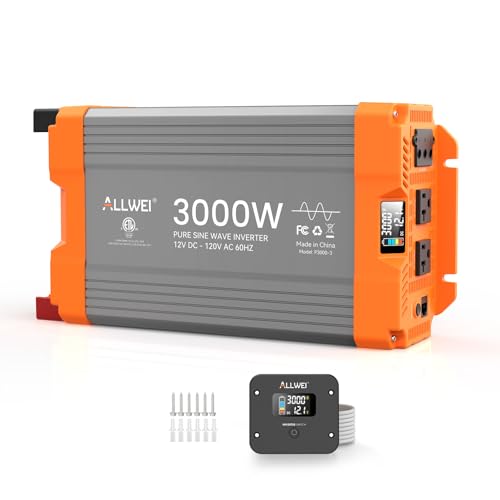
ALLWEI 3000W pure sine inverter, dual 20A sockets, 30A hardwire
3000W continuous6000W surgeDual 20A sockets30A hardwire
Check price on Amazon
Best for: Builders who want dual 20A sockets and a 30A hardwire output on one unit.

Output flexibility is this ALLWEI's strength: dual 20A AC sockets for plug-in loads and a 30A hardwire connection for fixed circuits. A 30A hardwire output matches the common RV shore-power rating, which makes it a neat fit when you want to run coach circuits from the inverter. The listing claims utility-grade pure sine power with ultra-low no-load loss.

Eight-fold protection covers low and high voltage, overload, short circuit and temperature. That is a thorough set for a unit living in a vibrating basement bay. At 3000W with 6000W of surge it handles a microwave, a coffee maker and a laptop.

It sits in the middle of the price tiers. The listing does not mention a transfer switch, so plan your wiring with a separate one if you connect to coach circuits. The no-load loss claim is attractive, but the listing gives no figure, so verify the idle draw in the manual before relying on it. For a builder who wants both outlets and hardwire in one unit, it is a strong candidate.

What works

  • Dual 20A sockets plus a 30A hardwire output
  • Pure sine output at 3000W continuous
  • Eight-fold protection suite
  • Ultra-low no-load loss is claimed

Watch out for

  • No transfer switch is listed
  • No idle draw figure is given
  • Middle price tier with no display listed

Spec sheet

Continuous output
3000W
Surge rating
6000W
AC sockets
Dual 20A
Hardwire
30A terminal
Protections
Eight-fold protection
04
3000W pure sine inverter, 4 AC, hardwire terminal, LCD remote
3000W continuous6000W peak4 AC outletsLCD remote
Check price on Amazon
Best for: RV owners who want many outlets, a remote and quieter cooling at a fair price.

Four AC outlets, a hardwire terminal, USB and Type-C ports and an LCD remote make this the most complete mobile power station in the group. The listing describes a design that does not lean only on fans and the outer housing to shed heat, which suggests an internal heat path that lets the fan run less. In a coach where the inverter sits near the bed, that matters.

Pure sine output at 3000W continuous with 6000W peak covers a microwave, a coffee maker and a laptop together. The LCD remote lets you check and switch the unit from inside. It sits in the lower-middle tier, which makes the feature list good value.

It does not list a transfer switch, so wire it with an external one if you connect to coach circuits. The brand is not named in the listing, which limits warranty clarity, so check the seller's terms. At 280A full-load draw, cable and bank sizing are the same as for the others. Mount it in a ventilated bay and check the hardwire terminal after the first trip.

What works

  • Four AC outlets plus a hardwire terminal
  • LCD remote for control from inside the coach
  • Heat path reduces reliance on the fan
  • USB and Type-C ports for phones

Watch out for

  • No transfer switch is listed
  • Brand and warranty are unclear
  • Draws about 280A at full load

Spec sheet

Continuous output
3000W
Peak surge
6000W
AC outlets
4 plus hardwire terminal
Ports
USB and Type-C
Control
LCD remote
05
3000W pure sine inverter charger, auto transfer switch, remote
3000W continuous6000W surgeCharger built inAuto transfer switch
Check price on Amazon
Best for: RV owners rewiring a coach who want an inverter, charger and transfer switch in one unit.

Combining an inverter, a battery charger and an automatic transfer switch in one box is the attraction here. The listing describes a 3000W pure sine output with 6000W surge and compatibility with gel, AGM, sealed lead acid and other battery types. A built-in charger means the unit recharges the house bank when shore power is present, so you may not need a separate converter.

A remote and an LCD complete the package. For an RV, a unit that switches automatically between shore power and the battery is the safe way to wire inverter output into the coach. It reduces the number of boxes in the basement bay, and fewer boxes mean fewer connections to fail.

It sits in the upper-middle tier, which is fair for three functions. Read the manual for the charger's maximum current and make sure it suits your battery chemistry. The listing's wording is rough, so confirm specifics with the seller. For a coach that is being rewired, this is an efficient solution.

What works

  • Inverter, charger and transfer switch in one box
  • Pure sine output at 3000W continuous
  • Works with gel, AGM, SLA and other batteries
  • Remote control included

Watch out for

  • Listing wording is rough, so confirm details
  • Charger current needs checking against your bank
  • Upper-middle price tier

Spec sheet

Continuous output
3000W
Surge rating
6000W
Waveform
Pure sine
Transfer
Automatic switch
Batteries
Gel, AGM, SLA and others

Spec sheet decoder

What the numbers on the box really mean

The specs manufacturers lead with, translated into what they tell you about real-world performance.

Continuous watts

The load the inverter carries for hours. At 3000W, a 12V bank must deliver about 280A.

Watch forAll five list 3000W, so compare the extras.

Surge watts

A startup allowance of a second or two. It covers a compressor or motor start.

Watch forFour of the five list 6000W surge.

Transfer switch

A relay that moves the load between shore power and the inverter. It prevents back-feeding.

Watch forThe Renogy PUH and the inverter charger include one. Follow the wiring diagram exactly, and have an electrician check the work if you are unsure.

No-load consumption

The power the inverter burns with nothing connected.

Watch forThe Renogy PUH states under 18W.

Hardwire terminal

A screw terminal for feeding a panel or fixed circuit.

Watch forThe ALLWEI lists a 30A hardwire output.

Methodology

How We Evaluated These 3000 Watt RV Inverters

Installation safety

We gave the most weight to features that prevent wiring errors, such as built-in transfer switches. The Renogy PUH and the inverter charger lead, followed by units with hardwire terminals and protections.

Efficiency and idle draw

We credited stated efficiency and idle figures. The Renogy PUH states above 92 percent and under 18W. Others give no idle figure, which we treated as unknown.

Output options

We counted sockets and terminals. The ALLWEI has dual 20A sockets and a 30A hardwire output and the 4-outlet unit has four sockets plus a terminal.

Monitoring

We compared Bluetooth, LCD and LED indicators. The Renogy PUH has the richest set and the Renogy P2 the simplest. Information shortens troubleshooting, which matters when the bay is hot and the coach is dark.

Battery realism

We computed the 280A full-load current and noted that every unit requires a large lithium bank. None of these is a casual purchase for a one-battery coach, and we scored them for owners who have already planned the bank.

Decision guide

How to Choose the Right 3000 Watt RV Inverters

By Wiring Plan

SituationPickWhy
Automatic shore to battery switchingRenogy PUH 3000WBuilt-in transfer switch
All-in-one with charger3000W inverter chargerInverter, charger and switch
Plug-in loads and coach circuitALLWEI 3000WDual 20A and 30A hardwire
Many outlets and a remote4-outlet 3000W unitFour sockets and LCD remote
Simple installRenogy P2 3000WPlug and terminal output

By Budget

SituationPickWhy
Lower endRenogy P2 3000WSimple pure sine
Lower-middle4-outlet 3000W unitMany features
MiddleALLWEI 3000WOutput options
Upper-middle3000W inverter chargerThree functions
TopRenogy PUH 3000WSwitch and Bluetooth

Inverter vs Inverter-Charger

Inverter only

The Renogy P2, ALLWEI and 4-outlet units convert battery power and nothing else. You keep your existing converter charger and add a transfer switch where needed.

Inverter-charger

The 3000W inverter charger also charges the bank from shore power and switches automatically. It saves space and wiring in a rebuild.

Choose an inverter-charger if you are replacing the converter, otherwise stay with an inverter.

Monitoring Style

SituationPickWhy
Phone app and remoteRenogy PUH 3000WBluetooth and wired remote
LCD remote4-outlet 3000W unitInside-the-coach display
Remote with charger3000W inverter chargerRemote included
LED lights onlyRenogy P2 3000WFault indicators
Output-focusedALLWEI 3000WEight-fold protection

For a Microwave and Coffee Maker Specifically

Look for

At least 3000W continuous, pure sine output and a bank that can supply about 280A. A 1000W microwave and a 1000W coffee maker together draw about 2000W, or about 190A at 12V, so run them one after the other when possible.

In this comparison

The Renogy PUH 3000W and Renogy P2 3000W both run those loads, and the PUH's transfer switch makes the wiring safer. A 24V system would halve the current.

When to Spend More

Spend more if

You move between campgrounds and boondocking, or want monitoring. The Renogy PUH 3000W and the inverter charger add safety and convenience.

Save if

You have a transfer switch already or rarely use shore power. The Renogy P2 3000W and the 4-outlet unit cost less.

Ownership

Maintenance schedule

The upkeep that decides whether this machine lasts two seasons or ten.

TaskIntervalWhy it matters
Check terminals and lugsEvery 3 monthsAt 280A, a loose lug becomes a fire risk. Re-tighten and look for discoloration or a smell of hot plastic, either of which means the lug must be remade.
Clean the ventsEvery 3 monthsDust blocks airflow in a basement bay. Use compressed air from the outside and make sure nothing is stored against the intake.
Inspect the fuse and cableEvery 6 monthsCorroded holders and chafed insulation add resistance. Replace as needed.
Test the transfer switchOnce a yearConfirm the changeover works and isolates the output. This is a safety item, so do it with the shore power cord unplugged and a known load connected.
Update firmware or app settingsOnce a yearBluetooth units may need setting checks. Verify low-voltage cutoffs match your battery chemistry, because a cutoff set for lead acid can strand a lithium bank early.

FAQ

Frequently Asked Questions

Can I run an RV air conditioner on a 3000W 12V inverter?

Usually not. Most rooftop units need a high startup current, and the 12V draw would be extreme. Use shore power, a generator or a larger 24V or 48V system. Even a soft-start kit only reduces the surge, not the running power.

How much battery do I need for 3000W?

At full load the draw is about 280A, so you need a lithium bank of several hundred amp-hours. A 400Ah bank holds about 5000Wh, which runs 3000W for about an hour and a half. Real figures run lower once conversion losses and cable resistance are counted.

Is a transfer switch necessary?

Yes if the inverter feeds coach circuits. It prevents the inverter from back-feeding shore power. The Renogy PUH and the inverter charger include one.

What cable do I need?

Very heavy cable, kept as short as possible, with a fuse near the battery sized above 280A and below the cable's rating. Voltage drop is the enemy, and every extra foot of cable makes the inverter work harder and run hotter.

Does idle draw matter?

Yes. A 3000W inverter at 18W idle burns about 430Wh a day. Switch it off when not needed if it has no sleep mode. The Renogy PUH's under 18W figure is the only stated idle number here.

Should I choose 24V instead?

At 3000W, 24V halves the current and the cable burden. The units here are 12V, so consider 24V for a new build with a large bank. Many components cost the same, while the copper bill drops.

Bottom line

The short version

Browse more 3000 watt rv inverterson Amazon →
James Miller, Lead Machine Editor

About the author

James Miller

Lead Machine Editor, MachineFanatic

James Miller leads MachineFanatic's buying guides, turning spec sheets, manuals and owner feedback into clear verdicts on power tools, outdoor power equipment, shop machines and kitchen machines.

More from James →

Keep reading

Related guides