
Amazon affiliate links - we earn a commission.Affiliate disclosure

Buying guide · 15 min read · Updated 2026-11-06

Best 4000 Watt Generators (2026)

Six 4000 watt generators compared on running watts, dual fuel output, noise, THD and runtime, so you can size one correctly for RV trips and home backup.

James MillerBy James MillerLead Machine Editor6 machines comparedSpec-sheet verified
Best 4000 Watt Generators

At a glance

Our top picks

At a Glance

Champion 4000W Dual Fuel RV Ready Inverter Generator
Best Overall

Champion 4000W Dual Fuel RV Ready Inverter Generator

↓ See why we picked it
Check price
Westinghouse 4000 Peak Watt Dual Fuel Inverter Generator
Best Features and Quietest

Westinghouse 4000 Peak Watt Dual Fuel Inverter Generator

↓ See why we picked it
Check price
Westinghouse 4650 Peak Watt Gas Portable Generator
Best for Long Run Time

Westinghouse 4650 Peak Watt Gas Portable Generator

↓ See why we picked it
Check price
Aceup Energy 4000W 149cc Inverter Generator
Best Low-THD Value

Aceup Energy 4000W 149cc Inverter Generator

↓ See why we picked it
Check price
Evernexta 4000W 208cc Inverter Generator
Best Value

Evernexta 4000W 208cc Inverter Generator

↓ See why we picked it
Check price
Pulsar PGD40ISCO 4000W Gas Inverter Generator
Best for Short Trips

Pulsar PGD40ISCO 4000W Gas Inverter Generator

↓ See why we picked it
Check price

A 4000 watt generator sits in the sweet spot for home backup and RV use: big enough to keep a refrigerator, a furnace blower and a few circuits alive, still small enough for one person to roll out of the garage. It is also the size class where the label misleads buyers most, because the headline figure is rarely what the machine can deliver hour after hour.

Below we explain how to size a generator from the loads you actually run, when an inverter is worth paying for, and what dual fuel, CO shutoff and transfer-ready outlets mean in practice. The quick picks are above; the detailed reviews show which machine suits backup power, camping or job-site work.

Before you buy

6 Criteria to Look For Before Buying a 4000 Watt Generator

  1. 01

    Running Versus Starting Watts

    Starting watts are a surge rating that lasts a few seconds to spin up a motor, while running watts are what the generator holds continuously. A 4000 watt label usually means 3000 to 3600 running watts. Size your load by adding the running watts of everything you want to power and then the largest starting surge on top. A common mistake is adding up the 4000 figure and assuming it all supports a furnace blower and refrigerator at once. In this lineup the Westinghouse 4650 leads at 3600 running watts, the Evernexta runs 3400, and the Champion drops to 3000 on gasoline.

  2. 02

    Dual Fuel Derating

    Propane has a lower energy density than gasoline, so the same engine makes roughly 10 percent less power on propane. The Champion illustrates it perfectly: 3000 running watts on gasoline and 2700 on propane. The tradeoff is storage, as propane does not go stale and burns cleaner. Size your loads against the propane number, not the gasoline one, if you plan to rely on the cylinder. The Westinghouse 4000 Peak is also dual fuel, so apply the same caution.

  3. 03

    Inverter Versus Conventional Output

    An inverter generator converts engine output into clean sine-wave power with a THD of 3 percent or less, which protects electronics that contain sensitive controller boards. A conventional generator produces a rougher waveform and runs at a fixed speed, which means more noise and fuel use. The Champion, Westinghouse 4000 Peak and Evernexta are under 3 percent THD, and the Aceup is under 1.5 percent. The Westinghouse 4650 states no THD, so keep delicate equipment off it. Small inverters also tend to have smaller tanks.

  4. 04

    Noise Ratings in Context

    Decibels are logarithmic, so 10 dB more sounds roughly twice as loud, and manufacturers measure at different loads and distances. The Champion is rated 64 dBA at 23 feet, the Aceup about 60 dB at 25 percent load, and the Westinghouse 4000 Peak as low as 52 dBA in Economy Mode. Do not compare these numbers directly. Look for the stated load and distance, and expect higher readings at full load.

  5. 05

    Run Time and Tank Size

    Run time depends on tank size and load. The Westinghouse 4650 carries 4 gallons for up to 14 hours, while the Pulsar has a 1 gallon tank good for 4 hours at half load. For an overnight outage, you want at least 8 hours without a refill. Remember that run time claims are usually measured at 25 to 50 percent load, so a heavier load shortens it significantly. The Champion claims 10 hours on gasoline and 25 on propane.

  6. 06

    Safety Shutoffs and Outlets

    A carbon monoxide shutoff senses CO at the unit and kills the engine, a critical feature given that portable generators cause deaths every year when run in garages. The Champion, Westinghouse 4000 Peak and Westinghouse 4650 have CO shutdown; the Evernexta and Pulsar listings do not mention it. Match the outlet to your use: a TT-30R 30 amp RV outlet supports up to about 3600 watts, while a 20 amp duplex is limited to 2400 watts. Always run a generator outdoors, well away from windows.

Detailed reviews

The 6 best 4000 watt generators, explained

01

Best Overall

Champion 4000W Dual Fuel RV Ready Inverter Generator

Champion 4000W Dual Fuel RV Ready Inverter Generator
4000 starting watts3000 running wattsDual fuelCO Shield
Check price on Amazon
Best for: RV owners and home backup users who want fuel flexibility, low THD and a CO shutoff.

The Champion is a dual fuel inverter, so you can fill it with gasoline or connect a propane cylinder using the supplied LPG hose. Propane stores for years without varnish, which is the main reason to buy a dual fuel machine for emergency backup. The tradeoff is power: propane has less energy per volume, so the output drops from 3000 to 2700 running watts, about a 10 percent loss.

That 4000 starting and 3000 running figure is the same pattern as the Aceup and Pulsar, though the Champion adds carbon monoxide auto-shutoff (CO Shield). Its 64 dBA rating at 23 feet is louder than the Westinghouse 4000 Peak at as low as 52 dBA, but it is still a conversational noise level. The run time of up to 10 hours on gasoline and 25 hours on propane is the longest of the inverter units here, and the clean sine wave (under 3 percent THD) is safe for electronics.

The outlet set includes a 120V 25A TT-30R for an RV, a 20 amp household duplex, a 12V outlet and parallel outlets. A parallel kit is sold separately if you want to connect a second Champion inverter for more power. Ownership is simple: change the oil on schedule, run the carburetor dry or use stabilizer before storing on gasoline, and consider propane for long standby. The recoil start is the weak point compared with the remote and electric start on the Westinghouse 4000 Peak.

What works

  • Runs on gasoline or propane right out of the box
  • Up to 25 hours on propane for long outages
  • CO Shield auto shutoff adds a real safety margin
  • Under 3 percent THD protects laptops and TVs

Watch out for

  • Drops to 2700 running watts when running on propane
  • Recoil start only, with no electric start option here
  • Parallel kit is sold separately, adding to the cost

Spec sheet

Starting / running watts
4000 / 3000 (gas)
Running watts on propane
2700
Noise
64 dBA at 23 ft
Run time
10 hr gas, 25 hr propane
THD
Under 3%
RV outlet
120V 25A TT-30R
Warranty
3 years limited
02

Best Features and Quietest

Westinghouse 4000 Peak Watt Dual Fuel Inverter Generator

Westinghouse 4000 Peak Watt Dual Fuel Inverter Generator
4000 peak watts3300 rated wattsRemote start52 dBA low
Check price on Amazon
Best for: Buyers who want electric start, a data display and the lowest quoted noise level.

Westinghouse gives this inverter the most convenience features in the roundup: a key fob remote start, electric start and a recoil backup, plus a rotating LED panel that shows fuel level, output, voltage, remaining run time and lifetime hours. Seeing remaining run time on a generator is genuinely useful, because it tells you when you can safely refuel a hot engine. It also has low oil and carbon monoxide shutdowns.

It is rated at 3300 running watts, 300 more than the Champion on gasoline, and the noise rating is as low as 52 dBA, a figure that applies at light load in Economy Mode. The tank is 1.69 gallons, good for up to 7 hours, which is shorter than the Champion's 10 hours on gasoline. The outlets include a household duplex, a TT-30R RV receptacle and two USB ports, but the 1.69 gallon tank means refueling during a long outage sooner than the Westinghouse 4650 would.

As a dual fuel unit it can run on propane, with the same lower output tradeoff that every dual fuel model has. The telescoping handle and the fob start make this a good pick for older owners or anyone who dislikes pulling a cord. The listing notes that these units may arrive with a small amount of residual oil or fuel odor from factory functional checks, which is normal. Change the oil after the first break-in period, check the spark arrestor, and keep the fob battery fresh.

What works

  • Key fob remote start plus electric and recoil starting
  • Highest running rating of the inverters at 3300 watts
  • Display shows fuel level, power and remaining run time
  • Low oil and CO shutdown, with USB ports on the panel

Watch out for

  • Small tank limits run time to about 7 hours
  • The 52 dBA figure applies only at light load in Economy Mode
  • Dual fuel use costs some running watts on propane

Spec sheet

Peak / rated watts
4000 / 3300
Noise
As low as 52 dBA
Fuel tank
1.69 gal
Run time
Up to 7 hr
THD
Under 3%
Outlets
5-20R, TT-30R, 2 USB
Start
Remote, electric, recoil
03

Best for Long Run Time

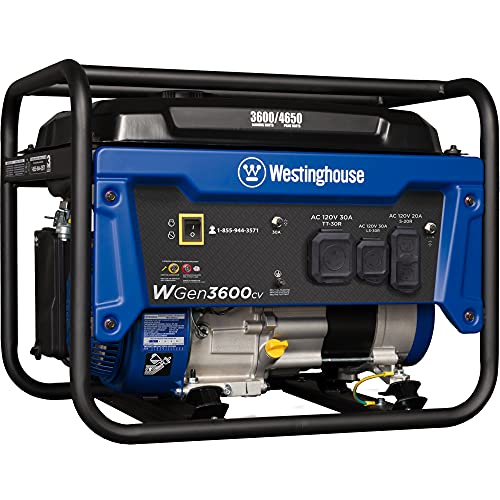
Westinghouse 4650 Peak Watt Gas Portable Generator

Westinghouse 4650 Peak Watt Gas Portable Generator
4650 peak watts3600 running watts4 gal tank212cc OHV
Check price on Amazon
Best for: Homeowners who want the longest runtime and most running watts for tools and a refrigerator.

This is the classic open-frame approach: a 212cc OHV engine with a cast iron sleeve, a 4 gallon tank and up to 14 hours of run time. It makes 3600 running watts, the highest in this roundup, and has two 120V duplex outlets plus a TT-30R and an L5-30R. The listing does not describe it as an inverter, so there is no quoted THD, which makes it a better fit for tools, pumps and a refrigerator than for sensitive electronics.

The long tank is the key advantage. Compared with the Westinghouse 4000 Peak (1.69 gallons, up to 7 hours) and the Evernexta (2 gallons, 6.5 hours at 50 percent load), this machine runs more than twice as long between refills at partial loads. For a power outage that lasts a day, that means fewer midnight refuelings. The tradeoff is size and sound. Conventional engines run at a fixed speed near 3600 rpm, so they are louder and use more fuel at light load than inverter units.

It arrives plug-and-play with oil, an oil funnel, a tool kit and a manual, with minimal assembly. The cast iron cylinder sleeve is a durability plus for anyone planning hundreds of hours of service. Maintenance is the standard small-engine routine: oil changes, an air filter check, and either stabilizer or a drained carburetor for storage. Add a transfer switch or interlock for home backup, and do not run extension cords through a window.

What works

  • 3600 running watts is the highest in this group
  • 4 gallon tank gives up to 14 hours per fill
  • Two 30 amp receptacles plus two household duplex outlets
  • Cast iron cylinder sleeve favors long engine life

Watch out for

  • No stated THD, so avoid it for delicate electronics
  • Conventional engine is louder than the inverter models here
  • Heavier and bulkier than the inverter generators

Spec sheet

Peak / running watts
4650 / 3600
Engine
212cc OHV, cast iron sleeve
Fuel tank
4 gal with gauge
Run time
Up to 14 hr
Outlets
2 duplex, TT-30R, L5-30R
Safety
Low oil and CO shutdown
04

Best Low-THD Value

Aceup Energy 4000W 149cc Inverter Generator

Aceup Energy 4000W 149cc Inverter Generator
4000 peak watts3200 rated wattsTHD under 1.5%149cc OHV
Check price on Amazon
Best for: Campers and light-use backup buyers who care about clean power and a simple control layout.

The Aceup is a gasoline-only inverter built on a 149cc engine and a fully enclosed case. It is rated at 4000 peak and 3200 running watts, which matches the Pulsar and sits 100 watts below the Westinghouse 4000 Peak. Its claim to fame is output purity: THD below 1.5 percent is tighter than the 3 percent that Champion and Westinghouse quote. That matters for laptops, medical chargers and some microwave control boards.

The Aceup has an intelligent gauge showing voltage, run time, fuel level, frequency and power, plus a low oil LED and an economy mode. A 5-in-1 knob combines fuel valve, ignition and choke, which reduces the chance of leaving the fuel on after shutting down. The tank is 1.32 gallons, giving about 5 hours at half load, only about an hour longer than the Pulsar's 4 hours at half load, and still short for overnight use.

A 149cc engine feeding 3200 running watts is working harder than the 208cc engine on the Evernexta (3400 running watts), so expect more engine strain under steady heavy loads. It ships with 10W-40 oil, a spark plug wrench and a funnel. The warranty is two years, a year shorter than Champion and Westinghouse, so factor that into long-term ownership. It is a good pick for sensitive electronics on a smaller budget.

What works

  • THD below 1.5 percent is the cleanest output listed
  • Fully enclosed body keeps noise near 60 dB in Eco mode
  • 5-in-1 knob combines fuel, ignition and choke in one control
  • Includes oil, funnel and spark plug wrench for first start

Watch out for

  • Only a 2 year warranty, shorter than Champion or Westinghouse
  • 1.32 gallon tank gives about 5 hours at half load
  • Gasoline only, with no propane option for storage

Spec sheet

Peak / rated watts
4000 / 3200
Engine
149cc 4-stroke OHV
Fuel tank
1.32 gal
Run time
About 5 hr at half load
THD
Under 1.5%
Noise
About 60 dB in Eco, 25% load
Warranty
2 years limited
05

Best Value

Evernexta 4000W 208cc Inverter Generator

Evernexta 4000W 208cc Inverter Generator
4000 starting watts3400 running watts208cc engine55 lb
Check price on Amazon
Best for: Budget buyers who want maximum running watts and a 30 amp outlet for camping and outages.

The Evernexta puts a 208cc engine behind 4000 starting and 3400 running watts, which is the second-highest running rating here after the Westinghouse 4650. It has a 30 amp outlet, two 120V AC outlets and a 12V DC port, and it keeps THD under 3 percent. For the price tier it is the most generous spec sheet in the roundup, and it can run a refrigerator, lights, fans and laptops within that 3400 watt limit.

The 2 gallon tank gives up to 6.5 hours at 50 percent load, and the listing's headline of 9 hours implies a lighter load with Eco mode on. The more honest figure is the 50 percent value. At 55 pounds it is portable for an inverter, though it uses an open-frame build rather than an enclosed case, so it is louder than the Westinghouse 4000 Peak or Aceup. Overload protection, an AC breaker and low-oil shutdown are the safety features, but the listing does not mention carbon monoxide shutoff, which the Champion and both Westinghouse models include.

Because it lacks CO sensing, never run it in a garage or near an open window, and consider a battery CO alarm. The two-year warranty and email-only support are a consideration for long-term ownership, so keep the receipt. It is a smart pick for occasional camping and outage use where cost and running watts matter more than CO sensing or dual fuel.

What works

  • 3400 running watts, second only to the Westinghouse 4650
  • Includes a 30 amp outlet and a 12V DC port for gear
  • 2 gallon tank gives 6.5 hours at half load
  • Under 3 percent THD suits laptops and phones

Watch out for

  • No carbon monoxide shutoff listed, unlike the Champion and Westinghouse
  • Open-frame build is louder than the enclosed inverters
  • Two year warranty and email-only support

Spec sheet

Starting / running watts
4000 / 3400
Engine
208cc
Fuel tank
2 gal
Run time
6.5 hr at 50% load
THD
Under 3%
Weight
55 lb
Warranty
2 years limited
06

Best for Short Trips

Pulsar PGD40ISCO 4000W Gas Inverter Generator

Pulsar PGD40ISCO 4000W Gas Inverter Generator
4000 peak watts3200 rated watts59 dB1 gal tank
Check price on Amazon
Best for: Short trips and tailgating where light weight and low noise matter more than run time.

The Pulsar PGD40ISCO is a gasoline inverter rated at 4000 peak and 3200 rated watts with a 59 dB noise claim. It matches the Aceup on running watts and runs a few decibels quieter than the Champion. The listing says it can handle air conditioners up to 13,500 BTU, which is a plausible claim at this output because a small RV rooftop unit typically draws about 1500 watts running but needs a surge several times that to start.

The weakness is the tank. A 1 gallon tank gives about 4 hours at half load, the shortest of the group and half of what the Westinghouse 4000 Peak (7 hours) manages. Overnight use means getting up to refill, and refilling a hot engine requires shutting it off first. The listing does not quote THD, a CO sensor, or a dual fuel option, so it is the thinnest spec sheet here.

It is parallel ready, so you can add a second unit later, and the compact, ultra-light positioning suits tailgating and short camping trips. Maintenance is standard: oil changes, spark plug checks, and stabilizer or an empty carburetor for storage. Compare it against the Aceup, which offers a documented sub-1.5 percent THD, or the Evernexta, which offers a 30 amp outlet and a 2 gallon tank for similar entry cost.

What works

  • Quoted at 59 dB, quieter than the Champion's 64 dBA
  • Parallel ready for adding a second unit later on
  • Rated to start AC units up to 13,500 BTU
  • Compact build suits tailgating and short camping trips

Watch out for

  • 1 gallon tank gives only about 4 hours at half load
  • No stated THD or CO shutdown in the listing
  • Gasoline only, so fuel goes stale during long storage

Spec sheet

Peak / rated watts
4000 / 3200
Noise
59 dB
Fuel tank
1 gal
Run time
4 hr at half load
AC rating
Up to 13,500 BTU
Parallel
Parallel ready

Spec sheet decoder

What the numbers on the box really mean

The specs manufacturers lead with, translated into what they tell you about real-world performance.

Starting watts

The brief surge capacity a generator can deliver to start motors such as compressors and pumps, typically lasting only a few seconds. It is higher than running watts because starting a motor draws several times its steady current.

Watch forA label of 4000 watts is a starting figure on every model here. Size your load against the 3000 to 3600 running figure instead.

Running watts

The continuous power the generator can supply indefinitely. It is the number you sum your loads against, and it is the true size of the generator.

Watch forWestinghouse lists 3300 as rated on the 4000 Peak, and Champion lists 3000 on gasoline. Check which fuel the number applies to.

THD

Total harmonic distortion measures how far the output waveform deviates from a perfect sine wave. Lower is cleaner, and under 3 percent is acceptable for most electronics.

Watch forNot every listing publishes it. The Aceup claims below 1.5 percent, while the Westinghouse 4650 and Pulsar state nothing.

dBA at 23 feet

A weighted sound pressure level measured at 23 feet, about 7 meters, which is the standard distance. It is logarithmic, so each 10 dB roughly doubles perceived loudness.

Watch forLook for the test load. The Westinghouse 52 dBA is at light load in Economy Mode, while the Champion's 64 dBA is a more typical figure.

Run time at half load

The hours a full tank lasts when the generator is carrying half of its rated running watts. It is the standard way to compare fuel endurance.

Watch forSome listings quote a longer figure at lower load. The Evernexta headline says 9 hours but its half-load figure is 6.5 hours.

Methodology

How We Evaluated These 4000 Watt Generators

Usable power

We compared running watts and not the 4000 watt starting label. The range runs from 3000 watts on the Champion (gasoline) to 3600 on the Westinghouse 4650. We also adjusted for propane derating on the dual fuel models.

Power quality

We checked whether each listing publishes THD and whether it is inverter-based. The Aceup (under 1.5 percent) leads, followed by the Champion, Westinghouse 4000 Peak and Evernexta at under 3 percent. Listings that omit THD were marked down for electronics use.

Safety systems

We looked for CO shutoff, low-oil shutdown, overload protection and GFCI-style safeguards. The Champion and both Westinghouse models list CO protection, while the Evernexta and Pulsar do not. This mattered heavily in scoring.

Noise and runtime

We compared quoted dB ratings and noted the stated load and distance, then compared tank size and half-load run time. The Westinghouse 4650 leads on endurance with 14 hours, and the Pulsar trails with about 4 hours at half load.

Ownership and support

We compared warranty length (three years on the Champion and Westinghouse models, two on the Aceup and Evernexta), start systems and included accessories. Owner feedback patterns about carburetor clogging and storage informed the maintenance advice.

Decision guide

How to Choose the Right 4000 Watt Generators

By Primary Use

Match the machine to what you plan to power.

ScenarioRecommended pickWhy
RV with a 30 amp hookupChampion 4000W Dual FuelTT-30R outlet, CO shutoff and low THD
Home outage with a refrigerator and sump pumpWestinghouse 4650 Peak Watt3600 running watts and a 14 hour tank
Laptops, TVs and medical chargersAceup Energy 4000WTHD under 1.5 percent
Camping on a tight budgetEvernexta 4000W3400 running watts and a 30 amp outlet
Tailgating and quiet weekendsPulsar PGD40ISCO59 dB claim and parallel ready

By Budget

Relative tiers within this roundup.

Budget tierRecommended pickWhat you give up
LowestEvernexta 4000WCO shutoff and enclosed noise control
LowWestinghouse 4650 Peak WattInverter output and quiet running
MidAceup Energy 4000WDual fuel and a long warranty
Mid-highPulsar PGD40ISCORun time and published THD
HighestWestinghouse 4000 Peak or Champion Dual FuelNothing important, but higher entry cost

Dual Fuel vs Gasoline Only

Dual fuel

Propane does not degrade in storage and burns cleanly, so a dual fuel generator starts reliably after years in a closet. You pay for it with about 10 percent less running power and a more complex fuel system. The Champion 4000W Dual Fuel and the Westinghouse 4000 Peak both fall here.

Gasoline only

Gas is easy to find and gives full rated output, but it goes stale in about 3 to 6 months without stabilizer, and varnish can block a carburetor. The Westinghouse 4650, Aceup, Evernexta and Pulsar fall here. They suit owners who run the unit often and rotate the fuel.

Choose dual fuel if the generator will sit idle for long periods or serve as home backup. Choose gasoline only if you use it often or need every watt.

Inverter vs Open-Frame Conventional

PreferenceRecommended pickWhy
Cleanest powerAceup Energy 4000WTHD under 1.5 percent
Quietest operationWestinghouse 4000 PeakAs low as 52 dBA in Economy Mode
Most running wattsWestinghouse 4650 Peak Watt3600 running watts, conventional design
Best balance of power and qualityEvernexta 4000W3400 running watts with THD under 3 percent
Fuel flexibility with clean powerChampion 4000W Dual FuelInverter output on two fuels

For RV Use Specifically

Look for

A TT-30R 30 amp outlet, CO shutoff, and a noise rating low enough for shared campgrounds. A 13,500 BTU air conditioner draws about 1500 running watts but needs a large surge to start, so size for the starting load. An RV also benefits from a low-THD source to protect the converter.

In this comparison

The Champion 4000W Dual Fuel is the best RV pick thanks to its TT-30R outlet, CO Shield and the option of propane from the RV's own tank. The Westinghouse 4000 Peak is a close second with a quieter 52 dBA rating and remote start.

When to Spend More

Spend more if

You rely on the unit for home backup or RV travel and want CO shutoff, dual fuel and a three-year warranty. The Champion and the Westinghouse 4000 Peak deliver all three and justify a higher entry cost.

Save if

You use it occasionally for camping or short outages. The Evernexta (3400 running watts) and the Westinghouse 4650 (3600) give you more running power for less money, as long as you add a battery CO alarm.

Ownership

Maintenance schedule

The upkeep that decides whether this machine lasts two seasons or ten.

TaskIntervalWhy it matters
Change engine oilFirst 5 to 20 hours, then every 50 to 100 hoursNew engines shed metal particles during break-in, so an early change protects the bearings. After that, clean oil keeps small air-cooled engines from overheating.
Stabilize or drain fuelBefore any storage over 30 daysGasoline degrades and leaves varnish in the carburetor jets. Add stabilizer and run the engine for a few minutes, or run the carburetor dry, to prevent a no-start.
Clean the air filterEvery 25 hours or each seasonA clogged filter richens the mixture and robs power. Foam elements can be washed and re-oiled, while paper elements are replaced.
Inspect the spark plugEvery 100 hoursA fouled plug causes hard starting and rough running. Check the gap and replace it if the electrode is worn.
Exercise the generatorMonthly for 15 to 20 minutesRunning under a load keeps seals lubricated and the carburetor clear. It also confirms the unit works before you need it.
Check CO sensor and ventilationEvery useA CO shutoff is a backup, not permission to run indoors. Keep the generator at least 20 feet from the house, exhaust facing away from windows.

FAQ

Frequently Asked Questions

Is a dual fuel generator better than a gasoline only model?

It depends on how often you run it. Dual fuel lets you use propane, which stores for years without stabilizer, but costs about 10 percent in running watts, as the Champion shows with 3000 watts on gasoline and 2700 on propane. If the generator will sit unused for months, dual fuel is the safer pick. If you run it often, a gasoline unit like the Evernexta gives you full output for less money.

How much should I spend on a 4000 watt generator?

In this roundup the least expensive picks are the Evernexta and the Westinghouse 4650, which deliver 3400 and 3600 running watts but skip some safety and quiet features. The mid tier adds the Aceup and Pulsar with inverter output. Spend the most on the Champion or Westinghouse 4000 Peak if you want CO shutoff, dual fuel and a three-year warranty.

How often does a portable generator need maintenance?

Plan an oil change after the first 5 to 20 hours and then every 50 to 100 hours, plus an air filter check each season. The biggest killer is stale fuel, so use stabilizer or run the carburetor dry before storage. Running the unit monthly for 15 minutes catches problems early. A neglected generator is the one that will not start in an outage.

Does 4000 watts mean I can run 4000 watts continuously?

No. On every model here, 4000 is the starting or peak watts, available for a few seconds. The continuous rating ranges from 3000 watts on the Champion (gasoline) to 3600 on the Westinghouse 4650. Always size your loads against the running figure, and leave 10 to 20 percent headroom so the engine does not run flat out.

Do I need a carbon monoxide shutoff?

Strongly recommended. A generator produces carbon monoxide, which is odorless and deadly, and CO sensors shut the engine down when levels rise near the unit. The Champion, Westinghouse 4000 Peak and Westinghouse 4650 list CO shutdown. Even with one, run the generator outdoors at least 20 feet from the house and use a battery CO alarm indoors.

Can I power my house with a portable generator?

Only through a properly installed transfer switch or interlock kit. Backfeeding through a dryer outlet with a double-male cord is dangerous and illegal in most places, because it can energize utility lines. A 3000 to 3600 watt generator can run a refrigerator, lights, a furnace blower and a few outlets, but not central air or an electric range. Have an electrician install the switch.

Bottom line

The short version

Browse more 4000 watt generatorson Amazon →
James Miller, Lead Machine Editor

About the author

James Miller

Lead Machine Editor, MachineFanatic

James Miller leads MachineFanatic's buying guides, turning spec sheets, manuals and owner feedback into clear verdicts on power tools, outdoor power equipment, shop machines and kitchen machines.

More from James →