
Amazon affiliate links - we earn a commission.Affiliate disclosure

Buying guide · 12 min read · Updated 2026-11-07

Best All-Wheel-Drive Lawn Mowers (2026)

Five true all-wheel-drive mowers compared: two Navimow robots, two WORX Landroid robots and a remote control slope mower, with a slope-first buying guide.

James MillerBy James MillerLead Machine Editor5 machines comparedSpec-sheet verified
Best All-Wheel-Drive Lawn Mowers

At a glance

Our top picks

Side by side

Spec comparison

True all-wheel drive is rare in lawn care. Most self-propelled walk behinds push through two wheels, and the label often means little more than a drive assist. Real four-wheel traction shows up mainly on robot mowers and a few remote controlled slope machines.

That matters because the problems AWD solves are specific: slopes, wet turf and uneven ground. This guide treats it as a tool for those problems and sorts the machines by what each one can realistically handle.

Before you buy

6 Criteria to Look For Before Buying an All-Wheel-Drive Lawn Mower

  1. 01

    What AWD actually means

    True all-wheel drive powers all four wheels, usually with separate motors, while many walk behinds only drive two. Among cordless and gas self-propelled mowers, AWD is rare. The five machines here are robots or remote controlled units, including the Navimow X450 and X430 and the WORX WR342 and WR344. A mower labelled front-wheel-drive or rear-wheel-drive is not AWD, regardless of the advertising.

  2. 02

    Slope rating and how to read it

    A slope rating of 84 percent means 84 feet of rise over 100 feet of run, which is about 40 degrees. The Navimow X430 and X450 state 84 percent and the Mowrator S1 states 40 degrees. Treat these as best case numbers on dry, short grass. Wet turf lowers real climbing ability, so leave a margin below the rated figure.

  3. 03

    Area claim versus real lawn size

    Robot area claims assume simple, open lawns and a dry season. The WORX WR342 claims half an acre, the WR344 and X430 one acre, and the X450 1.5 acres. A lawn with many beds, trees or narrow passages will reduce real coverage. Buy toward the middle of the range, not at the maximum.

  4. 04

    Navigation method

    Wire free robots use satellite RTK or camera mapping, and both rely on a clear view. The WORX models add vision AI for obstacles, while the Navimow models focus on drive and cut. Heavy tree cover can degrade satellite positioning, so check your yard before buying. A remote control mower like the S1 avoids the issue because you steer it.

  5. 05

    Cutting system and blade type

    Robots use small blades and cut often, so they mulch fine clippings back into the lawn. The X450 uses dual 180 watt motors, which gives more cutting power than a single small motor. The S1 has a 21 inch deck that cuts like a conventional mower but needs you present. Pick based on whether you want frequent light cuts or occasional heavy ones.

  6. 06

    Ownership and storage

    Robot mowers need a level dock, regular blade swaps and winter battery care. Lithium packs should be stored partly charged and kept out of extreme cold. Check that parts and support exist for your brand. The remote control S1 needs more frequent upkeep than a robot because you operate it.

Detailed reviews

The 5 best all-wheel-drive lawn mowers, explained

01
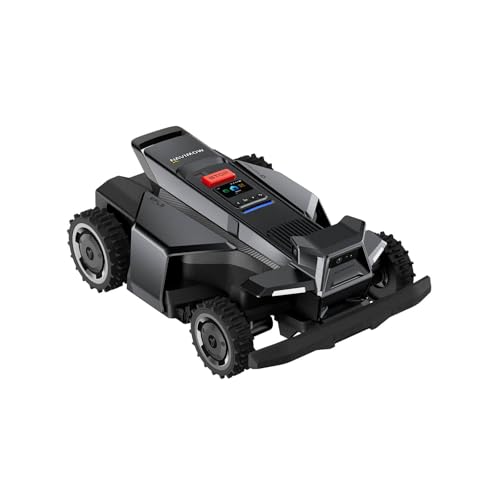
Segway Navimow X450 Wire Free AWD Robot Mower
Up to 1.5 acres4WD, 84% slopesDual 180W motorsWire free
Check price on Amazon
Best for: Large or hilly lawns where you want a hands-off cut and steep slope capability.

The X450 gets the top spot because it covers the most ground and still claims the steepest slope rating in this lineup. It drives all four wheels and steers with an eccentric front wheel design that lets it pivot in place, which is meant to reduce turf scarring on turns. Dual 180 watt cutting motors drive two cutting sections rather than a single small blade.

The tradeoff is complexity and the price tier that comes with it. Against the X430, which is sold for up to 1 acre, the X450 raises the area claim to 1.5 acres, but the two share the same drive layout and slope rating. It also depends on a wire free positioning setup, so open sky and a clear view matter more than they do for a wired system.

Ownership centers on software and upkeep. Blades are small and need regular swaps, the underside needs brushing, and the machine needs a charging station placed on level ground.

What works

  • Four driven wheels with a steep slope rating
  • Largest area claim in this group
  • Zero-turn steering limits turf scarring
  • Wire free setup avoids burying a boundary cable

Watch out for

  • Area and slope claims assume ideal conditions
  • Needs clear sky view for wire free positioning
  • Small blades need regular replacement

Spec sheet

Type
Robot, wire free
Area claim
Up to 1.5 acres
Slope rating
84%
Cutting motors
Dual 180W
Steering
Zero-turn AWD
02
Segway Navimow X430 Wire Free AWD Robot Mower
Up to 1 acre4WD, 84% slopesDual 180W motorsZero-turn
Check price on Amazon
Best for: Lawns up to about an acre with real slopes.

The X430 is the same machine family as the X450, sold for a smaller lawn. It shares the dual suspension, the four driven wheels and the dual 180 watt cutting motors, so the hill climbing and steering behavior should match its bigger sibling. The only headline difference is the area claim, which drops from 1.5 acres to 1 acre.

That makes it a sensible choice if your lawn is closer to three quarters of an acre. Running a robot well under its area rating also lets it finish the job sooner each day and leaves headroom for fast spring growth. Compared with the WORX WR344, which claims 1 acre as well, the Navimow adds a stated 84 percent slope capability.

The ownership picture is the same as the X450: keep blades fresh, brush grass out of the wheels, and give the dock level ground. A larger lawn eventually needs the bigger model, so be honest about your acreage before choosing.

What works

  • Same AWD hardware as the larger model
  • 84 percent slope rating
  • Area claim fits most large suburban lots
  • Zero-turn steering protects turf

Watch out for

  • Area claim stops at 1 acre
  • Positioning needs open sky
  • Blades and wheels need regular cleaning

Spec sheet

Type
Robot, wire free
Area claim
Up to 1 acre
Slope rating
84%
Cutting motors
Dual 180W
Steering
Zero-turn AWD
03
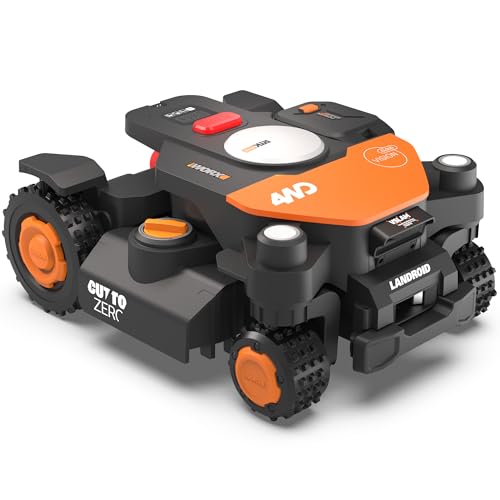
WORX Landroid Vision WR344 4WD Robot Mower
Up to 1 acre4WDRTK positioningAI obstacle view
Check price on Amazon
Best for: Irregular lawns with trees and beds where obstacle avoidance matters.

The WR344 pairs four driven wheels with a camera based mapping system. Its Vision AI looks at the lawn to detect boundaries and obstacles, while RTK positioning adds centimeter level location without a buried wire. That combination suits yards with trees, beds and irregular edges, where a simple boundary wire would be a chore to lay out.

The tradeoff is that WORX does not state a slope percentage in the listing data used here, so the slope capability is less clear than on the Navimow models. If your lawn has steep banks, the 84 percent rating on the X430 is a firmer commitment. On flat to moderate ground, the WR344 gives you obstacle awareness and an area claim of 1 acre.

Ownership involves a camera lens that needs wiping, a dock on level ground and the usual blade swaps. Camera systems can struggle in low sun or heavy shade, so choose the dock location with sun angles in mind.

What works

  • Four driven wheels with no boundary wire
  • Camera based mapping handles irregular shapes
  • RTK positioning gives precise location
  • Area claim of 1 acre

Watch out for

  • Slope capability is less specific than rivals
  • Camera needs a clean lens and decent light
  • Needs a clear view for RTK

Spec sheet

Type
Robot, no wire
Area claim
Up to 1 acre
Drive
4WD
Positioning
RTK cloud
Navigation
Vision AI mapping
04
WORX Landroid Vision WR342 4WD Robot Mower
Up to 1/2 acre4WDRTK positioningNo perimeter wire
Check price on Amazon
Best for: Half acre lawns that want four driven wheels and wire free setup.

The WR342 is the smaller sibling of the WR344, sized for about half an acre. It keeps the four driven wheels, the camera mapping and the RTK positioning, so you get the same obstacle awareness and wire free setup in a lower-capacity model. On a lot of that size, the 1 acre WR344 is more than you need.

Its limit is simply area. A robot that is asked to cover more than its rating leaves strips uncut and spends its days on the dock charging. Against the WR344, this model gives up half the area claim, and it still lacks the specific slope rating that the Navimow machines state.

Ownership matches the larger unit, with blade swaps, a level dock and a clean camera lens. It is the most practical way into AWD robotics for a small to mid lawn.

What works

  • Four driven wheels in a smaller package
  • Camera mapping avoids obstacles
  • No perimeter wire to bury
  • Right size for a half acre lawn

Watch out for

  • Area claim stops at half an acre
  • No stated slope percentage in listing data
  • Camera and RTK need a clear sky and light

Spec sheet

Type
Robot, no wire
Area claim
Up to 1/2 acre
Drive
4WD
Positioning
RTK cloud
Navigation
Vision AI mapping
05
Mowrator S1 4WD Remote Control Slope Mower
21 in cut1000W 4WD18Ah battery40 degree slope
Check price on Amazon
Best for: Steep banks and rough ground where you want to stay in control.

The Mowrator S1 is not a robot at all. You steer it with a remote control, and it cuts a 21 inch swath behind four driven wheels, with a combined 1000 watt drive system and wide wheels for stability. It is built for banks and ditches that are too steep to walk comfortably.

The tradeoff is that you stay involved. A robot like the Navimow X450 mows on a schedule while you do something else, but the S1 needs you at the remote the whole time. Its 21 inch deck is much wider than a robot's cutting path, so it cuts large patches faster, and the 40 degree rating is similar to the 84 percent slope claim on the Navimow models, since 84 percent is about 40 degrees.

Expect more mechanical upkeep, including a blade to sharpen, tires to inspect and a battery to charge and store properly. Its listing also mentions season attachments, which may add value if you want one machine for more than mowing.

What works

  • Remote control keeps you off the slope
  • 21 inch deck cuts a wide swath
  • Wide wheels add stability on steep ground
  • Four driven wheels with a 1000W drive system

Watch out for

  • You operate it the whole time
  • Heavier upkeep than a robot
  • Battery run time is limited for big jobs

Spec sheet

Type
Remote control
Cutting width
21 in
Drive system
1000W 4WD
Battery
18Ah
Slope rating
40 degrees, up to 85%

Spec sheet decoder

What the numbers on the box really mean

The specs manufacturers lead with, translated into what they tell you about real-world performance.

4WD or AWD

All four wheels receive drive power, which improves traction on slopes and wet ground. Many mowers that claim it only drive the front or rear pair.

Watch forAll five picks here state four driven wheels.

Slope rating (84% or 40 degrees)

The maximum grade the machine claims to climb. 84 percent is about 40 degrees, and ratings assume dry, short turf.

Watch forThe X430 and X450 state 84 percent, while WORX lists no percentage here.

Area claim (0.5 to 1.5 acres)

The lawn size a robot is meant to maintain on a regular schedule. It assumes simple geometry.

Watch forThe WR342 claims half an acre while the X450 claims 1.5 acres.

Dual 180W motors

Two cutting motors drive the cutting sections. More motor power helps in thicker grass, though blade and mulching design also matter.

Watch forBoth Navimow models list this, so the cutting difference between them is small.

RTK positioning

A satellite correction system for centimeter level location without a boundary wire. It needs a clear view of the sky.

Watch forBoth WORX models rely on it, so heavy tree cover can affect them.

Methodology

How We Evaluated These All-Wheel-Drive Lawn Mowers

Drive system

We checked that each machine drives all four wheels, based on the spec sheet and listing details. Models that only drive two wheels were excluded. The Navimow and WORX robots and the Mowrator S1 all qualified.

Slope claims

We compared stated slope ratings, converting percent to degrees where needed. The Navimow X430 and X450 state 84 percent, and the Mowrator S1 states 40 degrees. WORX models were scored on the lack of a stated rating.

Area and fit

We matched area claims to realistic lawn sizes, from half an acre on the WR342 to 1.5 acres on the X450. Claims were treated as ceilings, not guarantees. Fit mattered more than the headline number.

Navigation and setup

We weighed wire free positioning, camera mapping and remote control. Each approach has weaknesses under tree cover or low light. Owner feedback patterns informed the setup notes.

Ownership burden

We looked at blade swaps, dock placement, battery care and parts support. Robots lower daily effort but add software and seasonal chores. The remote control S1 trades daily effort for mechanical upkeep.

Decision guide

How to Choose the Right All-Wheel-Drive Lawn Mowers

By Lawn Size

SituationPickWhy
Up to half an acreWORX Landroid Vision WR342 4WD Robot MowerArea claim matches the lot.
Up to an acre, complex layoutWORX Landroid Vision WR344 4WD Robot MowerCamera mapping handles obstacles.
Up to an acre, steep slopesSegway Navimow X430 Wire Free AWD Robot MowerStates 84 percent slopes.
Up to 1.5 acresSegway Navimow X450 Wire Free AWD Robot MowerLargest area claim.
Steep banks, no scheduleMowrator S1 4WD Remote Control Slope MowerYou steer it by remote.

By Budget

Budget levelPickWhy
Lowest spend among robotsWORX Landroid Vision WR342 4WD Robot MowerHalf acre, AWD, no wire.
Mid rangeWORX Landroid Vision WR344 4WD Robot MowerAdds area and vision mapping.
Upper midSegway Navimow X430 Wire Free AWD Robot MowerAdds steep slope rating.
Highest spendSegway Navimow X450 Wire Free AWD Robot MowerBiggest coverage and slope claim.

Robot vs Remote Control

Robot mowers

Robots mow on a schedule while you do other things, and they mulch fine clippings daily. They need setup, a dock and a clear sky or camera view. The Navimow X450 and X430 and the WORX WR344 and WR342 fall here.

Remote control mowers

A remote mower cuts a wider swath and handles rough banks, but you operate it. It needs more frequent upkeep and your time. The Mowrator S1 is the only one in this group.

Pick a robot if you want to forget the lawn exists. Pick the S1 if you have steep ground and prefer to stay in control.

Navigation Method

PreferencePickWhy
Camera obstacle awarenessWORX Landroid Vision WR344 4WD Robot MowerVision AI maps boundaries and obstacles.
Camera plus smaller lotWORX Landroid Vision WR342 4WD Robot MowerSame mapping at half acre.
Wire free with focus on driveSegway Navimow X450 Wire Free AWD Robot MowerDual motors and steep slopes.
No positioning at allMowrator S1 4WD Remote Control Slope MowerYou steer it by remote.

For Steep Slopes Specifically

Look for

Look for four driven wheels and a stated slope rating, then leave margin for wet turf. Wide wheels and a low center of gravity improve stability on a bank. Avoid mowing across a slope in wet conditions.

In this comparison

The Segway Navimow X450 and X430 state 84 percent slopes, and the Mowrator S1 states 40 degrees. The X450 is the better pick for a large lawn, and the S1 suits rough banks.

When to Spend More

Spend more if

Spend more on the Navimow X450 if your lawn is large, hilly and you want the steepest rating and biggest area claim. A bigger machine also leaves headroom for fast spring growth. Reliable support matters more on an expensive robot.

Save if

Save with the WORX WR342 if your lawn is half an acre or less. A flat lawn needs no AWD at all, and a simpler robot or self-propelled mower is enough. The S1 is the budget answer for one steep bank.

Ownership

Maintenance schedule

The upkeep that decides whether this machine lasts two seasons or ten.

TaskIntervalWhy it matters
Replace bladesEvery few weeks in seasonRobot blades are small and dull quickly. Dull blades tear grass and drain the battery faster.
Clean wheels and undersideWeekly in seasonPacked grass reduces traction, which defeats the point of AWD. A soft brush clears the wheels and deck.
Wipe sensors and camera lensEvery few weeksDirty lenses and sensors cause navigation errors. Use a soft damp cloth.
Check dock and charging contactsMonthlyDirty contacts cause failed charges. Keep the dock on level ground with clear space.
Store the battery correctlyBefore winterLithium packs degrade if stored empty or in freezing cold. Store partly charged indoors.

FAQ

Frequently Asked Questions

Is a robot or remote control mower better for slopes?

A robot is better if you want hands-off mowing and the slope is within its rating. A remote mower suits steeper or rougher banks where you want control. The Navimow models and the Mowrator S1 state comparable slope ratings.

How much should I budget for an AWD mower?

Robots with AWD sit at the upper end of robot pricing, and the larger area models cost the most. Match the area claim to your lawn so you do not overpay for capacity you will not use.

How long does an AWD robot mower last?

Robots depend on battery life, wheel wear and software support. Expect blade swaps every few weeks and a battery that fades over several seasons. Good winter storage extends life.

Does an 84 percent slope rating mean it climbs any hill?

No. The figure is a best case on dry, short grass and equals about 40 degrees. Wet or tall grass reduces real traction, so leave a safety margin.

Do I need AWD on a flat lawn?

No. AWD helps on slopes, wet turf and uneven ground. A flat lawn is served well by a simpler robot or a self-propelled walk behind.

Are robot mowers safe around kids and pets?

Robots have blade stop sensors, but keep children and pets clear while a mower runs. Follow the manufacturer manual for lift and tilt behavior. Never reach under a running machine.

Bottom line

The short version

Browse more all-wheel-drive lawn mowerson Amazon →
James Miller, Lead Machine Editor

About the author

James Miller

Lead Machine Editor, MachineFanatic

James Miller leads MachineFanatic's buying guides, turning spec sheets, manuals and owner feedback into clear verdicts on power tools, outdoor power equipment, shop machines and kitchen machines.

More from James →

Keep reading

Related guides