
Amazon affiliate links - we earn a commission.Affiliate disclosure

Buying guide · 12 min read · Updated 2026-11-07

Best Battery Powered Space Heaters (2026)

Five cordless battery space heaters compared by battery platform, airflow design and tip-over protection, with honest limits on how much warmth to expect.

James MillerBy James MillerLead Machine Editor5 machines comparedSpec-sheet verified
Best Battery Powered Space Heaters

At a glance

Our top picks

Side by side

Spec comparison

A cordless heater trades output for freedom. Heat is energy, and a hand-sized battery holds a small fraction of what a wall outlet delivers in an hour, so every unit in this category is a personal-zone device. They suit a car cabin before the commute, a tent flap, a workbench in an unheated garage or a cold desk.

What separates one from another is the battery arrangement, the airflow path and the tip-over protection. Some borrow a power-tool pack you may already own, others ship with their own cells, and the difference decides both cost and how long you stay warm before swapping.

Before you buy

6 Criteria to Look For Before Buying a Battery Powered Space Heater

  1. 01

    Battery platform and compatibility

    A cordless heater is only as good as its pack. The Yudara takes DeWalt 20V Max batteries, the Odorkle names compatible Li-ion tool packs, the OPPWONG uses an A3-style pack and the GSQQTE ships with two 3000mAh packs. The common mistake is assuming 'battery not included' means any battery works; mounting shoes and voltages differ, so match the model number on your pack to the listing text before paying.

  2. 02

    Honest output, not a room heater

    Heat is energy, and a hand-held pack holds far less than a wall outlet supplies. The Odorkle's 200W rating is a fair guide: that is a seventh of a typical 1500W plug-in unit. Buy these for a windshield, a hand or a tent corner, and do not expect a thermostat setting to change the temperature of a whole garage.

  3. 03

    Runtime versus thermostat

    A thermostat lets the element rest once it reaches temperature, and on a battery that rest is the difference between an hour and a morning. The Yudara lists one, the Odorkle does not, so you control runtime by hand. If you will leave the heater on for long stretches, favour the model that cycles itself.

  4. 04

    Airflow and aiming

    Because the output is small, how you aim it matters more than how much there is. The OPPWONG's ball head tilts 50 to 60 degrees and spins a full turn, which lets you lock the stream on one spot. A fixed-angle body wastes heat blowing past you.

  5. 05

    Tip-over and overheat protection

    Cordless means it sits on car seats, tent floors and benches, all places where a heater can be knocked. The GSQQTE and Aopukidor both advertise anti-tilt cutoffs, and the Odorkle lists a tip-over cutoff. Treat the cutoff as a minimum, then keep fabric and paper well clear of the outlet anyway.

  6. 06

    Cold-weather battery behaviour

    Lithium cells deliver less and charge poorly in the cold. Store spare packs indoors and bring them out when needed. A spare pack, as in the GSQQTE bundle, is worth more in winter than a slightly larger single pack.

Detailed reviews

The 5 best battery powered space heaters, explained

01
Yudara Cordless Heater for DeWalt 20V Max Packs
DeWalt 20V MaxThermostatFlame-retardant ABSBattery not included
Check price on Amazon
Best for: Contractors and DIYers who already own DeWalt 20V Max packs and want a swap-in heater.

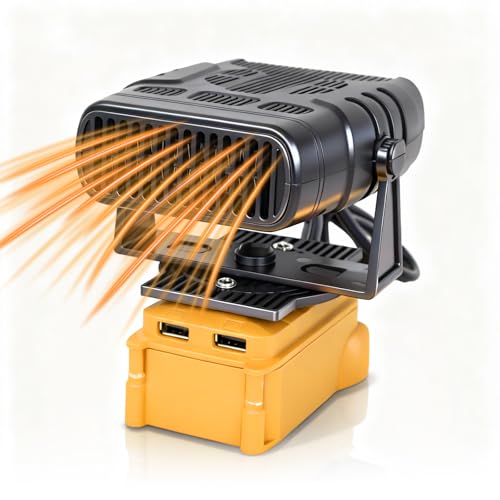
The Yudara is a bare tool: a heater body that accepts the DeWalt 20V Max pack family, with the listing naming the DCB200 through DCB205 batteries. That design means the heater never has to carry cells of its own, so the housing stays light and you can swap a drained pack for a charged one in seconds, exactly the way you would with a drill. It adds a thermostat, which matters on a battery because a heater that stops pulling current once it reaches temperature stretches a pack far longer than one that blasts continuously.

The tradeoff is that you must already be inside the DeWalt ecosystem, or buy a pack and charger on top. The coverage claim on the listing is generous for a battery unit; treat the 200 square foot figure as a best case in a sealed small space, not a promise for a drafty workshop. Next to the Odorkle, which also takes tool packs, the Yudara is the one that advertises a thermostat, so it makes more sense for long sessions in a vehicle or tent.

Ownership is simple. Keep the battery contacts clean and dry, store the body away from sawdust that could clog the intake, and do not leave a pack sitting in a freezing garage between charges, since lithium cells charge poorly when cold. Because the heater is flame-retardant ABS, it tolerates warm exhaust without softening, but it should still sit on a flat surface with clear space around it.

What works

  • Runs on packs you may already own
  • Thermostat reduces wasted battery drain
  • Fast pack swap keeps heat going
  • Body stays light without built-in cells

Watch out for

  • Battery and charger are not included
  • Coverage claim is only a best case

Spec sheet

Power source
DeWalt 20V Max Li-ion pack
Battery included
No
Control
Thermostat
Housing
Flame-retardant ABS
Listed coverage
Up to 200 sq ft claim
02
Odorkle Cordless Heater 200W, 360 Degree Head
200W360 degree headTwo heat levelsBattery not included
Check price on Amazon
Best for: Anyone testing the cordless idea who already owns a compatible pack.

The Odorkle is a 200W blower on a rotating head, and the number is the useful detail: 200 watts is roughly one-seventh of what a plug-in heater delivers, which tells you exactly what to expect. It warms air that passes through a small element and points it where you aim it, so it suits a hand, a foot or a windshield rather than a room.

Its two settings are worth reading carefully. The first level is described as natural wind, meaning it moves air without much heat, and only the second level actually heats. Against the Yudara, there is no thermostat in the listing, so you control runtime yourself by turning it off, and the battery will drain steadily on the hot setting. The tip-over cutoff is the safety feature to value in a car cup holder or on a tent floor.

Because the pack is not included, check the listing compatibility text against your actual battery before ordering; several tool-battery heaters differ in the mounting shoe. Keep the nozzle clear of fabric, since a 200W element still gets hot at the outlet, and wipe dust from the grille every few uses. It is a sensible low-cost way to test whether a cordless heater fits your routine before committing to a pricier setup.

What works

  • 200W output is honest about its limits
  • 360 degree head aims heat precisely
  • Tip-over cutoff for floors and seats
  • Low entry cost among tool-pack units

Watch out for

  • No thermostat listed, so runtime is manual
  • First setting is air only, not heat

Spec sheet

Rated power
200W
Power source
Compatible Li-ion tool packs
Battery included
No
Heat settings
Two levels, first is plain airflow
Safety
Tip-over cutoff
03
OPPWONG Cordless Ball-Head Heater, 60 CFM
60 CFM airflow360 degree ball headDual USB portsBattery not included
Check price on Amazon
Best for: Drivers and campers who need hot air aimed at one spot.

The OPPWONG is built around a ball head that turns a full circle horizontally and tilts 50 to 60 degrees up and down, which makes it the most directable heater here. Its listing quotes 60 CFM of airflow and an outlet temperature climbing to 50 to 80 degrees Celsius within about three seconds, a plausible claim for a small element moving a small volume of air, but one that describes the exhaust stream, not the temperature of your room.

The battery is a separate A3-style pack that is not included, so total cost depends on what you add. The dual USB ports are a thoughtful extra for charging a phone while working, though every milliamp they draw shortens heater runtime. Compared with the Yudara, it has no stated thermostat, so it behaves as an on-demand blower. It is the one to choose for defogging a side window or warming one gloved hand, because you can lock the aim.

Check compatibility before buying, since an A3-style pack is not a universal standard, and the near-identical Garosa listing uses the same ball-head design and battery family. After use, let the head cool before packing it in a bag, and keep the intake free of lint from clothing. Do not run it face-down on upholstery: a ball head that tips can point hot air at a surface.

What works

  • Ball head pans and tilts widely
  • 60 CFM moves air quickly
  • Dual USB ports charge a phone
  • Heat arrives within seconds

Watch out for

  • Battery pack sold separately
  • Outlet temperature claim is not room temperature

Spec sheet

Airflow
60 CFM
Head movement
360 degrees horizontal, 50 to 60 tilt
Outlet temperature
50 to 80 C claim
Power source
Rechargeable A3-style battery
Extras
Dual USB ports
04
GSQQTE Cordless Heater with Two 3000mAh Batteries
Two 3000mAh packsAnti-tippingCar defroster useRechargeable
Check price on Amazon
Best for: Drivers who want a complete kit with a spare battery.

The GSQQTE is the all-in-one answer to the battery question: two 3000mAh rechargeable packs come in the box, so you are not hunting for a compatible battery. Having a spare is the real advantage, because one cell can charge while the other works, which is how you keep warm through a long wait in a vehicle or a day at a cold site.

Its focus is automotive, with the listing emphasising window defrosting and an anti-tipping design that keeps it from sliding off a seat on a bumpy road. That targeting is also its limit: a unit tuned for a windshield is not meant to heat an open room. Against the Odorkle and Yudara, you give up the ability to share a pack with your tools, but you gain a bundle that works out of the box.

Every cell wears out, so plan for it. A 3000mAh lithium pack degrades with deep discharges and heat, and a pack left on a dashboard in summer ages faster. Charge it indoors, do not run it to empty repeatedly, and keep the two packs rotating so they wear evenly. A near-identical GSQQTE listing exists under a different name, so confirm that you are ordering the version you read about.

What works

  • Two packs included for rotation
  • No tool-brand dependency
  • Anti-tipping design suits vehicles
  • Charge one while using the other

Watch out for

  • Built around car use, not room heating
  • Proprietary packs are hard to replace

Spec sheet

Included batteries
Two 3000mAh packs
Power source
Own rechargeable cells
Primary use
Car cabin and window defrost
Safety
Anti-tipping design
Platform
Self-contained
05
Aopukidor Battery Heater with Dual USB Ports
Dual USB portsAnti-tiltMultiple battery optionsCar defog
Check price on Amazon
Best for: Commuters who want one device that heats and charges a phone.

The Aopukidor combines a heater with a phone-charging role, offering two USB ports and support for several battery choices according to the listing. That flexibility is its selling point: the same body can go from a car to a workshop to a campsite without being tied to one cell type.

The anti-tilt cutoff is the safety piece to rely on, since an unattended heater that gets jostled needs to stop heating on its own. As with the rest of the category, the heat is modest and aimed, so think of it as a defogger and personal warmer first. Compared with the OPPWONG, you trade the fully articulated ball head for a broader range of battery pairing.

Before buying, read which batteries the listing actually names, because multiple options do not mean every pack on the market. Treat the USB ports as a bonus and not a reason to buy: a phone charging from the same battery cuts into heater runtime. Wipe the vents with a dry cloth and keep the body away from liquids, particularly if you use it in a damp tent or a car with condensation on the windows.

What works

  • Two USB ports for phones
  • Anti-tilt cutoff guards against bumps
  • Flexible battery pairing
  • Quiet operation described

Watch out for

  • Battery details need checking before purchase
  • Modest heat, aimed at one zone

Spec sheet

Power source
Multiple battery options
USB output
Dual ports for phones
Safety
Anti-tilt cutoff
Primary use
Car defogging and personal warmth
Noise
Described as quiet

Spec sheet decoder

What the numbers on the box really mean

The specs manufacturers lead with, translated into what they tell you about real-world performance.

Wattage (W)

Watts describe how fast the heater converts battery energy to heat. A small number means a small, focused warm stream, not a room-filling one.

Watch forThe Odorkle at 200W shows the scale; any unit with no stated wattage deserves scepticism.

Battery capacity (mAh)

Milliamp-hours describe how much charge a pack holds, but the real energy depends on voltage too. Comparing mAh across different voltages is misleading.

Watch forThe GSQQTE packs are 3000mAh; a DeWalt pack on the Yudara is a different voltage, so do not compare them by that figure.

Airflow (CFM)

Cubic feet per minute shows how much air passes the element. More airflow cools the exhaust slightly but spreads warmth further.

Watch forThe OPPWONG lists 60 CFM; check whether competing models even state it.

Outlet temperature

This is the temperature of air leaving the nozzle, not the temperature of the space. A hot stream mixes quickly with cold ambient air.

Watch forThe OPPWONG's 50 to 80 C claim describes the exhaust, so it cannot predict your cabin temperature.

Coverage (sq ft)

A manufacturer's coverage figure assumes a sealed, small and insulated space. In a leaky vehicle or garage the real number is much lower.

Watch forThe Yudara quotes 200 square feet; treat it as a ceiling, not a target.

Methodology

How We Evaluated These Battery Powered Space Heaters

Battery arrangement

We evaluated whether each heater carries its own cells or borrows a tool pack, since that decides total cost and swap speed. Listings were checked for what is and is not included in the box. A heater sold without a battery is only a good deal if you already own a matching pack.

Realistic output

We read the spec sheets against basic physics to separate honest numbers from optimistic ones. The Odorkle's 200W rating sets the baseline, and coverage claims that ignore that scale were marked down. No unit here can match a plug-in heater.

Safety features

We looked for tip-over, anti-tilt and overheat protection described on each listing. Cordless heaters get knocked around, so a cutoff is a baseline feature. Missing detail counts against a model.

Directional control

We compared how each unit aims its heat, from the OPPWONG's tilting ball head to simpler fixed bodies. Small outputs only help when pointed at something, so aiming was weighted for personal-zone use.

Ownership burden

We considered charging, spare packs and cold-weather behaviour, using owner feedback patterns and general lithium-battery knowledge. The two-pack GSQQTE bundle scored well on convenience, while pack-less units scored on flexibility.

Decision guide

How to Choose the Right Battery Powered Space Heaters

By Primary Attribute: Battery Source

SituationPickWhy
You own DeWalt 20V Max packsYudara Cordless HeaterUses the packs you already have and adds a thermostat
You own a compatible tool pack but want to spend littleOdorkle Cordless HeaterLow entry cost for the 200W tool-pack route
You want a battery in the boxGSQQTE Two-Battery HeaterTwo 3000mAh packs included for rotation
You want a tilt-and-pan nozzleOPPWONG Ball-Head HeaterBall head locks the stream onto one spot
You want a phone charger built inAopukidor Battery HeaterDual USB ports share the pack

By Budget

TierPickWhy
Lowest outlay if you own a packOdorkle Cordless HeaterNo battery cost if you already have one
Mid tier, tool-pack routeYudara Cordless HeaterThermostat justifies a step up
Mid tier, own cellsOPPWONG Ball-Head HeaterDirectional control but pack sold separately
Highest outlay, complete kitGSQQTE Two-Battery HeaterBatteries included, so total cost is clearer

Tool-Battery vs Built-In Battery

Tool-battery heaters

The Yudara and Odorkle borrow a pack you may already own, which keeps the body light and lets you swap in seconds. The catch is that the pack is a separate purchase if you have none, and the heater is limited to that brand family.

Built-in battery heaters

The GSQQTE bundle includes its own two 3000mAh cells, so it works out of the box and carries a spare. The catch is that the cells are not shared with other tools and are costly to replace.

Tool owners should take the Yudara; everyone else should take the GSQQTE kit.

Where You Will Use It

UsePickWhy
Car cabin and windshieldGSQQTE Two-Battery HeaterDesigned around defrost and anti-tipping
Garage benchYudara Cordless HeaterThermostat and quick pack swaps
Camping tent cornerAopukidor Battery HeaterCharges a phone while warming
Hand warming outdoorsOPPWONG Ball-Head HeaterAim the airflow where you need it

For Defogging a Windshield Specifically

Look for

Look for a nozzle you can aim and lock, a stable base and a tip-over cutoff, since the heater will sit on a seat or a dash. Airflow matters because fog clears when warm air actually moves across the glass.

In this comparison

The OPPWONG's ball head and 60 CFM stream make it the most precise for glass, while the GSQQTE is built around automotive use and ships with two packs. The Aopukidor also advertises car defogging.

When to Spend More

Spend more if

Spend more on the GSQQTE kit if you will use the heater daily in a vehicle and need a rotating spare pack, or on the Yudara if you will run long sessions where a thermostat saves energy.

Save if

Save with the Odorkle if you already own a compatible pack and just want a small blower for occasional use, or with the Aopukidor if you mostly need a USB charger that also warms.

Ownership

Maintenance schedule

The upkeep that decides whether this machine lasts two seasons or ten.

TaskIntervalWhy it matters
Inspect battery contactsMonthlyDirt or corrosion adds resistance and can cause the heater to cut out. Wipe the contacts with a dry cloth and keep them away from moisture.
Clean intake and grilleEvery few usesLint and sawdust reduce airflow and can scorch on the element. Use a dry brush with the battery removed.
Store packs indoorsEvery winter nightLithium cells lose capacity and charge poorly when cold. Bring spare packs inside between uses.
Avoid full dischargeEach sessionRunning a pack flat repeatedly shortens its life. Recharge when the heater slows or cuts out.
Check the tip-over cutoffMonthlyTilt the unplugged body gently on a table and confirm the cutoff clicks or stops heating once power is restored. A stuck switch gives false safety.

FAQ

Frequently Asked Questions

Can a battery space heater warm a whole room?

No. A hand-held pack cannot deliver the sustained power a wall outlet can, and the Odorkle's 200W rating is a fair guide to the scale. Use these for a windshield, a hand or a tent corner.

Should I buy a tool-battery heater or one with built-in cells?

If you already own DeWalt 20V Max packs, the Yudara saves money and lets you swap packs fast. If you do not, the GSQQTE bundle with two 3000mAh packs is simpler than buying a pack and charger separately.

Is a battery heater cheaper than a plug-in one?

Only if you already own the batteries. A plug-in unit delivers far more heat for the same outlay, so a cordless model is a convenience purchase and not a savings plan.

How long will a pack last?

Runtime depends on the pack, the heat setting and temperature, and the listings do not guarantee a figure. A thermostat, as on the Yudara, helps by letting the element rest.

Is the outlet temperature the room temperature?

No. The OPPWONG's 50 to 80 C claim describes air leaving the nozzle, which mixes with cold air within inches. It cannot be read as the temperature of your space.

Are these safe to leave running unattended?

Treat them as attended tools. Tip-over and anti-tilt cutoffs reduce risk, but you should keep fabric, paper and anything flammable clear of the outlet, and never leave a heater running in an empty vehicle.

Bottom line

The short version

Browse more battery powered space heaterson Amazon →
James Miller, Lead Machine Editor

About the author

James Miller

Lead Machine Editor, MachineFanatic

James Miller leads MachineFanatic's buying guides, turning spec sheets, manuals and owner feedback into clear verdicts on power tools, outdoor power equipment, shop machines and kitchen machines.

More from James →

Keep reading

Related guides