
Amazon affiliate links - we earn a commission.Affiliate disclosure

Buying guide · 13 min read · Updated 2026-11-07

Best Bread Makers With Ceramic Pan (2026)

Five ceramic-pan bread makers compared on coating durability, capacity, heaters and programs, for bakers who want to avoid PTFE nonstick in the pan.

James MillerBy James MillerLead Machine Editor5 machines comparedSpec-sheet verified
Best Bread Makers With Ceramic Pan

At a glance

Our top picks

Side by side

Spec comparison

A bread maker pan lives a hard life. It is heated to a high temperature, filled with sticky dough and scrubbed after every use, and a coating that flakes or sticks is the most common reason people stop baking at home.

Ceramic pans are sold as a healthier and more durable alternative to PTFE nonstick, but the label hides real differences in thickness, release and care. This guide looks at what the coating actually does and which machines build the rest of the bread maker well around it.

Before you buy

6 Criteria to Look For Before Buying a Bread Maker With Ceramic Pan

  1. 01

    What ceramic coating actually is

    Most ceramic nonstick coatings are a silica-based sol-gel layer sprayed over aluminum, as opposed to PTFE. Buyers choose them to avoid PTFE, which is stable at normal baking temperatures but breaks down if overheated empty. Ceramic gives good release when new, but the slickness fades over a year or two if the pan is scrubbed or heated dry. Expect to treat it gently regardless of which brand you buy. A practical test of any new ceramic pan is to bake a plain white loaf with no added fat and see whether it slides out after a short rest, because that shows the release before you rely on it for sticky doughs. If the first loaf has to be levered out, the coating was either damaged in shipping or applied thinly.

  2. 02

    Pan size and shape

    A ceramic pan on a three-pound machine such as the KBS 750W has more surface to wear and is heavier to wash than a two-pound pan. A vertical pan makes a tall loaf with a paddle hole in the base, while a horizontal pan makes a sandwich shape. Choose the pan size that matches the loaves you actually bake, not the maximum on the box. Bakers who make one large loaf a week will see the coating wear differently from those who bake small loaves daily, because each cycle flexes the metal and heats the coating. A light, thin pan also heats faster than a thick one, which changes how quickly the crust forms.

  3. 03

    Cleaning and care routine

    Soak a stuck pan in warm water for ten minutes before washing, and never use steel wool or abrasive pads. Skip cooking sprays, since their lecithin builds up as a sticky film on ceramic. If baked-on residue persists, a baking soda paste on a soft sponge lifts it without scratching. Never put a hot pan into cold water, since the thermal shock can crack the coating or warp the metal. Let the pan cool on the rack for ten minutes first, then soak, rinse and dry it completely before storage so moisture does not sit in the paddle well.

  4. 04

    Heating power and layout

    The Neretva 20-in-1 uses 550W dual heaters, the Neretva 15-in-1 uses 600W and the KBS 750W uses 750W infrared heaters. More wattage helps thick loaves brown evenly, but a ceramic pan conducts heat differently from a PTFE one, so a machine designed around ceramic may adjust its bake times. Follow the manual's quantities. If a loaf comes out pale on the sides, raise the crust setting one notch rather than adding time, and if the top is dark while the bottom is pale, check that the pan is seated flat in the chamber. Small changes like these are easier to make on a machine with accessible heaters than on one that hides everything.

  5. 05

    Programs and custom slots

    The KBS 24-in-1 offers 24 menus and two custom modes, the VEVOR 19 functions and the Neretva models 20 and 15 programs. Beginners do not need more than basic, whole wheat, dough and gluten-free. Custom slots help experienced bakers who want to lengthen a rise or adjust a bake. A longer, cooler first rise develops flavor in a plain loaf, and a custom slot lets you save that schedule instead of babysitting the machine. If you never plan to change a preset, a machine without custom slots is a perfectly good choice.

  6. 06

    Replacement pan availability

    Every ceramic coating wears eventually, so the cost and availability of a replacement pan matter. Established makers like KBS and Neretva sell replacement pans, while newer or lesser-known brands may not. Check before you buy, because a machine with a worn pan and no replacement is a dead appliance. Also check whether the paddle is sold separately, since a worn paddle shaft can leak dough into the drive and ruin the machine long before the coating fails. Keep the order number of your pan, and buy a spare when the maker has it in stock.

Detailed reviews

The 5 best bread makers with ceramic pan, explained

01
KBS 24-in-1 2.2LB Stainless Steel Bread Maker With Ceramic Pan
Ceramic pan24 programs2 custom modes2.2 lb
Check price on Amazon
Best for: Bakers who want a ceramic pan with flexible custom programs.

The KBS 24-in-1 is a well-rounded machine built around a ceramic pan. Twenty-four menus and two custom modes cover everything from white bread to gluten-free, dough and jam, and a 2.2-pound capacity suits a family of four. A stainless steel body keeps the exterior easy to wipe.

The ceramic pan is the headline, and the claim behind it is about what the coating is not. Ceramic coatings are typically a sol-gel silica layer rather than PTFE, which many owners prefer on principle. In practice, they release dough well when new but can lose slickness faster than PTFE if scrubbed or heated dry. Against the VEVOR, the KBS offers more programs and custom modes, and against the Neretva machines it leans on a larger, more capable control set.

Ownership comes down to gentle care. Wash by hand with a soft sponge, avoid metal tools, soak sticky residue rather than scraping and never preheat the pan empty. With that routine, a ceramic pan should stay slick for years, and a replacement pan is a modest cost if it eventually does not.

What works

  • Ceramic pan avoids PTFE nonstick coating
  • Twenty-four menus plus two custom modes
  • Stainless steel body wipes clean
  • 2.2-pound capacity suits most families

Watch out for

  • Ceramic loses slickness if scrubbed or overheated
  • More expensive than basic ceramic models
  • Large program list takes time to learn

Spec sheet

Pan
Ceramic coated
Programs
24 menus
Custom modes
Two
Capacity
2.2 lb
Body
Stainless steel
02
Neretva 20-in-1 2LB Bread Maker With Ceramic Pan in Light Green
Ceramic pan20 programsDual heaters2 lb
Check price on Amazon
Best for: Buyers who want a ceramic pan at a moderate cost.

The Neretva 20-in-1 combines a nonstick ceramic pan with an all-metal body and 360-degree dual heaters. Twenty programs and 550W of power cover most recipes, and the maker describes the pan as free of added chemicals, which is the main selling point of a ceramic coating for buyers who want to avoid PTFE.

The value story is a sensible feature set at a moderate cost. A two-pound capacity suits most households, and the compact footprint is easier to fit on a counter than three-pound machines. Against the KBS 24-in-1, it has fewer programs and no custom slots, and against the VEVOR it offers a light green color option and a more familiar brand name.

In ownership, treat the pan with the same care as any ceramic coating. Hand wash, use nonmetal tools and dry thoroughly. If the coating dulls, a light rub with a cut lemon or a baking soda paste can remove baked-on film without scratching.

What works

  • Nonstick ceramic pan with no added chemicals claim
  • All-metal body and dual heaters
  • Twenty programs for varied recipes
  • Compact two-pound size

Watch out for

  • No custom program slots
  • 550W is modest for dense doughs
  • Ceramic coating requires gentle care

Spec sheet

Pan
Nonstick ceramic
Programs
20 menus
Heating
Dual heaters, 550W
Capacity
2 lb
Body
All metal
03
Neretva 2.2LB 15-in-1 Bread Machine With Ceramic Pan and Nut Dispenser
Ceramic panNut dispenser15 programs2.2 lb
Check price on Amazon
Best for: Bakers who want a ceramic pan and automatic mix-in loading.

This Neretva adds an automatic nut dispenser to a ceramic pan, which makes it the practical choice for seeded and fruit loaves. A 2.2-pound capacity and 600W of power with dual heaters cover family-sized bakes, and fifteen programs focus on the standard bread cycles rather than long lists.

The dispenser interacts with the pan in a useful way. Sticky fruit can glaze a pan, and a ceramic surface is generally easier to rinse clean than a worn nonstick one, which helps when you bake with raisins or dates. Against the other Neretva, it trades program count for the dispenser, and against the KBS 24-in-1 it has less control but a more focused feature set.

Ownership is simple. Clean the dispenser flap after every use, hand wash the pan and let both parts dry before the next bake. Avoid using nonstick sprays on a ceramic surface, as the buildup can reduce release. If you bake seeded breads often, watch for oil from seeds and nuts clinging to the pan walls, and wipe it off with a paper towel before washing so it does not turn tacky.

What works

  • Ceramic pan with automatic nut dispenser
  • 600W power and dual heaters
  • 2.2-pound capacity for family loaves
  • Focused fifteen-program list

Watch out for

  • Fewer programs than other ceramic options
  • Dispenser adds parts to clean
  • No custom program slot

Spec sheet

Pan
Nonstick ceramic
Dispenser
Automatic nut dispenser
Programs
15
Capacity
2.2 lb
Power
600W with dual heaters
04
VEVOR Stainless Steel Bread Maker With Nonstick Ceramic Pan
Ceramic pan19 programsStainless steelProgrammable
Check price on Amazon
Best for: Buyers who want a plain ceramic-pan machine in stainless steel.

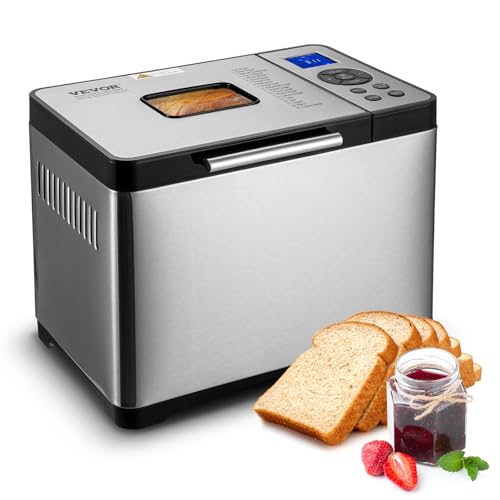
The VEVOR combines a stainless steel body with a nonstick ceramic pan and nineteen function programs. It is the most understated of the group, with a straightforward panel and a focus on covering the main bread cycles, dough and jam without dispensers or smart controls.

Its value comes from simplicity and a modest cost. A stainless body is easy to wipe and feels sturdier than plastic, while the ceramic pan answers the PTFE question. Against the KBS 24-in-1, it has fewer programs and no custom slots, and against the Neretva machines it offers a more minimal design. If you like plain appliances that do one job, that restraint is a feature, because fewer buttons mean fewer ways to select the wrong cycle on a rushed morning. A brand known for tools and equipment rather than kitchen appliances means documentation can be thinner.

Ownership is straightforward: hand wash, keep metal tools out of the pan and wipe the body. Read the manual carefully, because recipe quantities for ceramic pans can differ slightly from those for PTFE ones. Plan on running two or three plain loaves first, noting crust color and release, before trusting the machine with an expensive specialty flour.

What works

  • Nonstick ceramic pan
  • Stainless steel body is sturdy and wipes clean
  • Nineteen functions cover standard recipes
  • Plain controls

Watch out for

  • No dispenser or custom slots
  • Brand is better known for tools than kitchen gear
  • Thinner documentation than established makers

Spec sheet

Pan
Nonstick ceramic
Programs
19 functions
Body
Stainless steel
Brand
VEVOR
Use
Home baking
05
KBS 750W Programmable Bread Maker With 3LB Ceramic Pan
3 lb ceramic pan750W heaters20 menusFruit dispenser
Check price on Amazon
Best for: Large families that want a ceramic pan with serious capacity.

The KBS 750W gives a ceramic pan a larger stage: a three-pound capacity, 750W dual infrared heaters, twenty menus with two custom programs and a fruit dispenser. A brushless motor drives the paddle, and the maker pitches it as a quiet machine.

Capacity is the key difference. A three-pound pan means a taller, heavier loaf, and the ceramic surface has more dough to release, which can show wear faster if you bake large loaves several times a week. Against the KBS 24-in-1, it offers more size and power, while giving up a few programs. Against the Neretva models, it has a stronger heater system and a larger pan.

Expect to do the usual care: soak the pan, hand wash and let it dry. A large ceramic pan is heavier and more awkward to clean in a small sink, so plan the space. Because ceramic can chip at the rim, avoid knocking the pan against the sink, and lift it by the handle rather than the edge.

What works

  • Three-pound ceramic pan for big loaves
  • 750W infrared dual heaters
  • Twenty menus plus two custom programs
  • Fruit and nut dispenser

Watch out for

  • Heavier pan is awkward to wash
  • Costs more than two-pound ceramic models
  • Needs significant counter space

Spec sheet

Pan
Ceramic, 3 lb
Heating
750W infrared dual heaters
Programs
20 menus and 2 custom
Dispenser
Fruit and nut
Motor
Brushless

Spec sheet decoder

What the numbers on the box really mean

The specs manufacturers lead with, translated into what they tell you about real-world performance.

Ceramic nonstick

A sol-gel coating on the pan that releases dough without PTFE.

Watch forIt loses slickness if scrubbed or heated empty.

Dual heaters

Two elements, usually top and bottom, that brown the loaf evenly. Neretva lists 550W and 600W; KBS lists 750W.

Watch forMore power does not fix a pan that releases poorly.

Custom modes

Programmable slots for your own knead, rise and bake times, offered on KBS machines.

Watch forThey need a few test loaves before they work well.

Brushless motor

A motor with electronic commutation, used on the KBS 750W, that reduces mechanical noise.

Watch forIt lowers noise at the source but does not change the bake.

Nut dispenser

A hopper that releases mix-ins automatically, as on the Neretva 15-in-1.

Watch forSticky fruit can gum the flap.

Methodology

How We Evaluated These Bread Makers With Ceramic Pan

Coating care and durability

We evaluated how each ceramic pan is likely to age, considering construction and owner guidance. All of them need hand washing and nonmetal tools, and we favored brands that sell replacement pans. We also noted that thicker, heavier pans tend to resist warping, which matters because a warped pan sits unevenly in the chamber.

Capacity and loaf format

We compared the 2 lb Neretva 20-in-1 and VEVOR, the 2.2 lb KBS 24-in-1 and Neretva 15-in-1 and the 3 lb KBS 750W. Pan size shapes both the loaf and the wear on the coating.

Heating and bake quality

We looked at heater power and layout, from the Neretva's 550W and 600W to the KBS 750W's infrared heaters. A ceramic pan needs even heat for a consistent crust.

Programs and flexibility

We counted the useful cycles and custom slots, such as the KBS 24-in-1's two custom modes. Program lists were weighed against how many a baker actually uses.

Support and parts

Based on owner feedback patterns, replacement pans and paddles matter more than extra programs. We favored makers that sell spare parts.

Decision guide

How to Choose the Right Bread Makers With Ceramic Pan

By Household Size

SituationPickWhy
One or two peopleNeretva 20-in-1 2LBCompact two-pound ceramic machine
Family of fourKBS 24-in-1 2.2LB2.2-pound pan with custom modes
Large householdKBS 750W 3LBThree-pound ceramic pan and strong heaters

By Budget

Budget tierPickWhy
Lowest outlayVEVOR Stainless SteelPlain ceramic-pan machine
Middle groundNeretva 20-in-1 2LBCeramic pan and metal body
Highest outlayKBS 750W 3LBLarge ceramic pan with infrared heaters

Ceramic vs PTFE Nonstick

Ceramic

The machines in this guide use a silica-based coating that avoids PTFE. It releases well when new but needs gentle care and may lose slickness sooner.

PTFE

A traditional nonstick surface is durable and slick for longer if not overheated empty. It is cheaper but raises concerns for buyers who prefer to avoid it.

Choose ceramic if avoiding PTFE matters to you; otherwise choose on capacity and controls.

Plain vs Feature-Rich

PreferencePickWhy
Plain controlsVEVOR Stainless SteelNineteen functions with no extras
Mix-in dispenserNeretva 2.2LB 15-in-1Automatic nut dispenser
Custom recipesKBS 24-in-1 2.2LBTwo custom modes

For Avoiding PTFE Specifically

Look for

A ceramic pan, a source of replacement pans and a care routine that avoids scratching. Check the maker's description of the coating.

In this comparison

The KBS 24-in-1 and 750W and both Neretva machines name a ceramic pan clearly, and the VEVOR does too. KBS and Neretva are easier to find replacement parts for.

When to Spend More

Spend more if

You bake several times a week or want custom programs. The KBS machines justify the cost with more power and flexibility.

Save if

You bake occasionally. The Neretva 20-in-1 or VEVOR provides a ceramic pan for less.

Ownership

Maintenance schedule

The upkeep that decides whether this machine lasts two seasons or ten.

TaskIntervalWhy it matters
Hand wash the panAfter each bakeDishwashers and harsh detergents wear ceramic faster. Use warm water and a soft sponge.
Use nonmetal toolsAlwaysMetal spatulas scratch the coating and ruin release. Use silicone or wood.
Avoid cooking sprayAlwaysSpray residue builds up as a sticky film. Dust the pan with flour if needed.
Remove baked-on filmAs neededA baking soda paste on a soft sponge lifts residue without scratching.
Replace the panEvery few yearsWhen dough sticks despite care, the coating is worn. A replacement is cheaper than a new machine.

FAQ

Frequently Asked Questions

Is a ceramic pan better than nonstick?

It avoids PTFE, which some buyers prefer, but it is not tougher. Ceramic can lose its slick finish sooner if scrubbed or overheated. Its real advantage is peace of mind for buyers who would rather not have PTFE in contact with food, not a promise of a longer life.

Are ceramic bread maker pans safe?

They use a silica-based coating that is stable at baking temperatures. As with any coating, replace the pan if it flakes or is deeply scratched.

Can I use cooking spray in a ceramic pan?

It is best avoided, since spray residue builds up and reduces release. A light dusting of flour works instead.

How long does a ceramic pan last?

With gentle hand washing, often a few years. Baking large loaves daily wears it faster, so check for replacement pans.

Does a ceramic pan change bake times?

Slightly, because it conducts heat differently. Follow the manual's quantities and check the first few loaves.

Which ceramic bread maker is best for beginners?

The Neretva 20-in-1 is a simple, moderate-cost start, and the KBS 24-in-1 offers more room to grow with custom modes.

Bottom line

The short version

Browse more bread makers with ceramic panon Amazon →
James Miller, Lead Machine Editor

About the author

James Miller

Lead Machine Editor, MachineFanatic

James Miller leads MachineFanatic's buying guides, turning spec sheets, manuals and owner feedback into clear verdicts on power tools, outdoor power equipment, shop machines and kitchen machines.

More from James →

Keep reading

Related guides