
Amazon affiliate links - we earn a commission.Affiliate disclosure

Buying guide · 13 min read · Updated 2026-11-07

Best Carbon Fiber 3D Printers (2026)

Which enclosed FDM printers can handle carbon fiber filament without eating the nozzle in a week? Five CoreXY machines compared on hotend, chamber and upkeep.

James MillerBy James MillerLead Machine Editor5 machines comparedSpec-sheet verified
Best Carbon Fiber 3D Printers

At a glance

Our top picks

Side by side

Spec comparison

Carbon fiber filament is ordinary plastic loaded with chopped glass-hard fibers. Those fibers act like sandpaper inside a hotend, so the printer matters as much as the spool. A soft brass nozzle can lose its bore size within a few hundred grams of filament.

A good machine for this job pairs a hardened nozzle path with an enclosure and a stiff frame. Filaments such as nylon and PETG carbon blends warp and absorb water, so chamber control and a dry storage habit decide whether parts come out strong or brittle.

Before you buy

6 Criteria to Look For Before Buying a Carbon Fiber 3D Printer

  1. 01

    Hardened nozzle path

    Chopped carbon fibers abrade brass the way sand wears a file, and a stock brass 0.4 mm nozzle can open up within a few hundred grams. Hardened steel, ruby tipped or tungsten carbide nozzles last far longer but conduct heat less well, so expect to raise temperature by 5 to 10 degrees. The Elegoo Centauri Carbon ships with brass-hardened steel at 320C, while the Flashforge Adventurer 5M and Bambu P1S need a separate purchase.

  2. 02

    Maximum hotend temperature

    PLA-CF prints around 210 to 230 degrees, PETG-CF around 240 to 260, and nylon carbon blends often need 260 to 290 or more. A 280C hotend like the Adventurer 5M's covers the first two comfortably and sits at the edge for nylon. The Centauri Carbon's 320C leaves real headroom, which also helps with high flow rates on fibers.

  3. 03

    Enclosure and chamber

    Nylon and ABS blends shrink as they cool, so drafts cause warping and layer splits. A closed body like the P1S or Centauri Carbon stabilizes the air around the part, while a heated chamber, as on bigger QIDI machines, pushes this further. Buyers print a test cube in the actual filament before committing to a large part, because chamber behavior shows up fast.

  4. 04

    Direct drive extruder strength

    Fiber filament is stiffer and more brittle than plain PLA, so a weak extruder can crack it in the feed path. Look for a dual gear direct drive with a metal body and hardened gears, which all five machines here use in some form. Avoid long Bowden paths with sharp bends for composite spools.

  5. 05

    Filament drying and storage

    Nylon absorbs moisture in hours, and wet filament steams in the nozzle, leaving rough surfaces and weak layers. A filament dryer holding 60 to 80 degrees for several hours fixes most of it. Store open spools in airtight boxes with desiccant, and feed from the dry box while printing for the Bambu P2S or Elegoo machines.

  6. 06

    Realistic speed for composites

    Fiber filaments flow worse than plain filament, so volumetric flow, not travel speed, limits the job. A 600 mm/s headline on the Flashforge 5M or Bambu P2S is a ceiling for travel moves, while real carbon prints run at a fraction of that. Judge a printer by its sustained flow in mm3/s, such as the 32 mm3/s figure on the 5M, rather than by the big number on the box.

Detailed reviews

The 5 best carbon fiber 3d printers, explained

01
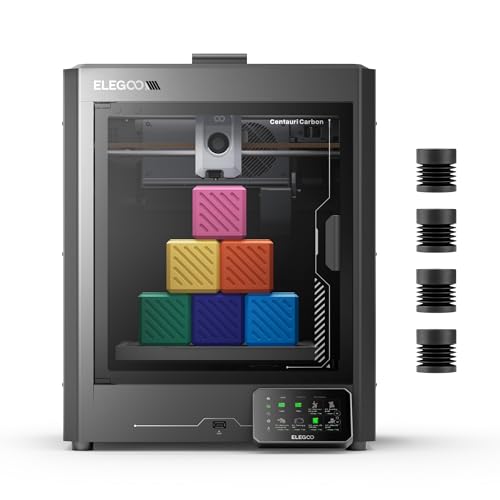
Elegoo Centauri Carbon CoreXY, hardened nozzle, 320C
320C hardened nozzle500 mm/s CoreXYEnclosed chamberAuto calibration
Check price on Amazon
Best for: Buyers who want a ready-to-run enclosed printer that treats carbon fiber filament as a normal material.

The Centauri Carbon is the clearest answer to the carbon fiber question because abrasive filament was designed into the hotend instead of bolted on later. Its nozzle is a hardened steel part rated to 320 degrees, which covers the printing range of PLA-CF, PETG-CF and most nylon carbon blends. The CoreXY gantry moves a light toolhead at up to 500 mm/s, though a fiber-filled filament will never run near that figure because the melt flow, not the motion system, is the limit.

The enclosed chamber keeps drafts off the part and holds in the warmth that nylon blends want to avoid warping. It does not actively heat the chamber, so large flat nylon parts can still curl at the corners, and the Plus4 style heated machines handle those jobs better. Against the Flashforge Adventurer 5M, which tops out at 280 degrees, the Elegoo has 40 degrees more headroom and a nozzle that does not need replacing before the first spool of carbon filament.

Long-term care is mostly about the nozzle and dust. Carbon filament wears a hardened nozzle slowly rather than instantly, so budget a replacement every few kilograms of abrasive spools. Fibers also leave fine black residue around the extruder gear, which needs a brush and compressed air every couple of spools. Keep the printer on a stable shelf, because a 500 mm/s machine will transmit ringing into a wobbly table.

What works

  • Hardened steel nozzle ships standard, no swap needed
  • 320C ceiling covers PETG-CF and many nylon blends
  • Arrives assembled and pre-calibrated for fast starts
  • Enclosed chamber blocks drafts on fiber-filled spools

Watch out for

  • No active chamber heating for big flat nylon parts
  • Fine carbon dust builds up around the extruder gear
  • Single-material out of the box, multicolor needs the later model

Spec sheet

Frame
CoreXY, enclosed
Nozzle
Brass-hardened steel, 320C
Top speed
500 mm/s
Setup
Assembled, pre-calibrated
Best material
PLA-CF, PETG-CF, PA-CF
02
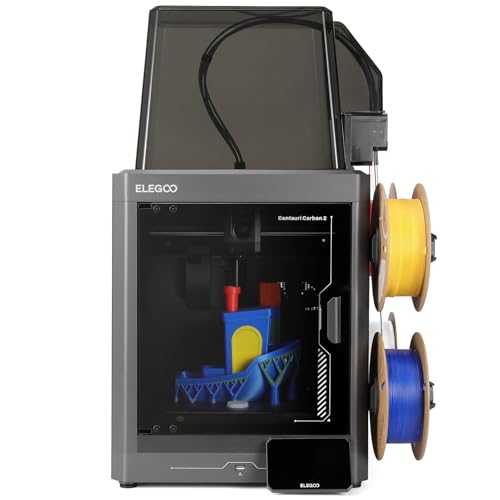
Elegoo Centauri Carbon 2 Combo, 4-color CANVAS
4-color CANVAS500 mm/s CoreXYEngineering-grade readyAuto calibration
Check price on Amazon
Best for: Makers who combine structural carbon fiber parts with colorful cosmetic pieces in the same job.

The second Centauri Carbon keeps the same CoreXY enclosed body and adds the CANVAS system, which feeds four spools into one nozzle. That matters for carbon fiber because many users want a stiff black structural part and a colored cosmetic part in the same print. The listing speaks of engineering-grade materials and automated calibration and monitoring, which fits shops that run mixed jobs.

The tradeoff is complexity. Every filament change in a single-nozzle system sends purge waste through the nozzle, and abrasive composites passing through a feed path with multiple switching points will wear PTFE tubes and gears faster than a straight run. Run the carbon spool on the main direct feed when you can, and let the CANVAS handle plain PLA colors. Next to the original Centauri Carbon, the extra capability costs more and adds more parts to maintain.

In year-three ownership, the thing to watch is the feeding hardware. Keep spools in a dry box, because the CANVAS path can pull moisture through the tubes and nylon blends will bubble. Replace PTFE sections when you see gouges inside, and keep spare nozzles in the drawer. If you never mix colors, the single-extruder sibling is the more sensible machine.

What works

  • Four-spool CANVAS handles color swaps automatically
  • Same fast 500 mm/s CoreXY body as the single model
  • Fully automated calibration and print monitoring
  • Rated for engineering-grade materials in the listing

Watch out for

  • Abrasive filament through a switching feed path wears parts
  • Purge waste rises with every color change
  • More moving parts than the single-extruder Centauri Carbon

Spec sheet

Frame
CoreXY, enclosed
Color system
CANVAS, 4 spools
Top speed
500 mm/s
Calibration
Fully automated
Best material
CF composites, PETG, PLA
03
Bambu Lab P2S Combo with AMS 2 Pro, 600 mm/s
600 mm/sAMS 2 ProAI failure detection15-minute setup
Check price on Amazon
Best for: Buyers who want the smoothest slicer and filament profile experience and are happy to buy a hardened nozzle.

The P2S is the most polished machine here for people who want less tuning and more finished parts. Bambu rates it for 600 mm/s with exceptional accuracy, and its slicer profiles are tuned per filament, which saves the hours of temperature towers other brands expect. AI failure detection watches for spaghetti and stops a bad print before a fiber spool is wasted.

For carbon fiber the important detail is nozzle choice. Bambu sells hardened steel nozzles separately for its abrasive filaments, and the default hotend is not what you want for a spool of PA-CF. Treat the hardened nozzle as a required purchase, the same way you would treat a replacement belt. With that swap, the P2S matches the Elegoo machines on materials and beats them on slicer polish, though the closed ecosystem is a tradeoff if you like open firmware.

As the P1S below it ages, the P2S is the successor most owners will cross-shop. It is the pricier of the two and sits at the top of the cost scale among this lineup. Upkeep is straightforward: clean the purge chute, lubricate the rods on schedule, and keep filament dry. Plan on the nozzle, not the motion system, being your recurring wear item.

What works

  • Mature slicer with tuned profiles for fiber filaments
  • AI failure detection saves expensive spools
  • 600 mm/s motion system with strong frame rigidity
  • Short setup, ready to print in about 15 minutes

Watch out for

  • Hardened nozzle is a separate purchase for abrasive spools
  • Closed ecosystem limits firmware freedom
  • Top of the cost scale in this lineup

Spec sheet

Frame
CoreXY, enclosed
Top speed
600 mm/s
Multi-color
AMS 2 Pro
Setup time
About 15 minutes
Software
Bambu Studio, MakerWorld
04
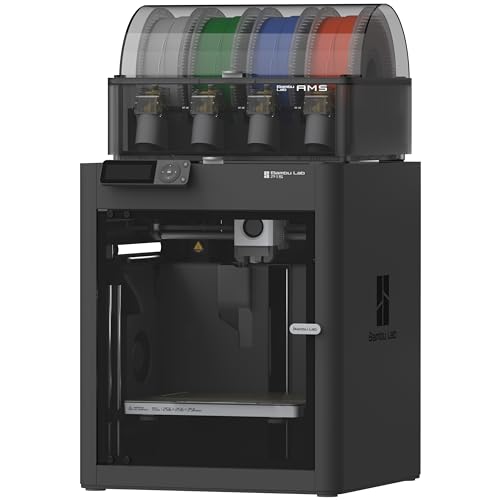
Bambu Lab P1S Combo with AMS, enclosed CoreXY
500 mm/sEnclosed bodyAMS multi-colorAuto bed leveling
Check price on Amazon
Best for: Owners who want a long-established, well-supported enclosed machine and plan to swap in a hardened nozzle.

The P1S has been the default enclosed hobby printer for a while, and its enclosure is why it earns a place in a carbon fiber list. The listing says the closed body improves results with advanced filaments, and any experienced owner will confirm that PETG-CF and nylon blends behave better without room drafts. It prints at 500 mm/s with 20000 mm/s2 acceleration, which is slightly slower than the P2S but still very quick.

Like its newer sibling, the stock hotend needs a hardened steel swap before you run a heavy diet of fibers. The P1S is happy with a few spools of abrasive material if you accept faster wear, yet a hardened nozzle removes that worry for a modest cost. The combo includes the AMS for up to 16 colors, though carbon spools are better run from an external holder for a clean feed path.

What the P1S gives up against the P2S is mostly refinement and some newer sensing. Its track record is longer, so spare parts, community guides and accessories are plentiful, which counts for a lot in year three. Expect to retension belts, clean the gantry rods and replace the nozzle on a regular rhythm.

What works

  • Established enclosed design with a deep parts supply
  • 500 mm/s and 20000 mm/s2 acceleration for quick builds
  • AMS combo gives up to 16 colors on one printer
  • Huge community library of tuned profiles

Watch out for

  • Needs a separate hardened nozzle for fiber filaments
  • No active chamber heating for tricky nylon
  • Slightly behind the P2S on refinement

Spec sheet

Frame
CoreXY, enclosed
Top speed
500 mm/s
Acceleration
20000 mm/s2
Multi-color
AMS, up to 16 colors
Bed leveling
Automatic
05
Flashforge Adventurer 5M, CoreXY, 600 mm/s, 280C
600 mm/s travel20000 mm/s232 mm3/s nozzle3-second nozzle swap
Check price on Amazon
Best for: Budget buyers who want PLA-CF and PETG-CF parts and will buy a hardened nozzle.

The Adventurer 5M is the cheapest machine in this comparison and it is a fast, tidy CoreXY, but it is a carbon fiber printer only if you buy the right nozzle. Its quick-swap system changes a nozzle in about three seconds, which makes keeping a hardened spare in the toolbox convenient. A 32 mm3/s high-flow nozzle and a 35 second warm-up make short work of ordinary PLA jobs.

The limits show up with composites. The hotend tops out near 280 degrees, below the 320 degrees on the Elegoo Centauri Carbon, so high-temperature nylon carbon blends are out of reach. PLA-CF and many PETG-CF spools sit comfortably inside that range, and for those the 5M gives good results for the lowest outlay here. Fiber-filled spools also ask for lower speeds, so ignore the 600 mm/s headline.

Ownership favors people who like tinkering. Keep a stock of hardened nozzles, since abrasive filament wears them, and lubricate the rails on schedule. If you want chamber insulation for nylon, a printer such as the Elegoo or QIDI classes will be a better home. For PLA-CF parts on a tight budget, this is a smart buy.

What works

  • Lowest cost on the list for a fast CoreXY
  • Three-second nozzle swap suits a hardened spare
  • 35 second warm-up speeds up short jobs
  • Large community and straightforward upkeep

Watch out for

  • 280C ceiling rules out hot nylon carbon blends
  • Hardened nozzle must be bought separately
  • Open-top style airflow gives less chamber stability

Spec sheet

Frame
All-metal CoreXY
Top travel
600 mm/s
Acceleration
20000 mm/s2
Nozzle flow
32 mm3/s
Warm-up
About 35 seconds

Spec sheet decoder

What the numbers on the box really mean

The specs manufacturers lead with, translated into what they tell you about real-world performance.

Nozzle material

The metal at the tip decides how long abrasive filament can pass before the bore widens. Hardened steel resists wear but conducts heat less well than brass.

Watch forThe Centauri Carbon ships hardened; the Adventurer 5M and P1S need a swap.

Max hotend temperature

This is the highest nozzle heat the heater and thermistor are rated for. Engineering plastics need more than hobby filaments.

Watch forThe 5M stops near 280C while the Centauri Carbon reaches 320C.

Max travel speed

Travel speed describes empty movement, not printing speed, and it assumes strong acceleration. It rarely applies during extrusion.

Watch forElegoo quotes 500 mm/s, Flashforge and Bambu P2S quote 600 mm/s.

Volumetric flow

This measures how many cubic millimeters of plastic the hotend can melt per second. Fiber-filled spools melt less freely, so flow limits real speed.

Watch forThe Adventurer 5M lists 32 mm3/s, a useful benchmark against the others.

Chamber heating

Passive enclosures only trap heat from the bed, while active chambers add a heater. Active heat reduces warping on large nylon parts.

Watch forNone of these five is a fully heated chamber except in the QIDI class, so test nylon cubes first.

Methodology

How We Evaluated These Carbon Fiber 3D Printers

Abrasive filament readiness

We evaluated whether the stock nozzle path suits carbon fiber or needs a swap, based on spec sheets. The Centauri Carbon scored highest because it ships hardened. The Adventurer 5M and Bambu P1S lost points for needing a purchase.

Temperature headroom

We compared hotend ceilings against the print temperatures of PLA-CF, PETG-CF and nylon carbon blends. Anything at or above 300C earned a clear advantage. The 280C Adventurer 5M sat at the lower edge.

Enclosure and stability

Enclosed bodies earned points because fiber filaments warp in drafty rooms. We gave extra credit for rigid CoreXY frames that keep layers aligned. The P1S and Centauri models led here.

Ownership and spare parts

We looked at nozzle availability, community support and how quickly a worn part can be replaced. Established platforms like the P1S do well. A cheaper machine can still win if spares are easy to get.

Value per capability

We weighed each machine against the others by cost tier. The Adventurer 5M is cheapest, the P2S is priciest. Value meant getting the needed hotend and enclosure without paying for features a carbon fiber user never touches.

Decision guide

How to Choose the Right Carbon Fiber 3D Printers

By Filament Type

SituationPickWhy
PLA-CF and PETG-CF onlyFlashforge Adventurer 5M280C covers these and costs least
Nylon carbon blendsElegoo Centauri Carbon320C hardened nozzle with an enclosure
Mixed fibers and colorsElegoo Centauri Carbon 2 ComboCANVAS adds four spools
Little tuning wantedBambu Lab P2S ComboMature profiles and AI detection
Established platformBambu Lab P1S ComboDeep parts and guide supply

By Budget

SituationPickWhy
Lowest cost tierFlashforge Adventurer 5MFast CoreXY, buy a hardened nozzle
Low to middle tierElegoo Centauri CarbonHardened nozzle included
Middle tier with colorElegoo Centauri Carbon 2 ComboMulti-color without a swap
Upper tierBambu Lab P1S ComboProven enclosed design
Top tierBambu Lab P2S ComboMost refined of the five

Open Ecosystem vs Closed Ecosystem

Closed ecosystem

Bambu Lab machines, the P2S and P1S, tune everything for you through Bambu Studio and the cloud. You get fewer settings to chase, but you depend on one company for firmware and filament profiles.

Open ecosystem

The Flashforge Adventurer 5M and Elegoo Centauri models accept more third-party slicers and community firmware. That freedom costs some polish, and you tune temperatures yourself.

Pick Bambu if you want predictable results; pick Elegoo or Flashforge if you like to tune.

Single Extruder vs Multi-Material

SituationPickWhy
Pure carbon fiber partsElegoo Centauri CarbonStraight feed path, less wear
Colored cosmetic facesElegoo Centauri Carbon 2 ComboCANVAS swaps spools automatically
Up to 16 colorsBambu Lab P1S ComboAMS expands the palette
Support material swapsBambu Lab P2S ComboAMS 2 Pro handles supports
No multi-materialFlashforge Adventurer 5MSimplest hardware

For Functional Brackets Specifically

Look for

Stiff parts such as brackets and jigs need a hot enough nozzle for good layer bonding, a dry spool, and a chamber that avoids warping. Print in nylon carbon or PETG-CF with at least 4 walls.

In this comparison

The Elegoo Centauri Carbon is the best match because its 320C hardened nozzle bonds layers well and the enclosure keeps shrinkage in check. The Bambu P2S matches it after a nozzle swap.

When to Spend More

Spend more if

You print nylon or PA-CF weekly, or sell parts. The Bambu P2S Combo and Elegoo Centauri Carbon 2 Combo reduce failures through monitoring and extra material capability, which saves spool money.

Save if

You print PLA-CF occasionally. The Flashforge Adventurer 5M plus a hardened nozzle handles that at the lowest outlay, and you can upgrade later.

Ownership

Maintenance schedule

The upkeep that decides whether this machine lasts two seasons or ten.

TaskIntervalWhy it matters
Replace the hardened nozzleEvery 2 to 5 kg of abrasive filamentEven hardened steel wears slowly. A widened bore under-extrudes and weakens parts, so check with a test cube.
Clean extruder gearEvery 1 to 2 spoolsCarbon dust packs between the gear teeth. A soft brush and compressed air restore grip and prevent skipped feeding.
Dry filamentBefore every nylon spoolMoisture causes steam bubbles and weak layers. Hold nylon at about 70 degrees for hours in a dryer.
Lubricate linear railsEvery 3 to 6 monthsFine fiber dust can settle on rails. A drop of light oil keeps the gantry smooth and quiet.
Check belts and PTFEEvery 6 monthsLoose belts add ringing, and scored PTFE tubes snag stiff filament. Replace worn pieces early.

FAQ

Frequently Asked Questions

Do I need a hardened nozzle for carbon fiber filament?

Yes, for anything beyond a spool or two. Brass wears quickly under abrasive fibers, which widens the bore and ruins dimensional accuracy. The Elegoo Centauri Carbon includes a hardened part, while others need a swap.

Is a cheaper printer enough for PLA-CF?

Often yes. The Flashforge Adventurer 5M handles PLA-CF and many PETG-CF spools once fitted with a hardened nozzle. Nylon blends need higher temperatures and a better enclosure.

Are these printers a good first machine?

The Bambu and Flashforge machines suit beginners, but carbon fiber adds wear costs and dust. Start with PLA, then step up to fibers once first-layer habits are solid.

Does carbon fiber filament make parts as strong as real carbon fiber?

No. Chopped fibers stiffen plastic and improve dimensional stability, but layer adhesion is still the weak point. Continuous fiber laminate is a different, much stronger process.

Is carbon fiber dust a health concern?

Printing releases few fibers, but sanding printed parts creates fine dust. Wear a respirator and eye protection when sanding, and vacuum the printer rather than blowing dust into the room.

Why does my 600 mm/s printer print carbon fiber slowly?

Headline speed refers to travel moves. Fiber-filled filament melts less freely, so volumetric flow, not motion speed, becomes the cap. Slow outer walls also improve surface finish.

Bottom line

The short version

Browse more carbon fiber 3d printerson Amazon →
James Miller, Lead Machine Editor

About the author

James Miller

Lead Machine Editor, MachineFanatic

James Miller leads MachineFanatic's buying guides, turning spec sheets, manuals and owner feedback into clear verdicts on power tools, outdoor power equipment, shop machines and kitchen machines.

More from James →

Keep reading

Related guides