
Amazon affiliate links - we earn a commission.Affiliate disclosure

Buying guide · 13 min read · Updated 2026-11-07

Best Carbon Monoxide Detectors for Generator Safety (2026)

Generator exhaust kills quietly. Six carbon monoxide alarms compared on battery backup, display, gas detection and which ones keep working in a power outage.

James MillerBy James MillerLead Machine Editor6 machines comparedSpec-sheet verified
Best Carbon Monoxide Detectors for Generator Safety

At a glance

Our top picks

Side by side

Spec comparison

Generators run when the power is out, which is exactly when families seal up the house against the cold. The engine produces carbon monoxide that has no smell, no color and no early warning, and it collects fast in garages, basements and enclosed shelters.

An alarm is a backup layer, not a plan. The useful questions are whether it keeps working without mains power, whether it shows a reading before the siren, where it can be mounted, and how soon it tells you to replace it.

Before you buy

6 Criteria to Look For Before Buying a Carbon Monoxide Detector for Generator Safety

  1. 01

    Power source and outage behavior

    A plug-in alarm without a backup battery fails exactly when you need it, during a blackout with a generator running. The Kidde and First Alert plug-ins include AA or 9 volt backup. Battery-only units such as the Kidde AA alarm and First Alert combination alarm work in any room and any outage.

  2. 02

    Digital display and readings

    An alarm that only sounds at the trigger level tells you nothing about a slow leak. A display, as on the Kidde COPD model, lets you see levels rising before the siren. That helps you find which appliance or generator exhaust path is leaking into the house.

  3. 03

    Placement and coverage

    Install an alarm on every level and outside every sleeping area, following the manual's height guidance. Keep alarms away from fuel-burning appliances and from very humid rooms. A single 85 decibel alarm in the hall may not wake a child behind a closed door.

  4. 04

    Sensor life and end-of-life

    Electrochemical sensors wear out in about 5 to 10 years, and cheap alarms may not warn you. Look for an end-of-life notice, as on the First Alert SMCO100. Write the install date on the back and replace the whole alarm when due.

  5. 05

    Gas and smoke add-ons

    A combined CO and explosive gas alarm, like the Kidde plug-in, covers propane and natural gas leaks that a CO sensor misses. A combo smoke and CO unit covers fire as well. Combos have a single end-of-life date and fewer details.

  6. 06

    Standards and listing

    Residential CO alarms are built to the UL 2034 standard, which sets alarm response times at defined ppm levels. Look for a listing mark on the package. A portable inspection tool may follow different rules and should not replace a listed alarm.

Detailed reviews

The 6 best carbon monoxide detectors for generator safety, explained

01
Kidde plug-in CO alarm, backlit display, 2 AA backup
Backlit CO display85 dB alarm2 AA backupRotating plug
Check price on Amazon
Best for: Households that run a portable generator in outages and want a live CO reading with battery backup.

This Kidde plug-in alarm is the best match for a generator household because it does two things most alarms do not. A backlit display shows the CO level in the room, so you can notice a slow rise long before the siren. Its two AA backup batteries, included in the box, keep it protecting the house when a storm takes out the power and you start the generator.

The 85 decibel alarm is loud enough to wake a sleeper in the same room, but it is not a house-wide system, so place alarms near sleeping areas and on every level. The rotating plug lets you orient the display upright on any outlet, and the compact body makes it usable in a hotel room, a cabin or a rental. Compared with the First Alert CO606, the Kidde adds a live reading and uses common AA batteries instead of a 9 volt.

Upkeep is light. Test it monthly with the button, replace the batteries each year and watch the end-of-life notice. Keep the vents clear of dust and avoid placing it directly beside a fuel-burning appliance. A display lets you spot when a gas appliance or a generator exhaust is entering the house.

What works

  • Backlit display shows live CO levels
  • 2 AA backup batteries included
  • Rotating plug fits any outlet orientation
  • Compact enough to travel with

Watch out for

  • 85 dB siren does not cover a whole house
  • Needs an outlet for primary power
  • Sensor has a limited life and needs replacing

Spec sheet

Power
120V plug-in with 2 AA backup included
Alarm
85 dB
Display
Backlit, shows CO level
Plug
Rotating
Travel
Compact and travel-ready
02
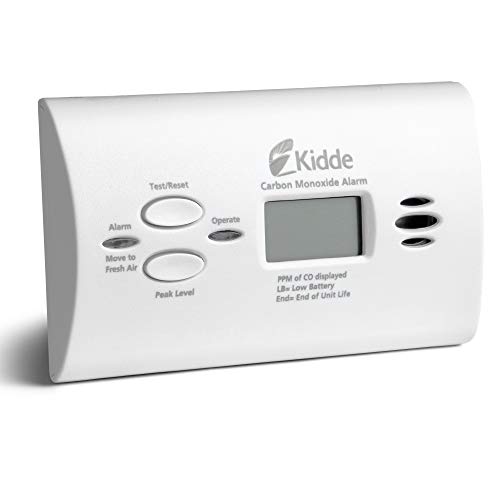
Kidde AA battery CO alarm with LEDs, test and reset button
2 AA batteriesElectrochemical sensorTest/reset buttonNo wiring
Check price on Amazon
Best for: Tents, sheds, workshops and any room without an outlet where a generator might be near.

The Kidde AA battery alarm is the simplest and cheapest way to cover a room with no outlet. It runs on two AA batteries, uses an electrochemical sensor, and mounts on a wall or sits on a tabletop. It does not depend on mains power, which makes it a natural choice for a tent, a workshop, a camper or the middle of a garage where an outlet is far away.

The tradeoff is information. You get lights and a siren, but no number, so you only know when levels reach the alarm point. It also relies on you to replace batteries, and a low battery indicator tells you when. Compared with the plug-in Kidde with a display, it offers fewer details, though it keeps working in any room and costs less.

Ownership means keeping a stock of AA batteries and testing monthly. Place it at sleeping height in a tent or RV, and keep it away from damp or dusty spots. This one is a good second alarm in a room where the generator's power cord enters the house.

What works

  • Battery power works anywhere
  • Electrochemical sensor with test and reset button
  • Low battery indicator warns before it dies
  • Wall or tabletop placement

Watch out for

  • No numeric display
  • Batteries need regular replacement
  • Siren only, no peak memory

Spec sheet

Power
2 AA batteries included
Sensor
Electrochemical
Indicators
LEDs and low battery indicator
Mounting
Wall or tabletop
Power outage
Keeps operating on batteries
03
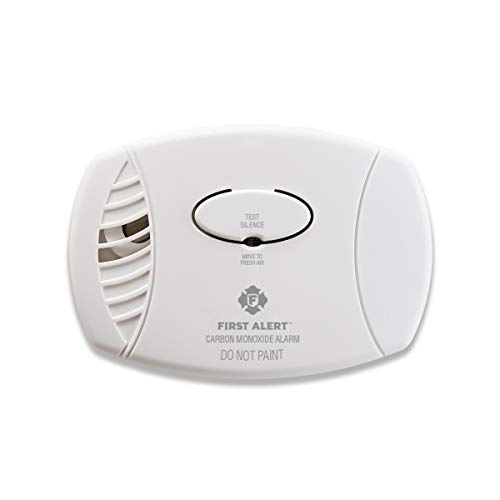
First Alert CO606 plug-in CO alarm, 9V backup, 85 dB
Plug-in, 9V backup85 dB alarmElectrochemical sensorSingle test button
Check price on Amazon
Best for: Budget-minded households that want a simple plug-in alarm with battery backup.

The First Alert CO606 is a straightforward plug-in alarm with a 9 volt battery backup. It uses an electrochemical sensor, plugs into any standard outlet and sounds an 85 decibel alarm when carbon monoxide reaches alarm levels. A single button handles test and silence, which makes it easy to use in an emergency.

Its strength is simplicity and a low cost tier among plug-in alarms. Its weakness is that it has no display, so you cannot see a gradual rise. The 9 volt backup keeps it going through an outage, but you must keep a fresh battery in the compartment, since a dead 9 volt turns a plug-in alarm into a decoration during a blackout. Against the Kidde with a backlit display, it is simpler and gives less information.

Ownership requires monthly tests, a new 9 volt battery each year and replacement of the whole alarm at the end of its sensor life. Place one in the hall near bedrooms and another on each level. It suits people who want a no-fuss alarm and a low price.

What works

  • Plug-in with 9V battery backup
  • Electrochemical sensor
  • One button for test and silence
  • Low cost tier

Watch out for

  • No display for live readings
  • 9V backup battery must be maintained
  • Sensor wears out and needs full replacement

Spec sheet

Power
Standard outlet with 9V backup
Alarm
85 dB
Sensor
Electrochemical
Controls
Single test and silence button
Placement
Any standard outlet
04
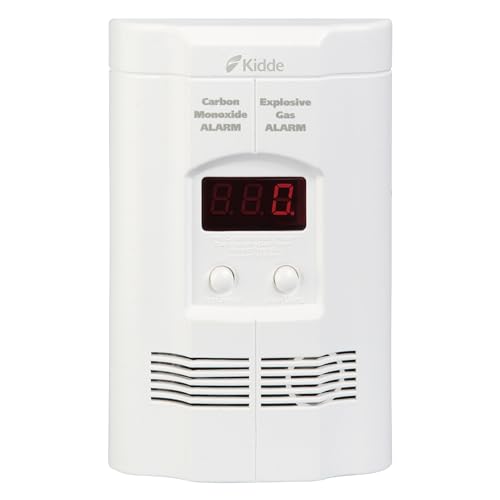
Kidde CO plus explosive gas alarm, natural gas and propane
CO plus gasDigital display9V backupPlug-in
Check price on Amazon
Best for: Homes and RVs with propane or natural gas appliances alongside a generator.

This Kidde alarm watches for two different hazards in one plug-in unit. It senses carbon monoxide and explosive gas, meaning natural gas and propane, and a digital LED display shows the CO level or the word GAS when an explosive gas is detected. A 9 volt backup keeps it running during a power outage.

For a generator household, that combination is useful when the generator runs on propane or when the house also has propane or natural gas appliances. A propane leak at a bottle or a regulator will not trip a CO alarm, but this unit has a separate gas sensing path. The cost is complexity: two sensors age at different rates, and false gas alarms from cleaning fumes or aerosols can occur. Compared with the simpler Kidde models, it covers more hazards and costs more.

Ownership means testing the unit monthly, replacing the 9 volt battery annually and moving it away from kitchen sprays. Mount it at the right height for each gas, since propane sinks and natural gas rises, and follow the manual. It is a strong choice for RVs, cabins and homes with gas appliances.

What works

  • Detects CO and explosive gas in one unit
  • Digital display shows CO level or GAS
  • 9V backup covers outages
  • Useful with propane generators and appliances

Watch out for

  • Gas sensor can trip on cleaning fumes
  • 9V backup battery needs upkeep
  • Higher cost tier than CO-only alarms

Spec sheet

Detects
Carbon monoxide, natural gas and propane
Display
Digital LED, shows CO level or GAS
Power
120V plug-in with 9V backup
Alarm
85 dB
Use
Home, garage-adjacent rooms, RV
05
First Alert SMCO100 battery smoke and CO combination alarm
Smoke plus COBattery poweredPrecision detectionEnd-of-life warning
Check price on Amazon
Best for: Bedrooms and hallways where you want smoke and CO coverage in one battery unit.

The SMCO100 combines a smoke alarm and a CO alarm in one battery-powered unit. For a generator household, that is a practical way to cover bedrooms without doubling the number of devices on the ceiling. First Alert says its Precision Detection technology complies with current industry standards to reduce nuisance alarms from cooking.

The combination has a tradeoff. The two sensors have different lives, and the unit has a single replacement date set by the shorter one. An end-of-life warning tells you when to replace it. It also has no readout, so against the Kidde AA alarm it adds smoke detection for a higher cost tier.

Ownership is routine. Test monthly, replace batteries as directed and clean the vents gently. Install according to the smoke alarm placement rules, which differ from CO guidance, so read the manual. It counts as a good way to upgrade bedrooms without wiring.

What works

  • Smoke and CO in one device
  • Battery power works through outages
  • Precision Detection reduces cooking nuisance alarms
  • End-of-life warning tells you when to replace

Watch out for

  • No numeric CO display
  • One replacement date for two sensors
  • Higher cost tier than a CO-only alarm

Spec sheet

Detects
Smoke and carbon monoxide
Power
Battery
Sensing
Precision Detection to reduce cooking nuisance alarms
End of life
Warning when replacement is due
Use
Ceiling or wall in bedrooms and halls
06
TOPTES CT-580 portable rechargeable CO detector, 3 alarm modes
RechargeableLight, sound, vibrationPortableManual inspection
Check price on Amazon
Best for: Workers, campers and inspectors who want a rechargeable handheld CO detector with vibration alerts.

The TOPTES CT-580 is a portable carbon monoxide detector rather than a fixed alarm. It is rechargeable and offers three alarm modes: an indicator light, an audible alarm and vibration. The listing describes it as a manual inspection tool that is ready to use out of the box for personal or business needs.

A portable detector shines for spot checks. You can carry it into a garage, a shed or a camper to check for CO near a generator, a heater or a stove, and the vibration alert helps in noisy places. It is not a substitute for a fixed alarm at the bedside, because it is not designed to sit powered on all night in every room. Compared with the Kidde plug-in with a display, it is better for inspection and worse for continuous protection.

Ownership means keeping it charged and storing it in a clean place. Recharge it before a trip, check it against fresh air and replace it if it stops responding. It is a sensible add-on for people who work around engines, run generators on job sites or camp.

What works

  • Rechargeable with no batteries to buy
  • Light, sound and vibration alarms
  • Handheld and easy to carry
  • Ready to use out of the box

Watch out for

  • Not a substitute for a fixed bedside alarm
  • Needs recharging to stay ready
  • Less proven than the major brands

Spec sheet

Power
Rechargeable battery
Alarm modes
Indicator light, audible alarm, vibration
Form
Handheld portable detector
Use
Personal and business inspection
Setup
Ready out of the box

Spec sheet decoder

What the numbers on the box really mean

The specs manufacturers lead with, translated into what they tell you about real-world performance.

Alarm volume (dB)

The siren loudness measured at a set distance. A louder alarm helps wake sleepers.

Watch forThe Kidde and First Alert plug-ins list 85 dB.

Backup battery type

The battery that powers the alarm in an outage. AA batteries are easy to find, and 9 volt batteries need regular replacement.

Watch forThe Kidde COPD uses 2 AA and the First Alert CO606 uses a 9V.

Sensor type

Electrochemical sensors react to CO and are the common residential type. They have a limited life.

Watch forThe CO606 and Kidde AA alarm list electrochemical sensors.

Display

A readout showing CO parts per million. It reveals low-level leaks.

Watch forKidde lists a backlit display on its COPD plug-in and a digital LED on its gas model.

End-of-life warning

A signal that the sensor is exhausted. It prevents you from relying on a dead alarm.

Watch forThe First Alert SMCO100 lists an end-of-life warning.

Methodology

How We Evaluated These Carbon Monoxide Detectors for Generator Safety

Outage reliability

We scored alarms on how they behave when mains power is lost. Battery backup or battery-only power earned the top marks. The Kidde and First Alert models all offer it.

Information and display

We valued live readouts that reveal slow leaks. The Kidde COPD and gas models include displays, while the CO606 and Kidde AA do not.

Hazard coverage

We looked at whether an alarm adds gas or smoke detection. The Kidde gas alarm and First Alert combo gain from that.

Ease of installation

We favored simple plug-in or wall mounting. The rotating plug on the Kidde COPD helps, and battery alarms install anywhere.

Ownership and replacement

We weighed battery type, end-of-life warnings and cost tier. The Kidde AA is the cheapest and the Kidde gas model the most capable.

Decision guide

How to Choose the Right Carbon Monoxide Detectors for Generator Safety

By Where the Alarm Goes

SituationPickWhy
Bedroom hall near outletKidde COPD plug-inDisplay and AA backup
Tent, shed or camperKidde AA battery alarmNo outlet needed
Basic plug-inFirst Alert CO606Simple and low cost
Gas appliances nearbyKidde CO plus gas alarmDetects propane and natural gas
Bedroom ceilingFirst Alert SMCO100Smoke and CO combo

By Budget

SituationPickWhy
Lowest cost tierFirst Alert CO606Plug-in with 9V backup
Low cost tierKidde AA battery alarmBattery only
Middle tierKidde COPD plug-inDisplay and AA backup
Upper middle tierFirst Alert SMCO100Smoke plus CO
Highest tierKidde CO plus gas alarmTwo hazards in one

Plug-In With Backup vs Battery-Only

Plug-in with backup

The Kidde COPD and First Alert CO606 draw mains power and use batteries in outages. They never need a battery change for normal use, but they only mount where an outlet exists.

Battery-only

The Kidde AA alarm and First Alert SMCO100 run on batteries and mount anywhere. They need battery replacement on schedule and keep working through any outage.

Choose plug-in for hallways; choose battery-only for rooms without outlets.

Fixed Alarm vs Portable Detector

SituationPickWhy
All-night bedroom protectionKidde COPD plug-inAlways on with display
Spot check of a garageTOPTES CT-580Handheld and rechargeable
Noisy job siteTOPTES CT-580Vibration alarm
Camper at nightKidde AA battery alarmBattery fixed alarm
Smoke and CO at onceFirst Alert SMCO100Combo alarm

For Portable Generator Use Specifically

Look for

Battery backup, a display and an alarm in every sleeping area. Keep the generator at least 20 feet from the house with exhaust pointing away, because an alarm is only the last defense.

In this comparison

The Kidde COPD plug-in with display and AA backup is the best fit, with the Kidde AA alarm as a second alarm in rooms without outlets.

When to Spend More

Spend more if

You have gas appliances, an RV or a propane generator. The Kidde CO plus gas alarm and First Alert combination alarm cover more hazards.

Save if

You need extra coverage in many rooms. The Kidde AA battery alarm and First Alert CO606 are the lowest cost tiers.

Ownership

Maintenance schedule

The upkeep that decides whether this machine lasts two seasons or ten.

TaskIntervalWhy it matters
Press the test buttonMonthlyA test confirms the horn and circuit work. It does not prove the sensor is fresh, so also watch the end-of-life date.
Replace backup batteriesYearlyA dead backup battery defeats a plug-in alarm in an outage. Swap on a fixed date.
Vacuum or brush the ventsEvery 6 monthsDust can block the sensor. Use a soft brush, never sprays.
Replace the alarmAt end of life, typically 5 to 10 yearsSensors wear out. Write the install date on the back and replace on time.
Recharge the portable detectorBefore every useA dead battery gives no protection. Top up before trips and jobs.

FAQ

Frequently Asked Questions

Is a CO alarm enough to run a generator near the house?

No. Run the generator outdoors at least 20 feet from the house with exhaust pointing away from windows and doors, and never in a garage. The alarm is only a backup.

Where should I put CO alarms for generator use?

On every level and outside each sleeping area, following the manual's height guidance. Add one in the room where the generator's cord enters, and one in any tent or camper.

Do plug-in CO alarms work in a blackout?

Only if they have battery backup. The Kidde COPD and First Alert CO606 include it, but you must keep fresh batteries.

How long do CO alarms last?

Typically 5 to 10 years. Check the end-of-life date on the back and replace the whole unit.

What should I do if the alarm sounds?

Get everyone outside to fresh air, call emergency services and do not re-enter until it is cleared. Shut down the generator only if you can do it safely.

Can a gas alarm replace a CO alarm?

No. A natural gas or propane sensor detects explosive gas, not carbon monoxide. The Kidde combo alarm has both, but you still need CO protection.

Bottom line

The short version

Browse more carbon monoxide detectors for generator safetyon Amazon →
James Miller, Lead Machine Editor

About the author

James Miller

Lead Machine Editor, MachineFanatic

James Miller leads MachineFanatic's buying guides, turning spec sheets, manuals and owner feedback into clear verdicts on power tools, outdoor power equipment, shop machines and kitchen machines.

More from James →