

Amazon affiliate links - we earn a commission.Affiliate disclosure

Buying guide · 14 min read · Updated 2026-11-06

Best Coffee Makers with Grinders (2026)

Five coffee makers with built-in grinders compared by burr versus blade design, grind control, cleaning effort and brew style, from drip to espresso.

James MillerBy James MillerLead Machine Editor5 machines comparedSpec-sheet verified
Best Coffee Makers with Grinders

At a glance

Our top picks

Side by side

Spec comparison

MachineGrinderTimer
Breville BDC650 Grind Control Thermal CarafeBest Overall Grind and BrewBreville BDC650 Grind Control Thermal CarafeStainless steel burrs, adjustableProgrammable auto start
Cuisinart DGB-400 12 Cup Grind and BrewBest ValueCuisinart DGB-400 12 Cup Grind and BrewBlade, with grind-off for pre-ground24 hour programmable
Ninja Luxe Cafe Premier ES601 3 in 1 MachineBest for Espresso and Milk DrinksNinja Luxe Cafe Premier ES601 3 in 1 MachineBuilt-in conical burr, 25 settingsn/a
Breville BES870XL Barista Express Espresso MachineBest for Learning EspressoBreville BES870XL Barista Express Espresso MachineIntegrated conical burr, dose controln/a
Gevi 10 Cup All in One Grind and Brew with Burr GrinderBest Budget Burr DripGevi 10 Cup All in One Grind and Brew with Burr GrinderBurr, 8 settings and 3 strength levels24 hour programmable

A coffee maker with a built-in grinder promises fresh grounds at the press of a button, and the appeal is real: coffee begins losing aroma within minutes of grinding. The difficulty is that the grinder and brewer share one body, one footprint and one cleaning routine, so the weakest part limits the whole machine.

This guide explains how burr and blade grinders differ, why grind consistency matters more than any feature on the box, and how drip and espresso machines in this category differ in daily effort. The top picks are above, and the reviews below show which machine suits which kitchen.

Before you buy

6 Criteria to Look For Before Buying a Coffee Maker with Grinders

  1. 01

    Burr Versus Blade Grinder

    A burr grinder crushes beans between two abrasive surfaces set a fixed distance apart, so particles come out in a narrow size range, while a blade chops randomly, producing both dust and boulders. Uneven grounds extract unevenly: dust turns bitter and boulders turn sour. Drip with a paper or mesh filter hides some of this, which is why a blade is acceptable for casual drip. In this lineup the Breville BDC650 and Gevi use burrs, the Ninja Luxe and Breville Barista Express use conical burrs, and only the Cuisinart DGB-400 uses a blade.

  2. 02

    Grind Adjustment Range

    The number of settings matters most when you change brew style. Drip needs a medium grind and tolerates a coarse range, but espresso needs a fine grind with small steps, because a small change flips a shot from fast and sour to slow and bitter. The Ninja Luxe offers 25 grind settings and the Gevi 8, while the Barista Express uses a size dial. A common mistake is assuming more steps always help: for pure drip, 8 settings is plenty, and for espresso you want finer increments.

  3. 03

    Cleaning Effort and Stale Oil

    Ground coffee leaves oils that turn rancid and flavor the next batch, and a grinder inside a brewer is hard to reach. Burr grinders have more parts to clean but collect less loose dust, and manufacturers typically suggest cleaning more often if you use dark, oily roasts. The Cuisinart DGB-400 needs wiping of a dust-prone blade chamber, while the Ninja Luxe adds a milk system and puck drawer. Plan for a weekly brush and a descale on the schedule in the manual, or you will taste last week's beans.

  4. 04

    Carafe and Keep-Warm Method

    Heat damages brewed coffee: a warming plate keeps it hot but slowly cooks it, while a thermal carafe holds temperature without direct heat. The Breville BDC650 brews into a thermal carafe, and the Gevi and Cuisinart use glass carafes on warming plates. If you drink one cup right after brewing, this does not matter. If you sip over two hours, a thermal carafe is worth more than a fancier grinder.

  5. 05

    Brew Style and Daily Effort

    Drip machines like the Breville BDC650, Cuisinart DGB-400 and Gevi make a pot with a single button, while the Ninja Luxe and the Barista Express make espresso and need steps, from dosing to milk. Decide whether you drink drip all day or want lattes, because buying an espresso machine for black coffee adds effort without benefit. The Ninja Luxe automates the hard steps, and the Barista Express keeps them manual for control.

  6. 06

    Counter Footprint and Height

    Combo machines are tall because the grinder and hopper sit above the brew basket. The Gevi is about 12 by 8 by 17 inches, and measuring cabinet clearance before buying prevents a frequent return. Remember you also need room to open the lid and fill the hopper, plus a water tank you can slide out. Espresso machines such as the Barista Express and Ninja Luxe need extra counter depth for the portafilter and a drip tray.

Detailed reviews

The 5 best coffee makers with grinders, explained

01
Breville BDC650 Grind Control Thermal Carafe
Stainless burrsThermal carafeLCD displayAuto start
Check price on Amazon
Best for: Drip drinkers who want real burr grinding and a thermal carafe in one machine.

The BDC650 is the one machine here built around the grinder first. It uses stainless steel burrs, which crush beans between two surfaces rather than chopping them, so particle size is far more uniform than from a blade. Uniform grounds matter because fine particles over-extract into bitterness while large ones under-extract into sourness, and a burr set narrows that spread. You can adjust the grind output for the bean and roast, and an LCD shows the setting, grind time and number of cups.

It brews into a thermal carafe, so the coffee stays hot without a warming plate scorching it, which is a real advantage over the Gevi and Cuisinart that use heated plates. Its Steep and Release approach, which holds water on the grounds before dripping, and its temperature control aim for a steadier extraction than a plain drip machine. You also get a programmable auto start. Against the Cuisinart DGB-400, it gives you a better grinder and a better carafe, at the cost of a higher price tier.

Ownership takes some discipline. Burr chambers collect oily residue, especially with dark roasts, so brush the burrs and chute regularly and descale the water path on the maker's schedule. The grinder drops grounds directly into the brew basket, so a stray bean skipping a cleaning is felt in the cup. If drip is how you drink coffee and you want one counter appliance, this is the strongest all-rounder.

What works

  • Stainless burrs give more uniform grounds than a blade
  • Thermal carafe holds heat without a warming plate
  • Adjustable grind lets you match bean and roast
  • LCD shows grind setting and cups at a glance

Watch out for

  • Burr chamber needs regular brushing to avoid stale oil
  • Higher price tier than the Cuisinart DGB-400
  • Fixed footprint, tall for under-cabinet spaces

Spec sheet

Grinder
Stainless steel burrs, adjustable
Carafe
Thermal, brews into a travel mug too
Brew method
Drip with Steep and Release
Display
LCD showing grind setting and cups
Timer
Programmable auto start
Water temperature
Controlled from start to finish
02
Cuisinart DGB-400 12 Cup Grind and Brew
Blade grinder12 cup24 hr timerGold-tone filter
Check price on Amazon
Best for: Casual drip drinkers who want fresh grinding at a modest cost.

The DGB-400 is the plain, affordable way to get beans into the machine without a separate grinder. Its grinder is a spinning blade, not a burr set: the blade chops beans at random, leaving a mix of fine dust and larger chunks. A paper or permanent filter in a drip machine smooths over part of that inconsistency, which is why blade grinders are acceptable for casual drip, but the cup will taste less clean than from the Breville BDC650.

Its conveniences are practical. A grind-off switch lets you brew pre-ground coffee, a 1 to 4 cup setting handles small batches, and a 24 hour timer starts the machine before you wake. A permanent gold-tone filter and a charcoal water filter cut paper waste and improve water taste. The carafe is glass on a warming plate, so the last cups in a pot can taste cooked, a drawback compared with the Breville's thermal carafe. Cup sizing is the usual drip convention of about 5 ounces, so a 12 cup pot is closer to 60 ounces.

Cleaning is the weak point of any blade-and-brew combo, because ground coffee dust gets into the blade chamber. Wipe the chamber after each use, replace the charcoal filter on schedule and descale periodically. If you want the lowest-effort path to fresh-ground drip and are not fussy about grind quality, it works. If you care about flavor, move up.

What works

  • Grind-off switch lets you brew pre-ground coffee
  • 1 to 4 cup setting suits small batches
  • Permanent gold-tone filter cuts paper waste
  • 24 hour timer for a ready pot in the morning

Watch out for

  • Blade grinder gives uneven grounds and some dust
  • Glass carafe on a warming plate can scorch the last cups
  • Chamber needs wiping because grounds fly around

Spec sheet

Grinder
Blade, with grind-off for pre-ground
Capacity
12 cups (about 5 oz each)
Timer
24 hour programmable
Small batch
1 to 4 cup setting
Filters
Permanent gold-tone plus charcoal water filter
Extras
Brew pause
03
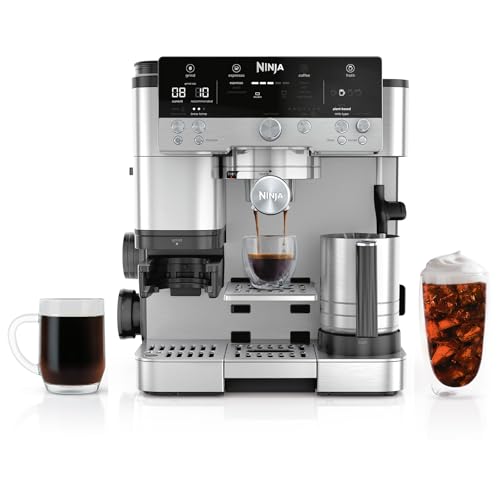
Ninja Luxe Cafe Premier ES601 3 in 1 Machine
Conical burr grinder25 grind settingsEspresso, drip, cold brewAuto frother
Check price on Amazon
Best for: Beginners who want lattes, espresso and drip from one guided machine.

The Ninja Luxe is the most versatile machine in the lineup, with espresso, drip and cold brew from a single body. A conical burr grinder with 25 settings feeds an espresso group head, and its Barista Assist system uses weight-based dosing and assisted tamping to take the guesswork out of the part where beginners usually fail: dose and tamp pressure. Espresso needs a much finer, more precise grind than drip, so the number of settings matters here in a way it does not on a drip maker.

The dual froth system combines a spinning whisk with an automatic steamer so you pour milk, pick a style and walk away. That is a real convenience for lattes and cappuccinos compared with the Breville Barista Express, which has a manual steam wand that rewards skill. It also does cold pressed espresso, which brews at lower temperature and pressure for a smoother cup, and drip and cold brew in several sizes. As a drip machine, it is less direct than the Breville BDC650, because the machine is built around single servings and small batches.

Ownership means more parts to clean: a milk system, a water reservoir, a puck drawer and the grinder. Descale on a schedule and wipe the frother after every milk drink, or it fouls quickly. It is the right choice if you want café drinks at home without learning technique, and too much machine if you only drink black drip coffee.

What works

  • Conical burr grinder with 25 settings covers espresso fineness
  • Weight-based dosing and assisted tamping guide beginners
  • Automatic frothing handles milk without a steam wand
  • One machine covers espresso, drip and cold brew

Watch out for

  • More parts to clean than a simple drip maker
  • Single-serve focus means less efficient for a full pot
  • Large footprint for small counters

Spec sheet

Grinder
Built-in conical burr, 25 settings
Espresso styles
Double shot or quad shot
Drip styles
Classic, rich, over ice
Cold brew
Cold pressed espresso or cold brew coffee
Milk system
Spinning whisk with automatic steamer
Guidance
Barista Assist with weight-based dosing and assisted tamping
04
Breville BES870XL Barista Express Espresso Machine
Conical burr grinderDose controlPID temperatureSteam wand
Check price on Amazon
Best for: Hobbyists who want to learn espresso with a built-in grinder and manual steaming.

The Barista Express is the enthusiast-leaning machine here: an espresso maker with an integrated conical burr grinder that doses straight into the portafilter. You control the grind with a size dial and the dose, so you can dial in fineness for the roast and the day's humidity. The grind is the most important variable in espresso, and having the grinder attached means the grounds arrive fresh, with little mess between grinding and tamping.

Two engineering details help consistency. Digital PID temperature control holds water at a steady temperature, because espresso extraction is sensitive to a few degrees, and low pressure pre-infusion ramps pressure at the start so water saturates the puck evenly before full extraction. Milk is handled by a manual steam wand, which makes real microfoam and latte art possible but demands practice, unlike the Ninja Luxe's automatic frother. It makes no drip coffee, so it is not a drip replacement like the Breville BDC650.

Ownership centers on routine: purge the steam wand after every use, backflush and descale on schedule, and clean the grinder and hopper. Expect a learning curve of several days to dial in shots. It is a rewarding machine for someone who wants to learn, and a frustrating one for someone who wants one-button convenience.

What works

  • Integrated conical burr grinder doses straight to the portafilter
  • PID temperature control holds a steady brew temperature
  • Manual steam wand produces real hand-textured microfoam
  • Grind size dial and dose control allow real tuning

Watch out for

  • No drip coffee function, espresso only
  • Learning curve before shots taste right
  • Needs regular backflush and steam wand purging

Spec sheet

Grinder
Integrated conical burr, dose control
Grind adjustment
Grind size dial
Temperature
Digital PID regulation
Extraction
Low pressure pre-infusion
Milk
Manual steam wand for hand-textured microfoam
Output
Espresso, lattes, cappuccinos
05
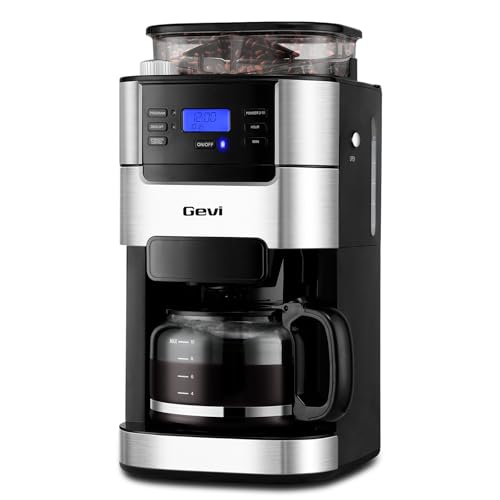
Gevi 10 Cup All in One Grind and Brew with Burr Grinder
Burr grinder8 grind settings2 to 10 cups1.5 L tank
Check price on Amazon
Best for: Budget buyers who want a burr grinder inside a simple drip machine.

The Gevi is a drip grind-and-brew machine that puts a burr grinder in a lower-tier body. It offers eight grind settings and three strength levels, and a 2 to 10 cup range, so you can set how many cups you want and how strong. Even a modest burr set beats a blade for uniformity, so in principle you get a more even extraction than from the Cuisinart DGB-400 at a similar tier.

The practical details are what you would expect from the category. A 24 hour timer, a reusable filter you rinse rather than replace, a 1.5 liter tank and a warming plate keep it simple. The warming plate means the coffee sits on a heated surface instead of a thermal carafe like the Breville BDC650, so drink it soon. A pre-brew extraction step wets the grounds first, a technique that helps release gases before the main brew. Its footprint is about 12 by 8 by 17 inches, so measure your cabinet clearance before buying.

A new brand with limited track record means build quality is a question, and a shorter service history means you should keep your receipt. Clean the burr chamber and the reusable filter regularly, and descale. It is a reasonable choice if your priority is a burr grinder at a lower cost, but it is not the match of a better-established machine for durability.

What works

  • Burr grinder grinds more evenly than a blade
  • 8 grind settings and 3 strength levels give control
  • 2 to 10 cup range handles small and large batches
  • Reusable filter avoids paper and is easy to rinse

Watch out for

  • Warming plate instead of a thermal carafe
  • Newer brand with a shorter durability record
  • Tall body needs cabinet clearance measured first

Spec sheet

Grinder
Burr, 8 settings and 3 strength levels
Capacity
2 to 10 cups
Water tank
1.5 liters
Timer
24 hour programmable
Filter
Reusable
Dimensions
12.36 x 8.38 x 16.93 inches

Spec sheet decoder

What the numbers on the box really mean

The specs manufacturers lead with, translated into what they tell you about real-world performance.

Grind settings

This is the number of distinct burr spacings the grinder offers, from fine to coarse. Each step changes particle size, which changes extraction. More steps give finer control, especially for espresso.

Watch forA number of settings says nothing about burr quality. The Ninja Luxe lists 25 settings and the Gevi 8, but a steel burr set with fewer steps can still grind more evenly than a loosely built one.

Cups (12 cup, 10 cup)

A drip machine cup is about 5 ounces, not a standard 8 ounce cup. A 12 cup machine therefore makes about 60 ounces, enough for roughly 7 or 8 mugs.

Watch forThe Cuisinart DGB-400 says so in a footnote. Do not expect 12 full mugs, and note that a small batch brewed in a large machine often tastes weaker.

Conical burr

A conical burr set has a cone-shaped inner burr inside a ring. It grinds with less heat and noise than flat burrs and clears grounds efficiently. It is standard in home espresso grinders.

Watch forBoth the Ninja Luxe and the Barista Express use conical burrs. Do not assume one conical set equals another, since burr material and alignment vary.

PID temperature control

A PID controller measures water temperature and adjusts the heater to hold a target within a degree or two. Espresso is sensitive to temperature swings, so stability helps repeat shots.

Watch forThe Barista Express uses digital PID. Basic drip machines use a simple thermostat that swings more, so do not equate the two.

Thermal carafe

A double-walled, usually stainless carafe keeps coffee hot by insulation instead of a heating plate. It avoids the cooked taste that develops on a warming plate.

Watch forThe Breville BDC650 has one, while others use glass. Check that the pour spout and lid are easy to clean, since oils collect there.

Methodology

How We Evaluated These Coffee Makers with Grinders

Grinder type and consistency

We compared grinder construction, separating burr sets from blades, and weighed how many adjustment steps each offers. The Breville BDC650 and Barista Express use stainless or conical burrs, and the Cuisinart DGB-400 is the only blade design. This is based on the spec sheet, not laboratory particle analysis.

Brew quality features

We looked at water temperature control, pre-infusion and carafe design. The Barista Express' PID regulation and low pressure pre-infusion, and the Breville BDC650's Steep and Release and thermal carafe, scored higher than machines with a plain warming plate.

Daily effort and cleaning

We estimated how much cleaning and handling each machine demands. A drip machine such as the Gevi is a one-button routine, while the Ninja Luxe adds a milk system and the Barista Express demands steam wand purging and backflushing.

Versatility

We compared the drink range. The Ninja Luxe covers espresso, drip and cold brew, the Barista Express is espresso only, and the three drip machines make pots. Versatility counted most for households with different coffee preferences.

Value across the lineup

The Cuisinart DGB-400 and Gevi are the lower tiers, the Breville BDC650 sits in the middle, and the Ninja Luxe and Barista Express are at the top. We judged value as how much grind and brew quality each tier delivers against its position.

Decision guide

How to Choose the Right Coffee Makers with Grinders

By Drink You Make

The drink decides the machine.

You mainly drinkRecommended pickWhy
Drip coffee, full potBreville BDC650Burr grinder plus thermal carafe
Drip, lowest costCuisinart DGB-400Basic blade grind and 12 cup pot
Drip with a burr grinder on a budgetGevi 10 CupBurr grinder at a lower tier
Lattes and cappuccinos, minimal skillNinja Luxe Cafe PremierAutomatic frother and guided dosing
Espresso you want to masterBreville Barista ExpressManual steam wand, grind dial and PID

By Budget

Relative tiers inside this roundup.

TierRecommended pickWhat you get
Least expensiveCuisinart DGB-400Blade grinder, 12 cup, timer
LowerGevi 10 CupBurr grinder, 8 settings, 2 to 10 cups
MidBreville BDC650Burr grinder, thermal carafe, LCD
UpperBreville Barista ExpressEspresso, PID, manual steam wand
TopNinja Luxe Cafe PremierEspresso, drip, cold brew, auto froth

Drip vs Espresso

Drip machines

A drip machine pours hot water over grounds under gravity, so it tolerates a wide grind range and makes a full pot with one button. It is the easier, cheaper path for most people. In this roundup: Breville BDC650, Cuisinart DGB-400, Gevi 10 Cup.

Espresso machines

An espresso machine pushes hot water through a compacted puck at high pressure, so grind fineness and dose control the result. It needs more technique and cleaning but makes lattes and shots. In this roundup: Ninja Luxe Cafe Premier, Breville Barista Express.

If you drink two mugs of black coffee a day, buy a drip machine. If you want milk drinks, choose the Ninja Luxe for ease or the Barista Express for control.

By Carafe and Keep-Warm

PreferenceRecommended pickWhy
Coffee stays hot for hours without cookingBreville BDC650Thermal carafe, no warming plate
Fine with a warming plate and drinking quicklyGevi 10 CupHeated plate keeps the pot warm
Small batches with brew pauseCuisinart DGB-4001 to 4 cup setting and brew pause
Single servings, no carafeNinja Luxe Cafe PremierBrews directly into your cup

For Small Kitchens Specifically

Look for

Check width, depth and total height with the lid open, plus whether the water tank slides out. Combo machines are tall, and espresso machines need extra depth for the portafilter and drip tray.

In this comparison

The Gevi at about 12 by 8 by 17 inches is a known quantity, and drip machines like it and the Cuisinart DGB-400 are the easiest fit. The Ninja Luxe and Breville Barista Express give you the most drinks but need more counter.

When to Spend More

Spend more if

You drink coffee all day and taste differences, which points to the Breville BDC650 for drip or the Barista Express for espresso. You want milk drinks without learning technique, which points to the Ninja Luxe Cafe Premier.

Save if

You drink one or two cups and are not picky, so the Cuisinart DGB-400 or Gevi 10 Cup cover it. A good rule is to spend on grinder quality before spending on features.

Ownership

Maintenance schedule

The upkeep that decides whether this machine lasts two seasons or ten.

TaskIntervalWhy it matters
Brush the grinder and chuteWeekly for drip combos, more often with dark roastsCoffee oils go rancid and flavor the next batch. A dry brush removes the buildup that a rinse cannot reach.
Wash removable partsAfter each potThe filter basket, carafe and drip tray hold oils and residue. Warm soapy water prevents bitterness.
Descale the water pathEvery 1 to 3 months, depending on water hardnessMineral scale narrows the heater tube and lowers brew temperature. Use a descaler or vinegar solution per the manual.
Replace the charcoal water filter (if fitted)About every 60 daysA spent filter stops removing chlorine taste. Machines like the Cuisinart DGB-400 include one.
Purge and wipe the steam wand or frotherAfter every milk drinkMilk dries and clogs the tip, and it becomes a bacteria trap. Wipe it right away.
Backflush the group head (espresso models)Weekly or per manualOils collect in the brew path of espresso machines. A cleaning tablet cycle clears it.

FAQ

Frequently Asked Questions

Are coffee makers with built-in grinders worth it?

They are worth it if convenience matters more than the last bit of cup quality. A grind-and-brew saves counter space and one step in the morning, and fresh grinding improves aroma. A separate good burr grinder and a simple brewer will usually make better coffee, but they take more space and effort.

How much should I spend?

A blade combo like the Cuisinart DGB-400 sits at the low end, and a burr machine like the Gevi or Breville BDC650 costs more. Espresso machines with grinders cost the most. Spend on grinder quality first, because the grinder limits the cup.

Do these machines need extra cleaning?

Yes, more than a plain drip maker. Ground coffee dust and oils collect around the grinder and chute, and the oils go stale. Brush the grinder weekly, wash removable parts after each use and descale the water path every month or two.

Is a bigger number of grind settings better?

Not automatically. For drip, 8 settings like the Gevi's is plenty, since drip tolerates a range. For espresso you need fine, repeatable steps, which is why the Ninja Luxe lists 25 settings. Burr quality matters more than the step count.

Is a blade grinder bad for coffee?

It is the weaker design, since it chops beans into mixed sizes and dust, but it is not unusable for drip. A filter smooths some of the inconsistency, so the Cuisinart DGB-400 makes acceptable coffee. For espresso or a cleaner cup, a burr grinder is clearly better.

Can I use pre-ground coffee in a grind and brew?

Usually yes. The Cuisinart DGB-400 has a grind-off feature for that. Check that the machine bypasses the grinder properly, because pre-ground coffee in a hopper can jam. Espresso machines need a fine grind that most supermarket pre-ground does not match.

Bottom line

The short version

Browse more coffee makers with grinderson Amazon →
James Miller, Lead Machine Editor

About the author

James Miller

Lead Machine Editor, MachineFanatic

James Miller leads MachineFanatic's buying guides, turning spec sheets, manuals and owner feedback into clear verdicts on power tools, outdoor power equipment, shop machines and kitchen machines.

More from James →

Keep reading

Related guides