
Amazon affiliate links - we earn a commission.Affiliate disclosure

Buying guide · 13 min read · Updated 2026-11-13

Best Commercial Leaf Vacuums (2026)

Six commercial leaf vacuums compared: Billy Goat walk-behinds, truck loaders and tow-behind collectors, by engine, impeller, capacity and mounting.

James MillerBy James MillerLead Machine Editor5 machines comparedSpec-sheet verified
Best Commercial Leaf Vacuums

At a glance

Our top picks

Side by side

Spec comparison

A commercial leaf vacuum is a different machine from a blower with a collection bag. It is built around a large engine and a steel impeller that can pull leaves, twigs and clippings through a wide intake, and its real job is to turn a pile or a lawn into a truckload with the fewest handlings.

There are three formats, and each fits a different working method. Walk-behind units roam a property under their own power, truck loaders mount to a truck and pull leaves through a long hose, and tow-behind collectors follow a tractor or mower. Choosing the format comes first, and the brand comes second.

Before you buy

6 Criteria to Look For Before Buying a Commercial Leaf Vacuum

  1. 01

    Choose the format first

    Walk-behind units like the KV601 and QV550H roam under their own power, truck loaders like the SuperHandy and Powerhorse pull leaves through a hose into a truck bed, and tow-behind units like the Agri-Fab follow a tractor. Each suits a different job, and no format is best for all. If you work small lots on foot, buy a walk-behind. If you work large properties with a truck, a loader moves far more per hour. A mixed fleet is common: one loader for the big jobs and a walk-behind for beds, corners and finish work, since the loader hose cannot reach everywhere.

  2. 02

    Engine size and starting

    The list runs from 160cc on the QV550H to 420cc and 13 HP on the Powerhorse. Bigger engines pull harder through long hoses and handle wet material better. Electric start, as on the SuperHandy 15 HP, saves time over a full day. Check whether the engine is a known brand such as Honda or Briggs, since parts are easier to find. An unbranded engine can be fine, but a worn carburettor or a broken recoil spring will take longer to fix if you cannot get a part locally.

  3. 03

    Impeller design

    The KV601 has a five-blade serrated impeller and the SuperHandy has a 16 inch serrated metal one. The impeller both moves air and shreds material, so its size and material matter. Metal impellers resist twigs and stones better than plastic, but they still wear. Look at the blade thickness and ask how replacement is done. On loaders the impeller sits close to the housing, so a bent blade scrapes and screams, and a quick change can save a day of downtime.

  4. 04

    Capacity and emptying

    The KV601 holds 40 gallons, the Agri-Fab 220 gallons and the loaders feed a truck bed. Capacity decides how often you stop, and stopping is the biggest hidden cost of a leaf job. A small bag means constant emptying, which can halve your productivity. A large soft-top bag is heavy to lift, so plan how you will dump it. A tailgate dump or a tarp to slide the load onto saves your back, and a bag that unzips at the bottom is the easiest to empty.

  5. 05

    Noise and site rules

    The QV550H is marketed as the world's quietest vacuum, and its cyclonic hood is part of that. Large gas engines are loud, and many schools, hospitals and residential areas limit working hours. If your contracts include noise rules, a quiet unit may be the only legal choice. Even where no rule applies, a quieter machine lets you start earlier, which is worth real money in leaf season when daylight is short.

  6. 06

    Hose diameter and clogging

    The Powerhorse comes with an 8 inch by 10 foot hose, which handles bulky material with fewer clogs. A narrower hose chokes on wet leaves and sticks. If you work with heavy or damp loads, the diameter of the intake matters as much as the engine.

Detailed reviews

The 5 best commercial leaf vacuums, explained

01
Billy Goat KV601 Lawn Vacuum 190cc Briggs 40 Gallon
190cc Briggs40 gal bag5-blade impellerHeight adjust
Check price on Amazon
Best for: Landscaping crews working residential and small commercial lawns on foot.

The KV601 is the classic professional walk-behind lawn vacuum. A 190cc Briggs and Stratton engine drives a large five-blade impeller with serrated edges, which is designed to maximise suction and reduce debris as it passes through. A variable height adjustment lets you set the nozzle for hard surfaces or for turf.

The breathable hard-bottom mesh bag has an integral dust cover and loads from the bottom, so the bag fills evenly. At 40 gallons the capacity suits residential and small commercial lots, but a large property means frequent emptying.

It is a machine that rewards routine care: keep the impeller clear of wrapped debris, change the oil on schedule and wash the mesh bag so dust does not clog it. If your crew works properties up to a few acres at a walking pace, it is the standard that other machines are judged against.

What works

  • 190cc Briggs engine with serrated 5-blade impeller
  • Height adjustment for turf and hard surfaces
  • Bottom-loading mesh bag with dust cover
  • Industry-standard dealer support

Watch out for

  • 40 gallon bag needs frequent emptying
  • Heavy to push on soft ground

Spec sheet

Engine
190cc Briggs and Stratton
Bag
40 gallon mesh turf bag
Impeller
5-blade with serrated edges
Height
Variable adjustment
Format
Walk-behind
02
Billy Goat QV550H Industrial Vacuum 160cc Honda
160cc Honda33 in nozzleQuiet designCyclonic hood
Check price on Amazon
Best for: Campuses, schools and noise-sensitive commercial properties.

The QV550H is billed by its maker as the world's quietest vacuum, and it trades some raw size for lower noise and a wider mouth. A 160cc Honda engine drives a 33 inch composite intake nozzle with a cyclonic hood, which spins debris and drops it into the collector. Rear turf tiles and front casters make it easy to steer with a fingertip.

That description fits schools, hospitals, campuses and any property where noise rules apply or where crews work near people. Compared with the KV601's 190cc Briggs, it has a smaller Honda engine but a nozzle designed for wide, quiet passes.

Honda engines are known for easy starts and long service, and the cyclonic design helps to keep dust where it belongs. That combination is why the machine earns a place in facilities that clean around people. Empty the bag regularly, clean the cyclonic hood and check the turf tiles for wear. Wipe the intake nozzle of sap and sticky leaf residue, which slows the airflow over time. It is a considered purchase for noise-sensitive jobs.

What works

  • Quiet design for noise-sensitive sites
  • 33 inch intake with cyclonic hood
  • Honda engine with easy starts
  • Casters and turf tiles for easy steering

Watch out for

  • Smaller engine than the KV601
  • Costly for a walk-behind

Spec sheet

Engine
160cc Honda
Intake
33 inch composite nozzle
Design
Cyclonic hood
Mobility
Rear turf tiles, front casters
Class
Industrial duty
03
SuperHandy Truck Loader Leaf Vacuum 15 HP Electric Start
15 HP16 in impellerElectric startHitch mount
Check price on Amazon
Best for: Small landscaping businesses loading directly into a truck bed.

This SuperHandy truck loader hangs from the back of a truck and sucks leaves through a hose into the bed. A 15 HP electric-start engine drives a 16 inch serrated metal impeller that shreds as it pulls, so the load takes up far less space. The mount is either a hitch bar or an optional tailgate hanger.

The format suits crews that clean large properties and dump into a truck, since there is no bag to empty. Compared with a walk-behind such as the KV601, it moves much more material per hour, but it needs a truck and a long hose. Do the arithmetic on a typical job: a crew that fills a 40 gallon bag every few minutes spends a large share of the day emptying it, while a loader keeps the intake working.

Because it is a mounted unit, you must secure it properly and watch for debris thrown from the discharge. Keep the impeller sharp and clear of wraps, change the oil and check the mount bolts every week. Keep hands and feet clear of the hose end when the engine runs, because the suction is strong enough to pull in a glove. It is a value-priced loader for small businesses that need more capacity than a walk-behind can offer.

What works

  • 15 HP engine with electric start
  • 16 inch serrated metal impeller shreds as it vacuums
  • Hitch or tailgate mounting
  • No bag to empty

Watch out for

  • Needs a truck and careful mounting
  • Thinner dealer support than established brands

Spec sheet

Engine
15 HP, electric start
Impeller
16 inch serrated metal
Mount
Hitch bar or tailgate hanger
Function
Vacuums and shreds
Format
Truck loader
04
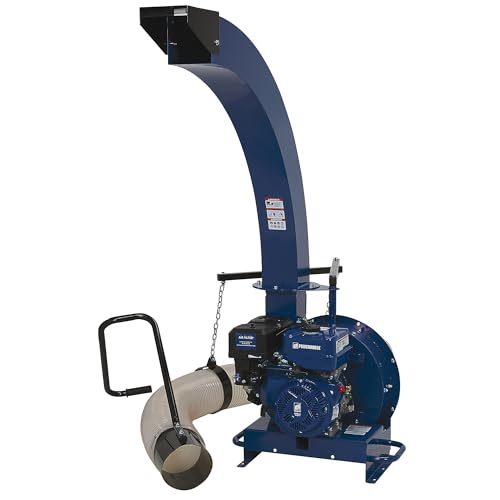
Powerhorse 13 HP Steel Debris Vacuum Truck Loader 420cc
420cc 13 HP8 in x 10 ft hoseAll-steelSkid mount
Check price on Amazon
Best for: Crews and municipalities wanting a steel, skid-mounted loader.

The Powerhorse loader is built from steel and uses a 420cc, 13 HP four-stroke OHV engine that is EPA certified, spinning to a maximum of 3,600 RPM. It ships with an 8 inch by 10 foot vacuum intake hose and mounts on a skid, which can sit in a truck bed or on a trailer.

The 8 inch hose is wide, which is the key advantage: it lets the machine swallow bulky material such as wet leaves and small branches that would clog a narrower inlet. The four-stroke engine is also quieter and more fuel efficient than a two-stroke, a benefit over a long day.

Against the SuperHandy 15 HP, it lists a lower horsepower but a heavier-duty steel build. Because it is a skid mount, you will need to secure it with straps or bolts. Change the oil on schedule, check the hose for tears and clean the intake of wrapped debris. Store the hose coiled loosely so it does not kink and crack in the cold.

What works

  • All-steel construction
  • 8 inch by 10 foot intake hose
  • 420cc EPA certified four-stroke engine
  • Skid mount for truck or trailer

Watch out for

  • Heavy and needs a lift or ramp to load
  • Pull start is harder than electric start

Spec sheet

Engine
420cc Ducar OHV, 13 HP
Hose
8 inch by 10 foot intake
Build
All-steel loader
Mount
Skid mount
Emissions
EPA certified engine
05
Agri-Fab Soft Top Mow-N-Vac 29 Cu Ft Tow-Behind Vacuum
29 cu ft220 gal208cc engine80 MPH suction
Check price on Amazon
Best for: Large lawns, parks and estates with a tractor already in use.

The Agri-Fab Mow-N-Vac tows behind a lawn tractor or mower and collects leaves and grass into a soft-top bag with a capacity of 29 cubic feet, or about 220 gallons. A 208cc LCT engine drives the suction, which the maker rates at up to 80 MPH. That much volume means far fewer trips to the compost heap than a walk-behind bag.

The tow-behind format suits large lawns, parks and estates where a tractor already does the mowing. It collects on the move, so one operator covers a lot of ground. It is less suited to tight landscaping, where the trailer is awkward to turn.

Because the bag is soft and large, check it for tears, and empty it before it is packed too tight. Clean the intake of wrapped grass and keep the engine oil topped up. It is the most productive option here for open turf. Match tow speed to the load, since going too fast on thick leaves overloads the intake and leaves a streaky finish.

What works

  • 29 cubic foot, 220 gallon bag
  • 208cc engine with up to 80 MPH suction
  • Collects on the move behind a tractor
  • Fewer trips to empty

Watch out for

  • Needs a tractor or mower to tow
  • Awkward in tight landscaping

Spec sheet

Engine
208cc LCT
Capacity
29 cubic feet, 220 gallons
Suction
Up to 80 MPH
Format
Tow-behind soft top collector
Use
Leaves and grass

Spec sheet decoder

What the numbers on the box really mean

The specs manufacturers lead with, translated into what they tell you about real-world performance.

cc and HP

Engine size and power. The KV601 is 190cc, the Agri-Fab 208cc and the Powerhorse 420cc at 13 HP.

Watch forA loader pulls through a long hose and needs more power than a walk-behind of the same impeller size.

Cubic feet and gallons

Bag capacity. The Agri-Fab lists 29 cubic feet or about 220 gallons, and the KV601 40 gallons.

Watch forA full soft-top bag can weigh a lot when wet, so check how it is emptied.

Cyclonic hood

A hood that spins debris and drops it into the collector. It helps keep dust out of the air.

Watch forIt is a design feature of the QV550H, so it may not apply to other models.

Serrated impeller

An impeller with toothed edges that cut material as it passes. It reduces volume and helps stop clogging.

Watch forEven serrated blades wear, so inspect them regularly, and replace the set when the edges are rounded off.

EPA certified engine

An engine certified to meet emissions rules. The Powerhorse engine carries this label.

Watch forCheck whether your area requires certification for commercial use. Some states restrict uncertified engines on commercial equipment, and a certified engine also tends to start more easily and idle more cleanly.

Methodology

How We Evaluated These Commercial Leaf Vacuums

Format and job fit

We sorted the machines into walk-behind, truck loader and tow-behind formats and compared them against typical crew jobs. A tool is only as good as its fit to the work.

Engine and impeller

We compared engine sizes from 160cc to 420cc and the impeller types. A larger engine and a metal serrated impeller scored higher for heavy work.

Capacity

We compared bag and hose capacity, from the 40 gallon KV601 to the 220 gallon Agri-Fab and the 8 inch Powerhorse hose. Larger capacity cuts downtime.

Support and parts

We considered how easily a crew can get parts. Billy Goat is a long-established dealer brand, and several loader brands are newer importers.

Honest data

Based on the spec sheet and owner feedback patterns, we described each machine by its listing and did not invent figures. Where a number was absent, we said so.

Decision guide

How to Choose the Right Commercial Leaf Vacuums

By Working Method

SituationPickWhy
Walking residential lotsKV601190cc and a bottom-loading bag
Noise-sensitive campusesQV550HQuiet design and cyclonic hood
Loading into a truck bedSuperHandy loader15 HP and electric start
Heavy debris and skid mountPowerhorse 13 HP8 inch hose, steel build
Large open lawns with a tractorAgri-Fab Mow-N-Vac220 gallon bag

By Budget

TierPickWhy
Lower costAgri-Fab Mow-N-VacTow-behind collector
Mid rangeSuperHandy loaderTruck loader value
Upper midKV601Established walk-behind
HighPowerhorse 13 HPSteel loader
HighestQV550HQuiet industrial unit

Walk-Behind vs Truck Loader

Walk-behind

The KV601 and QV550H. Self-contained, easy to maneuver on lawns and in tight areas, but limited by bag size.

Truck loader

The SuperHandy and Powerhorse. Far higher productivity with no bag, but they need a truck and a hose and must be mounted securely.

Take a walk-behind for lots under a few acres; take a loader when you move leaves in volume.

Collect on the Move vs Collect by Hose

PreferencePickWhy
Collect while mowingAgri-Fab Mow-N-VacTows behind a tractor
Pull leaves from beds and curbsPowerhorse 13 HP10 foot hose
Spot collection on footKV601Height adjustment
Quiet spot collectionQV550H33 inch quiet intake

For Wet Leaves Specifically

Look for

A wide intake and a strong impeller, since wet leaves clump and clog narrow paths. A bigger engine helps too.

In this comparison

The Powerhorse with its 8 inch hose and 13 HP engine is the best. The KV601's five-blade serrated impeller is also good. Small walk-behinds clog sooner.

When to Spend More

Spend more if

You run the machine daily and need dealer support. The Billy Goat units are the safe pick.

Save if

You use it a few times a season. The SuperHandy or the Agri-Fab covers it for less.

Ownership

Maintenance schedule

The upkeep that decides whether this machine lasts two seasons or ten.

TaskIntervalWhy it matters
Clear the impeller of wrapped debrisAfter every useWrapped grass and twigs unbalance the impeller and cut suction. Shut down and disconnect the spark plug before reaching in.
Change engine oilEvery 25 to 50 hoursCommercial engines run hard and hot in dusty air. Fresh oil is the cheapest insurance against engine wear.
Inspect hoses and bagsWeeklyA torn bag or hose leaks suction and dust. Patch or replace it before the damage spreads.
Check mounting hardwareWeekly for loadersVibration loosens hitch and tailgate bolts on the SuperHandy and Powerhorse. A loose mount is a safety hazard.
Clean the air filterDaily in dusty workLeaf dust clogs air filters fast. A clean filter restores power and protects the engine.

FAQ

Frequently Asked Questions

What is the best commercial leaf vacuum for most crews?

The Billy Goat KV601 is the standard walk-behind, with a 190cc Briggs engine and a 40 gallon bag. For heavier work, a truck loader like the Powerhorse with an 8 inch hose moves far more material.

Walk-behind or truck loader?

Walk-behind units suit small to medium lots and tight work, and they need no truck at all. A truck loader moves leaves in volume and suits large properties, but needs a truck and a hose.

How quiet is the QV550H?

Its maker calls it the world's quietest vacuum. No decibel figure is given in the listing, so treat it as a design intent and ask for a demo.

Does a loader shred leaves?

The SuperHandy's 16 inch serrated metal impeller shreds as it vacuums, which cuts the volume in the truck. The Powerhorse listing describes an all-steel loader and does not state shredding, so check before assuming.

How large is the Agri-Fab bag?

It lists 29 cubic feet, about 220 gallons, which is far larger than a walk-behind bag and means fewer stops.

Do these need a dealer?

A dealer is a big advantage for engines and impellers, especially when a part fails mid-season and you need it the same day. Billy Goat has a long dealer network, while some loader brands rely on online parts.

Bottom line

The short version

Browse more commercial leaf vacuumson Amazon →
James Miller, Lead Machine Editor

About the author

James Miller

Lead Machine Editor, MachineFanatic

James Miller leads MachineFanatic's buying guides, turning spec sheets, manuals and owner feedback into clear verdicts on power tools, outdoor power equipment, shop machines and kitchen machines.

More from James →

Keep reading

Related guides