
Amazon affiliate links - we earn a commission.Affiliate disclosure

Buying guide · 12 min read · Updated 2026-11-28

Best Commercial Paper Shredders (2026)

Five commercial-grade paper shredders compared on auto-feed capacity, run time, security level and jam handling for busy offices and heavy home use.

James MillerBy James MillerLead Machine Editor5 machines comparedSpec-sheet verified
Best Commercial Paper Shredders

At a glance

Our top picks

Side by side

Spec comparison

Commercial shredders are defined less by a label than by duty cycle. A machine earns the word when its motor can run for long stretches, its cutters resist wear, and its feed system handles stacks without constant attention.

The category splits into two designs: manual-feed machines that cut a fixed number of sheets per pass, and auto-feed machines with a hopper that swallows a whole stack. This guide compares both, explains why run time matters more than sheet count, and flags the claims that deserve skepticism.

Before you buy

6 Criteria to Look For Before Buying a Commercial Paper Shredder

  1. 01

    Duty cycle over sheet count

    A commercial shredder is defined by how long it can run, not how many sheets it takes per pass. The Fellowes 425Ci uses a continuous-duty motor, while the Bonsaii 240 and BONSEN 320 claim 60 minutes before cooldown. A machine that stops after 5 minutes cannot clear a filing cabinet no matter how large its hopper. Ask for the run time and the cooldown time, not just the sheet rating. A claimed 60 minute run followed by a 60 minute rest gives you half a working day of output at best, so compare the pair of numbers, and remember that feeding the full rated stack every pass pushes the motor toward the short end of that claim.

  2. 02

    Auto feed versus manual feed

    Auto-feed hoppers like the 320 sheets on the BONSEN let you load and walk away, while manual-feed machines like the Fellowes 225Ci demand an operator. The tradeoff is that auto mode usually accepts only paper, and cards or clips go through a separate slot. If your volume is high and your staff time is expensive, auto feed pays back quickly. If volume is occasional, manual feed with a stronger cutter is simpler. A practical test is to count the pages you destroy in a typical month: under a few hundred, the hopper rarely pays for itself, while several thousand pages justify the extra floor space and the higher purchase cost of a machine like the Bonsaii 240.

  3. 03

    Security level and particle size

    P-4 cross-cut like the Fellowes 425Ci gives particles near 5/32 by 1-1/8 inch, while P-5 micro-cut like the BONSEN gives 2 by 10 millimeters. Higher security means smaller particles and more cutter wear, so do not pay for P-5 when the paper is routine correspondence. Regulated records such as legal and medical files justify the step up. Also remember that the particle size is only half of security: a shredder that sits unattended with a full bin of readable chips, or one that jams and leaves partial pages in the throat, undermines the cut level you paid for.

  4. 04

    Jam handling and reverse

    Commercial machines jam when staples, binder clips or thick stock reach the cutters. The Fellowes units advertise a jam-proof design, while the auto-feed units rely on reverse and overload sensing. Neither approach covers wet paper, laminate or cardboard. Repeated forced feeding after a jam is how cutters get chipped, so back the sheet out fully, remove any clip or thick fold, and restart with a smaller stack rather than hammering the same bundle through again. Clearing a jam also means unplugging the unit first.

  5. 05

    Bin size and emptying

    High-volume shredding fills bins fast, especially with dense micro-cut chips. The BONSEN P-5 particles pack very tightly, so even a large bin gets heavy before it looks full. Look for a bin window or sensor and a pull-out design that does not require lifting the head of the machine.

  6. 06

    Footprint and noise

    A 300-plus sheet auto-feed shredder is a floor machine that wants its own corner and produces a constant roar while running. The Fellowes 225Ci is lighter and easier to place under a desk. Noise ratings are rarely published, so judge by motor size and read owner feedback patterns for anything that will share a room with staff. Many offices solve the problem by placing the large machine in a copy room or closet and running it during breaks, which makes the 320-sheet hopper of the BONSEN more attractive because it needs no one standing beside it.

Detailed reviews

The 5 best commercial paper shredders, explained

01
Bonsaii 240-Sheet Auto Feed Micro Cut Shredder
240-sheet auto feedMicro cut60 min run timeManual feed mode
Check price on Amazon
Best for: Offices that clear large volumes and want to load and leave.

The Bonsaii 240 loads a stack of up to 240 letter sheets into a hopper and shreds them without anyone standing there. That changes the economics of a clean-out, because the operator loads and walks away rather than feeding a dozen sheets at a time. The micro cut particles and a 60 minute run claim place it in the office tier rather than the desktop tier.

The tradeoff is that auto-feed mode handles paper only. A separate manual-feed slot accepts credit cards, staples and clips, which means mixed piles require two passes. Compared with the Aurora 200-sheet auto-feed unit, this model carries 40 more sheets of hopper and the same hour-long duty claim.

Ownership centers on hopper discipline. Keep the stack flat and free of binder clips, remove thick envelopes and oil the cutters on the maker's schedule. The hopper is a convenience, not a license to load wet or heavily stapled bundles.

What works

  • Large hopper for hands-off shredding
  • Micro cut particle size
  • 60 minute continuous run claim
  • Separate manual mode for cards and clips

Watch out for

  • Large and heavy for a home desk
  • Auto mode is paper only
  • Needs regular oiling for micro cutters

Spec sheet

Auto-feed capacity
240 sheets
Cut type
Micro cut
Continuous run
60 minutes
Manual mode
Cards, staples, clips
Use
Office
02
BONSEN 320-Sheet P-5 Micro Cut Auto Feed Shredder
320-sheet auto feedP-5 micro cut60 min non-stop2 x 10 mm particles
Check price on Amazon
Best for: Law, medical and finance offices that need top-tier particle security at volume.

BONSEN pairs the largest hopper in this group, 320 sheets, with P-5 particles of about 2 by 10 millimeters. P-5 sits a full step above the P-4 class that most office shredders reach, so it fits legal files, client records and anything covered by a retention policy.

The cost of tiny particles is motor effort. Cutting that fine pushes sustained torque up and wears cutters faster, so the hour-long run claim should be read as a best case. Next to the Kitnery 400-sheet, it trades 80 sheets of hopper for a more established P-5 pitch, and against the Fellowes 225Ci it swaps jam-proof manual feeding for volume.

Expect a floor-standing machine that wants a dedicated corner. Keep the hopper stack clean, oil the cutters regularly and empty the bin before it reaches the sensor line, because P-5 chips pack extremely densely. Over several years the cutter block is the wear item, so owners who shred daily should expect the first signs of aging as slower feeds and a rougher sound rather than a sudden failure, and should plan to service or replace the unit around that point.

What works

  • P-5 particle size for confidential files
  • Largest hopper except the Kitnery
  • 60 minute continuous run claim
  • Auto and manual modes

Watch out for

  • Cutters wear faster at P-5
  • Dense chips fill the bin quickly
  • Large footprint

Spec sheet

Auto-feed capacity
320 sheets
Security level
P-5
Particle size
2 x 10 mm
Continuous run
60 minutes
Use
Confidential records
03
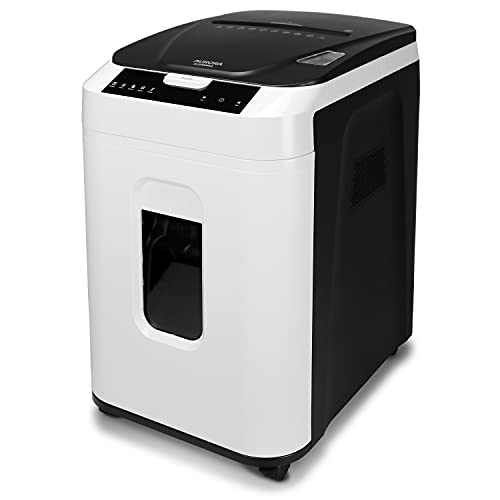
Aurora 200-Sheet Auto Feed Micro Cut Shredder
200-sheet auto feedMicro cut10 sheet manual60 minute run
Check price on Amazon
Best for: Small offices that want auto-feed convenience without a floor-standing monster.

Aurora's 200-sheet auto-feed model offers a hopper that holds 200 sheets and a manual slot for 10 sheets at a time. Particles come out at about 2 by 12 millimeters, which puts it in the high-security micro cut class. The hour-long run claim matches the larger Bonsaii and BONSEN machines.

The tradeoff is the smaller hopper. At 200 sheets it handles a typical filing drawer in a few loads, but it will not match the 320 sheets of the BONSEN. In exchange the body is more manageable, and for a small office this is often the more sensible footprint.

Upkeep follows the micro cut pattern: oil, empty and keep the stack flat. Do not use auto mode for cards or clips because that is what the manual slot is for.

What works

  • Auto and manual modes in one body
  • Micro cut particles near 2 by 12 mm
  • 60 minute run claim
  • More compact than the 300-plus sheet units

Watch out for

  • Smaller hopper than the top machines
  • Manual slot is only 10 sheets
  • Paper only in auto mode

Spec sheet

Auto-feed capacity
200 sheets
Manual capacity
10 sheets
Particle size
2 x 12 mm
Continuous run
60 minutes
Use
Small office
04
Fellowes Powershred 225Ci 22-Sheet Cross-Cut Jam-Proof
22 sheetsCross-cutJam-proofCommercial grade
Check price on Amazon
Best for: Offices that want a proven manual-feed cross-cut machine and value reliability over volume.

The Fellowes Powershred 225Ci is a manual-feed cross-cut machine rated at 22 sheets per pass with a jam-proof system the maker claims is complete. Its appeal is a long record in offices, where it runs for years without constant attention. Manual feeding means a person stands at the throat, so it is not a hands-free machine.

Cross-cut particles are larger than the micro-cut results from the Bonsaii or BONSEN, so this machine suits general office paper rather than the most sensitive documents. Against the 30-sheet Fellowes 425Ci in the same family, it trades eight sheets of capacity for a lighter and more affordable footprint.

Ownership is easy: Fellowes designs this class for steady duty. Empty the bin, keep the feed throat clear and follow the oiling guidance in the manual. The jam-proof claim should be read as a design goal rather than a guarantee against forced feeds.

What works

  • Established commercial jam-proof design
  • 22-sheet cross-cut capacity
  • Suited to continuous office duty
  • Simple controls

Watch out for

  • Manual feed needs an operator
  • Cross-cut is less secure than micro cut
  • Lower throughput than auto-feed units

Spec sheet

Sheet capacity
22 sheets
Cut type
Cross-cut
Jam control
100 percent jam-proof claim
Feed
Manual
Use
Office
05
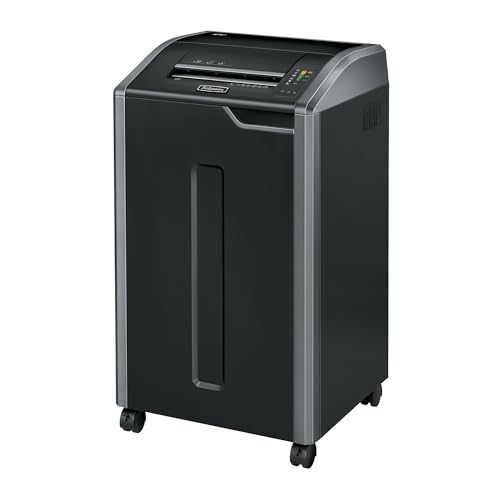
Fellowes Powershred 425Ci 30-Sheet Cross-Cut Shredder
30 sheetsP-4 cross-cutContinuous dutyMade in USA
Check price on Amazon
Best for: Busy shared offices that need sustained manual shredding without cooldown waits.

The Fellowes 425Ci raises the sheet rating to 30 per pass and carries a continuous-duty motor, a design intended to let the machine run all day without thermal cutoffs. Particles land at P-4 cross-cut, about 5/32 by 1-1/8 inch, which is adequate for typical business paper. It is designed and assembled in the USA, which some buyers prefer for compliance reasons.

The cost is price and size. A 30-sheet cross-cut is heavier than the 22-sheet 225Ci and its manual feed means the capacity is only useful while someone feeds it. It also lacks the finer cut of the BONSEN or Aurora units, so it is a throughput machine, not a security machine.

Maintenance is light: empty the bin, oil per the manual and keep the throat free of binders. The continuous-duty motor tolerates abuse better than the thermal-cutoff units in this lineup. In a shared office that matters, because the person who feeds the machine is rarely the person who pays for its repair, and a motor that does not cut out mid-task avoids the habit of restarting and forcing paper through a hot, strained gearbox.

What works

  • 30-sheet manual capacity
  • Continuous-duty motor
  • P-4 cross-cut particles
  • Domestic design and assembly

Watch out for

  • Manual feed requires an operator
  • Cross-cut is less secure than micro cut
  • Heavy and costly

Spec sheet

Sheet capacity
30 sheets
Particle size
5/32 x 1-1/8 in
Security level
P-4
Motor
Continuous duty
Use
Busy office

Spec sheet decoder

What the numbers on the box really mean

The specs manufacturers lead with, translated into what they tell you about real-world performance.

Auto-feed capacity

The number of sheets the hopper holds for hands-free shredding. It is separate from the manual slot capacity.

Watch forThe BONSEN holds 320 sheets while the Aurora holds 200.

Continuous run time

How long the motor can run before thermal protection stops it. Cooldown must follow.

Watch forThe Bonsaii 240 and BONSEN both claim 60 minutes, so check real use.

P level

A DIN 66399 grade of particle size. Higher means smaller particles.

Watch forThe BONSEN is P-5 and the Fellowes 425Ci is P-4.

Cut type

Cross-cut slices into small rectangles while micro-cut produces finer particles. Micro-cut is more secure but wears cutters faster.

Watch forThe Fellowes units are cross-cut while the Bonsaii, BONSEN and Aurora are micro-cut.

Manual slot capacity

The sheet count allowed through the manual-feed throat, used for cards and clips in auto-feed units.

Watch forThe Aurora 200 manual slot takes only 10 sheets.

Methodology

How We Evaluated These Commercial Paper Shredders

Duty cycle

We compared advertised run times and motor types. The Fellowes 425Ci stood out for continuous duty while auto-feed units advertised 60 minutes. Claims are treated as claims.

Security class

We read particle dimensions and P-levels from the specifications. The BONSEN reached P-5 at 2 by 10 millimeters while the Fellowes 425Ci is P-4 cross-cut. Higher security earned credit only where use justified it.

Throughput

We weighed hopper size, manual capacity and run time together. The BONSEN at 320 sheets and the Fellowes 425Ci at 30 sheets manual represent two approaches. The best machine for each depends on staffing.

Jam control

We checked for jam-proof designs, reverse functions and overload sensing. Units with documented designs scored higher. No unit was rewarded for claims that exceeded its category.

Ownership cost

We looked at oiling needs, bin access, cutter wear and footprint. Heavy micro-cut machines scored lower on wear while continuous-duty machines scored higher on durability. Scores reflect the spec sheet and owner feedback patterns.

Decision guide

How to Choose the Right Commercial Paper Shredders

By Volume

SituationPickWhy
Constant daily shreddingFellowes Powershred 425CiContinuous-duty motor
Large annual clean-outBONSEN 320-SheetBiggest hopper with P-5
Moderate weekly volumeAurora 200-SheetAuto feed in a smaller body
Mixed paper and cardsBonsaii 240-SheetAuto plus manual slot
Steady manual feedingFellowes Powershred 225CiProven jam-proof design

By Budget

TierPickWhy
Lower cost in groupFellowes Powershred 225CiManual feed with a lower cost
Mid tierAurora 200-SheetAuto feed at moderate cost
Upper mid tierBonsaii 240-SheetLarger hopper and 60 minute run
High tierBONSEN 320-SheetP-5 and a big hopper
Premium durabilityFellowes Powershred 425CiContinuous duty design

Auto Feed vs Manual Feed

Auto feed

Auto feed shines on the Bonsaii 240 and BONSEN 320, where you load a stack and walk away. It saves labor and keeps pages flat, but it cannot shred cards or clips in auto mode. It also takes more floor space.

Manual feed

Manual feed on the Fellowes 225Ci and 425Ci keeps the machine compact and simple, and it accepts stapled bundles within its rating. It needs an operator, so throughput depends on staff time.

Pick auto feed when someone else's time is valuable, and manual feed when volume is moderate and you want a simple, durable machine.

By Security Level

NeedPickWhy
Highest confidentialityBONSEN 320-SheetP-5 particles
High confidentiality, smaller footprintAurora 200-Sheet2 x 12 mm micro cut
General business paperFellowes Powershred 425CiP-4 cross-cut
Routine office paperFellowes Powershred 225CiCross-cut with jam-proof design
Mixed securityBonsaii 240-SheetMicro cut with manual slot

For Law and Medical Offices Specifically

Look for

Look for a P-5 or at least P-4 micro-cut result, an auto-feed hopper that keeps staff off the machine, and a duty cycle that matches your filing volume. Retention policies often require destruction to a documented standard.

In this comparison

The BONSEN 320-Sheet is the clearest match, with P-5 particles and a 320 sheet hopper. The Aurora 200-Sheet is a smaller-office alternative at a slightly lower security grade.

When to Spend More

Spend more if

Spend more if the machine runs most of the day, where the Fellowes 425Ci continuous-duty motor earns its cost. Also spend more for the BONSEN 320 when regulated records are involved.

Save if

Save if volume is modest, where the Fellowes 225Ci or Aurora 200-Sheet is plenty. Do not pay for a 320-sheet hopper you fill twice a year.

Ownership

Maintenance schedule

The upkeep that decides whether this machine lasts two seasons or ten.

TaskIntervalWhy it matters
Oil the cuttersEvery bin emptying or per manualMicro-cut cutters gum up with paper dust. Oil lowers torque and heat.
Empty the binAt three quarters fullDense chips overload the bin sensor and can jam the cutter head.
Clean sensor eyesQuarterlyPaper dust blocks auto start sensors and causes false stops.
Flatten hopper stacksEvery loadFolded or curled stacks cause misfeeds and jams in auto mode.
Check the cord and ventilationEvery six monthsHeavy motors run hot. Clear vents and inspect the cord for damage.

FAQ

Frequently Asked Questions

What makes a shredder commercial grade?

Mostly duty cycle and build. A commercial machine runs for long stretches without thermal cutoff and uses heavier cutters. Marketing sometimes stretches the term, so check the run time.

Is auto feed worth it?

Yes if you shred large volumes, because it frees staff time. Auto feed usually handles paper only, so keep a manual slot for cards and clips. For occasional use, manual feed is simpler.

Do I need P-5?

Only for regulated or highly confidential records. P-4 is adequate for most business paper. P-5 wears cutters faster and fills bins faster.

Why does my machine stop after a while?

Thermal protection stops the motor to avoid damage. Let it cool for the stated period. Repeated stops mean the load or duty is too high for the model.

Can commercial shredders handle staples?

Most accept staples in small numbers but heavy stapled bundles reduce capacity. Binder clips and thick binders should be removed. Check the listing for staple and clip handling.

How loud are they?

Large auto-feed models are loud and not suited to open offices without a separate room. Manual cross-cut units are generally quieter. Published decibel figures are claims, so check owner feedback.

Bottom line

The short version

Browse more commercial paper shredderson Amazon →
James Miller, Lead Machine Editor

About the author

James Miller

Lead Machine Editor, MachineFanatic

James Miller leads MachineFanatic's buying guides, turning spec sheets, manuals and owner feedback into clear verdicts on power tools, outdoor power equipment, shop machines and kitchen machines.

More from James →

Keep reading

Related guides