
Amazon affiliate links - we earn a commission.Affiliate disclosure

Buying guide · 12 min read · Updated 2026-11-11

Best Commercial Wet-Dry Vacuums (2026)

Five commercial wet-dry vacuums from 8 to 26.5 gallons compared by motor design, squeegee tools, HEPA filtration and the upkeep a busy shop really needs.

James MillerBy James MillerLead Machine Editor5 machines comparedSpec-sheet verified
Best Commercial Wet-Dry Vacuums

At a glance

Our top picks

Side by side

Spec comparison

Commercial wet-dry vacuums sit between a home shop vac and a full floor extractor. They have bigger tanks, tougher drums and sometimes two motors or a squeegee tool, so a facility can clear water and dry debris with fewer stops.

The word commercial is also a sales label. Some units are built for daily use in a shop, school or warehouse, and others are home-grade vacuums with a bigger tank and a steel finish. This guide separates the two using tank design, motor layout, filtration and the parts you will have to replace.

Before you buy

6 Criteria to Look For Before Buying a Commercial Wet-Dry Vacuum

  1. 01

    Single motor versus two motors

    A single motor, like the Vacmaster VJE1412SW at 6.5 peak HP, is simpler and draws less current. Two motors, like the Industrial JM773 at 2000 W, move more air and add redundancy, but use nearly a whole 15 A circuit. Check your outlet before buying a dual-motor machine. A tripped breaker mid-job costs more time than a smaller motor ever would.

  2. 02

    Tank material and size

    Stainless steel drums, as on the Vacmaster VJE1412SW and the Dapper Supply 26.5 gallon, resist dents, rust and chemicals that damage poly tanks over a few seasons. The price is weight. A 26.5 gallon drum full of water is hard to move, so you need a drain and good casters. For occasional use a poly drum is lighter and cheaper, but stainless survives daily abuse.

  3. 03

    Fine-dust filtration claims

    Down to 1 micron is useful for drywall dust but is not HEPA. A HEPA claim needs a sealed system with gaskets and a sealed filter seat, which is what the Dustless D1618 advertises. Silica and lead-safe work need a true HEPA extractor plus the correct hose. Never assume a cartridge filter in a leaky tank protects the room.

  4. 04

    Airflow versus suction

    CFM measures how much air the machine moves, and water lift measures suction against resistance. The Industrial JM773 lists 225 CFM for floor and flood work, while the Dustless D1618 lists 138 CFM and 83 in water lift for fine dust through a long hose. Floors need airflow, and sanding or dust extraction needs suction. Pick based on the job.

  5. 05

    Squeegee versus hose design

    A shovelnose squeegee like the TTS Viper recovers liquid from a flat floor in one pass but cannot take debris through a hose. A drum vac such as the Vacmaster takes a hose and attachments but is slower on large floors. If your work is janitorial, a squeegee head pays off in speed. If your work is a shop, choose a drum with a hose.

  6. 06

    Parts and warranty support

    A commercial vacuum is only commercial if you can keep it running. Vacmaster and Industrial-style machines sell bags, filters and hoses widely, while smaller importer brands may not. Before buying a 26.5 gallon unit like the Dapper Supply, confirm filter sizes and hose fittings are standard. A broken switch should not scrap a machine.

Detailed reviews

The 5 best commercial wet-dry vacuums, explained

01
Vacmaster Professional Beast VJE1412SW 14 Gallon Wet/Dry Vac
14 gallon steel tank6.5 peak HP1 micron filter18 accessories
Check price on Amazon
Best for: Shops and light commercial sites that need durable steel and fine-dust filtration.

The VJE1412SW pairs a stainless steel 14 gallon drum with a 6.5 peak HP motor and a cartridge filter that captures fine dust down to about 1 micron. That combination matters in a commercial setting because the stainless tank survives dents, chemical splashes and rust that wreck poly drums in a few seasons. The kit includes 18 accessories, among them dust collection bags and on-board storage, so the machine is usable out of the box.

It is heavier than the poly vacs you see in big-box stores, and the 14 gallon size is awkward on a loading dock ramp or a flight of stairs. The 5 gallon Vacmaster Beast VFB511H is far lighter, but it fills in a fraction of the time. For a multi-room cleanup or a full shop floor the 14 gallon drum gets through a shift with fewer trips to the dumpster.

Ownership is mostly bag and filter management. Fit a dust bag for drywall work, swap to a foam sleeve for wet pickup, and rinse the stainless tank to prevent odors. Replacement bags and cartridges for Vacmaster are common, which keeps the running cost predictable.

What works

  • Stainless 14 gallon tank resists dents and rust
  • Cartridge filter captures fine dust to 1 micron
  • 18 accessories ship with the machine
  • 6.5 peak HP motor handles heavy debris

Watch out for

  • Heavy and awkward on stairs when full
  • Bags and cartridges are a running cost
  • Overkill for light household cleanup

Spec sheet

Tank
14 gallon stainless
Motor
6.5 peak HP
Filter
Cartridge to 1 micron
Accessories
18 pieces
Power
Corded
02
Industrial JM773 Dual-Motor 21 Gallon Wet/Dry Vacuum
21 gallon tank2 motors2000 W225 CFM
Check price on Amazon
Best for: Floors and water cleanup where airflow matters more than fine filtration.

The JM773 uses two motors and lists 2000 W and 225 CFM, which is the sort of airflow that matters on a warehouse floor. Two motors split the work, so one can fail without taking the whole vacuum out of service, and the machine moves large volumes of air for water and dry debris. A 21 gallon drum suits floor cleanup and recovery from a flooded room.

The cost is a heavy machine and a high power draw. 2000 W on a standard 15 A, 120 V circuit uses most of the breaker, so do not share the outlet with a space heater or a compressor. Compared with the single motor Vacmaster VJE1412SW it moves more air, but it lacks the named fine-dust filter and the accessory kit. Treat it as a floor and water machine.

Expect to maintain the squeegee and filters. The tank is large enough that wet debris gets heavy, so use the drain rather than tipping it. Parts are less standardized than for a Vacmaster or Craftsman, so keep a spare filter on hand before you need it.

What works

  • Two motors keep working if one fails
  • 225 CFM lists strong airflow
  • 21 gallon drum reduces trips to empty
  • Suits floor and flood recovery

Watch out for

  • 2000 W draw uses most of a 15 A circuit
  • Heavy and bulky to move
  • Spare parts are less common

Spec sheet

Tank
21 gallon
Motors
Two
Power draw
2000 W
Airflow
225 CFM
Power
Corded
03
Dustless Technologies D1618 HEPA Wet+Dry Pro 8 Gallon Vacuum
8 gallon tankCertified HEPA138 CFM83 in lift
Check price on Amazon
Best for: Renovators and contractors who need fine-dust containment.

The D1618 is a HEPA-first machine. It uses a certified HEPA system that is meant to stop fine dust from bypassing the filter, with a 138 CFM, 83 in water lift motor. A hydrophobic polyester filter allows switching from dry to wet pickup without changing filters, which is rare in this class. It is aimed at contractors who deal with drywall dust, lead-safe work and fine renovation debris.

It costs more than a generic commercial vacuum and holds just 8 gallons, so it is not the machine for flooded floors. Next to the 21 gallon JM773 it moves much less air, but it keeps fine dust inside the unit, which is the point. Any dust-control claim depends on a sealed system, so use it with the factory hose and tools.

The owner task is keeping the HEPA path clean and sealed. Empty the tank before it fills, replace the filter when airflow drops, and avoid pulling wet debris through the HEPA filter unless the maker's manual allows it. This is a tool for dust control, not for pumping out a flood.

What works

  • Certified HEPA system limits dust escape
  • Hydrophobic filter handles dry and wet
  • 138 CFM and 83 in lift suit sanding dust
  • Compact 8 gallon size is easy to move

Watch out for

  • Premium price for the HEPA path
  • 8 gallons is too small for floods
  • Needs correct sealed accessories

Spec sheet

Tank
8 gallon
Filtration
Certified HEPA system
Airflow
138 CFM
Lift
83 in water lift
Filter
Hydrophobic polyester
04
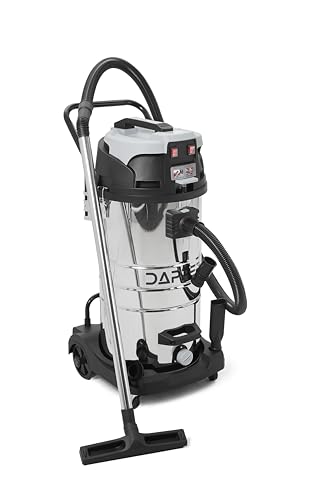
Dapper Supply 26.5 Gallon Commercial Wet/Dry Vacuum
26.5 gallon tank11 peak HP26 kPa suctionStainless tank
Check price on Amazon
Best for: Large floors and facilities that need a high-capacity single machine.

The Dapper Supply unit is the largest tank in the guide: 26.5 gallons of rust-resistant stainless steel behind an 11 peak HP motor rated at 26 kPa of suction. That puts it in the territory of a dedicated floor machine for a restaurant, gym or warehouse. The wet and dry design means a single tool cleans spills and debris without changing equipment.

Bigger is not always better. A 26.5 gallon drum is a floor machine you roll rather than carry, and the 11 peak HP rating is a surge figure from a lesser-known maker. Compared with the Vacmaster VJE1412SW it moves more, but a recognized parts network is not guaranteed. Consider what you will do if a switch or hose fails.

Plan for regular tank rinsing and filter cleaning. The big tank makes it tempting to let debris pile up, but a full drum is heavy and slow to empty. Lubricate casters, check seals and keep a spare hose, since this machine will see daily use.

What works

  • 26.5 gallon stainless drum rarely needs emptying
  • 26 kPa suction rating is strong
  • Rust-resistant tank suits wet work
  • Wet and dry design covers most facility tasks

Watch out for

  • Large footprint and weight
  • Brand support and parts are less proven
  • 11 peak HP is a surge figure, not sustained power

Spec sheet

Tank
26.5 gallon stainless
Motor
11 peak HP
Suction
26 kPa
Design
Wet and dry
Power
Corded
05
TTS Products Viper SN18WD Shovelnose 18 Gallon Wet/Dry Vacuum
18 gallon tankFront squeegeeShovelnose designCommercial grade
Check price on Amazon
Best for: Janitorial and facility floors where speed on spills matters.

The Viper SN18WD is a shovelnose machine: the intake is a wide front squeegee that sweeps along the floor and recovers liquid in one pass. That design is common in janitorial work, and the 18 gallon recovery tank cuts the stops during a mopping or spill job. It is built for schools, hospitals and similar commercial environments.

A squeegee vacuum is not a general shop vac. Debris like screws, wood chips and sawdust belongs in a drum vacuum with a hose and filter, not in a floor squeegee unit. Compared with the Vacmaster VJE1412SW, which also takes a hose and attachments, the Viper does one job much faster, but only on flat floors.

Ownership is about the squeegee blades and the recovery tank. Replace the rubber blades when they stop wiping dry, empty the tank after every use, and rinse it to avoid odors. It is a facility tool, not a garage tool.

What works

  • Front squeegee recovers water in one pass
  • 18 gallon recovery tank suits large floors
  • Commercial design for daily facility use
  • Fast to deploy for spills

Watch out for

  • Not a hose-and-attachment shop vac
  • Squeegee blades wear and need replacing
  • Poor choice for sawdust or debris

Spec sheet

Tank
18 gallon
Design
Shovelnose
Squeegee
Front mounted
Use
Schools, hospitals, facilities
Power
Corded

Spec sheet decoder

What the numbers on the box really mean

The specs manufacturers lead with, translated into what they tell you about real-world performance.

Peak HP

A surge rating taken with no load. It is not sustained power and does not compare across brands.

Watch forThe Dapper Supply 11 peak HP is not twice a 5.5 peak HP Vacmaster.

Watts and amps

The real electrical draw, which determines the circuit you need. Higher watts usually mean more airflow but also more load.

Watch forThe Industrial JM773 at 2000 W uses most of a 15 A circuit.

CFM

Airflow in cubic feet per minute, which carries debris and water through the hose. It matters more on large floors.

Watch for225 CFM on the JM773 versus 138 CFM on the Dustless D1618.

kPa suction

A pressure figure that shows how hard the machine pulls. Higher kPa helps with long hoses and fine dust.

Watch forThe Dapper Supply lists 26 kPa, but compare it to water lift for a fair view.

HEPA rating

HEPA means 99.97 percent capture at 0.3 microns, but only in a sealed system.

Watch forOnly the Dustless D1618 here is sold as a HEPA system.

Methodology

How We Evaluated These Commercial Wet-Dry Vacuums

Durability of the tank

We compared stainless steel against poly drums and looked at wheels and handles. The Vacmaster VJE1412SW and Dapper Supply use stainless, which suits daily use. Machines that rely on thin poly or tiny casters scored lower for commercial work.

Motor design and electrical load

We checked motor count and power draw. The Industrial JM773 uses two motors and 2000 W, and the Vacmaster uses one 6.5 peak HP motor. Circuit loading was part of every verdict, because a breaker trip stops work.

Filtration and fine dust

We compared cartridge, bag and HEPA setups. The Dustless D1618 is a certified HEPA system, while the VJE1412SW filters down to 1 micron. We ranked sealed systems above open cartridges for contractor dust.

Capacity and recovery speed

We weighed tank size against how fast each machine recovers liquid. The TTS Viper uses a front squeegee and an 18 gallon tank for floors, while the 26.5 gallon Dapper Supply favors volume. Capacity was matched to the likely job.

Parts and long-run cost

We looked at how easy it is to buy bags, filters and hoses. Vacmaster accessories are widely stocked, and imported brands vary. Running cost mattered more than the initial price for machines that run daily.

Decision guide

How to Choose the Right Commercial Wet-Dry Vacuums

By Facility Type

SituationPickWhy
Contractor and drywall workDustless D1618Certified HEPA system for fine dust
Workshop or garageVacmaster VJE1412SWStainless 14 gallon drum with accessories
Warehouse floor and floodsIndustrial JM773Two motors and 225 CFM
Janitorial floorsTTS Viper SN18WDFront squeegee recovers liquid fast
Large facility with high volumeDapper Supply 26.5 gallonLargest drum and 26 kPa suction

By Budget

Budget tierPickWhy
Lowest costIndustrial JM773Dual motors at a mid-range tier
Mid-rangeDapper Supply 26.5 gallonLarge stainless tank for the money
Mid-rangeTTS Viper SN18WDSpecialized squeegee machine
PremiumVacmaster VJE1412SWStainless, accessories and fine filter
Premium, HEPADustless D1618Pay for sealed HEPA containment

Squeegee vs Hose Drum

Squeegee shovelnose

The TTS Viper SN18WD recovers liquid across a floor in one pass and suits schools, hospitals and kitchens. It cannot take debris through a hose, so it does not replace a shop vac.

Hose drum

The Vacmaster VJE1412SW and Industrial JM773 take hoses and attachments, so they clean shelves, benches and floors. They are slower on big flat floors but handle debris.

Choose the Viper for janitorial floors, and the Vacmaster for a shop with benches and tools.

Dust Containment Level

PreferencePickWhy
True HEPADustless D1618Sealed, certified system
Fine dust bag and cartridgeVacmaster VJE1412SWFilters to 1 micron with bags
General floor debrisIndustrial JM773High airflow, basic filtration
Liquids onlyTTS Viper SN18WDSqueegee recovery tank
High-volume dryDapper Supply 26.5 gallonLarge tank, strong suction

For a Small Shop Specifically

Look for

A stainless or heavy poly drum, a hose with standard fittings, and an adapter for power tool dust extraction. Pick a drum size you can move yourself and a cord long enough for the shop layout.

In this comparison

The Vacmaster VJE1412SW fits best with its 14 gallon stainless drum and 18 accessories. The Dustless D1618 is the better choice if drywall and renovation dust is the main problem.

When to Spend More

Spend more if

The machine runs daily, or you work with fine or hazardous dust. The Vacmaster VJE1412SW and Dustless D1618 justify the cost with stainless construction and sealed filtration.

Save if

You mainly need volume and floor recovery with light-duty use. The Industrial JM773 or Dapper Supply 26.5 gallon give large capacity at a lower tier.

Ownership

Maintenance schedule

The upkeep that decides whether this machine lasts two seasons or ten.

TaskIntervalWhy it matters
Empty and rinse the tankAfter every useStanding debris smells and corrodes. Rinse stainless drums and dry them with the lid off.
Clean or replace filters and bagsWeekly in dusty work, monthly otherwiseA clogged filter cuts airflow and strains the motor. Bags catch most fine dust before the cartridge.
Replace squeegee bladesWhen streaks appearWorn rubber leaves a wet line and recovers less water. Blades are cheap compared with the machine.
Inspect hose, seals and gasketsMonthlyLeaks reduce suction and let dust escape. HEPA claims depend on intact seals.
Check cords and switchesEvery few monthsA frayed cord is a shock risk and heavy use wears switches first.

FAQ

Frequently Asked Questions

What makes a wet-dry vacuum commercial?

A larger stainless or heavy-duty tank, a stronger motor setup and parts built for daily use. The label alone does not guarantee it, so check tank material, motor design and the availability of filters and hoses.

How big should a commercial wet-dry vacuum be?

For a shop, 8 to 14 gallons covers most jobs. For floors in a warehouse or facility, 18 to 26 gallons reduces emptying. Bigger tanks are heavier, so match the size to what you can move.

Do I need two motors?

Only for large floors or flood recovery. Two motors move more air, as the Industrial JM773 shows at 225 CFM, but they draw about 2000 W. A single motor like the Vacmaster is simpler and uses less current.

Is a 1 micron filter the same as HEPA?

No. HEPA captures 99.97 percent of particles at 0.3 microns, and only in a sealed system. A 1 micron cartridge helps with drywall dust but does not make a machine suitable for lead or silica.

Can a squeegee vacuum replace a shop vac?

No. A shovelnose like the TTS Viper recovers liquid from floors quickly, but it cannot take a hose and attachments or handle debris such as screws and wood chips.

How do I keep a stainless tank from smelling?

Empty it after each job, rinse it with clean water and leave the lid off until it dries. Wash the foam sleeve and replace the dust bag. Standing water in a closed drum grows mildew quickly.

Bottom line

The short version

Browse more commercial wet-dry vacuumson Amazon →
James Miller, Lead Machine Editor

About the author

James Miller

Lead Machine Editor, MachineFanatic

James Miller leads MachineFanatic's buying guides, turning spec sheets, manuals and owner feedback into clear verdicts on power tools, outdoor power equipment, shop machines and kitchen machines.

More from James →

Keep reading

Related guides