


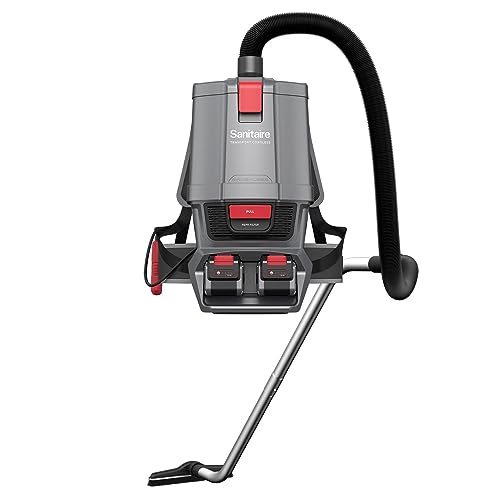

Makita builds this as a dust extractor, which is a more serious class than a household vacuum. A brushless motor produces 64 CFM of airflow and 44 inches of water lift, which are real engineering numbers rather than a peak horsepower claim. CFM describes how much air moves and water lift describes how hard it pulls when sealed, so together they predict how it handles fine dust and heavier debris.
Two 18V LXT batteries combine to make a 36V system. With two 5.0 Ah packs, the listing quotes up to 62 minutes on the normal setting and 33 minutes on high. A two-stage HEPA filter captures 99.97 percent of particles at 0.3 microns and larger, and it extends the life of the main filter. A backpack vacuum puts the exhaust near your breathing zone, so a sealed HEPA system is a real benefit.
The 1.6 gallon canister holds more than the half gallon sibling, which means fewer stops to empty it. The listing is for the bare tool, so check that you have batteries and a charger, or buy a kit version. Compared with the DeWalt, you get more airflow and a larger canister and carry more weight. Choose it for crews and homeowners who already use the Makita platform.
What works
- 64 CFM and 44 in water lift on a brushless motor
- Two-stage HEPA captures 99.97% at 0.3 micron
- Up to 62 minutes on normal with two 5.0 Ah packs
- 1.6 gal canister holds a full job
Watch out for
- Bare tool needs batteries and a charger
- Heavier than the 1 gal DeWalt
- Dry dust extractor, not a wet vacuum
Spec sheet
- Platform
- Two 18V LXT batteries (36V)
- Airflow
- 64 CFM
- Sealed suction
- 44 inch water lift
- Run time
- Up to 62 min normal, 33 min high, with two 5.0 Ah packs
- Filter
- Two-stage HEPA, 99.97% at 0.3 micron