
Amazon affiliate links - we earn a commission.Affiliate disclosure

Buying guide · 12 min read · Updated 2026-11-07

Best Cordless Hand Planers (2026)

Three battery-powered 3-1/4 inch hand planers compared on motor type, depth of cut, weight, dust handling and battery platform, with ownership notes.

James MillerBy James MillerLead Machine Editor3 machines comparedSpec-sheet verified
Best Cordless Hand Planers

At a glance

Our top picks

Side by side

Spec comparison

A handheld electric planer shaves a thin layer off an edge or a face. It is the tool a carpenter reaches for when a door sticks, a board needs a bevel or a stair tread sits a hair proud of its neighbour.

Taking the cord away makes it more useful on ladders, on roofs and in places without power, but it brings a different set of questions: which battery platform the tool takes, how long a charge lasts under load, and whether the cutter is a proper carbide design or a cheap clone. These three machines answer those questions in different ways.

Before you buy

6 Criteria to Look For Before Buying a Cordless Hand Planer

  1. 01

    Battery platform first

    The planer is sold as a bare tool, so the battery system decides the real cost. The Makita XPK01Z takes 18V LXT packs, the Craftsman takes V20, and the adapter-style Bigheimer takes DeWalt 20V. A new buyer should compare the cost of the tool plus a battery and charger rather than the tool alone. If you already own batteries, the cheapest planer is whichever one uses them.

  2. 02

    Brushless versus brushed motor

    A brushless motor, as in the Craftsman V20 and the Bigheimer, spins at 15,000 rpm with less wasted heat and no brushes to wear. The brushed Makita is simpler and proven but less efficient. The practical gain is more passes per charge, which the Craftsman claims at up to 30, though the real number depends on wood hardness and depth.

  3. 03

    Blade material and design

    Carbide blades, as on the Makita, resist dulling on paint, glue and knots, and double-edge blades flip to a fresh edge. Steel blades dull faster and tear. Check the blade design before you buy, because replacements for a clone tool may be hard to find. A sharp blade is the single biggest factor in finish quality. Hidden nails, staples and grit in reclaimed timber will chip any blade, so run a magnet or a metal detector over salvaged boards, and keep a spare set in the kit bag rather than finishing the day with a dull edge. A planer that tears the grain is often just asking for a blade change.

  4. 04

    Depth of cut

    Maximum depth on these machines runs about 5/64 inch for the Makita and Craftsman and 2 mm for the Bigheimer. Deeper cuts remove material faster but drain the battery and risk gouging. Most work is better done in several shallow passes, so depth is a convenience, not a quality number. A planer that bites 2 mm in one pass in pine will bog in oak, and the sound of the motor dropping in pitch is the signal to back off. Setting the depth dial to a fraction of the maximum and making a second pass leaves a cleaner surface and puts less strain on a small battery.

  5. 05

    Weight and balance

    The Makita weighs 7.4 pounds as a bare tool, and the battery adds more. A hand planer is held with one hand and guided with the other over long edges, so a heavy pack tires the wrist. Smaller 2 amp-hour packs lighten the tool but cut runtime. Choose the pack to match the job. For a morning of door fitting, a compact pack keeps the tool nimble, while a day of fascia and framing work justifies a larger pack and a spare on the charger. Balance also affects accuracy, since a nose-heavy tool dips at the end of a pass and leaves a rounded edge.

  6. 06

    Dust collection

    A planer throws a stream of chips. The Craftsman ships with a dust bag, which keeps a doorway or a deck cleaner, while the others rely on an open chute. If you work indoors, a bag or a vacuum hose attachment saves a lot of cleanup. Bags fill quickly, so empty them often.

Detailed reviews

The 3 best cordless hand planers, explained

01
Makita XPK01Z 18V LXT 3-1/4 Inch Cordless Planer, Tool Only
3-1/4 in. width5/64 in. depthCarbide blades7.4 lb
Check price on Amazon
Best for: A carpenter or serious DIYer who already owns Makita 18V LXT batteries.

The XPK01Z uses a two-blade cutterhead with double-edge carbide blades, which is the design to look for in a hand planer. Carbide holds an edge far longer than steel when planing glue lines, paint and knotty framing lumber, and double-edge blades mean you flip them before you replace them. It planes 3-1/4 inches wide and up to 5/64 inch deep in one pass.

The machine weighs 7.4 pounds without a battery, which is a respectable power-to-weight ratio, though a 5 amp-hour pack adds noticeable heft that you feel on long edges. It is sold as a bare tool, so a buyer outside the 18V LXT platform needs to budget for a battery and charger as well. Against the Craftsman it costs more and carries the benefit of a long-established parts supply.

Expect to set the shoe flat and check the blade height against a straightedge the first time, as an off-height blade leaves steps in the cut. Brush the chip chute clear after each session, store the planer on its heel so the blades never rest on a surface, and keep spare blades on hand. The heel rest is a small design feature that matters more than it looks, because a blade resting on a bench edge picks up a nick that shows up as a continuous line in every cut. Treat the tool like a chisel and the blades will last years.

What works

  • Double-edge carbide blades hold an edge in rough lumber
  • Weighs only 7.4 lb as a bare tool
  • Proven brand with parts and blades widely stocked
  • Cuts up to 5/64 inch deep in one pass

Watch out for

  • Sold as tool only, so batteries are extra for new users
  • Brushed design is not as efficient as a brushless motor

Spec sheet

Planing width
3-1/4 inch
Maximum depth
5/64 inch per pass
Cutterhead
Two blades, double-edge carbide
Weight
7.4 lb
Battery platform
18V LXT, bare tool
02
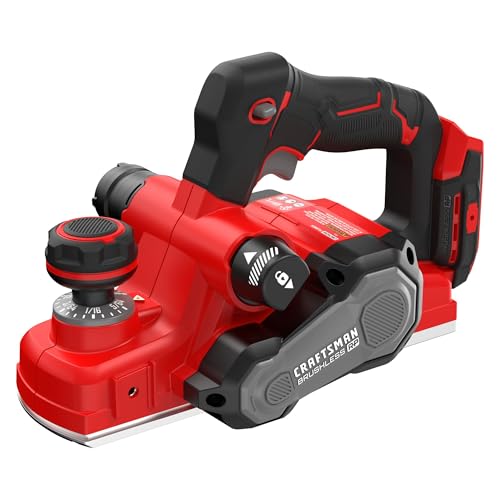
CRAFTSMAN V20 Brushless 3-1/4 Inch Cordless Hand Planer, Dust Bag
Brushless motor15,000 RPM5/64 in. depthDust bag
Check price on Amazon
Best for: A homeowner on the Craftsman V20 platform who wants brushless efficiency and a dust bag.

The Craftsman V20 planer builds around a brushless motor that spins to 15,000 rpm with no load, which works out to 30,000 cuts per minute. Brushless motors waste less energy as heat, so on a given battery they deliver more passes, and the maker's runtime claim is up to 30 passes per charge, a figure that depends heavily on the wood.

It matches the Makita on a maximum depth of cut of 5/64 inch and a 3-1/4 inch planing width, and it adds a dust bag in the box. The bag helps with chip control but fills quickly on a long face, so empty it often. Because it runs on the shared V20 battery platform, it suits owners of that battery family but not those on other systems.

Using it on a V20 pack means you can borrow a battery from a drill or a saw. Keep the shoe clean, because resin on the sole drags the tool, and replace blades as soon as the finish roughens. For homeowner jobs such as trimming doors it is hard to fault.

What works

  • Brushless motor spins to 15,000 rpm with no load
  • Dust bag included in the box
  • Claims up to 30 passes per charge
  • Same 5/64 inch depth as the Makita

Watch out for

  • Only works with the V20 battery family
  • Dust bag fills quickly on long surfaces

Spec sheet

Planing width
3-1/4 inch
Motor
Brushless
Speed
15,000 rpm, 30,000 cuts per minute
Maximum depth
5/64 inch
Platform
V20, tool only
03
Bigheimer Cordless Planer for DEWALT 20V Batteries, Tool Only
Brushless motor15,000 RPM2 mm depthDeWalt 20V fit
Check price on Amazon
Best for: An occasional user with DeWalt 20V batteries who wants a cheap planer.

This is an independent brand planer, and the maker states clearly that it is not a DeWalt product. It is designed to accept DeWalt 20V batteries, which is its whole appeal: a DeWalt owner can add a planer without buying a new battery system. A brushless motor spins to 15,000 rpm for 30,000 cuts per minute and a 3-1/4 inch width.

The depth of cut runs from 0 to 2 mm, about 0.08 inch, which is slightly deeper than the 5/64 inch of the Makita and Craftsman. The catch is support. A third-party tool on a major brand's battery interface means blade availability, warranty service and fit quality are less certain than with a name-brand product.

Try it on scrap first and check the battery seats firmly, because loose contacts cause cutouts. Keep the blades sharp, since a dull edge on a small brushless motor tears and stalls. It suits occasional use, not daily trade work.

What works

  • Uses DeWalt 20V batteries you may already own
  • Brushless motor for efficient runtime
  • Depth adjusts from 0 to 2 mm
  • Low cost as a bare tool

Watch out for

  • Third-party brand with uncertain support and parts
  • Fit and blade supply are less proven than name brands

Spec sheet

Planing width
3-1/4 inch (82 mm)
Motor
Brushless, 15,000 rpm
Depth of cut
0 to 2 mm
Cuts per minute
30,000
Battery
Fits DeWalt 20V packs, not included

Spec sheet decoder

What the numbers on the box really mean

The specs manufacturers lead with, translated into what they tell you about real-world performance.

Cuts per minute

Blade strikes per minute, calculated from rpm and blade count. Higher numbers produce a finer finish.

Watch forThe Craftsman and Bigheimer both quote 30,000 cuts per minute.

No-load rpm

The speed of the cutterhead with nothing in contact. It drops under load.

Watch forThe 15,000 rpm figure is a no-load number and falls in hardwood.

Depth of cut

The thickness removed in a single pass. Shallow passes give a better finish.

Watch forThe Makita is 5/64 inch while the Bigheimer is 2 mm.

Tool only

The listing sells the planer without a battery or charger.

Watch forAll three of these are bare tools, so factor in the battery.

Brushless motor

A motor with no carbon brushes, using electronics for commutation. It runs cooler and longer on a charge.

Watch forThe Craftsman and Bigheimer are brushless, the Makita is not.

Methodology

How We Evaluated These Cordless Hand Planers

Cutter design

We weighed blade material and count, since the cutterhead decides finish and longevity. The Makita double-edge carbide blades led, and unproven blades on the Bigheimer scored lower.

Motor and runtime

We compared brushless against brushed motors and the maker's runtime claims. The Craftsman claim of up to 30 passes per charge was treated as an optimistic ceiling.

Weight and handling

We looked at stated weights and how a pack changes balance. The Makita at 7.4 pounds bare is the reference. A bare weight is only half the story, so we also thought about where the battery sits and how the tool balances when planing a vertical door edge, where a heavy rear pack tends to lift the front shoe.

Platform and support

We considered how easily a buyer can get batteries, blades and service. Makita and Craftsman lead, while the Bigheimer depends on a third-party seller.

Dust control

We counted the dust bag in the Craftsman box as a real convenience and noted the open chutes on the others.

Decision guide

How to Choose the Right Cordless Hand Planers

By Battery You Already Own

SituationPickWhy
Own Makita 18V LXT batteriesMakita XPK01ZNative fit and carbide blades
Own Craftsman V20 batteriesCraftsman V20 planerNative fit, brushless, dust bag
Own DeWalt 20V batteriesBigheimer adapter planerFits those packs, with caveats
No batteries at allMakita XPK01ZBest long-term platform and parts supply

By Budget

TierPickWhy
Lowest costBigheimer adapter planerCheapest tool if you own the batteries
MidCraftsman V20 planerBrushless and a bag for a modest cost
HighestMakita XPK01ZCarbide blades and a trade-grade brand

Brushless vs Brushed

Brushless

The Craftsman and Bigheimer use brushless motors, which run cooler, last longer and stretch a battery further. They are the pick for a user making many passes per charge.

Brushed

The Makita is a proven brushed design with serviceable parts and a long track record. Its carbide blades matter more to finish quality than the motor type.

Pick brushless for runtime, or the Makita if blade quality and support matter more.

By Job

JobPickWhy
Trimming sticking doorsCraftsman V20 planerBag keeps the doorway clean
Planing framing lumber and paintMakita XPK01ZCarbide holds up to grit and knots
Occasional jobs on a budgetBigheimer adapter planerLow cost if batteries exist
Long edges on a ladderMakita XPK01ZLight 7.4 lb tool body

For Door and Trim Work Specifically

Look for

Look for shallow depth control, a flat shoe and some form of chip catching. Doors are planed in thin passes and chips scatter across floors. Remember that a door is usually planed on the latch edge while hung or lifted off its hinges, so a tool that balances well on a vertical edge and a battery that does not catch on the frame make the work noticeably easier. Mask the adjacent surface with tape when the door is painted to prevent chipping.

In this comparison

The Craftsman V20 ships with a dust bag and a brushless motor, which suits repeated passes on a door edge. The Makita is the choice if the door is painted or the lumber rough.

When to Spend More

Spend more if

Spend more if you plane for a living or work with paint, glue lines and knots; the Makita carbide blades and brand parts pay back over years of use. A trade user also benefits from the ability to buy a second battery, a replacement blade set or a repair part at a supply house on the same day, which no budget alternative can promise. Downtime on a job costs more than the difference in tool price.

Save if

Save if you plane a few doors a year. The Craftsman V20 or the Bigheimer is plenty, provided you already own the batteries. A tool that sits idle for months wins nothing from premium blades, so put the money toward a good straightedge and a spare set of blades, which improve results more than a more expensive body would.

Ownership

Maintenance schedule

The upkeep that decides whether this machine lasts two seasons or ten.

TaskIntervalWhy it matters
Check blade sharpnessBefore each jobA dull blade tears fibers and stalls the motor. Flip double-edge blades or replace them when the cut roughens.
Clear the chip chuteAfter each sessionPacked chips block the exhaust and overheat the motor. Brush the chute out and empty the dust bag.
Clean the shoeMonthlyResin and pitch on the sole drag on the work. Wipe it with solvent and keep it flat. Pine pitch is the usual culprit, and a rag with mineral spirits clears it in seconds. A sole that has picked up a burr or a dent will also leave a faint line along every cut, so inspect it under a raking light and file any raised metal flat.
Store the tool on its heelAlwaysResting the tool on its blades dulls them. A small block under the front shoe prevents this.
Care for batteriesSeasonallyStore packs partly charged in a cool place and avoid leaving them in a hot truck. Heat does more damage to lithium cells than cold does, and a pack left on a dashboard all summer loses capacity quickly. Remove the battery before touching the blades or clearing the chute, since an accidental trigger pull is how most planer injuries happen.

FAQ

Frequently Asked Questions

Are cordless hand planers powerful enough?

For doors, trim and edge work, yes. They plane about 5/64 inch per pass in softwood. Heavy stock removal on hardwood drains a battery quickly, and a corded planer is better for that. A practical test is to ask whether the job is fitting or removing. Trimming a door by an eighth of an inch is fitting and suits a cordless planer perfectly, while knocking a full inch off a beam is removal and belongs to a corded machine or a saw.

How many passes can I get per charge?

The Craftsman maker claims up to 30 passes, but real figures depend on wood species, depth and battery size. A 4 amp-hour pack lasts longer than a 2 amp-hour one.

Are third-party battery adapter tools safe?

They work on a mechanical fit, but support and quality vary. Check that the battery seats firmly, and avoid leaving the tool on a charger it was not designed for. The brand that makes the battery has no obligation to support a tool it did not build, so a failure under warranty is a conversation with the tool seller. If the planer matters to your income, buy the name brand on your platform instead.

Do I need a dust bag?

Indoors, yes, or a vacuum attachment. A planer throws a lot of chips. The Craftsman includes a bag, which fills fast on long surfaces.

Can a hand planer replace a thickness planer?

No. A hand planer works one edge or face by eye and cannot produce boards of uniform thickness. Use it for fitting, trimming and bevels.

How do I avoid ridges in the cut?

Keep the shoe flat on the work, apply steady pressure and take the last pass shallow. Check the blade height with a straightedge, since uneven blades leave steps. Start the cut with the front shoe firmly on the board, ease the rear shoe down as the blades engage and keep pressure over the front shoe as you leave the board, which prevents the dip at the end that makes edges look rounded. Skewing the planer slightly across the board also gives a slicing cut that tears less in cross-grained wood.

Bottom line

The short version

Browse more cordless hand planerson Amazon →
James Miller, Lead Machine Editor

About the author

James Miller

Lead Machine Editor, MachineFanatic

James Miller leads MachineFanatic's buying guides, turning spec sheets, manuals and owner feedback into clear verdicts on power tools, outdoor power equipment, shop machines and kitchen machines.

More from James →

Keep reading

Related guides