
Amazon affiliate links - we earn a commission.Affiliate disclosure

Buying guide · 15 min read · Updated 2026-11-06

Best Countertop Microwaves (2026)

Six countertop microwaves compared by real wattage, inverter or conventional power, cavity size and turntable, from compact 700W to 2.2 cubic feet.

James MillerBy James MillerLead Machine Editor6 machines comparedSpec-sheet verified
Best Countertop Microwaves

At a glance

Our top picks

Side by side

Spec comparison

MachineOutput powerCapacitySensorTurntableInput power
Panasonic NN-SN76LS 1.6 Cu Ft 1250W Inverter MicrowaveBest OverallPanasonic NN-SN76LS 1.6 Cu Ft 1250W Inverter Microwave1250W inverter1.6 cu ftGenius Sensor reheat and cookn/an/a
Sharp SMC2266KS 2.2 Cu Ft 1200W Inverter MicrowaveBest Large CapacitySharp SMC2266KS 2.2 Cu Ft 1200W Inverter Microwave1200W with inverter technology2.2 cu ftSensor Cook16.5 in carouseln/a
TOSHIBA 1.6 Cu Ft 1250W Inverter Microwave, 13.6 in TurntableBest Value InverterTOSHIBA 1.6 Cu Ft 1250W Inverter Microwave, 13.6 in Turntable1250W inverter1.6 cu ftn/a13.6 in glass1350W
TOSHIBA 1.2 Cu Ft 1000W Microwave with Humidity SensorBest Mid-Size Sensor ModelTOSHIBA 1.2 Cu Ft 1000W Microwave with Humidity Sensor1000W1.2 cu ftSmart humidity sensor12.4 in glass1600W
Chefman 0.9 Cu Ft 900W Countertop Microwave, Eco ModeBest Compact with MemoryChefman 0.9 Cu Ft 900W Countertop Microwave, Eco Mode900W0.9 cu ftn/an/an/a
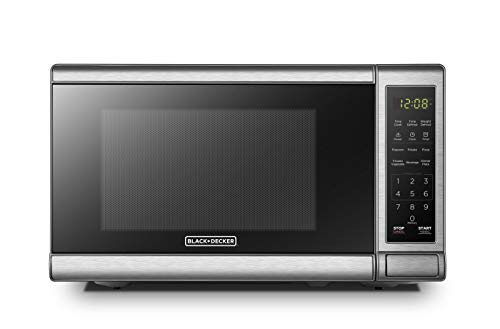
BLACK+DECKER 0.7 Cu Ft 700W Countertop MicrowaveBest for Tight SpacesBLACK+DECKER 0.7 Cu Ft 700W Countertop Microwave700W0.7 cu ftn/a10 in glass1050W

A countertop microwave looks like a box with a number on the door, but the number on the box, whether watts or cubic feet, hides how the oven delivers its power. Two machines with the same wattage can heat very differently depending on how they control it.

This guide explains how inverter and conventional power supplies work, why turntable size can matter more than cubic feet, and how to size a microwave to your counter. The quick picks are above, and the reviews below show which machine fits which kitchen.

Before you buy

6 Criteria to Look For Before Buying a Countertop Microwave

  1. 01

    Wattage and Real Power

    Microwave wattage is the output power, and it sets how fast food heats. Most recipes assume 1000 to 1100W, so a lower rating needs longer times. The Panasonic NN-SN76LS is rated 1250W, the Sharp 1200W, the Toshiba 1.2 cu ft 1000W, the Chefman 900W and the BLACK+DECKER 700W. Each 100W step down means roughly ten percent more time.

  2. 02

    Inverter vs Conventional

    A conventional microwave gets lower power by switching the full-power magnetron on and off, which heats food in bursts. An inverter keeps the power steady at the level you choose, giving more even defrosting and reheating. The Panasonic, Sharp and Toshiba 1.6 cu ft are inverter models, while the Toshiba 1.2, Chefman and BLACK+DECKER are conventional. Inverters matter most for defrosting and delicate foods, and they matter little if you only boil water. Do not pay for one if you never use a power level other than full.

  3. 03

    Cavity Size and Turntable

    Cubic feet gives total volume, but the turntable decides what fits. The Sharp has a 16.5 inch turntable, the Toshiba 1.6 cu ft a 13.6 inch, the Toshiba 1.2 a 12.4 inch and the BLACK+DECKER only 10 inches. A dinner plate is about 10 to 11 inches across, and it must be able to spin freely. Measure your largest dish before choosing, and remember that glass turntables can be replaced if one breaks, while a too-small cavity cannot be fixed.

  4. 04

    Footprint and Placement

    A microwave needs clearance around vents and a stable counter. The Panasonic takes about 21.9 by 19.4 inches and the BLACK+DECKER 17.3 by 13 inches. Check height under upper cabinets and leave several inches of ventilation space. Place the oven on a sturdy surface, away from the counter edge.

  5. 05

    Sensor and Preset Cooking

    Sensor cooking measures steam from food and adjusts time and power. The Panasonic Genius Sensor, Sharp Sensor Cook and Toshiba humidity sensor all do this. Sensors work best with covered dishes of ordinary leftovers. Presets for popcorn and pizza are convenient but vary in accuracy, so watch the first few runs and adjust. The Panasonic lists 15 presets, the Toshiba 1.6 cu ft six sensor menus and the BLACK+DECKER six one-touch buttons.

  6. 06

    Child Lock and Daily Features

    All US countertop microwaves now ship with a mandatory child lock, often enabled out of the box, and the Panasonic listing says so. Features like mute, eco mode and memory are small conveniences, and the Chefman 0.9 offers all three. A handle-pull door lock or push-button door are matters of preference, though the BLACK+DECKER push button is easier for stiff hands. Check that the lock is easy to disable for adults, because some are fiddly.

Detailed reviews

The 6 best countertop microwaves, explained

01
Panasonic NN-SN76LS 1.6 Cu Ft 1250W Inverter Microwave
1250W inverter1.6 cu ftGenius Sensor15 presets
Check price on Amazon
Best for: Households that reheat, defrost and cook often and want even results from a full-size inverter machine.

The Panasonic NN-SN76LS is the best overall pick because it combines the highest output in this lineup with the technology that makes high power usable. A conventional microwave gets lower power by switching the magnetron on and off in pulses. An inverter holds a steady lower output instead, so a 30 percent setting actually delivers 30 percent continuously, which is why inverter models defrost and reheat more evenly. At 1250W it is the strongest machine here, ahead of the 1200W Sharp and the 1000W Toshiba.

The Genius Sensor adjusts time and power from steam released by the food, and it feeds 15 preset menus plus Turbo Defrost and Keep Warm. At 1.6 cubic feet it is smaller than the Sharp's 2.2 cubic feet but larger than the 1.2 cubic foot Toshiba, and it takes a modest 21.9 by 19.4 inches of counter.

Ownership is simple but has one trap. The unit ships with a mandatory child lock enabled, so the door and keypad can appear dead until you disable it by following the manual. Wipe the cavity after splatters, because baked-on grease absorbs energy and causes hot spots.

What works

  • 1250W inverter holds steady low power for even defrosting
  • Genius Sensor adjusts time and power for reheating
  • Fifteen presets plus Turbo Defrost and a Keep Warm function
  • Compact footprint for a 1.6 cubic foot oven cavity

Watch out for

  • Costs more than the plain conventional 1000W machines
  • Ships with a child lock enabled that confuses new owners

Spec sheet

Output power
1250W inverter
Capacity
1.6 cu ft
Footprint
21.9 W x 19.4 D x 11.9 H in
Sensor
Genius Sensor reheat and cook
Presets
15 auto cook options
Extras
Turbo Defrost, Keep Warm, 3-stage cooking
02
Sharp SMC2266KS 2.2 Cu Ft 1200W Inverter Microwave
2.2 cu ft1200W inverter16.5 in turntableSensor Cook
Check price on Amazon
Best for: Families who cook large dishes and want a full-size turntable that fits platters and casserole dishes.

The Sharp SMC2266KS is the biggest microwave in this lineup, with a 2.2 cubic foot cavity and a 16.5 inch carousel turntable. That turntable matters more than the cubic foot number, because it decides whether a 13 inch dinner plate or a large casserole actually rotates without hitting the walls. Inverter technology and 1200W of output power mean it heats strongly and defrosts more evenly than a conventional 1100W machine.

It offers 10 power levels, two-stage cooking, Sensor Cook and weight or time defrost, which is a solid, uncomplicated feature set. Against the Panasonic NN-SN76LS, it has more capacity but slightly less power at 1200W versus 1250W, and fewer presets. Against the 1.6 cubic foot Toshiba inverter, it is a larger machine that needs counter space for its much wider body.

Because it is large, plan counter and outlet placement before you buy and check the cabinet clearance. Single-person households that mostly heat mugs will find it larger than they need. Wipe the interior after splatters so grease does not bake on.

What works

  • Largest cavity here at 2.2 cubic feet with a 16.5 inch turntable
  • Inverter technology delivers steady low-power cooking
  • Two-stage cooking and Sensor Cook add cooking flexibility
  • Gray interior and LED display are easy to read and clean

Watch out for

  • Large body needs a lot of counter and cabinet clearance
  • Overkill for one or two people reheating small portions

Spec sheet

Output power
1200W with inverter technology
Capacity
2.2 cu ft
Turntable
16.5 in carousel
Power levels
10 with 2-stage cooking
Sensor
Sensor Cook
Defrost
Weight and time
03
TOSHIBA 1.6 Cu Ft 1250W Inverter Microwave, 13.6 in Turntable
1250W inverter1.6 cu ft13.6 in turntableSmart Sensor
Check price on Amazon
Best for: Buyers who want inverter evenness and 1250W output without choosing the best-known brand.

The Toshiba inverter delivers the same headline specs as the Panasonic, 1250W and 1.6 cubic feet, in a straightforward package with six sensor menus and a 13.6 inch turntable. Its listing gives an input power of 1350W against a 1250W output, which is a useful clue: an inverter converts electricity to microwave energy more efficiently than the transformer in a conventional oven, which draws 1600W to deliver 1000W.

Compared with the Panasonic NN-SN76LS, it has fewer presets and a less established inverter reputation, but it is in the same capability class and sits in the value position for inverter ownership. Against the 1.2 cubic foot Toshiba with 1000W, it adds both capacity and a steadier power curve, and it has a larger turntable than that model's 12.4 inches. In daily use the difference from the Panasonic will show up mainly in the preset list rather than in how evenly it heats.

The external dimensions of 21.8 by 17.8 by 12.9 inches make it deeper than the Panasonic, so check the counter. The two-step child lock is mandatory and must be disabled before first use. Keep the door seal clean, and avoid running it empty. Give it a few inches of vent clearance, and place it where the deeper body does not hang over the counter edge.

What works

  • Inverter technology at 1250W gives even defrosting and reheating
  • 1.6 cubic feet with a 13.6 inch turntable suits dinner plates
  • Input power is close to output power, a sign of efficiency
  • Six sensor menus automate common reheating and cooking tasks

Watch out for

  • Deeper body takes more counter space than the Panasonic
  • Fewer presets than the Panasonic NN-SN76LS and a lesser known inverter

Spec sheet

Output power
1250W inverter
Input power
1350W
Capacity
1.6 cu ft
Size
21.8 x 17.8 x 12.9 in
Turntable
13.6 in glass
Sensor menus
6 auto sensor
04
TOSHIBA 1.2 Cu Ft 1000W Microwave with Humidity Sensor
1000W output1.2 cu ft12.4 in turntableHumidity sensor
Check price on Amazon
Best for: Everyday households that reheat meals and cook basics and want a mid-size oven without paying for an inverter.

This Toshiba is a conventional 1000W microwave in the sweet-spot size of 1.2 cubic feet. Its listing shows 1000W output and 1600W input, which means the transformer-based power supply is less efficient than the inverter designs, and it relies on pulsing to get lower power levels. For popcorn, beverages and frozen entrees, that is rarely a problem. For defrosting a roast or melting chocolate, it gives less even results than the Panasonic or the Toshiba inverter.

A humidity sensor lets it adjust time for reheating, and a mute function and ECO mode are useful for small kitchens. At 20.6 by 14.6 inches it fits a typical counter, and the 12.4 inch turntable takes a standard dinner plate with room to spin. Compared with the Chefman 0.9 cubic foot at 900W, it offers more capacity and power, and compared with the 1250W units it trades even heat for a lower price.

Sensor reheating works best on food of consistent moisture, so cover dishes and use it for leftovers rather than dry foods. It suits households that want a reliable microwave without inverter extras.

What works

  • Humidity sensor adjusts cooking time on reheated meals
  • Mute and ECO modes are handy in quiet kitchens and at night
  • 12.4 inch turntable takes a standard dinner plate with room to spin
  • Mid-size 1.2 cu ft body fits most kitchen counters comfortably

Watch out for

  • Conventional power pulses give less even defrosting
  • Draws 1600W input for 1000W output, less efficient than inverters

Spec sheet

Output power
1000W
Input power
1600W
Capacity
1.2 cu ft
Size
20.6 x 14.6 x 11.8 in
Turntable
12.4 in glass
Sensor
Smart humidity sensor
05
Chefman 0.9 Cu Ft 900W Countertop Microwave, Eco Mode
900W output0.9 cu ftMemory functionEco mode
Check price on Amazon
Best for: Small kitchens and apartments that want more power than a 700W mini oven without a full-size footprint.

The Chefman is a compact conventional microwave with 900W output and a 0.9 cubic foot cavity, a middle ground between the 700W mini machines and the larger 1000W models. It offers ten power levels, six one-touch presets and a memory function that stores a favorite routine for one-touch use. An eco mode can turn off the display to save standby power, and a lock mode disables the panel.

The 900W rating lands between the 1000W Toshiba and the 700W BLACK+DECKER. Food that takes 2 minutes in a 1000W machine will take longer here, so use the usual conversion of adding about ten percent per 100 watts. At 0.9 cubic feet it handles a dinner plate only if the turntable is large enough, so check the turntable diameter before buying. The handle-pull door has a built-in child safety lock.

Glass turntables are listed as top-rack dishwasher safe, which simplifies cleaning. The warranty is one year.

What works

  • 900W output is a step up from the 700W mini microwaves
  • Memory function saves a routine for one-touch cooking
  • Eco mode and lock mode save standby power and add safety
  • Dishwasher-safe glass turntable cleans easily after spills

Watch out for

  • Conventional pulsing gives less even low-power cooking
  • Smaller cavity may not fit larger plates or casserole dishes

Spec sheet

Output power
900W
Capacity
0.9 cu ft
Power levels
10
Presets
6 one-touch
Extras
Memory, eco mode, lock mode
Warranty
1-year
06
BLACK+DECKER 0.7 Cu Ft 700W Countertop Microwave
700W output0.7 cu ft10 in turntablePush-button door
Check price on Amazon
Best for: Dorms, offices and small apartments where counter space is more important than capacity.

The BLACK+DECKER is the smallest microwave in this lineup, with 0.7 cubic feet of cavity and a 17.3 by 13 by 10.2 inch body. That makes it a fit for a dorm, office or tiny kitchen where space is the constraint. A 700W output is the standard for mini microwaves, and the 1050W input is lower than the 1600W of the full-size units, so it also draws less from the outlet.

The 10 inch turntable cannot rotate a full dinner plate, so it is for mugs, bowls and smaller plates. Against the 900W Chefman, it is slower on every task and has a smaller cavity, and against the 1000W Toshiba it takes noticeably longer. It uses a push-button door release and a child safety lock, with six one-touch presets for popcorn, potato and pizza.

Because the power is low, food needs longer times, so adjust package directions upward. Keep an eye on food that is placed off center, since a small turntable can leave cold spots. A one-year limited warranty is listed.

What works

  • Smallest footprint here at about 17.3 by 13 inches
  • Push-button door and large LED display are easy to use
  • Six presets cover popcorn, potato, pizza and beverages
  • Lower input draw is easier on shared or limited circuits

Watch out for

  • 700W output makes every task slower than the bigger models
  • Ten inch turntable will not rotate a full dinner plate
  • Conventional pulsing power gives uneven low-power results

Spec sheet

Output power
700W
Input power
1050W
Capacity
0.7 cu ft
Size
17.3 x 13 x 10.2 in
Turntable
10 in glass
Warranty
1-year limited

Spec sheet decoder

What the numbers on the box really mean

The specs manufacturers lead with, translated into what they tell you about real-world performance.

Output watts

This is the microwave energy that reaches the food, measured under a standard test. It sets heating speed.

Watch forInput wattage is a different figure. The Toshiba 1.2 lists 1000W output with 1600W input, so don't compare input to output.

Inverter technology

An inverter power supply lets the magnetron run continuously at reduced power instead of cycling on and off.

Watch forSome marketing calls any digital control inverter. The Panasonic, Sharp and Toshiba 1.6 cu ft are true inverter designs.

Cubic feet capacity

Capacity is the internal volume of the cavity, measured in cubic feet. It sets how much food fits.

Watch forCapacity is not usable space. A 2.2 cu ft Sharp has a 16.5 inch turntable, while a 0.7 cu ft unit has a 10 inch one.

Sensor cooking

A sensor measures humidity or steam released from food and ends cooking when the food is hot.

Watch forSensors work with covered, moist food. They are less accurate with dry or dense foods.

Methodology

How We Evaluated These Countertop Microwaves

Power delivery

We compared rated output from 700W to 1250W and separated inverter machines from conventional ones, such as the Panasonic, Sharp and Toshiba inverter versus the Chefman and BLACK+DECKER.

Cavity and turntable fit

We matched cubic feet to turntable diameter, from the Sharp's 16.5 inch to the BLACK+DECKER's 10 inch, because the turntable decides what dishes can spin.

Controls and sensors

We looked at sensor reheating, presets, mute and memory functions, and how each machine handles the mandatory child lock.

Footprint and efficiency

We checked dimensions and input power, noting that the Toshiba inverter uses 1350W input for 1250W output while the Toshiba 1.2 uses 1600W for 1000W.

Decision guide

How to Choose the Right Countertop Microwaves

By Household Size

Cavity and turntable size follow how many people you cook for.

Your householdRecommended pickWhy
One person, tight spaceBLACK+DECKER 0.7Smallest footprint
Two people, small kitchenChefman 0.9900W in a compact body
Two to three peopleToshiba 1.2Mid-size with humidity sensor
Family cooking regularlyPanasonic NN-SN76LS1250W inverter at 1.6 cu ft
Large dishes and plattersSharp SMC2266KS2.2 cu ft and 16.5 inch turntable
Value inverterToshiba 1.6 cu ft1250W at a lower tier

By Budget

Relative tiers only.

TierRecommended pickWhy
Least expensiveBLACK+DECKER 0.7Basic mini microwave
Lower midChefman 0.9More power and memory
MidToshiba 1.2Humidity sensor and 1000W
Mid to upperToshiba 1.6 cu ftInverter at a lower price
UpperSharp SMC2266KSLarge and inverter
PremiumPanasonic NN-SN76LSEstablished inverter design

Inverter vs Conventional

Inverter

The Panasonic NN-SN76LS, Sharp SMC2266KS and Toshiba 1.6 cu ft deliver steady power at any level, which gives more even defrosting and reheating. They cost more but waste less power as heat.

Conventional

The Toshiba 1.2, Chefman 0.9 and BLACK+DECKER 0.7 pulse full power on and off for lower settings. They are fine for popcorn and reheating, but less even for delicate tasks.

Pick an inverter if you defrost meat or reheat leftovers often. Choose conventional if you mostly use full power.

Capacity vs Counter Space

PriorityRecommended pickWhy
Smallest footprintBLACK+DECKER 0.717.3 by 13 inches
Balance of space and sizeToshiba 1.220.6 by 14.6 inches
Largest cavitySharp SMC2266KS2.2 cu ft
Compact for its powerPanasonic NN-SN76LSLarge cavity, modest footprint

For Defrosting and Reheating Specifically

Look for

An inverter power supply, a sensor and a defrost mode by weight. Even heating matters more than peak watts.

In this comparison

The Panasonic NN-SN76LS leads with Turbo Defrost and Genius Sensor. The Sharp and Toshiba inverter are the next best fits.

When to Spend More

Spend more if

You defrost and reheat daily, which points to the Panasonic or Toshiba inverter. You also cook for a family and want the Sharp's cavity.

Save if

You mostly heat drinks and snacks, where the BLACK+DECKER or Chefman is enough. You have a small kitchen where a large oven would not fit.

Ownership

Maintenance schedule

The upkeep that decides whether this machine lasts two seasons or ten.

TaskIntervalWhy it matters
Wipe the cavityAfter splattersBaked-on food absorbs microwave energy, which creates hot spots and smells. A damp cloth after each use prevents it.
Clean the door sealWeeklyGrease on the seal can prevent the door from closing flat. Wipe it with mild soap.
Wash the turntable and ringWeeklyResidue on the roller ring makes the glass wobble or stick. Most turntables are dishwasher safe.
Check vents and clearanceMonthlyBlocked vents overheat the electronics. Keep a few inches free on the sides and top.
Inspect the door and cordYearlyA damaged hinge or cord is a safety issue. Stop using a microwave with a door that does not close and seal flat, and replace it rather than repair it.

FAQ

Frequently Asked Questions

Is an inverter microwave worth it?

If you defrost or reheat often, yes. It delivers steady lower power instead of pulses, which gives more even results on a defrosting roast or a bowl of soup. For popcorn and drinks, a conventional machine works fine, and you save money.

How much should I spend?

Compact 700W machines are the least expensive tier. Mid-size 1000W units cost more, and inverter models from Panasonic, Sharp and Toshiba are in the upper tiers. The extra cost buys evenness and capacity.

Why does my microwave heat unevenly?

Microwaves create standing waves with hot and cold spots, and the turntable averages them out. Inverter models reduce pulsing, and covering food and stirring halfway through help. A turntable that is too small leaves cold edges, and a plate pushed to the side will not rotate properly.

Is higher wattage always better?

Higher wattage heats faster, but evenness depends on the power supply. A 1250W inverter is gentler at low power than a 1000W conventional unit. Match wattage to recipe times, and adjust package directions when your oven differs from the 1000 to 1100W they assume.

Why does my new microwave not start?

US countertop microwaves ship with a mandatory child lock, often enabled. The manual explains how to disable it. The Panasonic listing specifically mentions it.

How big should the turntable be?

It should rotate freely with your largest dish. A dinner plate is about 10 to 11 inches, so a 10 inch turntable is too small. The Sharp's 16.5 inch turntable fits large platters.

Bottom line

The short version

Browse more countertop microwaveson Amazon →
James Miller, Lead Machine Editor

About the author

James Miller

Lead Machine Editor, MachineFanatic

James Miller leads MachineFanatic's buying guides, turning spec sheets, manuals and owner feedback into clear verdicts on power tools, outdoor power equipment, shop machines and kitchen machines.

More from James →