
Amazon affiliate links - we earn a commission.Affiliate disclosure

Buying guide · 15 min read · Updated 2026-11-09

Best Drill Presses Under $200 (2026)

Five benchtop drill presses under $200 compared on swing, motor amps, speed range, table tilt and cast iron build, with what budget presses give up.

James MillerBy James MillerLead Machine Editor5 machines comparedSpec-sheet verified
Best Drill Presses Under $200

At a glance

Our top picks

Side by side

Spec comparison

A drill press does one thing a hand drill cannot: it holds the bit square to the table and feeds it straight down, so holes land where you marked them at the angle you set. That accuracy is what makes the tool worth owning, and it is also what cheap versions compromise first.

At a low price the questions change from how much power you need to how much wobble you can live with. This guide covers swing, speed range, table design and the signs of a press that will hold a tolerance. The quick picks are above, and the reviews below show which press suits which shop.

Before you buy

6 Criteria to Look For Before Buying a Drill Press Under $200

  1. 01

    Swing equals twice the reach

    Swing is the diameter of the largest circle you can drill the center of, so a 10-inch swing reaches 5 inches from the column and an 8-inch swing reaches 4 inches. The JET and VEVOR are 10-inch presses, and the QD-KYOHO, ExploreHorizon and KYBOLT are 8-inch. If you drill the centers of panels wider than 8 inches, buy a 10-inch press. As a rough guide, a 10-inch press reaches 5 inches from the column, which lets you drill the center of a 10-inch-wide board for shelf pin holes.

  2. 02

    Motor amps versus horsepower

    The JET lists 1/3 HP and 6.2 amps, while the others list only amps, 3.2 for the VEVOR, 3.1 for the QD-KYOHO and 2.5 for the ExploreHorizon and KYBOLT. Higher amps generally mean a stronger motor, but an induction motor draws fewer amps for the same output than a universal motor. For metal, favor the higher figure. The JET's 6.2 amp rating is about double the 3.1 to 3.2 amp motors on the VEVOR and QD-KYOHO, and that headroom shows when drilling 1/2-inch holes in steel.

  3. 03

    Speed range for materials

    Large bits and metal need slow speeds, around 600 to 700 rpm for bits near 1/2 inch in steel, while small bits in wood run at 2,000 rpm and above. Most presses here run about 620 to 3,100 rpm. The KYBOLT's 740 slow speed is the least flexible for metal. As a rule, drill speed in rpm drops as bit diameter goes up, so a press that starts at 620 or 630 rpm handles larger bits better than one starting at 740.

  4. 04

    Chuck type and runout

    A taper-mounted chuck like the JET's JT33 seats by friction and stays concentric, while cheaper threaded chucks can wobble. Check runout by spinning a rod in the chuck and watching the tip. More than a few thousandths of an inch of wobble makes accurate holes impossible. Spin a straight drill rod in the chuck at low speed and watch the tip, because visible wobble means poor runout.

  5. 05

    Cast iron versus lighter materials

    Mass damps vibration, so a cast iron head and base like the QD-KYOHO's yield cleaner holes than lighter materials. Heavier also means more rust risk and a harder lift. Budget presses vary widely in casting quality, so look for a flat, machined table. Heavier castings damp vibration, but a thin, flat table that is ground true matters more than the head casting.

  6. 06

    Table tilt and stability

    The JET and KYBOLT tilt 45 degrees for angled holes. Cheap tables can sag under load or lose square, so check with a square before use. A table that does not lock firmly makes tilt features useless. Check that the table lock holds, since a table that droops by a degree under load will ruin angled work.

Detailed reviews

The 5 best drill presses under $200, explained

01
JET JWDP-10 10-Inch Benchtop Drill Press, 1/3 HP, 5 Speed
10-inch swing6.2 amp, 1/3 HP630-3300 rpmTable tilts 45 degrees
Check price on Amazon
Best for: Woodworkers and hobbyists who want a dependable press with a 1/2-inch chuck and brand support.

The JET is the only press here with a stated horsepower, 1/3 HP, which tells you how the 6.2 amp motor should be read: a real, sustained rating rather than a peak. That motor spins a five-speed belt drive from 630 to 3,300 rpm, a range that covers large bits in steel at the slow end and small bits in wood at the fast end. A 10-inch swing means it can drill the center of a board up to 10 inches wide, so it handles typical shelf and panel work.

The JT33 taper chuck is a better connection than the threaded or press-fit chucks on cheaper presses, because the taper seats by friction and stays concentric. A 1/2-inch chuck capacity allows common bits up to that size. The table tilts 45 degrees each way, which matters for angled holes in rails and legs. Compared with the VEVOR 10-inch, the JET has a name-brand parts and service backing and a stated horsepower, while the VEVOR has a lower amp draw.

You still get a benchtop press. Quill travel and column stiffness are modest, and deep holes in thick stock will deflect a little. Use clamps or the supplied hold-downs rather than your hand, and change belt positions only with the unit unplugged. Square the table to the bit with an engineer's square when you set it up.

What works

  • Stated 1/3 HP rating with a 6.2 amp motor
  • JT33 taper chuck holds bits concentrically
  • 10-inch swing handles wide panels
  • Table tilts 45 degrees either way

Watch out for

  • Belt changes mean reaching into the head for speed
  • Benchtop column flexes on deep holes in thick stock
  • Costs more than the unbranded 8-inch presses

Spec sheet

Swing
10 inches
Motor
1/3 HP, 120V, 6.2 amp
Speed range
630 to 3,300 rpm, 5 speeds
Chuck
JT33 taper, 1/16 to 1/2 inch
Table
Tilts plus or minus 45 degrees
Model number
JWDP-10 (JT1-3162)
02
VEVOR 10-Inch Benchtop Drill Press, 3.2 Amp Induction, 5 Speed
10-inch swing3.2 amp induction650-3100 rpm5-speed belt
Check price on Amazon
Best for: Buyers who want a 10-inch swing on a tight budget and accept unbranded parts.

The VEVOR is the budget way into a 10-inch swing. Its 3.2 amp motor is an induction type, which runs quieter and smoother than the universal motors that dominate cheap hand tools because it has no brushes to wear and spins at a steady speed. Induction motors, however, make less starting torque for their size, so a 3.2 amp unit is more modest than the JET's 6.2 amp rating.

Its speed range of 650 to 3,100 rpm is close to the JET's, with five steps changed by moving the belt. At the slow end you can drill 1/2-inch holes in steel, and at the fast end you can drill small bits in wood. The VEVOR gives you the larger swing without the brand price, though you give up the JT33 taper chuck and the name-brand parts supply, and a replacement belt or chuck may be harder to find.

The listing promises holes without offset, which depends on the quill and chuck. Check the runout when you get it by spinning a drill rod in the chuck and looking for wobble at the tip. Cheap presses vary unit to unit, so test it before you build a fixture around it.

What works

  • Quiet induction motor with no brushes
  • 10-inch swing at a budget price
  • Five speeds from 650 to 3,100 rpm
  • Suits wood and light metal work

Watch out for

  • 3.2 amp motor is weaker than the JET's 6.2 amp
  • Replacement parts may be harder to source
  • Runout varies between units and should be checked

Spec sheet

Swing
10 inches
Motor
3.2 amp induction
Speed range
650 to 3,100 rpm, 5 speeds
Intended use
Wood and metal
Build
Benchtop
Claim
Precise holes without offset
03
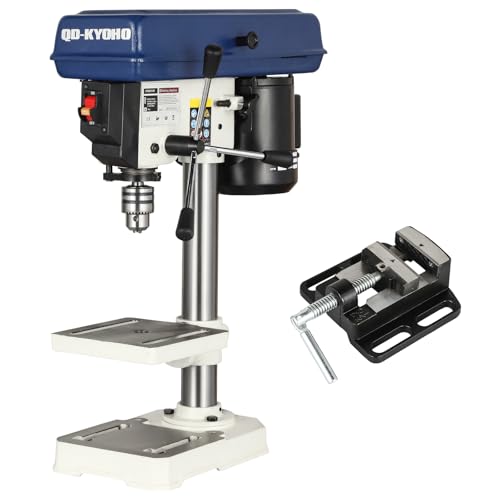
QD-KYOHO 8-Inch Benchtop Drill Press, 300W Cast Iron Head, Vise
8-inch swing3.1 amp, 300W5 speeds, 620+ rpmIncludes vise
Check price on Amazon
Best for: Small-parts and metalwork users who want a heavy base and a vise included.

The QD-KYOHO leads with metal, a cast iron head and an extra-thick cast iron base. Cast iron damps vibration better than the stamped steel and aluminum on many budget presses, and a heavy base keeps the press from walking across the bench. A drill press is a vibration problem as much as a motor problem, so that mass is worth more than a few extra watts.

The 300W motor, rated at 3.1 amps, sits in the same class as the VEVOR's 3.2 amp motor but in an 8-inch swing, so it reaches only 4 inches from the column to the center. The five preset speeds start at 620 rpm. Compared with the JET, which costs more and offers a taper chuck, the QD-KYOHO adds a vise in the box, with jaws 2-1/2 inches wide opening 2-1/4 inches, which solves the hold-down problem for small parts.

The 8-inch swing means you cannot drill the center of a board wider than 8 inches. That is the main limit. Keep the table and vise surfaces clean, because chips under the vise ruin accuracy, and wipe the cast iron with a light oil to prevent rust.

What works

  • Cast iron head and base reduce vibration
  • Precision vise included in the box
  • 300W motor handles wood and light metal
  • Heavy base resists walking

Watch out for

  • 8-inch swing limits wide panels
  • Motor is modest for drilling thick steel
  • Cast iron needs a wipe of oil to prevent rust

Spec sheet

Swing
8 inches
Motor
300W, 3.1 amp
Speeds
5 preset, starting at 620 rpm
Head and base
Cast iron
Included
Precision vise, 2-1/2 inch jaws
Vise opening
2-1/4 inches
04
ExploreHorizon 8-Inch Benchtop Drill Press, 2.5A, Laser and LED
8-inch swing2.5 amp induction620-3100 rpmLaser and LED light
Check price on Amazon
Best for: Beginners who want help aligning marks and a work light for dim shops.

The ExploreHorizon adds the laser and light that many first-time buyers want. A Class II laser at 1 mW maximum projects a line or crosshair on the workpiece, so you can align a mark with the bit before lowering the quill, and a 1 W LED lights the work area under the head. These are conveniences, and useful ones for people who struggle to see the mark.

Underneath is a 2.5 amp induction motor, tied with the KYBOLT for the smallest in the group, running five speeds from 620 to 3,100 rpm. It is adequate for wood, plastic and small holes in thin metal. Against the QD-KYOHO, it has a smaller motor and no vise, but it has a laser, and against the KYBOLT it offers a slightly lower slow speed.

A laser is only as accurate as its alignment, so check it with a test hole in scrap and adjust it if the manufacturer allows. Do not trust it for precision work. The cheapest way to improve any drill press is to clamp the work and use a backing board, and that applies equally here.

What works

  • Laser and LED simplify aligning the bit to a mark
  • Induction motor is quiet and steady
  • 620 rpm slow speed suits bigger bits
  • Compact footprint for small benches

Watch out for

  • 2.5 amp motor is the weakest tier here
  • 8-inch swing limits wide boards
  • Laser alignment should not be trusted without a test hole

Spec sheet

Swing
8 inches
Motor
2.5 amp induction
Speed range
620 to 3,100 rpm
Positioning aid
Class II laser, 1 mW maximum
Work light
1 W LED
Speed control
Five-speed
05
KYBOLT 8-Inch Benchtop Drill Press, 2.5 Amp, 5 Speed
8-inch swing2.5 amp motor740-3100 rpmTable tilts 0-45 deg
Check price on Amazon
Best for: Buyers who need a drill press for occasional wood and plastic and want to spend the least.

The KYBOLT is the plain 8-inch press: a 2.5 amp motor, five speeds from 740 to 3,100 rpm and a table that tilts from 0 to 45 degrees. The slowest speed is higher than the others here, which is a limitation for drilling steel or large bits, where slower speeds keep the bit from overheating. A faster minimum speed is fine for wood and plastic.

It is the lowest-priced press in the group apart from the mini model, and that is its pitch. Compared with the QD-KYOHO it has no vise or cast iron head, and compared with the ExploreHorizon it has no laser. What you get is the essentials, which makes sense for someone who wants a drill press and does not need extras.

Set it up carefully. Square the table to the bit, and tighten the table lock firmly, since budget presses often let the table sag. Use a drill press vise or clamps, and never hold small parts by hand, since a spinning bit will grab the stock.

What works

  • Lowest price in the benchtop group
  • Table tilts 0 to 45 degrees
  • Simple five-speed belt drive
  • Compact 8-inch size fits small benches

Watch out for

  • 740 rpm slowest speed is too fast for large bits in steel
  • No vise, laser or extras
  • 2.5 amp motor limits metal work

Spec sheet

Swing
8 inches
Motor
2.5 amp
Speed range
740 to 3,100 rpm, 5 speeds
Table
Tilts 0 to 45 degrees
Materials
Wood, metal and plastic
Extras
None listed

Spec sheet decoder

What the numbers on the box really mean

The specs manufacturers lead with, translated into what they tell you about real-world performance.

Swing

Swing is twice the distance from the column to the center of the chuck. It sets the widest workpiece you can center a hole in. A 10-inch swing means a 5 inch reach, and the actual maximum is less once you add the fence or vise.

Watch forSome makers quote the swing as the size of the press, but the usable reach is half of it.

Amps and HP

Amps measure current draw and HP rates mechanical output. The JET's 1/3 HP at 6.2 amps shows the relationship. Stated horsepower often means peak, so the JET's 1/3 HP is best read alongside its 6.2 amp draw.

Watch forBudget listings often skip HP. Do not infer power from amps across motor types.

Induction motor

An induction motor has no brushes and runs quietly at a steady speed. It lasts longer than a universal motor. Quiet running is a real benefit when you drill for long periods.

Watch forCheck that the listing says induction. The VEVOR and ExploreHorizon do.

Runout

Runout is how far the bit tip wobbles as the chuck spins. Less is better for accurate holes. Some manufacturers measure runout at the chuck face rather than at the bit tip, so ask before comparing.

Watch forBudget presses rarely publish runout. Measure it yourself.

JT33 taper

A Jacobs taper is a cone that seats the chuck by friction. It holds more concentrically than a threaded fit. Taper-mounted chucks can be removed with a drift, which makes upgrades possible later.

Watch forOnly the JET lists a JT33 chuck here. A press without it may have a threaded chuck that wobbles.

Methodology

How We Evaluated These Drill Presses Under $200

Swing and capacity

We compared swing and chuck capacity first, because they define which jobs fit. The JET and VEVOR offer 10 inches, and the others 8. We compared stated motor ratings across amps and horsepower and noted when only one was given.

Motor strength

We ranked motors by stated amps and HP, giving the JET's 6.2 amps top place, followed by the VEVOR's 3.2 and QD-KYOHO's 3.1. We counted belt speeds and their range rather than simply the number of speeds.

Speed range

We checked slow speeds for metal and fast speeds for small bits. The JET's 630 and VEVOR's 650 beat the KYBOLT's 740. Mass and cast iron got extra credit because drill presses are vibration problems first.

Build and mass

We favored cast iron and heavier bases for vibration control, which gave the QD-KYOHO credit. We treated included vises and lasers as conveniences, not core capability.

Fit across the lineup

Each press was placed by use: woodworker, metal hobbyist and beginner. We assumed a home workshop with a bench, not a production line.

Decision guide

How to Choose the Right Drill Presses Under $200

By Workpiece Size

Choose by how wide your work is.

WorkRecommended pickWhy
Wide panels and shelvesJET JWDP-1010-inch swing, strong motor.
Wide work on a tight budgetVEVOR 10-inch10-inch swing, lower price.
Small metal partsQD-KYOHO 8-inchCast iron and a vise.
Dim shop and small marksExploreHorizonLaser and LED.
Basic occasional drillingKYBOLT 8-inchLowest price.

If you drill centers of boards over 8 inches, take a 10-inch press.

By Budget

Relative tiers in this group.

TierPickWhat you get
LowestKYBOLTBasic 8-inch.
LowExploreHorizonLaser and LED.
MidVEVOR 10-inch10-inch swing.
UpperQD-KYOHOCast iron and a vise.
TopJET JWDP-10Brand and 6.2 amp motor.

The JET costs the most but gives the strongest motor and best chuck.

8-Inch vs 10-Inch Swing

Swing is the most visible spec.

8-inch

The QD-KYOHO, ExploreHorizon and KYBOLT are smaller, lighter and easier to store. They reach 4 inches from the column.

10-inch

The JET and VEVOR reach 5 inches, handle wider panels and carry stronger motors.

Choose 8-inch for small work and limited bench space, and 10-inch for furniture.

Wood vs Metal Use

Material decides speed and motor needs.

MaterialPickReason
Mostly woodVEVOR 10-inchQuiet induction, wide swing.
Mixed wood and steelJET JWDP-10Slow 630 rpm and strong motor.
Small metal partsQD-KYOHOVise and mass.
PlasticsExploreHorizonLight and controllable.
Light general useKYBOLTBasic and cheap.

Use cutting oil on steel and slow the press as the bit gets bigger.

For Furniture Making Specifically

Furniture needs wide reach and clean holes.

Look for

A 10-inch swing, a tilting table and a fence-friendly flat table. Use a backer board to prevent tear-out.

In this comparison

The JET and VEVOR fit best, with the JET holding bits more securely through its taper chuck.

When to Spend More

Budget presses have limits.

Spend more if

You drill large holes in steel or want floor-standing capacity. The JET is the upper limit here.

Save if

You drill small holes in wood. The KYBOLT or ExploreHorizon will do.

Ownership

Maintenance schedule

The upkeep that decides whether this machine lasts two seasons or ten.

TaskIntervalWhy it matters
Check belt tensionMonthlyA loose belt slips under load. Adjust after changing speeds.
Wipe cast ironAfter useBare iron rusts. A light film of oil protects the table.
Lubricate the quillEvery few monthsDry quills bind. Use light machine oil.
Check runoutWhen bits wobbleA loose chuck ruins accuracy. Tighten or reseat.
Clear chipsAfter each jobChips scratch the table. Brush them off.

FAQ

Frequently Asked Questions

Is a benchtop drill press worth it?

Yes, if you need accurate square holes. A press holds the bit vertical, which a hand drill cannot. Clamp the work and drill on a backing board so the bit does not tear out the bottom face.

What size drill press should I buy?

Ten-inch presses handle most hobby work. Eight-inch suits small parts and tight benches. Do not wear gloves or loose sleeves near a spinning chuck.

Can I drill steel?

Yes with a slow speed, cutting oil and sharp bits. The JET's 630 rpm is the lowest speed here. Slow the speed as the bit diameter increases and use cutting oil on steel.

Do I need a vise?

Yes. Never hold parts by hand. The QD-KYOHO includes one, and others need one bought separately.

What is runout?

It is bit wobble at the tip. More than a few thousandths of an inch makes sloppy holes.

How do I change speeds?

Unplug the press, open the head and move the belt to the right pulley steps. Re-tension afterward.

Bottom line

The short version

Browse more drill presses under $200on Amazon →
James Miller, Lead Machine Editor

About the author

James Miller

Lead Machine Editor, MachineFanatic

James Miller leads MachineFanatic's buying guides, turning spec sheets, manuals and owner feedback into clear verdicts on power tools, outdoor power equipment, shop machines and kitchen machines.

More from James →

Keep reading

Related guides