
Amazon affiliate links - we earn a commission.Affiliate disclosure

Buying guide · 14 min read · Updated 2026-11-07

Best Dust Collectors for Woodworking (2026)

Six woodworking dust collectors compared by airflow, filtration, bag size and mounting, with honest notes on rated versus real-world suction.

James MillerBy James MillerLead Machine Editor6 machines comparedSpec-sheet verified
Best Dust Collectors for Woodworking

At a glance

Our top picks

Side by side

Spec comparison

A woodworking shop produces two very different wastes: coarse chips that fall straight down, and fine dust that stays airborne for hours. Chip collection is a volume problem and fine dust is a filtration problem, and most buyers shop for the first while suffering from the second.

Single-stage machines sit at the heart of home shops because they are affordable and move a lot of air for the money. They also rise or fall on three details that spec sheets bury: how much air survives once hose and bends are attached, how fine the filter is, and whether the bag can be emptied without making a fresh cloud.

Before you buy

6 Criteria to Look For Before Buying a Dust Collector for Woodworking

  1. 01

    Rated CFM versus real CFM

    A dust collector's CFM rating is measured with the inlet wide open, and the number falls the moment you attach hose, bends and a blast gate. A 4 inch flexible hose is far more restrictive than smooth duct, so the WEN DC1300 at 1,300 CFM may deliver well under that at the tool. Treat the rating as a ceiling and compare machines by impeller size and motor power too. As a rough rule, a machine rated near 800 CFM like the POWERTEC suits one machine, and anything chaining two tools wants the larger WEN DC1300.

  2. 02

    Filter micron rating matters

    Fine dust under 10 microns is what lodges in lungs, and a bag that only stops 5 micron particles passes the worst of it straight back to the room. The WEN DC1300 uses a 5 micron bag, the VEVOR claims 2.5 micron, and the POWERTEC ships a 1 micron bag. Finer bags clog sooner, so the benefit comes with more shaking and cleaning. Buyers who sand a lot should favour the finer bag or the DYNAVEX HEPA extractor over a larger machine with a coarse one.

  3. 03

    Bag size and emptying

    A thickness planer can fill a small bag in a single board, and a full bag cuts suction dramatically. The WEN DC1300 holds 50 gallons, the VEVOR 21, the WEN 7.4-amp 15 and the WEN DC3401 only 12. Pick bag size around your heaviest chip maker, not your lightest. Emptying is the other half: a clean-looking bag that is awkward to empty creates a dust cloud, so wear a respirator and empty outdoors.

  4. 04

    Motor type and noise

    Induction motors run quieter and longer than the brushed universal motors that cheaper machines use. The WEN 7.4-amp induction unit is the quietest here, while the 5.7-amp brushed DC3401 spins faster and is louder. Brushed motors also need new brushes eventually. If you run a collector for long sanding sessions, noise is a daily cost rather than a one-time inconvenience, so it is worth paying for an induction motor.

  5. 05

    Mobile versus wall mount

    A collector on casters can follow the active machine, which shortens hose runs and keeps airflow high. A wall-mounted unit like the VEVOR saves floor but forces long hoses or a fixed machine layout. Short hose is the cheapest way to gain real CFM, so mobility is worth more than it looks. If you mount a unit, find studs, because a full bag is heavy.

  6. 06

    Port size and hose

    Most of these machines use a 4 inch port, which suits a table saw or router table but starves a planer that really wants 6 inches or a larger bore. The WEN DC1300 offers two 4 inch inlets, which helps with two small tools but is not equivalent to a 6 inch main. Use the shortest, smoothest hose you can, and avoid sharp elbows; each one costs air. Reducers also cost airflow, so match hose to the tool port.

Detailed reviews

The 6 best dust collectors for woodworking, explained

01
WEN DC1300 1,300 CFM 14-Amp Dust Collector, 50-Gallon Bag
1,300 CFM rated14-amp motor50-gal bagDual 4 in. inlets
Check price on Amazon
Best for: A shop with a planer or jointer that fills bags fast and has room for a large mobile unit.

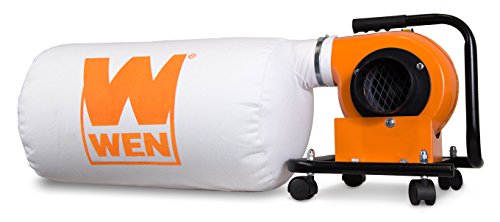
This is the biggest machine in the lineup and the only one built around a tall vertical bag holding up to 50 gallons. The 14-amp motor drives a large impeller that the maker rates at 1,300 CFM, and the two 4 inch inlets let you plug a planer and a second tool into the same unit. That much bag volume matters more than it sounds, because chip-heavy machines like thickness planers fill a small bag in a single board.

The trade-off is that 1,300 CFM is measured with an open inlet, and a 4 inch hose with a couple of bends will cost you a large share of it. The 5 micron rating also means the finest dust passes through the bag and returns to the room, so this is a chip mover first and an air cleaner second. Against the WEN 7.4-amp unit, which claims 600 CFM, it moves roughly twice the air, but it also takes up a lot more floor.

Ownership is mostly about the bag. The tall bag is awkward to shake out, so expect to empty it outdoors or into a drum and wear a respirator while doing it. The mobile base makes it manageable to roll between a planer and a saw, but the footprint means a one-car garage has to give up a corner for it. Brushed motors on collectors at this price are loud, so ear protection is part of the package.

What works

  • Highest airflow rating in the lineup by a wide margin
  • 50 gallon bag goes many boards between empties
  • Two 4 inch inlets serve a pair of tools
  • Mobile base lets it roll to the active machine

Watch out for

  • 5 micron bag lets the finest dust recirculate
  • Large footprint and loud under load

Spec sheet

Rated airflow
1,300 CFM
Motor
14 amp
Bag capacity
50 gallons
Filtration
5 micron
Inlets
Two 4 in.
02
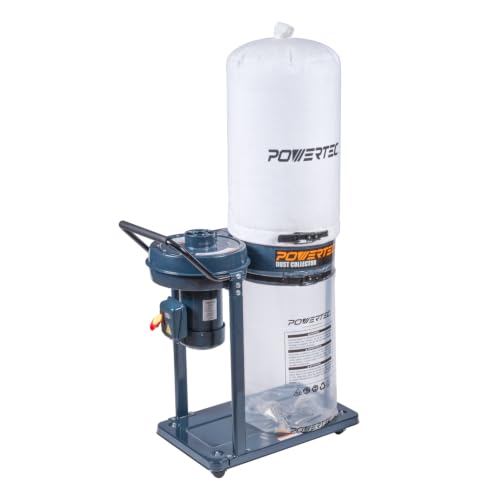
POWERTEC 1 HP 800 CFM Dust Collector with 1 Micron Bag
1 HP motor800 CFM rated1 micron bagCasters
Check price on Amazon
Best for: A garage woodworker who runs one machine at a time and wants finer filtration than a bargain bag.

The POWERTEC puts an 800 CFM rating and a 1 micron upper bag onto a caster base roughly 15 by 25 inches. That combination is the reason it ranks high: the finer bag catches far more of the dust that actually harms lungs, while the airflow is still enough to pull chips from a table saw or a drill press.

It does not match the WEN DC1300 for volume, and it will struggle if you chain two machines through long hose runs. A 1 micron bag also loads faster than a 5 micron one, so suction falls off sooner and the bag needs more frequent attention. The maker also ships a second lower bag, which is the right layout, because the upper bag filters and the lower one collects.

Plan on shaking the upper bag clean every few sessions and checking the lower bag seal, since a loose clamp is where a lot of home-shop leaks start. Because the unit rolls on casters it is easy to park against a wall between jobs. It is the model to choose if one tool runs at a time and you care about air quality more than raw chip capacity.

What works

  • 1 micron bag filters far finer than most rivals
  • 800 CFM rating is plenty for one tool
  • Caster base rolls easily between machines
  • Upper and lower bag layout is the right design

Watch out for

  • Fine bag loads sooner and needs regular cleaning
  • Falls short with two tools or long hose runs

Spec sheet

Motor
1 HP
Rated airflow
800 CFM
Filter bag
1 micron
Base
Caster mobile base
Base footprint
About 15 x 25 in.
03
WEN 7.4-Amp Induction Motor Dust Collector, 15-Gallon Bag
7.4-amp induction600 CFM rated9 in. impeller15-gal bag
Check price on Amazon
Best for: A small shop where noise matters and the machine runs for long stretches.

Its defining part is the induction motor. Induction motors run cooler and quieter than the brushed universal motors in cheaper collectors, and they have no brushes to wear out, so this is the machine you can leave running through a long sanding session without wanting to leave the room.

The 9 inch impeller gives it a 600 CFM rating, which sits below the POWERTEC 800 CFM unit on paper, but the larger impeller does not have to spin as fast for the same air. Bag capacity is 15 gallons, a middle size that suits sanders, a bandsaw and a small planer but not a heavy lumber dimensioning routine. You can run it on the mobile base or hang it on a wall, which is useful if floor space is short.

It is the better long-term machine than the brushed 5.7-amp model, mainly because the motor does not fade. Keep the filter bag clean, since a loaded bag makes even an induction motor draw more current. If you have a dedicated outlet you are better off, because motors in this class dislike long extension cords.

What works

  • Induction motor runs cooler and quieter
  • Mobile base or wall mounting options
  • Large 9 inch impeller moves air without screaming
  • No brushes to wear out

Watch out for

  • 600 CFM rating trails the larger machines
  • 15 gallon bag fills fast on a planer

Spec sheet

Motor
7.4 amp induction
Rated airflow
600 CFM
Impeller
9 inch
Bag capacity
15 gallons
Mounting
Mobile base or wall
04
WEN DC3401 5.7-Amp Dust Collector, 12-Gallon Bag, Wall Mountable
5.7-amp brushed660 CFM rated6 in. impeller12-gal bag
Check price on Amazon
Best for: A tight garage with a small saw and router table that needs a collector you can put away.

This is the smallest machine here, with an onboard handle and a 12-gallon bag. It uses a brushed motor to spin a 6 inch impeller and the maker rates it at 660 CFM, which is competitive with the larger 600 CFM induction model on paper because the smaller impeller spins faster.

The cost of that arrangement is noise and heat. Brushed motors scream compared to induction, and the brushes eventually need replacing. It is also the machine most likely to clog its bag on a planer, because 12 gallons is only a few boards. It suits a bench saw, a router table or a drill press, not a dimensioning workflow.

What it does better than anything else here is storage. The handle and the wall mount option mean it can disappear when not in use, which counts in a shared garage. Lift it by the handle, never by the hose, and empty the bag well before it is full, because a half-full bag already costs suction. Replace the brushes if you hear arcing or notice sparks inside the motor housing.

What works

  • Smallest footprint with a carrying handle
  • Wall mount option frees the floor
  • Single 4 inch port suits one tool
  • Good first collector for light use

Watch out for

  • Brushed motor is loud and wears
  • 12 gallon bag fills quickly on chip-heavy tools

Spec sheet

Motor
5.7 amp brushed
Rated airflow
660 CFM
Impeller
6 inch
Bag capacity
12 gallons
Port
4 inch
05
VEVOR 1 HP 560 CFM Wall-Mount Dust Collector, 21-Gallon Bag
1 HP motor560 CFM rated2.5 micron filter21-gal bag
Check price on Amazon
Best for: A fixed-layout shop with machines clustered along one wall.

The VEVOR is built to hang on a stud wall, which keeps the whole machine off the floor. It pairs a 1 HP motor and a 560 CFM rating with a 21-gallon non-woven bag and a 2.5 micron filter, so the filtration is finer than the 5 micron WEN bag and the bag is larger than the other compact units.

Its compromise is mobility. Once mounted it stays on one wall, which means you either run a hose to each machine or move the machine to the dust. It works well in a small shop where the major machines cluster near one wall. Its 560 CFM rating is lower than the POWERTEC 800 CFM unit, so a long hose run will starve it.

Mounting is the main ownership task. Hang it on studs rather than drywall anchors, because a full 21 gallon bag is heavy and the vibration loosens weak fasteners. Empty the bag at the halfway mark and inspect the non-woven bag for pinholes, since torn cloth quietly defeats the 2.5 micron rating.

What works

  • 2.5 micron filter beats a typical 5 micron bag
  • 21 gallon bag is generous for the size
  • Wall mounting recovers floor space
  • 1 HP motor handles a small machine cluster

Watch out for

  • Fixed to one wall, so hose runs get long
  • 560 CFM rating is modest for a planer

Spec sheet

Motor
1 HP
Rated airflow
560 CFM
Filtration
2.5 micron
Bag capacity
21 gallons
Mounting
Wall mount
06
DYNAVEX 10-Amp Dust Extractor, 12-Gallon Tank, HEPA Filter
10-amp motor12-gal tankHEPA filterLinked switch
Check price on Amazon
Best for: Sanding, routing and track saw work where fine dust matters more than chip volume.

This one is a different animal: a hose-and-tank extractor with a HEPA filter and a switch that starts the machine when the connected tool starts. It is meant for sanders, track saws and routers where fine dust is the problem and chip volume is low, and a HEPA filter is the correct answer to that problem.

It cannot do what the bag collectors do. A 12 gallon tank and a vacuum-style motor will not keep up with a thickness planer, and the narrow hose limits how much air it moves compared with the 800 CFM units. Think of it as a precision tool for fine dust rather than a chip mover, closer in function to a shop vacuum with automatic switching.

The linked switch is the feature that saves effort, because the extractor spins up and down with the sander so you never forget it. Empty the tank before it fills so the HEPA filter does not clog, and wash or replace the filter per the maker's schedule. It pairs well with a bag collector, which handles the heavy machines while this deals with sanding.

What works

  • HEPA filter captures the finest dust
  • Linked switch starts with the tool
  • Wheels make it easy to move around
  • Low-volume work stays cleaner than with a bag

Watch out for

  • Tank is too small for planer or jointer chips
  • Airflow cannot match the bag collectors

Spec sheet

Motor
10 amp
Tank
12 gallons
Filter
HEPA
Wheels
Mobile
Switch
Linked to the tool

Spec sheet decoder

What the numbers on the box really mean

The specs manufacturers lead with, translated into what they tell you about real-world performance.

CFM

Cubic feet of air moved per minute with the inlet open. It falls as resistance rises from hose and bends.

Watch forThe WEN DC1300 at 1,300 CFM and the VEVOR at 560 CFM are not comparable once both sit behind identical hose.

Micron rating

The smallest particle size the filter is rated to catch. Lower numbers mean finer filtration and faster loading.

Watch forThe POWERTEC 1 micron bag is much finer than the WEN DC1300 5 micron bag.

Amps and horsepower

Motor load figures that hint at power but do not guarantee airflow. Impeller design decides how much work becomes airflow.

Watch forThe 14-amp WEN DC1300 and 7.4-amp WEN induction unit differ by far more than the amps suggest.

Bag capacity

How much dust the bag holds before suction falls. Bigger bags mean fewer interruptions.

Watch forThe DC3401 holds 12 gallons against the DC1300 at 50, so planer work suits one and not the other.

Impeller diameter

The fan wheel inside the housing. Larger wheels move more air at lower speed and noise.

Watch forThe WEN 9 inch impeller is the largest among the small units and explains its quiet running.

Methodology

How We Evaluated These Dust Collectors for Woodworking

Airflow versus restriction

We read each spec sheet for rated CFM, impeller size and port count. Then we judged how that airflow would survive a realistic hose run. The WEN DC1300 at 1,300 CFM led the field, with the POWERTEC at 800 CFM leading the 1 HP class.

Filtration quality

We compared stated micron ratings and bag construction, because filtration decides how much fine dust returns to the room. Finer bags earned credit while their faster loading was counted against them. The 1 micron POWERTEC bag and the HEPA DYNAVEX filter ranked highest here.

Capacity and emptying

We weighed bag or tank size against the chip volume of typical machines. Bigger bags mean fewer interruptions, but awkward emptying costs points. The 50 gallon WEN and 21 gallon VEVOR scored best.

Noise and motor design

We looked at induction versus brushed motors and the likely sound under load. Quieter, longer-lived motors earned higher ratings for daily use. The WEN induction unit stands out against the brushed DC3401.

Footprint and mounting

Garage shops live and die by floor space. We assessed casters, handles and wall mounting, and the real hose reach each allows. Mobility counted because short hose preserves airflow.

Decision guide

How to Choose the Right Dust Collectors for Woodworking

By Shop Layout

SituationPickWhy
Planer and jointer in a large garageWEN DC1300Highest airflow and a 50 gallon bag
One table saw, one tool at a timePOWERTEC 1 HP 800 CFMEnough air with a fine 1 micron bag
Long sanding sessions, noise mattersWEN 7.4-amp inductionQuieter induction motor
Tiny shared garageWEN DC3401Handle and wall mount allow storage
Machines clustered on one wallVEVOR 1 HP wall mountBag hangs on the wall, 21 gallons
Sander and track saw workDYNAVEX extractorHEPA filter with tool-linked switch

By Budget

TierPickWhy
Lowest cost entryWEN DC3401Cheapest way to start collecting chips
Mid tierVEVOR 1 HP wall mountFiner filter and bigger bag for the money
Mid to upperPOWERTEC 1 HP 800 CFMBest airflow per unit cost with fine bag
Upper tierWEN 7.4-amp inductionPays for a quieter, longer-lived motor
Top tierWEN DC1300Most capacity and airflow in the group

Bag Filter vs HEPA Extractor

Bag collector

A bag collector like the WEN DC1300 or POWERTEC moves a large volume of air and holds a lot of chips. Its weakness is fine dust, which depends entirely on bag micron rating. Choose this for sawing, planing and jointing.

HEPA extractor

The DYNAVEX captures the finest dust and starts with the tool, but its tank and hose are small. It suits sanders and routers where dust is fine and chips are few.

Planer owners pick the bag collector; sanding-heavy shops pick the extractor; many shops run both.

By Mounting Style

PreferencePickWhy
Roll it to each machineWEN DC1300Mobile base keeps hose short
Hang it and forget itVEVOR 1 HPBuilt for wall mounting
Switch between bothWEN 7.4-amp inductionSupports mobile base or wall mount
Carry it between jobsWEN DC3401Onboard handle and compact body

For a Thickness Planer Specifically

Look for

Planers throw huge chip volumes, so look for the largest bag and the most airflow, ideally with a short, wide hose to the planer port. Avoid collectors with small bags that need emptying every few boards.

In this comparison

The WEN DC1300 is the clear answer, with 50 gallons of bag and the highest airflow rating. The POWERTEC 800 CFM is the cheaper fallback if you plane occasionally and empty often.

When to Spend More

Spend more if

Spend more if you plane lumber regularly or run two machines at once, because the WEN DC1300 buys real capacity. Also spend more if you sand heavily and want an induction motor or a HEPA extractor in place of a cheap bag.

Save if

Save if you run a small saw and a router table a few hours a week; the WEN DC3401 or VEVOR will do the job. Pair it with a respirator and you cover most of the safety gap.

Ownership

Maintenance schedule

The upkeep that decides whether this machine lasts two seasons or ten.

TaskIntervalWhy it matters
Empty the bagAt half fullSuction drops sharply as the bag fills. Empty outdoors and wear a respirator.
Shake or clean the filter bagEvery few sessionsFine dust packs the cloth and cuts airflow. A 1 micron bag needs this far more often than a 5 micron one.
Inspect clamps and sealsMonthlyA loose clamp between bags leaks dust into the room. Check the lower bag ring and any tape joints.
Check brushes on brushed modelsYearlyThe DC3401 uses a brushed motor and brushes wear out. Replace them when you see arcing.
Check the mountingEvery few monthsA full bag is heavy and vibration loosens fasteners. Make sure wall mounts sit on studs.

FAQ

Frequently Asked Questions

Is a single-stage collector enough for a home shop?

For most hobby shops, yes. A single-stage machine like the POWERTEC or WEN handles chips well, and a fine bag improves air quality. A cyclone separator ahead of it keeps the bag cleaner for longer.

How much airflow do I really need?

A single tool on a 4 inch hose is well served by a machine rated near 800 CFM. Planers and anything on longer duct want more. Rated figures fall with hose length, so shop with margin.

Are 1 micron bags worth it?

If you sand or cut sheet goods, yes, because fine dust is the health risk. The tradeoff is faster loading, so you will clean the bag more often. A coarse 5 micron bag mostly protects the motor rather than your lungs.

Can I use a shop vacuum instead?

For small tools, a vacuum with a good filter works well. A vacuum cannot move the chip volume a planer produces. A dust collector handles volume, while a vacuum or HEPA extractor handles fine dust.

How long do these machines last?

Induction motors can run for many years with little attention. Brushed motors need new brushes sooner and run louder. Bags and clamps are the usual wear items.

Is wood dust a fire risk?

Fine dust can ignite in unusual conditions, so keep collectors away from grinders and welding sparks. Empty bags regularly and do not let dust pile up around the motor.

Bottom line

The short version

Browse more dust collectors for woodworkingon Amazon →
James Miller, Lead Machine Editor

About the author

James Miller

Lead Machine Editor, MachineFanatic

James Miller leads MachineFanatic's buying guides, turning spec sheets, manuals and owner feedback into clear verdicts on power tools, outdoor power equipment, shop machines and kitchen machines.

More from James →

Keep reading

Related guides