
Amazon affiliate links - we earn a commission.Affiliate disclosure

Buying guide · 12 min read · Updated 2026-11-07

Best Electric Dethatchers Under $300 (2026)

Six corded electric dethatcher-scarifiers priced under $300, compared on motor amps, width, depth settings and bag size for small to mid-size lawns.

James MillerBy James MillerLead Machine Editor6 machines comparedSpec-sheet verified
Best Electric Dethatchers Under $300

At a glance

Our top picks

Side by side

Spec comparison

MachineMotorWorking widthTinesDepth settings
SENIX 15-Inch 13 Amp 2-in-1 DethatcherBest OverallSENIX 15-Inch 13 Amp 2-in-1 Dethatcher13 amp corded15 inches24 spring steel, 1.5 mm4 positions
EWORK 14-Inch 12 Amp Dethatcher ScarifierBest ValueEWORK 14-Inch 12 Amp Dethatcher Scarifier12 amp corded14 inchesn/an/a
Westinghouse 13-Inch 12 Amp DethatcherBest for Tight YardsWestinghouse 13-Inch 12 Amp Dethatcher12 amp, up to 3300 RPM13 inches20 spring tines4 positions
Sun Joe AJ798E 12.6-Inch 12 Amp DethatcherBest Depth ControlSun Joe AJ798E 12.6-Inch 12 Amp Dethatcher12 amp corded12.6 inchesn/a5 positions
Greenworks 14-Inch 13 Amp Dethatcher ScarifierBest Tool-Free SwapGreenworks 14-Inch 13 Amp Dethatcher Scarifier13 amp corded14 inchesn/a3 positions
Westinghouse 16-Inch 15 Amp DethatcherBest High-Power OptionWestinghouse 16-Inch 15 Amp Dethatcher15 amp, up to 3500 RPM16 inches24 spring tines5 positions, -0.5 to +0.25 inch

A dethatcher is a corded rake: a spinning reel of flexible tines drags dead grass and moss out of the lawn surface so water, air and seed can reach the soil. At this budget nearly every machine is a 2-in-1 that also carries a blade reel for light scarifying.

The cap here is $300, and prices move, so it reflects listing prices when this guide was updated. Within that limit the real differences are motor current, working width, how many depth positions you get, and how quickly the bag fills.

Before you buy

6 Criteria to Look For Before Buying an Electric Dethatcher Under $300

  1. 01

    Motor amps versus real load

    On a corded tool the rating is current draw, not horsepower, so a 15-amp motor has more potential than a 12-amp one but also uses most of a household circuit. Thatch drags the reel down much more than clean grass, so reserve matters: the 15-amp Westinghouse 16-inch has about a quarter more headroom than the 12-amp EWORK. Buyers often assume more RPM equals more power, but RPM without torque just means a fast stall.

  2. 02

    Working width and passes

    Width sets how many passes a lawn needs, but wider machines also demand more motor and a bigger bag. The 16-inch Westinghouse covers about 23 percent more ground per pass than the 13-inch version of the same machine. On tight, bed-heavy yards the narrow 13-inch head wins because the wide ones scalp edges when tilted.

  3. 03

    Depth positions

    Depth is the setting that decides whether you remove thatch or damage the crown of the grass. Three positions on the Greenworks is the minimum; five positions on the Sun Joe AJ798E or the Westinghouse 16-inch let you adjust by a small step on a crowned patch. Always make the first pass at the shallowest setting and step down only if thatch remains.

  4. 04

    Tine gauge and material

    Spring-steel tines flex over obstacles and spring back, while thin wire bends and stays bent. The SENIX specifies 1.5 mm tines, a concrete thickness number most listings leave out. Carbon steel rusts if stored wet, so wipe the reel dry after each use and replace tines individually when they bend.

  5. 05

    Bag capacity and cleanup

    A bag that fills in ten minutes turns a one-hour job into a two-hour one. The SENIX at 13.2 gallons holds over 60 percent more than the Sun Joe at 8 gallons. Plan to empty bags often regardless, and expect a lot of volume: a thatched lawn can fill a dozen bags of debris.

  6. 06

    Cord and circuit

    A thin extension cord causes voltage drop, which makes the motor run hot and stall under load. Use a 14-gauge outdoor cord for runs of 50 feet or less and heavier beyond that, and keep the cord behind you when working. The 15-amp machines are especially sensitive since they use almost the entire circuit capacity.

Detailed reviews

The 6 best electric dethatchers under $300, explained

01
SENIX 15-Inch 13 Amp 2-in-1 Dethatcher
13 amp15 in path24 spring tines13.2 gal bag
Check price on Amazon
Best for: Quarter-acre lawns with a moderate thatch layer where fewer passes and fewer bag stops matter.

The SENIX is built around a 15-inch reel carrying 24 spring-steel tines at 1.5 mm gauge, which is a heavier wire than the thin tines on the cheapest machines. Thicker wire resists bending when it meets a root flare or a buried sprinkler head, and it flicks thatch upward into the bag instead of just combing it flat. The 13-amp motor is rated for sustained load rather than a peak figure, which matters because thatch drags the reel down more than clean grass does.

Compared with the 14-inch Greenworks, the SENIX covers about seven percent more ground per pass and holds 13.2 gallons against a smaller bag, so you stop to empty it less often. The trade is weight and storage footprint: it is the biggest machine in this price bracket and needs a proper wall hook or shelf. Depth is a four-position lever, coarser than the five-step levers on the Sun Joe, so fine tuning on uneven turf takes a test strip.

Ownership is simple. Clear the tines after every session, check the reel nut for tightness, and rinse the bag so damp thatch does not mildew. Spring-steel tines can be unbolted and replaced individually, which is cheaper than a new reel. It is a good fit for lawns up to roughly a quarter acre where the thatch layer is moderate.

What works

  • Heavier 1.5 mm spring-steel tines resist bending on roots
  • 15-inch path cuts passes versus 13 and 14 inch rivals
  • Large 13.2 gallon bag means fewer stops
  • 13-amp motor holds speed in dense thatch

Watch out for

  • Largest and heaviest machine here, awkward to store
  • Four depth positions are less fine than five-step rivals

Spec sheet

Motor
13 amp corded
Working width
15 inches
Tines
24 spring steel, 1.5 mm
Depth settings
4 positions
Bag
13.2 gallons
02
EWORK 14-Inch 12 Amp Dethatcher Scarifier
12 amp14 in path2-in-1Grass catcher
Check price on Amazon
Best for: Small lawns and first-time buyers who want the lowest entry cost.

The EWORK is the cheapest machine in this lineup and it earns the Best Value badge by offering the same basic architecture as machines costing noticeably more: a 12-amp motor, a 14-inch reel and a removable bag. The listing warns that the body is 22 inches wide at its widest while the working path is 14 inches, so check gate and shed-door clearance before assuming it fits through a narrow side yard.

Power is the compromise. A 12-amp motor has less reserve than the 13-amp SENIX or the 15-amp WEN, so on a lawn with a thick spongy mat you will need to take shallower passes and go over the area twice instead of one deep pass. That is slower but not damaging, and for lawns under about 3,000 square feet the extra time is small.

Because it is the newest and least established brand here, owner support and replacement-tine availability are the questions to ask before buying. Keep the spare hardware and take a photo of the reel layout before the first teardown. As a first dethatcher for a small yard it is a sensible low-risk purchase.

What works

  • Lowest priced machine in this lineup
  • Dual dethatching and scarifying functions in one body
  • 12-amp motor draws less from a shared circuit
  • Included grass catcher simplifies cleanup

Watch out for

  • Body is far wider than its 14-inch path
  • Brand has a shorter record, so confirm tine availability

Spec sheet

Motor
12 amp corded
Working width
14 inches
Maximum body width
22 inches
Function
Dethatch and scarify
Collection
Grass catcher bag
03
Westinghouse 13-Inch 12 Amp Dethatcher
12 amp13 in path3300 RPM20 tines
Check price on Amazon
Best for: Yards divided by beds, trees and tight corners.

Westinghouse sells the same platform in a 13-inch and a 16-inch version, and this is the narrower one. It carries 20 spring tines on the dethatching reel and 16 blades on the scarifier reel, spinning at up to 3,300 RPM from a 12-amp motor. The reel is smaller than the SENIX, so it turns faster for its size but removes less per pass.

The narrow path is the point. It maneuvers around beds, tree rings and fence corners where a 15 or 16-inch machine would have to be tilted and scalp the edge. If your lawn is chopped into small areas, a 13-inch head will finish with fewer awkward turns than the wider models, even though the straight runs are longer.

Expect to swap reels with a few bolts rather than a tool-free latch, and keep the blade reel away from stones. At this price tier it is a plain, predictable machine, with the usual caveat that the 12-amp motor wants shallow passes in heavy thatch.

What works

  • 13-inch head fits between beds and tree rings
  • Up to 3300 RPM reel keeps tines whipping at speed
  • Includes both tine and blade reels
  • Same platform has a wider sibling if you outgrow it

Watch out for

  • Narrow path means more passes on open lawns
  • 12-amp motor has little reserve in heavy thatch

Spec sheet

Motor
12 amp, up to 3300 RPM
Working width
13 inches
Tines
20 spring tines
Scarifier head
16 blades
Depth settings
4 positions
04
Sun Joe AJ798E 12.6-Inch 12 Amp Dethatcher
12 amp12.6 in path5 depths8 gal bag
Check price on Amazon
Best for: Uneven small lawns where fine depth steps prevent scalping.

The Sun Joe AJ798E offers a five-position depth lever, the finest control among the narrow 12-amp machines here. Five steps matter on lawns that are not billiard-table flat, because you can raise one notch over a crowned patch instead of scalping it. The tines are spring steel shaped to move air, which helps carry loosened thatch into the removable 8-gallon bag.

That bag is the limitation. Eight gallons fills quickly on a thick mat, and against the 13.2 gallons on the SENIX you will be walking to the compost pile far more often. The 12.6-inch path is also the narrowest on the list, so this is a machine for small areas more than a half-day project.

Sun Joe is a long-established brand with widespread parts and manuals, which is a real ownership advantage at this price. Plan on hosing the bag clean, checking the cord strain relief, and storing it dry. A reliable choice where fine depth adjustment is more valuable than raw width.

What works

  • Five depth positions give finer height control
  • Established brand with accessible parts and manuals
  • Removable bag keeps cleanup straightforward
  • Reel moves air as well as scraping thatch

Watch out for

  • 8-gallon bag fills fast in thick thatch
  • Narrowest cutting path of the group

Spec sheet

Motor
12 amp corded
Working width
12.6 inches
Depth settings
5 positions
Bag
8 gallons, removable
Tine design
Spring steel with airflow shaping
05
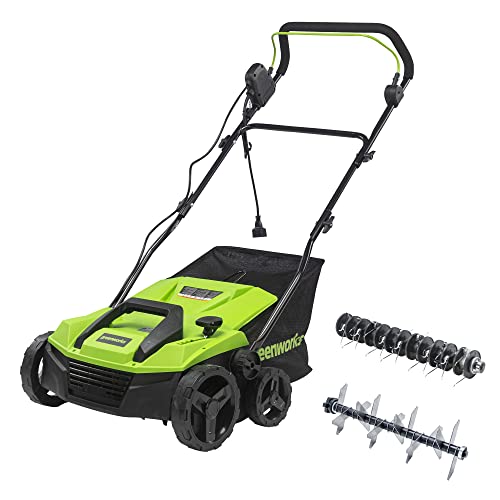
Greenworks 14-Inch 13 Amp Dethatcher Scarifier
13 amp14 in path3 depthsQuick release
Check price on Amazon
Best for: People who switch between raking and scarifying and want a tool-free change.

Greenworks centers its design on convenience. A quick-release mechanism swaps the dethatching and scarifying attachments without hunting for a wrench, and a push-button start replaces the safety-bail pattern on some rivals. A 13-amp motor in a 14-inch body gives a good balance of power to width.

The depth control has only three positions, the coarsest of the group. That is fine for flat turf but a limitation on rolling ground, and the SENIX at four steps or the Sun Joe at five will give you more precision. Greenworks also describes the machine as lightweight and easy to maneuver, which suits owners who lift it into a trunk or carry it up steps.

The brand ranks among the more recognizable names in garden power tools, so replacement tines and bags are easier to find than for lesser-known imports. Clean the attachments after each use and check the quick-release latch for debris. A solid mid-range choice when swapping reels is a regular chore.

What works

  • Quick-release attachment swap needs no tools
  • 13-amp motor in a compact 14-inch body
  • Push button start is easy on the hand
  • Recognizable brand with accessible spares

Watch out for

  • Only three depth positions
  • Less width than 15 or 16 inch machines

Spec sheet

Motor
13 amp corded
Working width
14 inches
Depth settings
3 positions
Attachment change
Quick release
Start
Push button
06
Westinghouse 16-Inch 15 Amp Dethatcher
15 amp16 in path3500 RPM24 tines
Check price on Amazon
Best for: Larger or thatchier lawns that need the most motor and width under the cap.

The 16-inch Westinghouse is the strongest machine in this under-$300 lineup, pairing a 15-amp motor turning up to 3,500 RPM with 24 spring tines and a 20-blade scarifier head. Five depth settings from -0.5 to +0.25 inch span the full range from skimming moss to cutting shallow grooves for overseeding.

Sixteen inches of width plus the extra current make it the machine to pick for the largest or thickest lawn on this list. The cost is on the circuit side: 15 amps is the most a standard household circuit can handle before the breaker trips, so use a heavy outdoor extension cord, ideally 14 gauge or thicker, and do not share the circuit with anything else.

Compared with its 13-inch sibling it takes about a quarter fewer passes on open turf, and compared with the SENIX it has finer depth control. It is also the heaviest feeling in use, and the long cord is the main hazard near the reel. Rinse the tines, store the machine dry and replace bent tines early.

What works

  • 15-amp motor has the most reserve of the group
  • Five depth positions from -0.5 to +0.25 inch
  • 16-inch path covers open turf quickly
  • Both tine and blade reels included

Watch out for

  • Needs a heavy gauge cord and a dedicated circuit
  • Heaviest to carry and store of the lineup

Spec sheet

Motor
15 amp, up to 3500 RPM
Working width
16 inches
Tines
24 spring tines
Scarifier head
20 blades
Depth settings
5 positions, -0.5 to +0.25 inch

Spec sheet decoder

What the numbers on the box really mean

The specs manufacturers lead with, translated into what they tell you about real-world performance.

Amps

The current the motor draws at full load. Higher amps usually means more torque, until the circuit limit.

Watch forThe 12-amp EWORK and 15-amp Westinghouse 16 differ by three amps, a real gap in thick thatch.

RPM

Reel speed with no load. Under load it drops, and loaded speed is what rakes thatch.

Watch forThe 3,500 and 3,300 RPM figures on the Westinghouse pair are no-load numbers.

Working width

The path the reel clears per pass. It is not the same as the machine's overall body width.

Watch forThe EWORK lists a 14-inch path but a 22-inch body, so measure your gate.

Depth positions

How many steps the height lever has. More steps give finer control on uneven ground.

Watch forThe Greenworks offers three steps while the Sun Joe AJ798E and Westinghouse 16 offer five.

2-in-1

The machine ships with a tine reel for dethatching and a blade reel for scarifying.

Watch forBlade reels cut roughly a few millimetres into soil, which is much lighter than a dedicated gas scarifier.

Methodology

How We Evaluated These Electric Dethatchers Under $300

Motor and width balance

We compared amp rating against cutting width, because a wide reel on a weak motor stalls in thick thatch. The 13-amp SENIX at 15 inches and 15-amp Westinghouse at 16 inches scored highest here. The 12-amp machines scored lower for heavy work but remain fine for light annual maintenance.

Depth adjustment range

We read each spec sheet for number of depth steps and range. Five-position levers on the Sun Joe AJ798E and the Westinghouse 16 earned more credit than the three steps on the Greenworks. Fine control reduces scalping risk.

Tine and reel construction

We checked whether tines are spring steel and what gauge is stated. The SENIX is the only one that states a 1.5 mm gauge. Replaceable individual tines were rated above sealed reels.

Collection and cleanup

We weighed bag volume, since the 13.2 gallon SENIX bag and 8 gallon Sun Joe bag lead to very different job lengths. We also considered how easily bags remove and empty.

Owner feedback patterns

We evaluated owner feedback patterns for common failure points such as reel nuts working loose, thin cords, and difficulty finding spare tines. Established brands like Sun Joe and Greenworks gained points for spares availability.

Decision guide

How to Choose the Right Electric Dethatchers Under $300

By Lawn Size

SituationPickWhy
Under 3,000 sq ftEWORK 14-InchLowest cost, enough power for a small yard
Small yard with many bedsWestinghouse 13-Inch13-inch path turns tightly
Up to a quarter acreSENIX 15-InchWide path and 13.2 gallon bag
Quarter acre with thick thatchWestinghouse 16-Inch15 amps and 16 inches

By Budget

TierPickWhy
Cheapest in the listEWORK 14-InchBasic 2-in-1 for small yards
Lower midSENIX 15-InchBest width and bag for the money
MidWestinghouse 13-InchCompact, well-equipped
Upper bandWestinghouse 16-InchMost motor under the cap

12 Amp vs 15 Amp

12 amp

The EWORK, Westinghouse 13-inch and Sun Joe AJ798E run on 12 amps. They draw less, cost less and are fine for light thatch if you make shallow, repeated passes.

15 amp

The Westinghouse 16-inch has the most reserve and cuts deeper in one pass, but demands a heavy cord and an uncluttered circuit.

Choose 12 amps for light annual care on small lawns, and 15 amps if thatch is thick or the lawn is large.

Depth Control Preference

PreferencePickWhy
Fine steps for uneven groundSun Joe AJ798EFive positions
Widest rangeWestinghouse 16-InchFive positions, -0.5 to +0.25 inch
Simple and flat lawnGreenworks 14-InchThree positions are enough
BalancedSENIX 15-InchFour positions

For Moss and Heavy Thatch Specifically

Look for

Look for 15 amps or at least 13 amps, a bag over 12 gallons, and stiff spring-steel tines. Make the first pass at the shallowest setting and repeat if needed.

In this comparison

The Westinghouse 16-inch and SENIX are best here: the Westinghouse for pure motor, the SENIX for bag size and 1.5 mm tines.

When to Spend More

Spend more if

Your lawn exceeds a third of an acre, you dethatch every year, or you want the Westinghouse 16-inch and its 15-amp motor over the EWORK.

Save if

The lawn is small and thatch is light, in which case the EWORK or Westinghouse 13-inch will do the job once a year.

Ownership

Maintenance schedule

The upkeep that decides whether this machine lasts two seasons or ten.

TaskIntervalWhy it matters
Clear tines and reelAfter every useDamp thatch packs between tines and rusts them. A stiff brush clears it in a minute.
Check reel nut and boltsEvery few sessionsVibration loosens fasteners. A loose reel nut can damage the shaft.
Inspect tines for bendsEach seasonBent tines drag unevenly and shred turf. Replace them individually.
Empty and rinse bagAfter each jobWet debris left in the bag grows mildew. Dry it before storing.
Inspect cord and plugBefore each useCuts in the cord are a shock hazard. Replace damaged cords.

FAQ

Frequently Asked Questions

What is the difference between dethatching and scarifying?

Dethatching uses flexible tines to pull loose thatch from the surface. Scarifying uses rigid blades to cut shallow grooves into the soil, which helps overseeding. Most machines here do both by swapping reels.

Can I get a good electric dethatcher for under $300?

Yes. Every machine here has an electric motor of 12 to 15 amps and a bag, and prices move, so the cap reflects listing prices when this guide was updated. The limit is the lack of a gas engine for very large lawns.

How long do these machines last?

With rinsing, dry storage and replacing bent tines, a corded unit can run for many seasons. Most failures come from loose reel hardware, damaged cords or overloaded motors.

Does more RPM mean better dethatching?

Not necessarily. RPM is the no-load speed and drops under thatch. Torque and tine design matter more than the headline RPM number.

When should I dethatch?

Dethatch while grass is actively growing: early fall for cool-season grasses, late spring for warm-season. Soil should be moist but not soaked.

How do I know if my lawn needs dethatching?

Cut a small wedge out with a spade. If the spongy brown layer is thicker than about half an inch, dethatch. A thinner layer is healthy.

Bottom line

The short version

Browse more electric dethatchers under $300on Amazon →
James Miller, Lead Machine Editor

About the author

James Miller

Lead Machine Editor, MachineFanatic

James Miller leads MachineFanatic's buying guides, turning spec sheets, manuals and owner feedback into clear verdicts on power tools, outdoor power equipment, shop machines and kitchen machines.

More from James →

Keep reading

Related guides