
Amazon affiliate links - we earn a commission.Affiliate disclosure

Buying guide · 12 min read · Updated 2026-11-07

Best Electric Knife Sharpeners (2026)

Six electric knife sharpeners compared by abrasive, angle guides and stages: Chef'sChoice 15XV, Presto, Northmas, Narcissus and a 4-in-1 diamond model.

James MillerBy James MillerLead Machine Editor6 machines comparedSpec-sheet verified
Best Electric Knife Sharpeners

At a glance

Our top picks

Side by side

Spec comparison

An electric knife sharpener passes a blade between rotating abrasive wheels held at a fixed angle, so you get a consistent edge without learning to hold an angle by hand. The trade is that it removes metal quickly, and a wheel that is too aggressive can wear a blade down in a few passes.

What matters is the abrasive, the angle guide and how many stages the machine has, because coarse, medium and fine stages do different jobs. Think about your knives, European and American blades at 20 degrees versus Japanese blades at 15, before comparing models.

Before you buy

6 Criteria to Look For Before Buying an Electric Knife Sharpener

  1. 01

    Knife type and edge angle

    European and American knives are typically sharpened at 20 degrees, while Japanese knives use about 15. Some machines, like the 15XV, convert a 20 degree edge to 15, while others hold a fixed angle. Matching the angle to your knives matters more than any other spec. A quick way to know your knife's angle is to check the maker's website, and when in doubt, 20 degrees is the safe choice for any thick Western blade. Check whether your knives are single-bevel or double-bevel too, since some traditional Japanese knives are not suited to a two-sided wheel at all.

  2. 02

    Abrasive material

    Diamond abrasives, as on the 15XV, Northmas and Narcissus, cut hard steel and ceramic and stay flat. Conventional abrasives work for softer steel but wear faster. Diamond costs more but lasts longer. Diamond wheels also resist glazing, which is the slow loss of bite that makes cheaper abrasives feel dull after a year. Because diamond is so hard, it needs a very light touch on thin blades, so fewer passes are better than more.

  3. 03

    Number of stages

    Coarse, medium and fine stages do different jobs: coarse repairs, medium sharpens and fine polishes. The Presto 08810 and 15XV offer three stages and the 08800 offers two. More stages give a more refined edge. Even with three stages, you rarely need the coarsest one: use it once to establish a new edge, then live on the fine stage. Plan your sharpening session around the dullest knife first, so you do not have to switch wheels back and forth.

  4. 04

    Angle guides and control

    Precision guides hold the blade steady through the wheel, which is the point of an electric sharpener. The 15XV has precision guides and the 4-in-1 has a built-in guide. Without guides, you can ruin a knife. Never force a knife through a guide, since the wheel should do the cutting while you provide only light, steady pressure. Guides also protect the bolster and heel, which a free-hand pass often damages.

  5. 05

    Metal removal and knife life

    A powered wheel removes metal fast, so use it sparingly. Overuse shortens the knife's life. Use fine stages for regular upkeep and coarse stages only on very dull blades. If you have an expensive chef knife, keep it for a whetstone or professional service and use the machine on workaday blades. Dull knives are more dangerous than sharp ones, so a sharpener you actually use is a safety tool.

  6. 06

    Serrated and special blades

    Some sharpeners handle serrated edges and scissors, while others do not. Check the maker's list. A machine that rounds off serrations is a poor match for bread knives. A bread knife is best sharpened at a shop or with a special rod, since a powered flat wheel flattens the teeth. If you cook with a mix of steel types, look for a sharpener that lists the hardness range it supports.

Detailed reviews

The 6 best electric knife sharpeners, explained

01
Chef'sChoice 15XV EdgeSelect professional electric sharpener
100% diamond3 stagesPrecision angle guides15 degree edge
Check price on Amazon
Best for: Serious home cooks with Western knives who want a sharper edge.

The 15XV EdgeSelect uses 100 percent diamond abrasives in three stages, with precision angle guides that hold the blade at the right angle through each wheel. Its signature trick is converting traditional 20 degree factory edges on household knives into a high-performance 15 degree edge, which cuts with less force and stays sharp longer. Diamond cuts steel quickly without glazing, so each stage does its job.

The tradeoff is that it takes metal off every time, so you should use the finer stages for upkeep and the coarse stage rarely. Compared with the Presto machines, it is more precise and has a deeper angle conversion, and against the 4-in-1 model it is a refined single-purpose tool. It is a better match for good Western knives than for thin Japanese blades.

Clean metal filings from the slots with a brush and a vacuum, and avoid pulling the knife through quickly. Let the guides do the work and keep the pull steady. If you like the result, pairing it with a honing steel keeps the edge keen between sessions. Hold the handle level and keep the same angle all the way through the pull.

What works

  • 100 percent diamond abrasives in three stages
  • Precision angle guides hold the blade steady
  • Converts 20 degree edges to 15 degree
  • Handles kitchen and sport knives

Watch out for

  • Removes metal quickly if overused
  • Not meant for very thin Japanese blades

Spec sheet

Abrasive
100 percent diamond
Stages
3
Guides
Precision angle guides
Edge
Converts 20 degree to 15 degree
Knives
Kitchen and sport knives
02
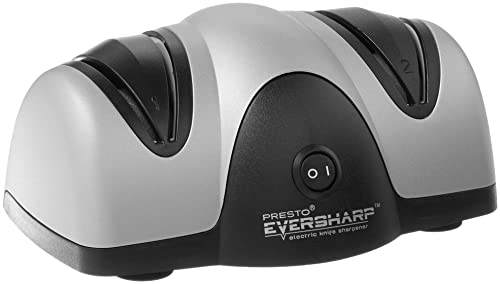
Presto 08810 Professional EverSharp 3-stage sharpener
3 stagesSantoku capableKitchen and sport knivesSimple
Check price on Amazon
Best for: Everyday cooks who want fast, repeatable sharpening.

The 08810 uses a three-stage system that sharpens, hones and finishes kitchen and sport knives, and it handles Santoku blades. Guided slots set the angle, so you pull the blade through each stage in turn and get a reasonably sharp edge in a minute. It is a straightforward machine for cooks who want fast, repeatable results.

The tradeoff is abrasive quality and precision. It does not use full-diamond wheels like the 15XV and offers less angle control, so edges are good rather than exceptional. Compared with the Presto 08800, it adds a third stage, and against the Narcissus it offers a more established design.

Brush out the filings regularly and do not push the blade. Use the coarse slot only on dull knives. Spend a minute reading the pull-through instructions, because a rushed pass is the usual cause of a rough edge.

What works

  • Three-stage system sharpens, hones and finishes
  • Handles kitchen, sport and Santoku knives
  • Guided slots set the angle
  • Fast and simple

Watch out for

  • Less precise than diamond systems
  • Limited angle control

Spec sheet

Stages
3
Knives
Kitchen, sport and Santoku
Result
Professional results at home
Design
Guided slots
Use
Anytime
03
Presto 08800 EverSharp 2-stage electric sharpener
2 stagesKitchen and sport knivesFastCompact
Check price on Amazon
Best for: Quick, inexpensive touch-ups on everyday knives.

The 08800 is a two-stage electric sharpener that is among the most affordable ways to sharpen kitchen and sport knives. Two stages, sharpen and hone, take a dull knife to a usable edge in a minute, and a compact body fits in a cabinet. It is the sort of tool a household keeps for quick touch-ups.

The limit is finesse. Two stages means less refinement than a three-stage machine, and aggressive wheels can remove more metal than necessary. Compared with the 08810, it is simpler and cheaper, and against the 15XV it is far less precise.

Pull the knife gently and avoid overuse. Keep the filings tray clean. A slip-resistant mat keeps it steady on a polished counter. Make sure you pull the blade heel to tip, not just a section of it.

What works

  • Two-stage system for fast sharpening
  • Handles kitchen and sport knives
  • Compact size
  • Lowest cost in this guide

Watch out for

  • Less refinement than three-stage machines
  • Can remove more metal than needed

Spec sheet

Stages
2
Knives
Kitchen and sport
Result
Razor-sharp edge, fast
Size
Compact, 8.18 inches
Design
Guided slots
04
Northmas S810 3-stage diamond electric knife sharpener
3-stage diamondRestores and honesAngle guidesCompact
Check price on Amazon
Best for: Cooks who want diamond abrasives without a premium price.

The S810 offers a three-stage diamond system that restores, sharpens and hones, giving more refined results than a two-stage machine. Diamond abrasives cut hard steel quickly and last, and three stages let you start coarse for a dull knife and finish fine for a polish.

The tradeoff is brand depth and long-term support. Compared with the 15XV, it uses a similar approach at a lower tier but with less detailed angle control, and against the Presto 08810 it uses diamond rather than conventional abrasives.

Keep the slots clean, pull steadily and use the fine stage for regular upkeep. Wear and replace wheels as the manual suggests. Diamond does not rust, but the casing can collect damp, so store it dry. Follow the stage order and do not skip the fine stage.

What works

  • Three-stage diamond system
  • Restores and hones
  • Compact for a cabinet
  • Fast on dull knives

Watch out for

  • Less established brand
  • Less precise angle control than the 15XV

Spec sheet

Stages
3-stage sharpening
Abrasive
Diamond
Function
Restoring and honing
Model
S810
Class
Home use
05
Narcissus S867 diamond electric sharpener for steel and ceramic knives
Diamond abrasivesDual systemSteel and ceramicHome
Check price on Amazon
Best for: Owners of ceramic and very hard steel knives.

The S867 uses diamond abrasives in a dual sharpening system and is designed for stainless steel and ceramic knives, which are too hard for ordinary wheels. Diamond is hard enough to cut ceramic, which most conventional sharpeners cannot sharpen at all, so this is one of the few machines that serve ceramic owners.

The tradeoff is that ceramic is brittle, so a heavy hand can chip an edge, and the dual system offers fewer steps than a three-stage unit. Compared with the Northmas, it targets ceramic as well as steel, and against the Presto machines it uses a harder abrasive.

Go slowly with ceramic, let the wheel do the work and avoid twisting the blade. Clean filings regularly. Check the maker's list of compatible knives before putting a ceramic blade near any wheel.

What works

  • Diamond abrasives sharpen steel and ceramic
  • Dual sharpening system
  • Compact design
  • Fast sharpening

Watch out for

  • Ceramic edges chip with a heavy hand
  • Only two steps

Spec sheet

Abrasive
Diamond
System
Dual sharpening
Knives
Stainless steel and ceramic
Model
S867
Class
Professional kitchen at home
06
4-in-1 electric knife sharpener with angle guide and 6,500 RPM motor
6,500 RPM3-stageAngle guideRepair mode
Check price on Amazon
Best for: Cooks who want one machine for knives and other edges.

This 4-in-1 sharpener uses a high-speed 6,500 RPM motor and a built-in angle guide with a three-stage system that handles repair, sharpening and honing. A built-in guide keeps the angle consistent, and the multiple functions are meant to cover scissors and other edges as well as kitchen knives.

The compromise is speed and heat. A 6,500 RPM wheel removes metal fast and can heat a thin blade, which risks softening the edge if you linger. Compared with the Presto machines, it is faster and more versatile, and against the 15XV it is less precise.

Use quick, steady passes and let the blade cool if it warms. Keep the filings tray empty. Take it slow on the first knife and compare results with a rough tomato slice.

What works

  • 6,500 RPM motor sharpens quickly
  • Built-in angle guide
  • Three-stage professional system
  • Handles repair and honing

Watch out for

  • High speed can overheat thin blades
  • Less precise than diamond-guided units

Spec sheet

Motor
6,500 RPM
Stages
3-stage professional
Guide
Built-in angle guide
Functions
Sharpen, repair, hone and more
Class
Home cooks

Spec sheet decoder

What the numbers on the box really mean

The specs manufacturers lead with, translated into what they tell you about real-world performance.

Edge angle

The angle between the blade faces at the edge. Smaller angles cut more easily but are less durable. A knife that cuts paper cleanly and slices a tomato without pressure has a good edge.

Watch forWestern knives are usually 20 degrees and Japanese about 15.

Diamond abrasive

Industrial diamond grit bonded to a wheel. It cuts hard steel and ceramic and holds its shape. Abrasive grit size is also printed on some wheels, with lower numbers cutting faster and coarser.

Watch forThe 15XV, Northmas S810 and Narcissus use it.

Stages

The number of sharpening steps, usually coarse to fine. Stages are best used in order, from coarse to fine.

Watch forThe 15XV and Presto 08810 have 3 and the 08800 has 2.

RPM

The speed of the abrasive wheel. Higher speeds remove metal faster and generate heat. Heat is the enemy of thin edges, so work in short passes.

Watch forThe 4-in-1 lists 6,500 RPM.

Angle guide

A slot or plate that holds the blade at a fixed angle against the wheel. A good guide matters more than extra wattage. Guide slots often have a spring that centers the blade, so check that it moves freely.

Watch forThe 15XV has precision guides.

Methodology

How We Evaluated These Electric Knife Sharpeners

Abrasive and angle control

We compared abrasive material and angle guides. The 15XV uses diamond and precision guides, and the Presto machines use guided slots. Better control scored higher. We also noted whether each manual explains how to find your knife's original angle. We checked whether each model supports left-handed use comfortably.

Stages and finish

We looked at the number of stages. The 15XV and 08810 offer three, and the 08800 offers two. More refined stages scored higher. We considered how many passes each stage is meant to take. We read the manuals for how many pulls each stage recommends.

Knife compatibility

We checked support for ceramic, serrated and Japanese blades. The Narcissus S867 targets ceramic. Wider compatibility scored higher. We looked at how well each machine contains metal dust. We noted whether the case is plastic or metal.

Safety for the blade

We considered speed and metal removal. The 4-in-1 runs 6,500 RPM, which needs care. Gentler designs scored higher. We noted the weight of each unit and whether it slides on the counter.

Ownership

We weighed cleaning, noise and owner feedback patterns about wheel life. Easy upkeep scored higher. We checked feedback patterns on wheel replacement. We looked at noise during sharpening.

Decision guide

How to Choose the Right Electric Knife Sharpeners

By Knife Type

SituationPickWhy
Good Western knivesChef'sChoice 15XVDiamond and 15 degree conversion
Everyday kitchen knivesPresto 08810Three-stage guided
Quick touch-upsPresto 08800Two-stage and compact
Ceramic and hard steelNarcissus S867Diamond dual system
Multiple edge types4-in-1 sharpenerAngle guide and repair

By Budget

SituationPickWhy
Lowest tierPresto 08800Two-stage
Entry three-stagePresto 08810Three-stage guided
Mid tier diamondNorthmas S810Three-stage diamond
Upper tierNarcissus S867Diamond for ceramic
PremiumChef'sChoice 15XVPrecision and 15 degree

Diamond vs Conventional Abrasive

Diamond

The 15XV, Northmas and Narcissus use diamond. It cuts hard steel and ceramic and lasts longer.

Conventional

The Presto machines use conventional abrasives. They are cheaper and fine for softer steel.

Hard steel and ceramic owners should pick diamond.

Speed and Care

SituationPickWhy
Gentle on bladesChef'sChoice 15XVGuides and fine stages
Fast on dull blades4-in-1 sharpener6,500 RPM
Simple pull-throughPresto 08810Guided slots
Ceramic cautionNarcissus S867Diamond dual

For Home Cooks Specifically

Look for

Look for angle guides, a fine finishing stage and compatibility with your knives. Use it for occasional maintenance and learn the sound of a sharp edge.

In this comparison

The Presto 08810 is the easiest, the 15XV is the most precise and the Narcissus suits ceramic.

When to Spend More

Spend more if

Spend more if you own good knives and sharpen often. The 15XV preserves edge life.

Save if

Save if you sharpen a few times a year. The Presto 08800 covers touch-ups.

Ownership

Maintenance schedule

The upkeep that decides whether this machine lasts two seasons or ten.

TaskIntervalWhy it matters
Brush out filingsAfter each useMetal dust collects in slots and dulls the wheels. A small paintbrush is perfect for clearing slots.
Check wheel wearEvery few monthsWorn wheels sharpen unevenly. Look for visible grooves or flat spots that suggest a wheel needs replacing. Mark the date you replace wheels so you can track wear.
Wipe the housingMonthlyOil and dust build up and hide wear. Wipe each blade clean before sharpening, since grease clogs wheels.
Use the fine stage regularlyEvery few weeksRegular honing delays the need for coarse sharpening. Keep fingers clear of the slots at all times.
Store coveredAlwaysDust and moisture shorten wheel life. Keep the machine on a non-slip mat. Do not use water or oil on the wheels unless the manual says so.

FAQ

Frequently Asked Questions

Are electric sharpeners bad for knives?

They remove metal quickly, so use them sparingly. A good machine with guides is fine for most kitchen knives. Many cooks hone weekly with a steel and use a sharpener only when the knife struggles to slice a tomato. Whichever method you choose, never put a dirty or wet knife in the slot.

Can I sharpen serrated knives?

Only if the machine says so. Many electric sharpeners round off serrations. Serrated knives are best sharpened with a tapered rod, which preserves each tooth. Check the maker's page before putting any serrated knife near a wheel.

What angle should I use?

Western knives are usually 20 degrees and Japanese about 15. Check your knife's maker. A new knife often needs no sharpening for a year or more with regular honing. A paper-slicing test is a fast way to check your result after sharpening.

How often should I sharpen?

A few times a year for home cooks, with regular honing between. Over-sharpening wears blades. If your knife chips after sharpening, the blade may be too hard for the wheel, and a manual stone would be safer. Switch to a whetstone if you notice chips or burn marks.

Can I sharpen ceramic knives?

Only with diamond abrasives. The Narcissus S867 is made for it. Safety tip: cut slowly, keep the knife straight and let the wheel do the work.

How long do these last?

Several years with care. The abrasive wheels are the wear parts. Replace wheels when they glaze or the machine takes noticeably longer. Replace a wheel that cracks or becomes uneven rather than trying to repair it.

Bottom line

The short version

Browse more electric knife sharpenerson Amazon →
James Miller, Lead Machine Editor

About the author

James Miller

Lead Machine Editor, MachineFanatic

James Miller leads MachineFanatic's buying guides, turning spec sheets, manuals and owner feedback into clear verdicts on power tools, outdoor power equipment, shop machines and kitchen machines.

More from James →