
Amazon affiliate links - we earn a commission.Affiliate disclosure

Buying guide · 13 min read · Updated 2026-11-15

Best Electric Patio Heaters (2026)

Seven plug-in electric patio heaters compared by wattage steps, waterproof rating, timers, remote control and stand design, with circuit and coverage guidance.

James MillerBy James MillerLead Machine Editor7 machines comparedSpec-sheet verified
Best Electric Patio Heaters

At a glance

Our top picks

Side by side

Spec comparison

An electric patio heater works by sending infrared radiation from a hot element straight to people and objects, instead of heating the air. That makes it a good fit for a small, sheltered seating area, and a poor one for a big open lawn. It also burns no fuel, makes no flame and gives off no exhaust, which is why it is the default choice near a covered porch.

The decisions come down to wattage steps, weather rating, stand design and control. Every plug-in unit is limited by the same household circuit, so the useful differences sit in how each one delivers that heat.

Before you buy

6 Criteria to Look For Before Buying an Electric Patio Heater

  1. 01

    Circuit and wattage

    A standard 15A circuit supports about 1,800W continuous, so 1500W is the practical ceiling. The SereneLife draws 900W and leaves room for lights and a speaker on the same circuit. Do not run a 1500W heater on a shared extension. Add up everything on the circuit before a party, since string lights, a speaker and a heater together can reach the breaker limit. Many outdoor outlets are on a ground-fault protected circuit that trips easily, which is a warning sign worth heeding rather than bypassing.

  2. 02

    Ingress protection

    IP44 on the hykolity protects against splashes, IPX5 on the VAGKRI tolerates jets, and IP65 on the SereneLife and MEPTY is dust tight and jet resistant. Match the rating to where the heater sits. A rating does not make it safe to leave out in a storm. The first digit refers to dust and the second to water, so IPX5 means no dust rating was stated at all. Wiring and plugs are usually the weak points, so keep the plug end dry even when the body is sealed.

  3. 03

    Power steps

    The Haimmy and VAGKRI offer nine steps from 620W to 1500W, the Dr. Infrared gives three, and the hykolity gives two. More steps let you hold a gentle output on a mild night, which saves electricity. Hold the heater at the lowest step that keeps you comfortable, because a hot element a few inches from skin feels harsh even when the room is cold. Two steps may be enough in a mild climate, while nine steps pay off where nights vary a lot.

  4. 04

    Element length and height

    A longer tube on a 42 inch tower, as on the Haimmy, warms from head to waist. A short element on a table-top unit warms one zone. Choose the height to match seating. A tall tower mounted on a deck rail table will push heat past people instead of onto them. Aim the element at chest height for seated guests and slightly lower for people standing.

  5. 05

    Stand and stability

    A weighted wheeled base, like the Dr. Infrared, beats a tripod for steadiness. A tripod like the Garvee stores flatter. Keep any tower away from foot traffic. A tipped heater is a burn hazard, so a tip-over switch is worth looking for even on an electric unit. Pets and kids are the usual cause of a knocked heater, so place it where they cannot run into it.

  6. 06

    Timers and remotes

    A timer protects against forgetting the heater. The VAGKRI and MEPTY offer 24 hours, the Haimmy 9 hours. A remote avoids reaching up to a hot tower. Remote batteries are the first thing to fail in cold weather, so keep a spare set in the same drawer as the remote. A unit that is hard to use without its remote is a poor buy if the remote is easy to lose.

Detailed reviews

The 7 best electric patio heaters, explained

01
Dr. Infrared 1500W portable freestanding patio heater with remote
1500W900/1200/1500WWeighted baseRemote
Check price on Amazon
Best for: Patios that also want wall or ceiling mounting later.

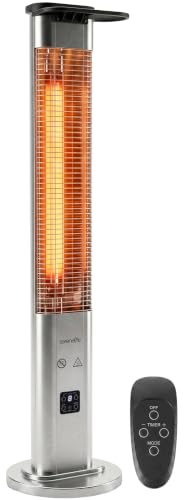
The Dr. Infrared 1500W is built around a carbon infrared element and a weighted base with easy-roll wheels. The listing describes three ways to mount it: freestanding, on a wall or hanging overhead. That flexibility lets one purchase move from a patio in summer to a garage in winter.

It offers three power steps of 900W, 1200W and 1500W through a remote. At 1500W it produces about 5,120 BTU per hour, which is the practical ceiling for a plug-in heater on a 15A circuit. Infrared heat warms people and surfaces, so it holds up in a light breeze better than a fan heater.

Compared with the Haimmy at 42 inches it has fewer power steps but more mounting choices. Treat the remote as the main control, since the unit sits at head height and the controls are not meant to be reached while seated. Plug it into a weather-rated outlet and keep the cord off wet ground. Wipe the reflector with a dry cloth once it cools, and keep spiders out of the element cover.

What works

  • Three power steps from 900W to 1500W
  • Weighted base with wheels steadies the tower
  • Freestanding, wall and ceiling mounting
  • Remote control for adjusting from a seat

Watch out for

  • Fewer fine steps than the nine-level towers
  • Needs a weather-rated outlet and short cord

Spec sheet

Power steps
900W, 1200W, 1500W
Mounting
Freestanding, wall or ceiling
Base
Weighted with wheels
Control
Remote
Use
Indoor and outdoor
02
Haimmy 42 in infrared patio heater, 9 levels and 9 hour timer
1500W9 levels9H timer42 in
Check price on Amazon
Best for: Evenings where you want small steps of heat.

The Haimmy is 42 inches tall and its heating tube runs about two-thirds of that height. A longer tube spreads radiant heat from head to waist, which suits seated guests better than a short element. It has nine heat modes from 620W to 1500W, which is the finest control in this lineup.

A timer runs from 1 to 9 hours, so the heater turns itself off if you forget it. Nine steps let you hold a gentle output on a mild evening, saving electricity. At full power the same 1500W limit applies, so it will not heat a large open patio.

Against the VAGKRI, which also offers nine levels, it has a shorter timer range but a clear tube height description. Neither is a substitute for a wind block. Place it at about arm's length from seating and aim it at the middle of the group. Owners should expect the glow tube to be the part that ages, so keep the tower upright in storage and avoid knocking the element against hard objects.

What works

  • Nine power modes from 620W to 1500W
  • Tube covers about two-thirds of the tower height
  • 1 to 9 hour timer shuts it off
  • Remote control included

Watch out for

  • Timer tops out at 9 hours
  • Still limited by the 1500W ceiling

Spec sheet

Power
620W to 1500W, 9 modes
Height
42 in
Timer
1 to 9 hours
Control
Remote
Element
Tube about two-thirds of height
03
VAGKRI 42 in 1500W infrared heater, 9 levels, 24 hour timer, IPX5
1500W9 levels24H timerIPX5
Check price on Amazon
Best for: All-evening use under a light shelter.

The VAGKRI is a 42 inch tower with nine power settings from 620W to 1500W, a 24 hour timer and an IPX5 rating. IPX5 means water jets from any direction are tolerated, but it carries no dust rating in the code. The 100 degree wide-angle spread helps a group fit inside the warm zone.

A 24 hour timer is more than most people need, though it permits all-evening use without resetting. A rating of IPX5 is a step up from the splash rating on some rivals. Combined with nine levels it makes this the most adjustable weather-ready tower here.

Against the Dr. Infrared it trades mounting options for finer power steps. Position it a few feet from seating. Cover or store the heater when a storm is forecast, even with an IPX5 rating. Pull the plug before a thunderstorm as well, since a lightning surge does not care about water ratings.

What works

  • Nine power levels and a 24 hour timer
  • IPX5 rating tolerates water jets
  • 100 degree wide spread covers a group
  • 42 inch tower reaches seated guests

Watch out for

  • IPX5 has no dust rating
  • Less flexible mounting than the Dr. Infrared

Spec sheet

Power
620W to 1500W, 9 levels
Timer
24 hour
Rating
IPX5
Spread
100 degree wide angle
Height
42 in
04
hykolity 38.5 in 1500W infrared patio heater, dual carbon tubes
1500WDual tubesIP4424H timer
Check price on Amazon
Best for: Covered patios where two simple levels are enough.

The hykolity uses dual carbon heating tubes and offers two heat output levels. It stands 38.5 inches tall and carries an IP44 rating, which protects against splashing water from any direction and objects over 1 mm. A timer runs from 0 to 24 hours, and a remote handles the controls.

Two levels are simpler than nine, which many owners prefer. IP44 is adequate under a roof but is the lowest weather rating here, so it is not a heater for a rain-exposed deck.

Against the SereneLife at IP65 it gives up weather protection but doubles the wattage. Aim the tubes at the seats and keep it about three feet from furniture.

What works

  • Dual carbon tubes spread heat
  • Two levels keep controls simple
  • 0 to 24 hour timer
  • Remote included

Watch out for

  • IP44 is weak for open exposure
  • Only two power levels

Spec sheet

Power
1500W, 2 levels
Element
Dual carbon tubes
Rating
IP44
Timer
0 to 24 hours
Height
38.5 in
05
SereneLife 900W infrared patio heater, IP65, aluminum reflector
900WIP65ETLReflector
Check price on Amazon
Best for: Small nooks and exposed decks needing a high IP rating.

The SereneLife uses 900W, which is about 3,070 BTU per hour, and adds an IP65 rating and ETL certification. IP65 means dust tight and protected against water jets, the strongest weather rating among the tower-style units here. It has an aluminum reflector and aluminum alloy frame.

At 900W it draws far less than a 1500W unit, so it can share a circuit with other loads. That helps on a deck with a few other plugs.

It will not warm a large group. Treat it as a small-nook heater for one or two seats. A weather-rated outlet is still needed.

What works

  • IP65 is dust tight and jet resistant
  • ETL certification named in the listing
  • 900W draw is easy on a shared circuit
  • Aluminum alloy frame resists rust

Watch out for

  • 900W is too little for groups
  • Fewer controls than the nine-level towers

Spec sheet

Power
900W
Rating
IP65
Certification
ETL certified
Frame
Aluminum alloy
Control
Remote
06
MEPTY 1500W infrared patio heater, IP65, 24 hour timer
1500W500/1000/1500WIP6524H timer
Check price on Amazon
Best for: Quiet evenings with real weather protection.

The MEPTY lists three heat steps of 500W, 1000W and 1500W with an IP65 rating and a 24 hour timer. It has no fan, which is why the listing describes zero-decibel operation. Heat arrives instantly because the element glows, not because the air is moved.

Its value is the combination of an IP65 rating and 1500W of power. Most IP65 units are low wattage, and this one keeps the weather rating without the power penalty.

Against the Dr. Infrared it lacks multiple mounting options. Place it where cord lengths are short and dry.

What works

  • IP65 rating with full 1500W output
  • Three steps from 500W to 1500W
  • 24 hour timer
  • No fan noise

Watch out for

  • Less mounting flexibility
  • 1500W still limits coverage on open decks

Spec sheet

Power
500W, 1000W, 1500W
Rating
IP65
Timer
24 hour
Noise
No fan noise
Control
Remote
07
Garvee 1500W infrared patio heater with tripod stand
1500WTripod3 levels24H timer
Check price on Amazon
Best for: Occasional use and easy storage.

The Garvee uses a carbon fiber infrared element on a tripod stand, with three heat settings, a 24 hour timer and a remote. A tripod folds flat and stores in a closet, unlike a weighted tower. That is a practical edge for a renter.

A tripod is also less stable on a deck than a weighted base. Keep it away from foot traffic and place it on a level surface.

Against the Dr. Infrared it is lighter to move but less steady. It suits occasional use. Wipe the element cover with a dry cloth.

What works

  • Tripod folds for storage
  • Carbon fiber infrared element
  • Three levels and a 24 hour timer
  • Remote included

Watch out for

  • Less stable than a weighted base
  • Tripod legs can catch a foot

Spec sheet

Power
1500W, 3 levels
Element
Carbon fiber infrared
Stand
Tripod
Timer
24 hour
Control
Remote

Spec sheet decoder

What the numbers on the box really mean

The specs manufacturers lead with, translated into what they tell you about real-world performance.

Wattage

Electric input. One watt makes about 3.4 BTU per hour, so 1500W is about 5,120 BTU.

Watch forSereneLife 900W versus the 1500W towers.

IP rating

Two digits for dust and water protection. Higher means better sealing.

Watch forIP44, IPX5 and IP65 appear in this lineup.

Heat levels

Fixed power steps. More steps give finer control.

Watch forNine on Haimmy and VAGKRI, three on Dr. Infrared, two on hykolity.

Timer

Auto shut off after a set time.

Watch for9 hours on Haimmy, 24 hours on VAGKRI and MEPTY.

Wide-angle spread

The arc over which heat is emitted.

Watch forVAGKRI lists 100 degrees.

Methodology

How We Evaluated These Electric Patio Heaters

Power and circuit fit

We compared wattage with the 1,800W continuous limit of a 15A circuit. The 900W SereneLife and the 1500W towers differ by how much room they leave. We assume a typical patio outlet on a 15A circuit and give no credit for output that cannot be used continuously. Units that gave more steps below the maximum earned extra points.

Weather protection

We read each listing for IP ratings and gave extra credit to IP65 over IP44. A rating is a design claim rather than proof, so we treated it as one input and did not let it outrank sensible placement. Plugs and cords were noted as the likeliest failure points.

Controls

We looked at power steps, timers and remotes. The nine-level towers lead on control. A long timer was valued less than a reliable shutoff, since an evening heater is usually turned off by hand. Remote range was not rated, because listings rarely give it.

Stand design

We compared weighted bases with tripods for stability. A wheeled base also matters for cleanup, because owners move these heaters daily. Models with a clear mounting option gained flexibility points.

Ownership

We considered cords, elements and covers, which wear first. Dust on the reflector and a cracked cover are the typical year-three complaints. This section draws on the spec sheet and owner feedback patterns rather than long-term measurements.

Decision guide

How to Choose the Right Electric Patio Heaters

By Seating Area

SituationPickWhy
One or two seatsSereneLife 900WSmall nook, IP65
Four seats under coverHaimmy 42 inTube covers head to waist
Open deck seatingVAGKRI 42 in100 degree spread
Garage or patioDr. Infrared 1500WFreestanding or wall mount

By Budget

SituationPickWhy
Lowest outlaySereneLife 900WSimple and weather rated
Mid-range valuehykolity dual tubeTwo simple levels
Feature spendHaimmy 42 inNine levels
Higher spend for stabilityDr. Infrared 1500WWeighted base

Tower vs Tripod

Tower with weighted base

The Dr. Infrared and the 42 inch towers stand steady and reach seated guests.

Tripod

The Garvee folds flat and stores easily but needs a level spot.

Frequent use favors a tower; occasional use favors a tripod.

By Weather Exposure

SituationPickWhy
Rain-exposed deckMEPTY IP65Dust tight and jet resistant
Covered porchhykolity IP44Splash protection
Windy cornerVAGKRI IPX5Jet tolerant
Sheltered nookSereneLife IP65Small and sealed

For Evening Entertaining Specifically

Look for

A tall element, a wide spread and a timer.

In this comparison

The VAGKRI and Haimmy cover a group with nine steps and a long tube.

When to Spend More

Spend more if

You use the heater nightly: the Dr. Infrared and VAGKRI add stability and control.

Save if

You use it occasionally: the SereneLife or Garvee is enough.

Ownership

Maintenance schedule

The upkeep that decides whether this machine lasts two seasons or ten.

TaskIntervalWhy it matters
Inspect the cordBefore each seasonA warm plug signals a poor connection. Replace damaged cords.
Wipe the reflectorEach month in useDust cooks on hot surfaces. Wipe when cool.
Check the baseEach seasonLoose wheels or legs cause wobble. Tighten hardware and look for any cracks in the stand or base plate.
Test the remoteEach seasonBatteries fail in cold weather. Replace cells at the start of each season and keep the remote indoors between uses.
Store dryOff seasonMoisture ruins electronics. Cover the unit and keep it off a damp concrete floor, since humidity creeps into the base.

FAQ

Frequently Asked Questions

How much power does an electric patio heater use?

A 1500W heater uses 1.5 kWh per hour at full power. Lower steps use less. A few hours a night over a cool season adds up, so use the lowest step that keeps you comfortable.

Will it heat a large patio?

No. Electric infrared is best for a small seating area. A big open space needs propane. If you want to heat more than two or three seats, add a second unit on a separate circuit instead of hoping for more reach.

What IP rating do I need?

IP44 is for covered areas, IPX5 tolerates jets and IP65 is dust tight and jet resistant. A rating does not cover the plug and cord, so keep those dry and under a cover.

Can I use an extension cord?

Only a heavy-gauge outdoor cord rated for the load. A thin cord is a fire risk. Keep the run short and check that the plug stays cool after an hour.

Does infrared heat work in wind?

Better than convection heat, since it warms people directly, but a strong gust still cools you.

Do I need a remote?

It is handy because the controls sit at head height. Without one you have to reach up to a hot tower, which is awkward for seated guests and for anyone with limited reach.

Bottom line

The short version

Browse more electric patio heaterson Amazon →
James Miller, Lead Machine Editor

About the author

James Miller

Lead Machine Editor, MachineFanatic

James Miller leads MachineFanatic's buying guides, turning spec sheets, manuals and owner feedback into clear verdicts on power tools, outdoor power equipment, shop machines and kitchen machines.

More from James →

Keep reading

Related guides