

Amazon affiliate links - we earn a commission.Affiliate disclosure

Buying guide · 12 min read · Updated 2026-11-07

Best Electric Space Heaters (2026)

Six electric space heaters compared across ceramic fans, an infrared hybrid and an oil radiator, with the safety and heat-delivery details that matter at 1500W.

James MillerBy James MillerLead Machine Editor6 machines comparedSpec-sheet verified
Best Electric Space Heaters

At a glance

Our top picks

Side by side

Spec comparison

Electric heating is the simplest heating there is: current runs through a resistive element, and nearly every watt becomes heat. Because the conversion is close to perfect in every design, differences between models are about how the heat is moved, how finely it can be controlled and how well the safety systems are built.

Plug-in units are also capped by the household outlet, so no portable electric heater can promise more than a modest room. The honest way to shop is to pick the delivery style that suits your space, then confirm the safety details and controls that make it livable day after day.

Before you buy

6 Criteria to Look For Before Buying an Electric Space Heater

  1. 01

    Heat delivery style

    Electric heaters come in blown-air ceramic, radiant infrared and oil-filled forms. The DREO and AUBKN blow air, the Dr Infrared mixes radiant quartz with PTC, and the PELONIS radiates from oil fins. All convert watts to heat at close to 100 percent, so choose by noise, speed and where you sit.

  2. 02

    Realistic room coverage

    A rule of thumb is 10 watts per square foot, so 1500W suits roughly 150 square feet of insulated room. The Dr Infrared lists coverage up to 1000 square feet, which cannot be reconciled with that limit. Treat any such claim as marketing and size by your room.

  3. 03

    Thermostat precision

    A thermostat that holds a number precisely cycles the element less. The DREO 24 inch lists 41 to 95 degrees Fahrenheit in 1 degree steps. A basic knob like the PELONIS's dials are coarser, which is fine for a bedroom radiator.

  4. 04

    Timer length

    A timer prevents a heater from being left on. The AUBKN offers 1 to 12 hours and the WINHL 12 hours. A timer is more valuable than a high number of heat modes. Think about the actual failure case: you fall asleep with the heater on, or you leave for work and forget it. A long timer such as the AUBKN's catches both, whereas a unit with only a thermostat will keep cycling indefinitely.

  5. 05

    Safety stack

    Look for tip-over, overheat, cool-touch housing and an ETL or UL listing. The DREO lists a child lock, a safety plug and cool-touch housing. A safety plug is a plug with built-in protection against overheating at the wall.

  6. 06

    Power steps and shared circuits

    A step below 1500W lets a heater share a circuit. The PELONIS offers 600W, 900W and 1500W, and the GiveBest 750W. Plug any heater directly into the wall and keep other high-draw items off the same circuit. The usual surprise is a breaker that trips when a vacuum or hair dryer starts on the same line, and the fix is a lower step or a different outlet, not a thicker extension cord.

Detailed reviews

The 6 best electric space heaters, explained

01
DREO 24 Inch Dual-Motor Ceramic Tower, Remote
PTC ceramicDual DC motors41 to 95 F rangeECO mode
Check price on Amazon
Best for: Living rooms and bedrooms where precise control and safety detail matter.

What stands out on the DREO 24 inch is the pair of DC motors, which the listing says doubles airflow at 10 ft/s. In a fan-driven ceramic heater, airflow decides how quickly warmth reaches you, so moving more air across the element is a real design lever and not a spec-sheet flourish.

Control is equally detailed: a temperature range from 41 to 95 degrees Fahrenheit in 1 degree steps, an ECO mode and a remote. Fine steps matter because a thermostat that can hold a number precisely cycles the element less. The safety list reads long, with a child lock, a safety plug, overheat and tip-over protection and a cool-touch housing, and the ETL listing is the credential to look for.

Ownership comes down to dust. The twin fans pull air through the cabinet and any lint bakes on the ceramic, so vacuum the intake before the heating season. Set it on a hard floor, give it clearance and use the timer or remote so it does not run unattended. Against the GiveBest, the DREO's extra cost buys quieter, more controllable heating.

What works

  • Dual DC motors double airflow
  • 1 F thermostat steps limit cycling
  • Cool-touch housing and child lock
  • ETL-listed with multiple cutoffs

Watch out for

  • Same 1500W ceiling as cheaper heaters
  • Tall body needs a stable floor

Spec sheet

Element
PTC ceramic
Airflow
Dual DC motors, 10 ft/s
Temperature range
41 to 95 F in 1 F steps
Control
Remote and thermostat
Safety
Child lock, safety plug, overheat, tip-over, cool-touch
02
Dr Infrared DR-968 Quartz and PTC Heater, 1500W
1500W5,200 BTU claimInfrared quartz plus PTCCherry cabinet
Check price on Amazon
Best for: A favourite chair or desk where radiant warmth feels better than blown air.

The DR-968 stands apart by combining two heat sources: an infrared quartz element that warms objects and people directly, and a PTC element that heats the air. The direct radiant part feels like sun on skin, which is why people with a favourite chair tend to like this style.

Treat the coverage claim of up to 1000 square feet with care. A 1500W heater gives off about 5,100 BTU an hour whatever its type, and the listing's 5,200 BTU figure matches that limit, which means the area it can realistically warm is a fraction of what the claim implies. The extra radiant feel is real, but it lives in the line of sight.

Cherry cabinets are furniture-like, which suits a living room, but they are also more of a visible object, so keep it away from walls and fabrics. Dust the front grille and the quartz tube gently with a dry cloth when cool, and do not move it while hot. It is the choice when you want to feel warmth on yourself quickly and do not mind that heat stops where the line of sight does.

What works

  • Infrared quartz warms people directly
  • PTC element adds warm air
  • Furniture-style cabinet
  • Tip-over protection included

Watch out for

  • 1000 sq ft claim is far beyond 1500W reality
  • Radiant heat needs line of sight

Spec sheet

Power
1500W
Heat output claim
Up to 5,200 BTU
Heating method
Infrared quartz plus PTC
Coverage claim
Up to 1000 sq ft
Safety
Tip-over protection and more
03
PELONIS Oil-Filled Radiator 1500W, 3 Modes
600/900/1500WOil-filledDual knobsFanless
Check price on Amazon
Best for: Quiet overnight heating where noise would wake you.

The PELONIS is the only fanless radiator in this lineup, so the 1500W element heats sealed oil and the fins give off warmth with no motor noise at all. That makes it the one to take into a bedroom when a fan's hum would keep you awake.

Its three power steps of 600W, 900W and 1500W can be combined, which is a useful trick on a shared circuit: you can run the 600W step alongside a lamp or a laptop charger without leaving much margin, or step up to full power when the room is cold. Dual knobs handle power and temperature, which is a simple pair of controls that works without a remote.

Oil radiators reward patience because they warm slowly and keep radiating after power cuts. Keep the casters clean, plug it directly into the wall and never put damp towels on the fins. A radiator is heavy and sealed, so there is little to maintain beyond dusting, and if it ever leaks oil it should be retired.

What works

  • Fanless, so effectively silent
  • Three combinable power steps
  • Dual knobs need no remote
  • Radiates after cycling off

Watch out for

  • Slow to warm a cold room
  • Heavy sealed body

Spec sheet

Power steps
600W, 900W and 1500W
Type
Oil-filled radiator
Controls
Dual knobs
Noise
Fanless
Combine modes
Steps can be combined
04
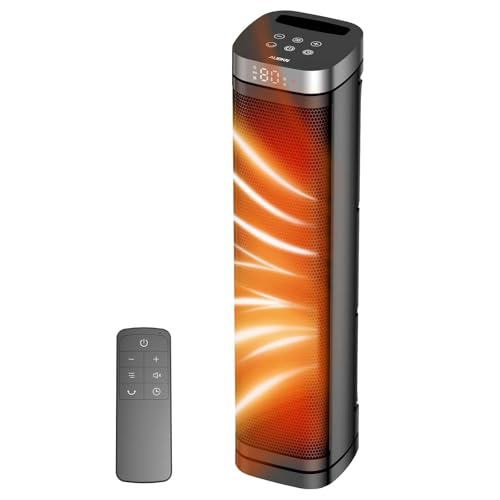
AUBKN 24 Inch Ceramic Tower, 1-12 Hour Timer
1500W PTC1-12 hour timer70 degree swingECO modes
Check price on Amazon
Best for: People who want a long programmable timer for overnight or workday use.

The AUBKN is a 24 inch ceramic tower whose headline feature is a programmable timer that runs from 1 to 12 hours. A timer that long covers a full night or a full workday, which is useful because most heater accidents involve a unit left running when nobody was watching.

It also has ECO modes, a 70 degree swing, a thermostat and a remote, which puts it in the same feature class as the DREO. The difference is detail: the DREO lists dual motors and a 1 degree thermostat range, while the AUBKN leans on the timer. Choose it if scheduling is your priority.

Because the timer is the point of this model, set it every time you use it instead of leaving the heater in continuous mode, and pick the shortest interval that covers your need. A tower that clicks off at the end of a two hour warm-up is far less likely to be forgotten than one you must remember to switch off. Treat it as you would any ceramic tower. Dust the intake before the season, keep it on a hard flat floor and keep curtains well clear. If the plug runs warm, stop using it, and unplug the heater at the wall whenever you leave the house.

What works

  • 1 to 12 hour timer covers a night
  • ECO modes trim running time
  • 70 degree swing spreads warmth
  • Remote adjusts from across the room

Watch out for

  • Less detail on airflow than DREO
  • Tall body tips more easily

Spec sheet

Power
1500W PTC ceramic
Height
24 inches
Timer
1 to 12 hours
Oscillation
70 degrees
Control
Thermostat and remote
05
WINHL 1500W PTC Heater, 70 Degree Swing, 12H Timer
1500W PTC70 degree swing12 hour timerRemote
Check price on Amazon
Best for: Buyers who want remote control and a timer at a lower tier.

The WINHL packs a thermostat, a remote and a 12 hour timer around a 1500W PTC ceramic element, and it sweeps 70 degrees to spread warmth into a corner. The listing says it blows warm air within seconds, which is typical of PTC ceramics and not a sign of extra power.

It sits in the value end of the remote-equipped heaters, so you get the control features without the extra airflow engineering of the DREO. If your decision is between this and the AUBKN, the WINHL tops out at a 12 hour timer while the AUBKN offers a 1 to 12 hour range, which is a small difference unless you want short timed bursts.

Upkeep is routine: keep the grille free of dust, test the tip-over cutoff each season and do not run the heater through a power strip. A remote makes it tempting to leave a heater on, so use the timer.

What works

  • Remote, thermostat and timer included
  • 70 degree swing covers a corner
  • Warm air arrives in seconds
  • Straightforward controls

Watch out for

  • Less airflow detail than DREO
  • Same 1500W ceiling as every plug-in

Spec sheet

Power
1500W PTC ceramic
Oscillation
70 degrees
Timer
12 hour
Control
Remote and thermostat
Warm-up
Warm air within seconds claim
06
GiveBest 1500W/750W Ceramic Desk Heater with Fan Mode
1500W / 750WCool air fanCarry handleV0 housing
Check price on Amazon
Best for: A desk or workbench where a cheap personal heater is enough.

The GiveBest is a small desk heater with two heat steps, 1500W and 750W, plus a cool-air fan mode, so it doubles as a summer fan. A built-in carry handle makes it easy to move between a desk and a bench.

It includes a thermostat and a V0 flame retardant housing, which means the plastic is rated to resist burning. For a budget unit that covers the main safety bases. What it lacks next to the larger models is oscillation and a remote, so you point it at yourself and leave it there.

Its compact size makes it best for personal warmth, not a room. Dust the vents, keep it clear of paper and unplug it when you leave. It is the practical answer when a bigger heater is overkill. The 750W step is worth using on cool shoulder-season days, because half power often holds a small office comfortable, and the cool-air fan mode earns its place in summer when the same unit can move air across a desk.

What works

  • Two heat steps plus a cool-air fan
  • Carry handle eases moving
  • V0 flame retardant housing
  • Compact body suits a desk

Watch out for

  • No remote or oscillation
  • Heats a personal zone, not a room

Spec sheet

Heat steps
1500W and 750W
Fan mode
Cool air
Housing
V0 flame retardant
Portability
Built-in carry handle
Control
Thermostat

Spec sheet decoder

What the numbers on the box really mean

The specs manufacturers lead with, translated into what they tell you about real-world performance.

Wattage

Wattage is how much electricity the heater draws, and almost all of it becomes heat. A 1500W unit draws about 12.5 amps at 120 volts.

Watch forEvery plug-in unit here tops out at 1500W; larger claims are not electrical.

BTU

One watt makes about 3.41 BTU an hour. A 1500W heater therefore produces about 5,100 BTU.

Watch forThe Dr Infrared's 5,200 BTU figure matches that limit and not a 1000 sq ft room.

PTC ceramic

A ceramic element whose resistance rises with temperature, which limits its own heat. It is a built-in safety property.

Watch forThe DREO, AUBKN and WINHL use PTC ceramic.

Oscillation angle

How widely the cabinet swings. A wider angle spreads heat and adds none.

Watch forThe AUBKN and WINHL list 70 degrees.

ETL listing

A third-party safety mark showing the product was evaluated to a recognised standard. It is a signal, not a guarantee.

Watch forThe DREO 24 inch is described as ETL listed.

Methodology

How We Evaluated These Electric Space Heaters

Heating method

We separated blown-air ceramic, radiant infrared and oil-filled units by how they deliver warmth. The conversion of watts to heat is near equal across them. The delivery style decides noise, speed and comfort.

Claim realism

We checked every coverage and BTU claim against the 1500W electrical limit. A number that cannot be reached on a standard 15 amp circuit is a marketing figure, not an engineering one. The Dr Infrared's 1000 square foot claim was marked down. Claims in line with the 150 square foot rule scored higher.

Control and timing

We compared thermostat steps, timers and remotes, from the DREO's 1 degree steps to the AUBKN's 12 hour timer. Controls that reduce unattended running scored higher.

Safety stack

We looked for tip-over, overheat, child lock, cool-touch housing and an ETL listing. A longer verified list scored higher. Missing detail counted against a model.

Owner feedback patterns

We read themes on noise, odour and remote range from owner feedback. They supported the ranking and did not drive it. The lineup runs from a desk heater to a dual-motor tower.

Decision guide

How to Choose the Right Electric Space Heaters

By Heat Delivery

SituationPickWhy
Silent sleepingPELONIS Oil RadiatorFanless with three power steps
Fast blown warmthDREO 24 InchDual DC motors
Warm a chair directlyDr Infrared DR-968Infrared quartz plus PTC
Long timerAUBKN 24 Inch1 to 12 hour timer
Cheap desk warmthGiveBest Desk HeaterCompact with fan mode

By Budget

TierPickWhy
Lowest outlayGiveBest Desk HeaterCompact and plain
Lower midWINHL 1500WRemote and timer
Mid tierAUBKN 24 InchLong timer and ECO
Higher tierPELONIS RadiatorSilent oil design
Highest outlayDREO 24 InchDual-motor airflow

Fan Heater vs Radiant Heater

Fan-driven heaters

The DREO, AUBKN, WINHL and GiveBest warm air and blow it around. They heat a space fast but add fan noise.

Radiant heaters

The Dr Infrared warms you directly and the PELONIS radiates from oil fins. They are quieter but need line of sight or time.

Pick the DREO for room warming and the Dr Infrared for a chair.

Controls That Matter

PreferencePickWhy
Fine thermostatDREO 24 Inch1 F steps
Long timerAUBKN 24 InchUp to 12 hours
Simple knobsPELONIS RadiatorDual knobs
Remote valueWINHL 1500WRemote and timer

For Bedrooms Specifically

Look for

Look for silence, a timer and a cool surface. A bedroom heater should shut itself off and not hum.

In this comparison

The PELONIS is fanless, the AUBKN has a 12 hour timer and the DREO has a child lock and cool-touch housing.

When to Spend More

Spend more if

Spend more on the DREO if you want precise control and the longest safety list, or the PELONIS if silence is a must.

Save if

Save with the GiveBest or WINHL if the heater is for a desk or occasional use.

Ownership

Maintenance schedule

The upkeep that decides whether this machine lasts two seasons or ten.

TaskIntervalWhy it matters
Vacuum intakeMonthly in seasonLint bakes onto the element and creates odours. Use a soft brush with the plug pulled.
Test tip-over cutoffEach seasonLift one edge of the unplugged unit and verify the heat cuts out. A stuck switch gives no safety.
Inspect plug and cordEvery few weeksA warm plug signals trouble. Swap the unit out once the plug starts to discolour.
Clear clearance zoneEach useKeep three feet clear of curtains and bedding. Heat output reaches farther than you expect.
Store cleanedEnd of seasonWipe it down and store dry. Dust left on the element can smell next winter.

FAQ

Frequently Asked Questions

Which type of electric heater is cheapest to run?

All convert nearly 100 percent of electricity to heat, so the hourly cost at 1500W is the same. Savings come from controls that cycle the element and from heating only the room you occupy.

Are infrared heaters more efficient?

Not in energy conversion, since they match every other electric heater. They feel warmer to you because heat lands on your body, which can let you run them at a lower setting.

Can I run a heater all night?

Use a timer and a model with tip-over and overheat protection. The AUBKN's 12 hour range or the PELONIS's silence suits overnight use.

Why does my heater smell at first?

A light dusty smell for a few minutes is common as residue burns off. A strong or lasting smell means you should stop and unplug.

Is a bigger tower better?

Not in output, since every plug-in unit is limited to 1500W. A taller tower throws warmth higher and farther but tips more easily.

Can I use an extension cord?

No. Plug a heater directly into a wall outlet, because thin cords can overheat under a 1500W load.

Bottom line

The short version

Browse more electric space heaterson Amazon →
James Miller, Lead Machine Editor

About the author

James Miller

Lead Machine Editor, MachineFanatic

James Miller leads MachineFanatic's buying guides, turning spec sheets, manuals and owner feedback into clear verdicts on power tools, outdoor power equipment, shop machines and kitchen machines.

More from James →

Keep reading

Related guides