
Amazon affiliate links - we earn a commission.Affiliate disclosure

Buying guide · 12 min read · Updated 2026-11-07

Best Fast 3D Printers (2026)

Five fast FDM 3D printers compared on real speed, acceleration, enclosure and ease of use, from Bambu Lab and FLASHFORGE to Entina and AOSEED.

James MillerBy James MillerLead Machine Editor5 machines comparedSpec-sheet verified
Best Fast 3D Printers

At a glance

Our top picks

Side by side

Spec comparison

Speed has become the headline spec for consumer 3D printers, and the numbers on the box are often misleading. A single quoted top speed tells you how fast the toolhead can travel in a straight line, not how long a real print takes.

What actually shortens print time is a combination of acceleration, cooling, hotend flow and a frame stiff enough to take the motion. This guide separates marketing numbers from those underlying limits so you can judge what each machine will really do.

Before you buy

6 Criteria to Look For Before Buying a Fast 3D Printer

  1. 01

    Acceleration over top speed

    The Bambu Lab P1S lists 500 mm/s and 20000 mm/s2 acceleration, and the FLASHFORGE Adventurer 5M lists 600 mm/s and 20000 mm/s2. Reaching 600 mm/s at 20000 mm/s2 needs roughly 9 mm of travel, so short moves never get there. A printer with higher acceleration finishes small features sooner, which matters more than the peak.

  2. 02

    Hotend flow limit

    A hotend can only melt so much plastic per second, measured in cubic millimeters per second. If the nozzle cannot melt fast enough, the printer slows down or under-extrudes regardless of the travel speed on the box. Check the maker's flow claims and look for actual print-time estimates in the slicer rather than a top speed. A high-flow hotend lets a 0.4 mm nozzle lay thicker, faster layers, and it is the single spec that most reliably predicts shorter prints on large, simple parts like trays and covers.

  3. 03

    Cooling and quality at speed

    Fast prints deposit plastic quicker, so the part must cool faster to hold detail. Machines with strong part-cooling fans, like the enclosed Bambu P1S and P2S, keep overhangs sharp at speed. An open or underpowered fan setup produces droopy corners that cancel the time saved. PLA is the most forgiving at speed because it solidifies quickly, while PETG and ABS run into flow and cooling limits sooner and usually need slower profiles.

  4. 04

    Frame stiffness and ringing

    High acceleration shakes the frame, causing ghosting ripples after corners. CoreXY machines such as the Adventurer 5M keep moving mass low, which helps, but a flimsy table can still amplify vibration. Place the printer on a heavy, stable surface and check belt tension when ringing appears.

  5. 05

    Ecosystem and profiles

    Fast printing depends on well-tuned slicer profiles. The Bambu machines ship with profiles that set flow, temperature and acceleration for common filaments, while the Adventurer 5M and Tina2 Plus rely more on user tuning. A good profile is what turns the headline speed into real prints.

  6. 06

    Part size and the speed you will use

    Small printers like the Tina2 Plus rarely reach their top speed because moves are short. Larger parts let acceleration reach cruising speed, which is where a 600 mm/s machine pays off. Match the machine to the part sizes you print most often. A buyer who mostly prints phone stands and small organizers will see little difference between 250 mm/s and 600 mm/s, while someone printing large trays and enclosures will save real hours. Look at the slicer's time estimate for a model you actually want before deciding.

Detailed reviews

The 5 best fast 3d printers, explained

01
Bambu Lab P2S Combo With AMS 2 Pro
600 mm/sAMS 2 ProEnclosed15-minute setup
Check price on Amazon
Best for: Buyers who want fast, multi-color printing with minimal setup.

The P2S pairs a 600 mm/s top speed with an enclosed frame and the AMS 2 Pro filament system. The maker says it is ready to print in about fifteen minutes, which reflects how much of the calibration is automated. Speed here is supported by the machine's tuning: pre-built profiles in the slicer set acceleration and flow for common filaments, so the headline number is closer to what you actually get.

Against the P1S, the P2S is the newer design and the better choice if you want multi-color printing from day one. The enclosure also contains noise and drafts, which helps fast prints stay clean. Compared with the FLASHFORGE Adventurer 5M, it costs more but wraps the whole experience in software, a model library and colors.

Ownership is mostly about keeping up routine care: clean the plate, check the nozzle, and keep the AMS dry. Because speed stresses belts and bearings, tension and lubrication matter more than on a slow machine. The automatic calibration routine also helps after a move or a nozzle swap, since it re-measures the bed and flow without manual dial turning. For most buyers who want fast without fuss, this is the right place to spend.

What works

  • Up to 600 mm/s with tuned slicer profiles
  • AMS 2 Pro adds multi-color printing from day one
  • Enclosed frame contains noise and drafts
  • Ready to print in about fifteen minutes

Watch out for

  • Higher purchase cost than open-frame rivals
  • Fast motion wears belts and bearings sooner
  • Tied to the maker's software ecosystem

Spec sheet

Top speed
Up to 600 mm/s
Multi-color
AMS 2 Pro included
Setup
About 15 minutes
Frame
Enclosed
Ecosystem
MakerWorld model library
02
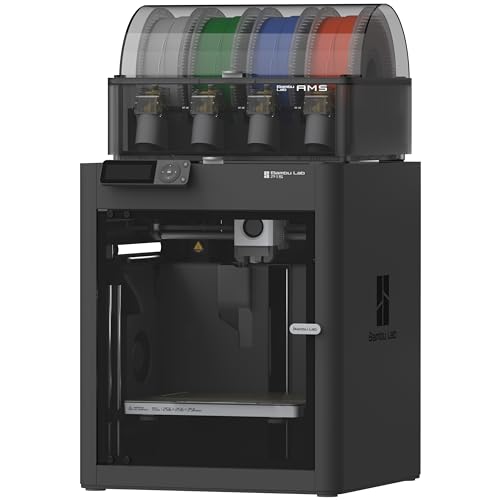
Bambu Lab P1S Combo With AMS
500 mm/s20000 mm/s2Up to 16 colorsEnclosed
Check price on Amazon
Best for: Buyers who want a proven enclosed fast printer with strong community support.

The P1S is the established fast enclosed printer, quoting 500 mm/s and 20000 mm/s2 acceleration. The acceleration figure matters more than the top speed, because a toolhead needs distance to reach full velocity and most real prints are made of short moves. A high acceleration value means it gets to speed sooner and so loses less time on small features. In everyday printing this shows up as shorter estimates on detailed models, such as figures, brackets and organizers, where the toolhead is constantly turning corners.

The AMS combo supports up to sixteen colors when units are chained, which is a lot of flexibility for a machine at this level. Against the P2S, the P1S has a slightly lower ceiling but a longer track record and a large body of community advice. Against open-frame fast printers, its enclosure is both a noise and temperature advantage.

In year two, watch for ordinary wear: nozzle changes, belt tension and a plate that picks up scratches. The machine tolerates all of this well, and spare parts are widely available. If the P2S is out of budget, this is the sensible fast pick.

What works

  • 500 mm/s and 20000 mm/s2 acceleration
  • AMS combo supports up to sixteen colors
  • Enclosed frame improves noise and print stability
  • Large community and parts availability

Watch out for

  • Slightly slower ceiling than the newer P2S
  • Combo adds cost and purge waste on multi-color jobs
  • Software ecosystem is tied to one maker

Spec sheet

Top speed
500 mm/s
Acceleration
20000 mm/s2
Multi-color
Up to 16 colors with AMS units
Frame
Enclosed
Ecosystem
MakerWorld model library
03
FLASHFORGE Adventurer 5M All-Metal CoreXY Printer
600 mm/s travel20000 mm/s2CoreXYOne-click print
Check price on Amazon
Best for: Beginners who want CoreXY speed at a lower cost.

The Adventurer 5M uses an all-metal CoreXY frame with a 600 mm/s maximum travel speed and 20000 mm/s2 acceleration. The maker pitches it as up to twelve times faster than older machines, but the useful comparison is against other modern printers, where it sits near the top of the spec sheet. One-click automatic printing handles leveling and start-up so a beginner can run it without a calibration ritual.

The trade-off is the ecosystem. Compared with the Bambu printers, the Adventurer has a smaller model library and less tuned slicer profiles, which means more manual adjustment to match their quality at speed. Expect to spend the first few weekends adjusting flow ratio, pressure advance and cooling per filament, a process that the Bambu profiles largely do for you. It also lacks the multi-color depth of the AMS. In exchange, it is simpler and less costly to enter.

Ownership is straightforward. Keep the plate clean, tighten belts if ringing appears, and use the quick-swap nozzle where fitted. For a household that wants fast prints without buying into an ecosystem, it is a strong choice.

What works

  • All-metal CoreXY frame with 600 mm/s travel
  • 20000 mm/s2 acceleration for quick direction changes
  • One-click automatic printing for easy starts
  • Lower cost than the Bambu alternatives

Watch out for

  • Smaller model library and less tuned slicer profiles
  • No multi-color system of comparable depth
  • Needs more tweaking to match top-tier quality at speed

Spec sheet

Max travel speed
600 mm/s
Acceleration
20000 mm/s2
Structure
All-metal CoreXY
Operation
One-click automatic printing
Audience
Beginner friendly
04
AOSEED AI 3D Printer 400 mm/s Enclosed
400 mm/sEnclosedWiFi app20,000+ models
Check price on Amazon
Best for: Families who want a safe, enclosed printer with a ready model library.

The AOSEED is a family-oriented printer that quotes 400 mm/s and ships with access to more than twenty thousand models through an app. The enclosed frame keeps small hands away from moving parts, and one-click WiFi printing hides most of the setup. It supports single-color printing only, which is a limit worth knowing about, since multi-color designs must be assembled from separate prints.

That limit is the main difference from the Bambu Lab P1S and P2S, which both offer multi-color systems. The AOSEED is a toy-factory style machine, intended to make small figures and household items quickly and safely rather than to push the limits of engineering prints. Its speed is useful for small parts, where a 400 mm/s ceiling will still be mostly unused.

In practice, use it as a family tool. Keep it in a spot with a stable table, clean the plate, and run the library models first. Because the build space is modest, plan to print small toys, desk organizers and replacement parts rather than anything near the size of a helmet. If you want a platform for experimentation and big parts, buy one of the larger printers in this list.

What works

  • Enclosed frame keeps hands clear of moving parts
  • One-click WiFi app printing for easy starts
  • Library of more than twenty thousand models
  • Quoted 400 mm/s speed for small parts

Watch out for

  • Single-color printing only
  • Smaller scale limits larger projects
  • Depends on a proprietary app and library

Spec sheet

Top speed
400 mm/s
Frame
Enclosed and safe
Control
One-click WiFi app
Model library
20,000+ models
Color
Single-color printing only
05
Entina Tina2 Plus Fast Mini 3D Printer
250 mm/sFully assembledWiFi appBeginner
Check price on Amazon
Best for: First-time users who want a ready-built printer for small parts.

The Tina2 Plus is the slowest on paper here, at up to 250 mm/s, but it arrives fully assembled and ready to use out of the box. That makes it a sensible beginner machine where the aim is to print something in the first hour rather than to win a speed contest. WiFi and an app handle sending files.

Because it is a mini printer, its small frame means short moves, and short moves rarely reach even 250 mm/s. In practice, the machine feels quick on small parts but cannot match the P1S or Adventurer 5M on anything larger. It suits kids and first-time users who value an easy start over a faster finish.

Ownership is simple: keep the plate clean, use the supplied filament first and upgrade later. If you outgrow it, the skills transfer directly to the faster machines above.

What works

  • Fully assembled with no setup required
  • WiFi and app control for easy file transfer
  • Quoted 250 mm/s is quick for small parts
  • Beginner and kid friendly

Watch out for

  • Slowest ceiling in this group
  • Mini scale limits part size
  • Not suited to demanding engineering filaments

Spec sheet

Top speed
250 mm/s
Assembly
Fully assembled
Control
WiFi and app
Audience
Beginners and kids
Setup
No setup required

Spec sheet decoder

What the numbers on the box really mean

The specs manufacturers lead with, translated into what they tell you about real-world performance.

mm/s top speed

The fastest speed the toolhead can move, such as 600 mm/s on the P2S and Adventurer 5M.

Watch forIt describes travel speed, not average print speed on real parts.

mm/s2 acceleration

How quickly the toolhead reaches speed. The P1S lists 20000 mm/s2.

Watch forHigher acceleration adds noise and can cause ringing on light frames.

CoreXY

A layout where the toolhead moves in X and Y while the bed only moves in Z, reducing moving mass.

Watch forBelt tension matters more on fast CoreXY machines.

AMS

Bambu's automatic material system that feeds multiple spools to one printer.

Watch forMulti-color prints waste filament during color changes.

Enclosed frame

A shell around the printing area that holds heat and blocks drafts, as on the P1S, P2S and AOSEED.

Watch forPLA prints can overheat in a closed chamber, so vent as needed. Enclosures also trap fine particles from heated plastic, so place the printer in a ventilated room rather than a closed bedroom or small office.

Methodology

How We Evaluated These Fast 3D Printers

Real speed potential

We compared quoted speeds and acceleration, such as the P1S's 500 mm/s and 20000 mm/s2 against the Adventurer 5M's 600 mm/s. Acceleration was weighted above top speed because most prints use short moves.

Out-of-box experience

We looked at how quickly each printer starts printing. The Tina2 Plus arrives fully assembled and the P2S is ready in about fifteen minutes, while the Adventurer 5M uses one-click printing.

Ecosystem depth

We checked model libraries and slicer support. Bambu's MakerWorld library and AOSEED's twenty thousand models reduce the need to design from scratch. A strong library shortens the time between unboxing and a useful print, which is the first speed test any new owner experiences.

Enclosure and noise

We considered how each frame handles noise and drafts. Enclosed machines contain fast-motion noise better than open designs. We also noted how loud the fans become at full speed, since a printer that runs for ten hours should not dominate a living space.

Ownership burden

Based on owner feedback patterns, belt wear, plate care and nozzle changes shape long-term satisfaction. Machines with clear spare-parts access scored higher. We also noted that fast machines put more stress on bearings and belts, so a printer with easily replaceable wear parts counts for more over three years of ownership.

Decision guide

How to Choose the Right Fast 3D Printers

By Skill Level

SituationPickWhy
Complete beginnerEntina Tina2 PlusFully assembled and ready to print
Beginner wanting speedFLASHFORGE Adventurer 5MOne-click printing on a fast CoreXY frame
Experienced or ambitiousBambu Lab P2S ComboFast motion with tuned profiles and AMS 2 Pro

By Budget

Budget tierPickWhy
Lowest outlayEntina Tina2 PlusEntry mini printer
Middle groundFLASHFORGE Adventurer 5MCoreXY speed without a premium ecosystem
Highest outlayBambu Lab P2S ComboNewest speed platform with multi-color

Open Ecosystem vs Closed Ecosystem

Closed ecosystem

The Bambu P1S and P2S bundle slicer profiles, a model library and automatic features. It is easier and faster out of the box but ties you to one maker.

Open tinkering

The Adventurer 5M offers speed with more manual tuning and fewer ties. It suits people who like to adjust profiles and learn the machine.

Pick the closed route for convenience; pick the open route for control.

Single Color vs Multi-Color

PreferencePickWhy
Single-color onlyAOSEED AI PrinterSingle-color designed, enclosed and safe
Multi-color nowBambu Lab P1S ComboAMS supports up to sixteen colors
Multi-color with newest techBambu Lab P2S ComboAMS 2 Pro included

For Saving Print Time Specifically

Look for

High acceleration, a stiff frame and a hotend that can feed enough plastic. Check print-time estimates in the slicer rather than relying on the box.

In this comparison

The P2S and P1S have tuned profiles that translate their spec sheets into real time savings, while the Adventurer 5M comes close with more manual setup.

When to Spend More

Spend more if

You print daily or sell prints. The P2S and P1S save hours each week and reduce failed prints.

Save if

You print occasionally. The Adventurer 5M or Tina2 Plus delivers fast enough results for hobby use.

Ownership

Maintenance schedule

The upkeep that decides whether this machine lasts two seasons or ten.

TaskIntervalWhy it matters
Tighten beltsEvery few monthsFast motion loosens belts, causing ringing. Check tension on both axes.
Clean the build plateBefore long printsOils cause first-layer failures. Wash with soap or isopropyl alcohol.
Lubricate rails and rodsEvery 3 to 6 monthsDry rails add noise and wear at high acceleration.
Replace the nozzleAs neededWear shows as under-extrusion. Brass nozzles are cheap consumables.
Dry the filamentMonthlyDamp filament pops and strings, undoing the benefit of speed. A sealed box with desiccant or a filament dryer fixes it.

FAQ

Frequently Asked Questions

Is a faster printer always better?

No. Speed reduces print time but can increase noise, ringing and failures. Choose speed only if your prints are large enough to use it. A small desk printer that finishes a figure in one hour instead of ninety minutes is a convenience, not a transformation, so weigh the saved minutes against the extra cost and noise.

What matters more, speed or acceleration?

Acceleration, because most prints are made of short moves that never reach top speed. A machine with high acceleration finishes detailed parts sooner.

Do I need an enclosure for fast printing?

It helps with noise and drafts and is needed for ABS. PLA prints can be fine in open frames, but an enclosed machine like the P1S is quieter.

Is the Adventurer 5M as good as a Bambu printer?

It matches the headline speed and costs less, but has a smaller ecosystem and less tuned profiles. Expect more manual adjustment, but the same hardware class prints at a comparable pace once flow and cooling are dialed in for each filament you use. For many households the saved cost is worth the extra weekend of tuning.

Can fast printers handle multiple colors?

Yes, with systems like the Bambu AMS. Multi-color printing wastes filament during changes, so print time and cost both rise.

Are fast prints lower quality?

They can be if the machine cannot cool or flow enough plastic. Good profiles and strong cooling keep quality close to slower prints. The exception is fine surface detail on small curved models, where a slower outer wall still looks better and costs only a few extra minutes.

Bottom line

The short version

Browse more fast 3d printerson Amazon →
James Miller, Lead Machine Editor

About the author

James Miller

Lead Machine Editor, MachineFanatic

James Miller leads MachineFanatic's buying guides, turning spec sheets, manuals and owner feedback into clear verdicts on power tools, outdoor power equipment, shop machines and kitchen machines.

More from James →

Keep reading

Related guides