
Amazon affiliate links - we earn a commission.Affiliate disclosure

Buying guide · 12 min read · Updated 2026-11-07

Best Food Processors (2026)

Six food processors compared by motor, bowl size, discs and ownership reality, from an 8-cup budget bowl to a 16-cup prep station.

James MillerBy James MillerLead Machine Editor6 machines comparedSpec-sheet verified
Best Food Processors

At a glance

Our top picks

Side by side

Spec comparison

A food processor is a motor base with a spinning blade or disc inside a bowl. It earns its counter space by doing repetitive cutting work that would otherwise cost you twenty minutes with a knife: shredding blocks of cheese, slicing cabbage, mincing onions for a big batch of soup.

Bowl size, motor strength and the quality of the discs decide how useful one is. Most disappointments come from buying too small a bowl or expecting a budget motor to handle dense loads, so the guide explains those limits before it ranks anything.

Before you buy

6 Criteria to Look For Before Buying a Food Processor

  1. 01

    Bowl size you will fill

    Bowl capacity is nominal, and the usable volume is lower: liquid lines sit under the cup rating, and slicing loads fill less than chopping. An 8-cup bowl like the BLACK+DECKER's is fine for a salsa batch but forces you to split a double recipe, while the Cuisinart 14-cup takes a full head of cabbage. Match the size to your largest regular recipe, not your biggest holiday dish.

  2. 02

    Motor strength under load

    Under 300 watts stalls on dense loads, and 400 to 450 watts is the practical budget range, as in the Hamilton Beach 10-cup. The Cuisinart 14-cup at 720 watts is where shredding hard cheese and mixing dough becomes routine. The Ninja's 1200 peak watts is a burst figure, so do not read it as three times the Hamilton Beach. Sustained torque and blade shape matter as much as any number on the box.

  3. 03

    Feed tube width

    A wide chute lets you drop in a whole small tomato, a block of cheese or half an onion, which cuts prep time. Small tubes force pre-cutting and erase the time savings that justify the machine. The Cuisinart 14-cup has an extra-large tube and the KitchenAid 13-cup has a two-in-one chute with a small inner pusher for thin items like carrots. Check the tube width before you buy, because it decides how often you use the slicing disc.

  4. 04

    Discs and slicing control

    Reversible discs cover slicing and shredding; fixed thickness is common, and the KitchenAid's lever-adjusted disc is a rare exception. If you slice potatoes for gratin one week and cucumbers for salad the next, adjustable thickness is worth paying for. The Ninja offers presets rather than fine control, which is faster but less precise.

  5. 05

    Pulse control and technique

    Pulse control is the key technique with any processor: short bursts give an even chop, while holding the button turns food to paste. The Cuisinart and Hamilton Beach models give you direct pulse control, while the Ninja's presets run fixed cycles. If you prefer to walk away from the machine, choose a preset model and accept less control.

  6. 06

    Storage and cleanup

    A processor with six loose parts becomes a drawer of sharp edges. The KitchenAid stores its blades and discs in the bowl, while the Cuisinart pieces are separate. Dishwasher use is fine for bowls and lids on the top rack, but hand washing blades keeps edges sharp. Wash right away after puree work, because dried food packs into the center post and lid seam.

Detailed reviews

The 6 best food processors, explained

01
Cuisinart 14-Cup Food Processor 720-Watt
14-cup bowl720-watt motorExtra-large feed tubePulse control
Check price on Amazon
Best for: Cooks who want one dependable full-size machine for shredding, slicing and dough.

This is a classic full-size design: a heavy base with a direct-drive induction motor rated at 720 watts, a wide work bowl and an extra-large feed tube. The motor sits low in the base and the bowl locks over a center spindle, so the machine stays planted when the blade meets dense food.

The tradeoff is bulk. At 14 cups it needs real cabinet space, and the pieces (bowl, lid, pusher, blade and discs) do not nest as neatly as on the KitchenAid. Against the Hamilton Beach 10-cup at 450 watts, the extra 270 watts show up when you shred a block of cheddar or knead a small batch of pizza dough, where the smaller motor slows and warms. For a family that cooks most nights, the larger bowl also means one batch instead of three.

Ownership is easy. The bowl and lid go in the top rack, the blade is best washed by hand to protect the edge, and the lid interlock must seat fully or the motor stays off. Expect the base to outlast several bowls, since plastic clouds and cracks long before an induction motor wears out.

What works

  • 720-watt motor keeps going through cheese and dough
  • Extra-large feed tube takes whole tomatoes and potato halves
  • Only two buttons, so nothing to learn
  • 14-cup bowl cuts batch count for big families

Watch out for

  • Large footprint and tall box to store
  • Blade and discs do not nest inside the bowl

Spec sheet

Bowl
14 cups
Motor
720 W
Controls
On and off/pulse
Discs
Slicing and shredding
Feed tube
Extra large
02
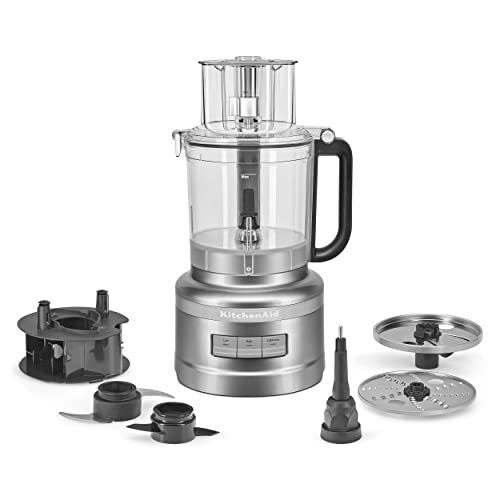
KitchenAid 13-Cup Food Processor KFP1318
13-cup bowlExact Slice discIn-bowl storageLatched lid
Check price on Amazon
Best for: Cooks who slice a lot and hate a drawer of loose discs.

The standout feature is the externally adjustable Exact Slice disc. A lever on the lid lets you move from thick to thin without opening the bowl or swapping discs, which matters for potato gratin one minute and coleslaw the next. Most processors give you two fixed slicing thicknesses at best, so this saves both clutter and time.

The second design idea is storage. Blades and discs live in a caddy inside the work bowl, which removes the drawer full of loose, sharp parts that most processors create. The twist-free bowl assembly clicks in and the lid latches, so it sets up faster than the Cuisinart 14-cup. The price is complexity: more molded parts means more places for food to pack in, so rinse straight away.

In use, it sits between the Cuisinart 11 and 14 in capacity, so it suits a household that finds 11 cups tight but 14 excessive. Plan on batch work for wet doughs, as with every home machine, and keep the blades out of the dishwasher so they stay sharp for years.

What works

  • Lever-adjusted slicing thickness without swapping discs
  • Blades and discs store inside the bowl
  • One-click bowl assembly and latched lid
  • 13 cups covers most family recipes

Watch out for

  • More molded parts to rinse out after sticky loads
  • Premium money for a motor not far above budget units

Spec sheet

Bowl
13 cups
Slicing
Adjustable external disc
Storage
In-bowl caddy
Assembly
One-click bowl
Dough
Kneading blade
03
Ninja Professional XL Food Processor NF701 12-Cup
12-cup bowl1200 peak watts4 Auto-iQ programsDough blade
Check price on Amazon
Best for: Buyers who want one-touch presets and a dough blade in the box.

Ninja leads with a 1200 peak-watt rating and four Auto-iQ presets that run timed pulse and pause cycles for chop, slice, shred, puree and dough. Peak watts is a burst figure at the motor, not a continuous output, so do not compare it directly with the Cuisinart's 720 W. What the presets deliver is repeatability: press one button, walk away and get a similar result each time.

That suits cooks who want less technique. The cost is control. On the Cuisinart you can feather the pulse button to stop at a rough chop, while a preset runs its whole cycle, so delicate herbs can end up too fine. The dough program is a genuine plus because the kit includes a dough blade, something several budget rivals leave out.

Ownership is touch-pad and plastic. Wipe the base, wash the bowl and lid, and treat the presets as convenience rather than extra power. The motor base is stable, but the unit is lighter than the Cuisinart, so it can creep on a slick counter during dough.

What works

  • Four presets give repeatable results with no technique
  • Dough blade is included in the kit
  • 12 cups handles a double batch of hummus
  • Touch-pad base wipes clean quickly

Watch out for

  • Presets give less control than a pulse button
  • Peak wattage rating overstates sustained power

Spec sheet

Bowl
12 cups
Motor
1200 peak W
Programs
4 Auto-iQ presets
Blades
Chop, slice, shred, dough
Style
Touch-pad base
04
BLACK+DECKER 8-Cup Food Processor 450W
8-cup bowl450-watt motorS-bladeLid-lock design
Check price on Amazon
Best for: First-time buyers and small kitchens that want to try a processor cheaply.

This is the entry point: an 8-cup bowl, a 450-watt motor and a stainless steel S-blade, with reversible shred and slice discs. The smart touch is the lid-as-lock design: you set the bowl on the base and turning the lid engages the interlock, so there is no separate latch to align. That makes it quick to set up on a weeknight.

It is a lighter machine than the Cuisinart 14-cup, with a 450-watt motor that is perfectly fine for salsa, hummus, pesto and shredding soft cheese. Push it into dense work, like a whole block of parmesan or stiff dough, and it will slow and warm. Keep batches small and use the pulse button as the main technique.

Ownership is simple but short-lived at the cheap end. Wash the bowl and lid on the top rack, hand wash the blade, and expect a warranty measured in a year. For a first food processor or a small kitchen, it is the sensible way to find out whether you will actually use the category.

What works

  • Lid doubles as the safety lock for fast setup
  • Reversible slice and shred disc included
  • 450 watts is enough for salsa and hummus
  • Cheapest entry among the full-size bowls here

Watch out for

  • Struggles on dense blocks and stiff dough
  • Only 8 cups, so big recipes need batches

Spec sheet

Bowl
8 cups
Motor
450 W
Blade
Stainless S-blade
Discs
Shred and slice
Lock
Lid is the lock
05
Hamilton Beach 10-Cup Food Processor with Bowl Scraper
10-cup bowl450-watt motorBuilt-in bowl scraperChute cover
Check price on Amazon
Best for: Dip, hummus and sauce makers who dislike scraping the bowl.

The built-in bowl scraper is the reason to look at this one. A handle on the lid moves a blade along the wall of the bowl while the motor runs, so you can push sticky hummus or pesto back to the center without stopping, lifting the lid and reaching for a spatula. It is a small feature that removes the most annoying step in puree work.

The bowl holds 10 cups, two more than the BLACK+DECKER and four fewer than the Cuisinart 14, and the 450-watt motor matches the BLACK+DECKER. In practice they feel similar on soft loads, but the scraper makes the Hamilton Beach the better choice for purees, spreads and nut butters. Dense shredding is still better left to the Cuisinart's 720 watts.

Cleaning is manageable, since the bowl, lid and discs are dishwasher safe on the top rack. Hand wash the blade and watch the scraper's pivot, where food can lodge.

What works

  • Built-in scraper keeps sticky loads moving
  • 10 cups is a useful middle size
  • Dishwasher-safe bowl, lid and discs
  • Low price for the capacity

Watch out for

  • 450 watts limits dense shredding
  • Scraper pivot traps food if not rinsed

Spec sheet

Bowl
10 cups
Motor
450 W
Scraper
Built-in
Attachments
S-blade, slice/shred disc
Cleaning
Dishwasher-safe parts
06
Cuisinart Pro Custom 11-Cup Food Processor
11-cup bowlSlice and shred discsDishwasher-safe partsPulse control
Check price on Amazon
Best for: Two to four person households that want a proven design in a smaller size.

The Pro Custom 11 is the compact version of the same design as the 14-cup: induction motor, wide bowl, simple controls, stainless steel S-blade and slicing and shredding discs. Where the 14-cup suits a family of five, this one fits a household of two to four and a deeper cabinet shelf.

The motor is weaker than the 14-cup's 720 watts, so doughs and large loads of cheese are slower, but for the work people do most, such as chopping onions, shredding carrots and making a batch of pesto, the difference is hard to notice. It also costs less and stores more easily than the Cuisinart 14, which is why many cooks stop at this size.

Parts are dishwasher safe, though the blade belongs in the sink. The same caveat applies as on every Cuisinart bowl: the plastic scratches over years of use, and replacement bowls are available because the design has been stable for a long time.

What works

  • Same proven layout as the 14-cup in a smaller box
  • Slicing and shredding discs included
  • Dishwasher-safe bowl, lid and discs
  • Replacement parts are widely sold

Watch out for

  • Less power than the 14-cup for dough
  • Pusher tube is smaller than the 14-cup feed tube

Spec sheet

Bowl
11 cups
Discs
Slicing and shredding
Controls
On and pulse
Cleaning
Dishwasher-safe parts
Family
Pro Custom line

Spec sheet decoder

What the numbers on the box really mean

The specs manufacturers lead with, translated into what they tell you about real-world performance.

Cup capacity

The nominal bowl volume, measured to the brim. Working capacity is lower, often by a third for liquids.

Watch forA 14-cup Cuisinart holds far less than 14 cups of soup, so keep liquids to small batches.

Watts

Motor input power, usually rated at peak or continuous. Peak is a burst figure; continuous is what the motor sustains.

Watch forThe Ninja lists 1200 peak watts against the Cuisinart's 720 W, so compare design and bowl torque, not just the number.

Feed tube

The opening in the lid used to add whole food while the machine runs. Wider tubes cut pre-chopping time.

Watch forTubes under about two inches wide, common on 8-cup budget units, force you to quarter most produce.

Disc type

A flat blade that spins on a spindle to slice or shred. Reversible discs do both; adjustable discs change thickness.

Watch forOnly the KitchenAid 13-cup here lets you change slice thickness without removing a disc.

Pulse function

A momentary run button that spins the blade only while pressed, giving you control over chop texture.

Watch forPreset-only models like the Ninja run full cycles, so check for a manual pulse before buying if texture matters.

Methodology

How We Evaluated These Food Processors

Motor and drive

We compared stated wattage, motor type and how each unit is likely to behave on dense loads. The Cuisinart 14-cup at 720 watts sits at the high end for sustained work, while the 450-watt Hamilton Beach and BLACK+DECKER sit at the budget baseline. Peak ratings like the Ninja's 1200 W were treated as burst figures.

Bowl and feed design

We looked at nominal capacity, usable volume and feed tube width, since a larger bowl with a narrow chute is less useful than a mid-size bowl with a wide one. The 8-cup, 10-cup, 11-cup, 12-cup, 13-cup and 14-cup bowls in this lineup give a clear size ladder. Feed tube design affects daily convenience more than the bowl label.

Discs and attachments

We counted what ships in the box: slicing and shredding discs, dough blade, adjustable slicer. The KitchenAid's Exact Slice disc and the Ninja's dough blade were weighed as real differentiators, while basic S-blade-only kits were treated as entry level.

Cleaning and storage

We weighed dishwasher-safe parts, in-bowl storage, and the number of loose components. The KitchenAid's caddy and the Hamilton Beach scraper pivot represent opposite ends of the cleanup spectrum.

Value for what you use

We matched capacity and power to typical home jobs, from salsa to dough. Price tier from budget BLACK+DECKER to premium Breville-style machines was used only for ordering.

Decision guide

How to Choose the Right Food Processors

By Household Size

SituationPickWhy
Single or couple, small kitchenBLACK+DECKER 8-CupSmallest bowl and lowest footprint, enough for salsa and hummus
Family of three to fourCuisinart Pro Custom 11-CupProven design at a size most cabinets accept
Family of five or batch cookingCuisinart 14-CupLargest bowl and the strongest motor of the lineup's mainstream models
Mixed cooking, wants less cleanupKitchenAid 13-CupIn-bowl storage and adjustable slicing

By Budget

TierPickWhy
Cheapest tierBLACK+DECKER 8-CupLowest cost of entry, fine for light work
Low to mid tierHamilton Beach 10-CupMore capacity and a built-in scraper
Mid tierCuisinart Pro Custom 11-CupBest durability per unit of cost
Upper tierCuisinart 14-Cup or Ninja NF701More power or preset convenience
Premium tierKitchenAid 13-CupAdjustable slicing and storage caddy

Presets vs Manual Pulse

Presets (Ninja NF701)

Four Auto-iQ programs run timed cycles for chop, slice, shred, puree and dough. Results are repeatable, and you do not need to learn pulse technique. The downside is that you cannot stop midway for a coarse chop without pressing stop.

Manual pulse (Cuisinart 14-Cup, Hamilton Beach 10-Cup)

You control texture with short taps. It takes a few uses to learn, but you get precise results on onions, nuts and herbs. Mechanically it is simpler and has fewer electronics to fail.

Choose presets if you want walk-away convenience. Choose manual pulse if you want control over texture.

By Primary Task

TaskPickWhy
Hummus, pesto, saucesHamilton Beach 10-CupScraper keeps sticky loads moving
Shredding cheese and vegetables in bulkCuisinart 14-CupStrongest motor and widest chute
Mixed slicing thicknessKitchenAid 13-CupLever-adjusted Exact Slice disc
Occasional doughNinja NF701Dough blade included in the kit
Light choppingBLACK+DECKER 8-CupEnough power for soft ingredients

For Shredding and Slicing Specifically

Look for

A wide feed tube, a sturdy pusher and a motor at or above 600 watts. Hard cheese and cold carrots resist thin motors, and a small chute adds pre-cut time.

In this comparison

The Cuisinart 14-Cup is the strongest bulk shredder because of its 720-watt motor and extra-large tube. The KitchenAid 13-Cup is the best slicer for variable thickness.

When to Spend More

Spend more if

You cook daily, shred in volume or want adjustable slicing. The Cuisinart 14-Cup and KitchenAid 13-Cup give more power and cleaner storage and tend to last through years of heavy use.

Save if

You use a processor for dips and occasional chopping. The BLACK+DECKER 8-Cup and Hamilton Beach 10-Cup do those jobs at 450 watts and cost far less.

Ownership

Maintenance schedule

The upkeep that decides whether this machine lasts two seasons or ten.

TaskIntervalWhy it matters
Wash bowl and lidAfter every useDried food packs into the lid seam and center post. A quick warm-water rinse prevents odors and stuck residue.
Hand wash blades and discsAfter every useThe dishwasher dulls sharp edges over time. Hand washing keeps the S-blade cutting cleanly for years.
Inspect bowl for cracksEvery few monthsPlastic bowls scratch and crack with age. A cracked bowl can leak and strain the interlock.
Check lid interlockQuarterlyThe motor will not start unless the lid is fully seated. Worn tabs lead to nuisance failures.
Wipe the baseWeeklySpills creep into the controls and drive coupler. Wipe with a damp cloth and never submerge the base.

FAQ

Frequently Asked Questions

Is a food processor better than a blender?

They do different jobs. Processors chop, shred and mix dry or thick loads, while blenders handle liquids and smoothies. If you mostly make soups and smoothies, buy a blender; if you shred and slice, buy a processor.

How much should I spend on a food processor?

Entry-level models like the BLACK+DECKER 8-cup cover light use, while the Cuisinart 14-cup and KitchenAid 13-cup cost more for stronger motors and better design. Spend based on how often you shred and slice, not on the number of presets.

Will a food processor last?

The base usually outlasts the plastic parts. Bowls scratch, lids crack and blades dull long before an induction motor wears out. Hand wash the blades and avoid overfilling to extend life.

Can I knead bread dough in one?

Some can, but most budget machines are not rated for heavy bread dough. The Cuisinart 14-cup and Ninja with its dough blade are better suited, but check the manual for batch limits.

Why does it leak when I add liquid?

Thin liquids slip past the center post on many bowls, so keep liquids below the max line and process in small batches. Soups should be pureed in portions or in a blender.

Are the blades dishwasher safe?

Many are labelled dishwasher safe, but heat and detergent dull them. Hand washing keeps edges sharp, and it takes seconds.

Bottom line

The short version

Browse more food processorson Amazon →
James Miller, Lead Machine Editor

About the author

James Miller

Lead Machine Editor, MachineFanatic

James Miller leads MachineFanatic's buying guides, turning spec sheets, manuals and owner feedback into clear verdicts on power tools, outdoor power equipment, shop machines and kitchen machines.

More from James →

Keep reading

Related guides