
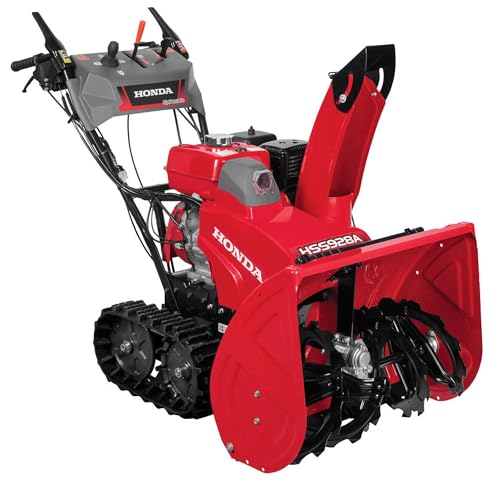



Honda builds the HSS928 around its commercial-grade GX270 overhead-valve engine, the same family of powerplant used on generators and construction equipment. That engine is the main reason owners pay more: it tends to start reliably, run smoothly and last for many seasons. The 28-inch path and throw of up to 52 feet make it a big-driveway tool.
The dual rubber tracks are the other differentiator. Compared with wheels, tracks keep more rubber on the ground, which helps on slopes, ice and the loose base of a gravel or packed driveway, and they reduce the tendency to wander when the auger loads. The downside is cost and weight, and tracks are slower to turn in a tight space.
Against the budget 24-inch models, it gives up value but wins on service life and resale. Plan on seasonal oil, a fresh plug when due and fuel stabilizer at season end. The electric start works from a wall outlet, which is welcome on bitter mornings. Parts and dealer support are broad, which matters in year five.
What works
- Commercial-grade GX270 engine built for long service
- Dual rubber tracks hold grip on slopes and ice
- 28-inch path reduces passes on big driveways
- Throws up to 52 feet for tall banks
Watch out for
- Highest price tier in this guide
- Heavy and slow to turn in tight spaces
- Gas upkeep every season
Spec sheet
- Engine
- Honda GX270 OHV commercial grade
- Clearing width
- 28 inches
- Drive
- Dual rubber track drive
- Throw distance
- Up to 52 feet
- Start
- Electric start