
Amazon affiliate links - we earn a commission.Affiliate disclosure

Buying guide · 12 min read · Updated 2026-11-07

Best Fuel Cans for Generators (2026)

Seven gasoline cans and fuel caddies for generators compared by capacity, spout design, safety features and handling, from 2 gallon cans to 15 gallon caddies.

James MillerBy James MillerLead Machine Editor7 machines comparedSpec-sheet verified
Best Fuel Cans for Generators

At a glance

Our top picks

Fuel storage is the part of generator ownership people forget until the engine coughs in the middle of an outage. A good container keeps gasoline fresh, pours without spilling and stores safely until you need it.

Cans differ in capacity, spout design, material and whether they carry fire-safety hardware. Larger caddies move more fuel with wheels and a pump, but they are for transfer and short storage, and they demand a stricter location and handling routine.

Before you buy

6 Criteria to Look For Before Buying a Fuel Can for Generators

  1. 01

    Capacity versus lifting

    A full 5 gallon can weighs about 30 pounds, a 2 gallon can about 13 pounds, and a 15 gallon caddy about 90. Match the size to what you can lift and pour. A heavy can you struggle with is a spill waiting to happen.

  2. 02

    Spout and venting design

    Squeeze spouts like the Scepter SmartControl, and thumb-button spouts like the No Spill 1405, limit splashing. A Type I safety can needs a funnel. Pick the pour style you can control with one hand.

  3. 03

    Material and fire safety

    HDPE cans such as the Scepter will not rust but soften in heat. A metal Type I can like the Eagle adds a flame arrester. Choose by where it will live and what local rules require.

  4. 04

    Compliance marks

    EPA and CARB compliance, stated on the Scepter cans, means a spill-proof, sealed design. It pours slower than older cans, and compliance is mandatory in many states. Look for the label.

  5. 05

    Fuel type and colour

    Red cans are for gasoline and yellow for diesel by convention. The Scepter diesel can in yellow is not for a gasoline generator. Mixing fuels can wreck an engine, so keep cans marked.

  6. 06

    Caddy transfer method

    The MAXSA and 15 gallon caddies offer manual pumps with 10 foot hoses, and the Scepter Flo 'N Go offers gravity flow. A pump works from the ground, while gravity needs a platform. Choose the method you can set up safely.

Detailed reviews

The 7 best fuel cans for generators, explained

01
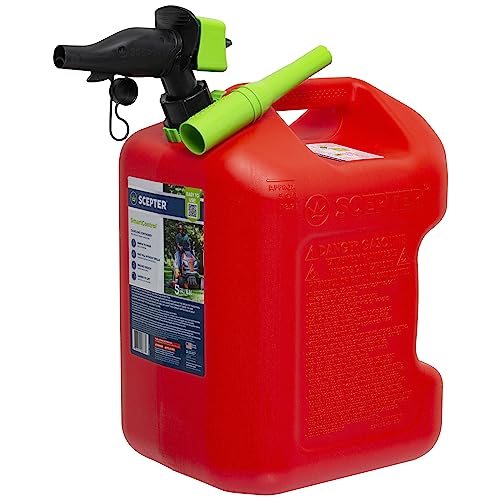
Scepter 5-gal SmartControl gas can, EPA/CARB compliant
5 galSmartControl spoutHDPERed
Check price on Amazon
Best for: Most portable generators with a 3 to 5 gallon tank.

The spout is the design point: a squeeze-control SmartControl nozzle with an integrated air vent lets fuel flow in a steady stream and stops when you release it. That removes the glug and splash of older cans, and the included funnel and spout extender help when the generator's fill neck is recessed.

Five gallons is the practical size for a portable generator. It holds about one full refill of a mid-size tank and weighs roughly 30 pounds when full, which is about the limit most people can lift and pour comfortably. Next to the 2 gallon Scepter, it halves the number of trips; next to a 15 gallon caddy, it stays lifting-friendly.

The resin is high-density polyethylene, so it will not rust or dent. Keep it in the shade, because heat softens plastic and raises internal pressure. Check the spout seal at the start of each season and replace the can if the neck is cracked or the gasket is hardened. Before a storm, fill the cans you plan to use, add stabiliser to any fuel older than a few months and label each can with the fill date. Pouring is easier if you rest the spout on the tank neck and let the vent work, rather than squeezing hard.

What works

  • Controllable flow reduces spills
  • Integrated vent for fast filling
  • HDPE will not rust or dent
  • Spout extender helps recessed tank necks

Watch out for

  • Squeeze spout needs a firm grip when full
  • Plastic softens in direct heat

Spec sheet

Capacity
5 gallons
Spout
SmartControl squeeze flow
Flow rate
Up to 3 gallons per minute
Compliance
EPA and CARB
Fuel
Gasoline
02
Eagle 5-gal Type I safety gas can with flame arrester
5 galType IFlame arresterMetal
Check price on Amazon
Best for: Owners who want metal construction and a flame arrester.

A Type I safety can has a single opening for filling and pouring, a self-closing gasketed cap and a non-sparking flame arrester in the neck. The arrester is a mesh that keeps a flashback from reaching the fuel inside, which is the reason these cans are common on job sites.

The seam is a double interlock with no weld on the bottom, and the handle is fixed. It includes an F-15 funnel for filling. That makes it a better long-term container than plastic where fire safety rules are strict.

The tradeoff is pouring. A single-opening can needs a funnel and a steady hand, and it can glug if the stream is not controlled. It also dents and, over many years, rusts at the seams if it lives in a damp shed. Compared with the plastic Scepter, it is also more resistant to fuel permeation, which matters if the can sits for a year. Wipe it dry after rain and keep the arrester clear of debris, since a clogged mesh slows the pour.

What works

  • Flame arrester guards against flashback
  • Self-closing gasketed cap
  • Double interlock bottom seam
  • Metal resists permeation and heat

Watch out for

  • Single opening can glug without a funnel
  • Metal can dent and rust over time

Spec sheet

Capacity
5 gallons
Type
Type I safety can
Safety
Non-sparking flame arrester
Lid
Self-closing gasketed cap
Construction
Double interlock bottom seam
03
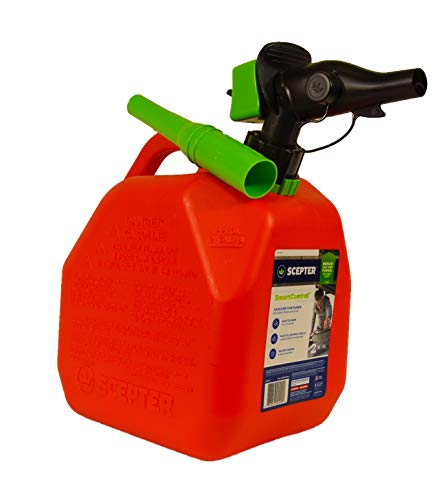
Scepter 2-gal SmartControl gas can, EPA/CARB compliant
2 galSmartControl spoutHDPE5-layer
Check price on Amazon
Best for: Small inverter generators and anyone who struggles with heavy cans.

The two gallon can uses the same squeeze-control spout as the five gallon model, with a five-layer high-density polyethylene wall that resists corrosion, denting and breakage. It is light enough to carry in one hand when full, about 12 to 13 pounds.

For a small inverter generator with a one to two gallon tank, this is the more sensible size, because you are rarely pouring more than a gallon at a time. It also suits owners who cannot lift a five gallon can safely.

The downside is trips and storage. During a multi-day outage a two gallon can runs out quickly, so keep two or three on hand or step up to the five gallon size. Its handle sits near the spout, which suits a smooth one-handed pour, and the five-layer wall tolerates being tossed in a truck bed better than thin plastic. Keep one dedicated to the generator and mark it, so the contents are never in doubt.

What works

  • Light enough to pour one-handed
  • Five-layer HDPE resists denting
  • Same controllable spout as the 5 gallon size
  • Easy to store in a small shed

Watch out for

  • Runs out quickly in a long outage
  • More trips to the pump than larger cans

Spec sheet

Capacity
2 gallons
Spout
SmartControl with extender
Resin
HDPE, 5-layer
Compliance
EPA and CARB
Fuel
Gasoline
04
No Spill 1405 2.5-gal gasoline can
2.5 galThumb buttonFunnel spoutDust cover
Check price on Amazon
Best for: Owners who prefer a button-controlled pour in a mid-small size.

A thumb button controls the pour, which keeps flow steady and lets you stop instantly. The 7/8 inch funnel spout is slim enough to fit small equipment inlets, and an attached dust cover keeps the spout clean.

At 2.5 gallons it sits between the two gallon and five gallon Scepter cans. That size is comfortable to lift and gives a little more runtime than a two gallon can.

The design is a different philosophy from squeeze spouts: you press a button rather than squeeze the body. Owners with weak hands may find the button easier, while others prefer a squeeze. Keep the dust cover closed so grit does not scratch the seal. Because the can is shorter than a five gallon model, it stores easily on a low shelf and pours cleanly into a generator with a low fuel door. Over time the button spring and seal are the wear points, so test the stop action each season before you rely on it.

What works

  • Thumb button gives instant stop
  • Slim spout fits small inlets
  • Attached dust cover protects the spout
  • 2.5 gallon size is easy to lift

Watch out for

  • Smaller than a full 5 gallon refill
  • Button mechanism has more parts than a simple cap

Spec sheet

Capacity
2.5 gallons
Control
Thumb button pour
Spout
7/8 inch funnel spout
Cover
Attached dust cover
Height
13.5 inches overall
05
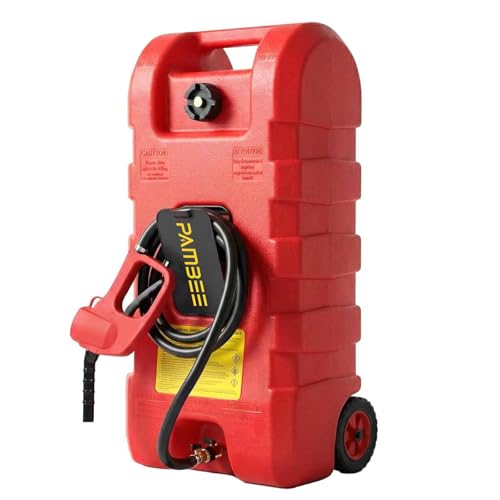
MAXSA 15-gal fuel caddy with manual pump and 10 ft hose
15 galWheeledHand pump10 ft hose
Check price on Amazon
Best for: Long outages or job sites where one trip should cover several refills.

A 15 gallon caddy moves a lot of fuel on wheels and uses a manual pump with a 10 foot hose to move it into a generator tank. The reinforced LLDPE tank is described as resistant to UV, corrosion and impact, and there is an adjustable air vent and a brass fitting for smooth flow.

At 15 gallons the container holds about three generator refills, which suits a multi-day outage or a job site. Full, it weighs around 90 pounds, so it must be wheeled, not lifted.

The tradeoff is storage and risk. A large volume of gasoline in a plastic tank should sit in a ventilated outbuilding, not a living area, and you should follow local limits on stored fuel. Fill it only as much as you can use in a reasonable time. Prime the pump hose with a few strokes before you start, and keep the hose end below the tank opening to avoid backflow. After use, drain the hose and cap it so fuel does not sit in the line.

What works

  • Holds about three mid-size refills
  • Manual pump and 10 ft hose
  • Wheels make 90 lb full weight manageable
  • UV and impact resistant tank

Watch out for

  • Heavy when full
  • Large fuel volume demands careful storage

Spec sheet

Capacity
15 gallons (57 L)
Material
Reinforced LLDPE
Transfer
Manual pump, 10 ft hose
Venting
Adjustable air vent
Mobility
Wheels and handle
06
15-gal fuel caddy with siphon pump, 10 ft hose, wheeled
15 galSiphon pumpGravity mode6-inch wheels
Check price on Amazon
Best for: Owners who want gravity and siphon modes in one wheeled caddy.

The listing describes two modes: a manual siphon pump and a gravity drive for refuelling. Six-inch wheels and a top handle make it easy to move from the garage to the generator.

At 15 gallons it matches the MAXSA caddy on size, so the choice between them is about pump design and listing detail. A siphon system fills slower than a gravity feed when the caddy sits on a raised platform.

Because gravity feed needs the caddy to sit higher than the tank, plan a safe platform. Keep it clear of the generator's hot exhaust and never refuel a running or hot engine. A raised platform also helps when the generator's fill neck is below the caddy's outlet, since gravity then does the work and you only have to watch the level. Keep a small spill kit nearby, such as absorbent pads, because even careful transfers drip.

What works

  • Siphon and gravity modes
  • Six-inch wheels roll over gravel
  • Ten-foot hose reaches distant generators
  • Top handle helps lifting onto a truck

Watch out for

  • Gravity mode needs a raised platform
  • Heavy and bulky to store

Spec sheet

Capacity
15 gallons (57 L)
Modes
Siphon and gravity
Hose
10 ft
Wheels
6-inch
Handle
Top carry handle
07
Scepter Duramax Flo 'N Go 14-gal gas caddy
14 galGravity flowWheeledDuramax resin
Check price on Amazon
Best for: Owners who want a caddy from a known can maker.

The Flo 'N Go is a fuel tank on wheels with 6-inch wheels and a heavy-duty top handle. It offers two fueling modes: gravity-flow when elevated above the tank being filled, and a pump mode for lower targets.

At 14 gallons it is a notch below the 15 gallon caddies, which matters little in practice. It comes from a brand that already makes the five gallon can at the top of this list, so spare parts and documentation are easy to find.

Treat it as a transfer vehicle, not long-term storage. Fill it only for the job, keep it in a ventilated place and drain unused fuel into approved cans before winter. Check the wheels and axle each season, since a caddy that wobbles under 90 pounds is a tip-over risk. Compared with the 15 gallon models, the capacity difference is small, so choose by pump or gravity preference and by whether you value an established accessory range.

What works

  • Gravity and pump modes
  • Established brand with accessories
  • Six-inch wheels and sturdy handle
  • Suits generators and other equipment

Watch out for

  • Large when stored
  • Fuel left in plastic for months can degrade

Spec sheet

Capacity
14 gallons (53 L)
Wheels
6-inch
Modes
Gravity flow and pump
Handle
Heavy-duty top handle
Use
Farm, marine, lawn, generators

Spec sheet decoder

What the numbers on the box really mean

The specs manufacturers lead with, translated into what they tell you about real-world performance.

Type I safety can

A metal can with one opening, a self-closing cap and a flame arrester.

Watch forThe Eagle 5 gallon can is Type I; it needs a funnel.

EPA and CARB compliant

A design standard for sealed, spill-resistant gasoline cans with automatic closing spouts.

Watch forThe Scepter cans state it.

HDPE

High-density polyethylene, a plastic that resists corrosion and denting.

Watch forThe Scepter 2 gallon lists a five-layer HDPE wall.

Flame arrester

A mesh in the neck that stops a flame from entering the container.

Watch forThe Eagle can lists a non-sparking one.

Gravity versus pump flow

Gravity uses height to move fuel; a pump moves it from any position.

Watch forThe Scepter Flo 'N Go and 15 gallon caddy list gravity modes.

Methodology

How We Evaluated These Fuel Cans for Generators

Pour control

We compared squeeze, thumb-button and funnel designs, noting spill risk for each. The Scepter SmartControl and No Spill 1405 offer controllable pours. The Eagle needs a funnel.

Capacity fit

We matched can sizes to generator tanks: 2 and 2.5 gallon for small inverters, 5 gallon for mid-size portables, and 14 to 15 gallon caddies for long outages. Bigger is not better if you cannot move it.

Safety hardware

We credited flame arresters, self-closing caps and EPA and CARB compliance. These are listing facts, not claims about a particular accident. We drew this from listed specifications and common buyer reports.

Material durability

We compared HDPE and metal, and noted UV resistance on the MAXSA caddy. Plastic resists rust but not heat. Metal resists heat but not rust.

Transfer method

We separated cans that pour from caddies that pump or gravity feed. The right method depends on how high your generator tank sits.

Decision guide

How to Choose the Right Fuel Cans for Generators

By Generator Tank Size

SituationPickWhy
Small inverter, 1 to 2 gallon tankScepter 2-galLight and easy to pour
Mid-size portable, 3 to 5 gallon tankScepter 5-galOne full refill
Want metal and a flame arresterEagle 5-gal Type ISafety can design
Multi-day outageMAXSA 15-gal caddyAbout three refills

By Budget

TierPickWhy
Lowest costScepter 2-galSmall and simple
Value mid-sizeNo Spill 1405 2.5-galThumb-button pour
Mid-rangeScepter 5-galCompliant and versatile
Higher cost for volumeScepter Flo 'N Go 14-galLarge caddy

Plastic Can vs Metal Can

Plastic can

The Scepter cans resist rust and dents and are light, and their spouts pour cleanly. They soften in strong heat and can permeate over years.

Metal can

The Eagle Type I can adds a flame arrester and resists heat. It dents, can rust in damp sheds and needs a funnel to pour.

Choose plastic for easy pouring and metal if local rules or your preference call for a safety can.

By Lifting Ability

SituationPickWhy
Limited grip strengthScepter 2-galAbout 13 lb full
Comfortable lifting 30 lbScepter 5-galStandard refill size
Cannot lift heavy loadsMAXSA 15-gal caddyWheels carry the weight
Want a button instead of squeezeNo Spill 1405Thumb control

For Long Outages Specifically

Look for

Enough volume for several refills, a wheeled or pumped transfer, a stabiliser plan and a safe storage place. Fuel stored for months needs stabiliser and rotation.

In this comparison

The MAXSA 15 gallon caddy and the 15 gallon siphon caddy hold about three refills, and the Scepter Flo 'N Go adds a gravity mode.

When to Spend More

Spend more if

You run a generator for days at a time or need metal safety hardware, pointing to a 15 gallon caddy or the Eagle can.

Save if

You run a small inverter for a few hours, where the Scepter 2 gallon can is enough.

Ownership

Maintenance schedule

The upkeep that decides whether this machine lasts two seasons or ten.

TaskIntervalWhy it matters
Inspect the spout and gasketEvery seasonA hardened gasket leaks vapour and fuel. Replace the can if the seal will not close.
Add stabiliser to stored fuelAt each fillEthanol blends absorb water and degrade over months. Stabiliser extends useful life.
Rotate stored fuelEvery 3 to 6 monthsBurn old fuel in a car and refill with fresh. A can of stale gas can gum a carburettor.
Check for cracks and dentsEvery seasonUV and impact weaken plastic, and dents weaken metal seams. Retire damaged cans.
Clean the vent and spoutYearlyDebris blocks the vent and slows flow. A clear vent also prevents glugging.

FAQ

Frequently Asked Questions

What size fuel can should I buy for a generator?

A 5 gallon can suits most mid-size portables. A 2 gallon can suits small inverter generators and anyone who cannot lift heavy loads. Caddies suit multi-day outages.

How long can I store gasoline for a generator?

Untreated gasoline can degrade in a few months, and ethanol blends absorb water. With stabiliser it can last about a year in a sealed can. Rotate it into a vehicle and refill with fresh fuel.

Is a metal or plastic can safer?

Both can be safe if they are the right type and in good condition. Metal Type I cans add a flame arrester, and plastic cans resist rust. Follow local storage rules and keep cans out of living spaces.

Why do new gas cans pour slowly?

EPA and CARB compliant cans use sealed, self-closing spouts that vent through the nozzle. They pour slower than old vented cans. Squeeze or button controls help, and a firm seat on the tank neck reduces spills.

Can I use a diesel can for gasoline?

No. Cans are colour coded by convention, with yellow for diesel. Use a red can for gasoline and never mix fuels.

Is it safe to refuel a running generator?

No. Shut the engine off and let it cool before refueling, because spilled gasoline on a hot engine can ignite. Fill outdoors, away from ignition sources.

Bottom line

The short version

Browse more fuel cans for generatorson Amazon →
James Miller, Lead Machine Editor

About the author

James Miller

Lead Machine Editor, MachineFanatic

James Miller leads MachineFanatic's buying guides, turning spec sheets, manuals and owner feedback into clear verdicts on power tools, outdoor power equipment, shop machines and kitchen machines.

More from James →