
Amazon affiliate links - we earn a commission.Affiliate disclosure

Buying guide · 13 min read · Updated 2026-11-18

Best Generator Transfer Switch and Plug Kits (2026)

Six pre-wired generator transfer switch kits with a plug or inlet box, compared by amp rating, circuits and generator match so you pick the right one.

James MillerBy James MillerLead Machine Editor6 machines comparedSpec-sheet verified
Best Generator Transfer Switch and Plug Kits

At a glance

Our top picks

Side by side

Spec comparison

A transfer switch with a matching plug is the part that lets a portable generator feed your house without sending power back onto the utility line. The switch isolates your wiring from the grid, and the plug or inlet box gives the generator cord a weatherproof place to land.

Most buyers choose by circuit count and amp rating, but the plug style decides everything else: it must match the generator outlet, the cord you own and the wire gauge behind the wall. Getting that pairing right matters more than any extra feature on the switch.

Before you buy

6 Criteria to Look For Before Buying a Generator Transfer Switch and Plug Kit

  1. 01

    Match the generator outlet exactly

    The plug on the switch kit has to match the receptacle your generator actually has, because adapters between amp ratings are where fires start. An L14-30 outlet suits the 30 amp VEVOR kit, a CS6375 four-prong outlet suits the 50 amp VEVOR kit, and a 5-20 outlet suits the OPL5 switch. Many buyers pick the switch first and discover the generator uses a different locking pattern, so check the generator's label before shopping.

  2. 02

    Whole-house versus single circuit

    A ten circuit kit like either VEVOR unit moves a spread of branch circuits, while a single circuit switch such as the Journeyman-Pro 15A moves exactly one. More circuits mean more panel work, so count the loads you truly need during an outage: fridge, furnace, lights, one or two outlets. Buying ten circuits for a four-load house is wiring effort you will never use.

  3. 03

    Amps, volts and real watts

    Watts equal volts times amps, so 20 amps at 125V is about 2,500 watts, 30 amps at 120V is about 3,600 watts and 30 amps at 240V is about 7,200 watts. A 120V only switch such as the Nature's Generator six circuit box cannot serve a 240V well pump no matter how many circuits it has. Add up the running watts of your chosen loads and leave about 20 percent headroom for motor startup.

  4. 04

    Enclosure weather rating

    A NEMA 3R enclosure, as on both VEVOR kits and the Journeyman-Pro, is rated for rain and external ice formation, not for submersion or hose spray. The Joinfworld steel box is aimed at garages and sheltered spots. Mount the inlet box under an eave, keep the cover latched and never point it where roof runoff lands.

  5. 05

    Listing and inspection

    Look for UL or ETL listed components, since an unlisted switch can fail an inspection or complicate an insurance claim after an outage. The Nature's Generator box and the Joinfworld switch both cite UL-listed parts. Many jurisdictions require a permit and inspection for inlet boxes and transfer switches, so check with the local building department before buying.

  6. 06

    Wire gauge behind the switch

    A 30 amp feed from an inlet box to the switch is generally 10 gauge or heavier, and a 50 amp feed needs heavier again, per the manual and local code. The cheap mistake is reusing 14 gauge wire left over from another job, which overheats at 30 amps. Budget for the correct cable length between the outdoor inlet and the indoor switch, because it can cost as much as the kit.

Detailed reviews

The 6 best generator transfer switch and plug kits, explained

01
VEVOR 30A 10-Circuit Manual Transfer Kit, L14-30P Inlet
30A, 10 circuitsL14-30P inlet boxNEMA 3R enclosurePre-wired kit
Check price on Amazon
Best for: Homeowners with a 5,000 to 7,500 watt portable generator who want to power a meaningful set of circuits.

This kit pairs a 10 circuit double-throw switch box with a separate power inlet box built around the L14-30 locking connector. That connector is the standard outlet on most portable generators in the 5,000 to 7,500 watt class, which is why this kit fits so many households without any adapter. The double-throw lever moves every wired circuit from utility to generator in one motion, so there is no moment where both sources are connected at once.

The tradeoff is installation. Ten circuits means ten branch circuits must be moved from the main panel into the switch box, and the listing calls it pre-wired, which covers the internal wiring but not the run between the inlet box and the switch. Next to the 50 amp VEVOR kit in this lineup, the 30 amp unit tops out at roughly 7,200 watts at 240V, so it suits a mid-size portable, while the bigger kit suits a 12,500 watt unit. If your generator has only a 20 amp 120V outlet, this is more switch than you need.

For ownership, the NEMA 3R enclosure handles rain but not standing water, so mount the inlet box where roof runoff will not hit it. Keep the generator cord coiled indoors between outages, because the locking blades corrode if left outside.

What works

  • Ten circuits cover fridge, furnace, lights and outlets
  • L14-30 inlet matches most portable generators
  • Double-throw lever prevents both sources connecting
  • NEMA 3R box suits outdoor mounting

Watch out for

  • Moving ten circuits means real panel work
  • Caps near 7,200W at 240V, too small for big units
  • Permit and inspection are likely required

Spec sheet

Amp rating
30A
Circuits
10
Inlet
NEMA L14-30P
Enclosure
NEMA 3R
Listed generator size
up to 7500W
02
VEVOR 50A 10-Circuit Manual Transfer Kit, CS6375 Plug Inlet
50A, 10 circuitsCS6375 plug inletNEMA 3R enclosurePre-wired kit
Check price on Amazon
Best for: Owners of a 9,000 to 12,500 watt generator who want to power a well pump or air conditioner.

The 50 amp version of this kit uses the same double-throw switch idea but scales the contacts, wiring and inlet to the connector found on large portable and inverter generators, the CS6375 four-prong plug. At 50 amps and 240V, the arithmetic gives up to 12,000 watts of capacity, and the listing quotes a 12,500 watt generator match. That headroom is the point: you can wire in a well pump, an electric range circuit or a central air conditioner without crowding the switch.

The cost of that capacity is cable and cord. Fifty amp cords are thick, heavy and stiff, and the wire from the inlet box to the switch must be heavier than the 10 gauge typical of a 30 amp run. Compared with the 30 amp VEVOR kit above, you are buying more copper and a larger breaker budget for power you can only use if your generator can supply it. Matching a 50 amp inlet to a 30 amp generator wastes money and tempts people to plug in adapters, which is not a safe workaround.

Ownership is mostly about the inlet. Keep the cover shut and the gasket clean, and inspect the plug pins for pitting once a year.

What works

  • 50A rating handles a 12,500 watt generator
  • Four-prong CS6375 inlet suits large units
  • Ten circuits leave room for 240V loads
  • Pre-wired switch box reduces internal work

Watch out for

  • Heavy 50A cord and wiring cost more to install
  • Overkill for a small portable generator
  • Needs a licensed electrician in most areas

Spec sheet

Amp rating
50A
Circuits
10
Inlet
CS6375 plug
Enclosure
NEMA 3R
Listed generator size
up to 12500W
03
Joinfworld 30A 125V Manual Transfer Switch, L5-30P Plug
30A, 125VL5-30P plugBuilt-in breakerSteel enclosure
Check price on Amazon
Best for: Detached garages, workshops and RV pads that need one 30 amp 120V feed.

This is a compact 120V switch with an L5-30 plug, a connector common on RV power cords and some generators and power stations. Inside is a UL-listed receptacle and a breaker, with the terminals engraved L, N and GND so a first-time installer is less likely to cross the neutral and line wires. It transfers a single 30 amp feed, which at 120V is about 3,600 watts.

Unlike the VEVOR kits, it does not move ten circuits at once. You wire it ahead of one subpanel, a workshop, a pump or an RV hookup, and the whole branch moves together. That makes it excellent for a detached garage or a camper pad, and a poor fit for a main house panel with dozens of circuits. The enclosure is powder-coated steel with gasketed covers, which resists dust and splash but is positioned for sheltered garage conditions rather than full weather exposure.

In ownership terms, the simplicity is the selling point: there is nothing electronic to fail, only a switch, a breaker and a plug. Check the L5-30 connector is what your generator or power station actually provides, because it looks like the L14-30 and is not interchangeable.

What works

  • Engraved L, N and GND terminals aid wiring
  • UL-listed receptacle and breaker components
  • Handles 30A on a single dedicated feed
  • Simple switch with no electronics to fail

Watch out for

  • Single 120V feed, not a whole-house solution
  • L5-30P is easy to confuse with L14-30
  • Steel box suits sheltered mounting best

Spec sheet

Amp rating
30A
Voltage
125V
Plug
NEMA L5-30P
Enclosure
Powder-coated steel
Terminals
Labeled L, N, GND
04
Nature's Generator 30A 6-Circuit Manual Transfer Switch, 120V
30A, 120V6 circuitsUL listedPre-wired
Check price on Amazon
Best for: Households running a 3,500 to 4,000 watt generator who want to pick circuits one at a time.

This switch box gives each of six circuits its own manual selector, so you choose which loads run on generator power one by one rather than flipping everything at once. For a house, that is a useful way to manage a modest generator: you can leave the furnace and refrigerator on, then add the living room lights, and keep the microwave off. The box is pre-wired and carries a UL listing, which matters for inspection.

The constraint is the 120V rating. A 30 amp 120V rating is roughly 3,600 watts total, so it cannot serve a 240V well pump or central air conditioner. Beside the VEVOR 30 amp kit, which uses a 240V capable L14-30 inlet and a double-throw lever, this unit is more flexible per circuit but less capable overall.

On the maintenance side, six individual selectors means six contacts to keep clean and six positions to label clearly. Walk the household through the labels so nobody leaves a selector on generator when the utility returns.

What works

  • Per-circuit selectors allow load management
  • UL-listed pre-wired box eases inspection
  • Six circuits cover the essentials
  • Works with common 120V portable generators

Watch out for

  • 120V only, no 240V loads possible
  • Inlet and cord may need separate purchase
  • Easy to leave a selector in the wrong spot

Spec sheet

Amp rating
30A
Voltage
120V
Circuits
6
Listing
UL listed
Switching
Per-circuit selectors
05
OPL5 20A 125V Transfer Switch with Breaker, 5-20P Inlet Box
20A, 125V5-20P inlet boxBuilt-in breakerPre-wired
Check price on Amazon
Best for: Single critical circuits, such as a refrigerator or sump pump, on a small generator.

This is the entry point to the category: a pre-wired 20 amp switch with its own circuit breaker and a 5-20P inlet box. The 5-20P is the connector used on small generators and power stations, so the whole kit is built around a generator you can carry. The listing quotes a 2,500 watt maximum, which matches the arithmetic of 20 amps at 125V, and the breaker protects the wiring if a load tries to exceed that.

Its limit is scope. This switch feeds one circuit, so it suits a room, a freezer or a sump pump rather than a house. Compared with the Joinfworld 30 amp switch, you give up 10 amps of capacity and gain a simpler, cheaper path to protecting one critical load.

For ownership, the inlet box is the weak point because it sits outside. Keep the lid closed, use a cord of the matching 5-20 style and a gauge that does not sag on long runs, and avoid daisy-chaining extension cords, which defeats the purpose of a dedicated inlet.

What works

  • Built-in breaker protects the wiring
  • 5-20P inlet matches small portable generators
  • Pre-wired, so wiring work stays minimal
  • Clear single-circuit scope keeps installs easy

Watch out for

  • About 2,500W maximum, one circuit only
  • Large motor startup can trip the breaker
  • Inlet box exposed outdoors needs a cover habit

Spec sheet

Amp rating
20A
Voltage
125V
Inlet
NEMA 5-20P
Max load
about 2500W
Protection
Circuit breaker
06
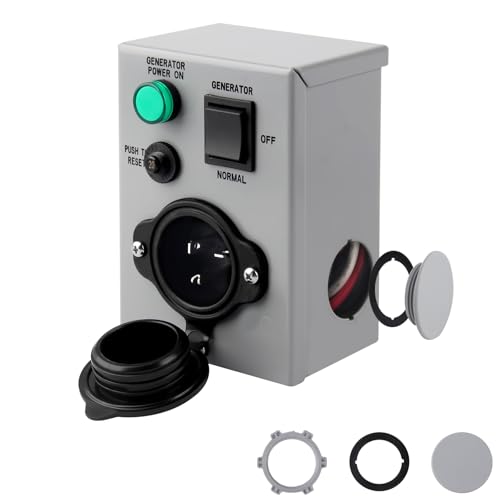
Journeyman-Pro 15A Single-Circuit Transfer Switch, NEMA 3R
15A, 120V1 circuitNEMA 3R box12 AWG leads
Check price on Amazon
Best for: Gas furnace, boiler or freezer circuits that need a small, simple backup feed.

This small box is built for the one job many people actually need: keeping a gas furnace or boiler running when the grid fails. It is a single-circuit switch with a NEMA 3R enclosure, four knockouts and pre-attached 24 inch leads in 12 AWG wire, which is a heavier gauge than a basic 15 amp circuit requires and eases the furnace startup draw. A plug cover keeps weather out of the inlet.

At 15 amps and 120V, its ceiling is about 1,800 watts, so it cannot share duty with other loads. Next to the OPL5 20 amp switch, it carries less but costs less to install and is easier to fit inside a small mechanical room.

In practice, the install is a junction-box-level job: cut the furnace feed, land it in the switch and cap the unused leads. Confirm the furnace is on its own circuit, because a shared circuit would also move other outlets over to the generator.

What works

  • Pre-attached 12 AWG leads ease wiring
  • NEMA 3R enclosure suits utility spaces
  • Ideal for a dedicated furnace circuit
  • Low capacity keeps installation straightforward

Watch out for

  • 15A and about 1,800W is a hard ceiling
  • Only one circuit can be switched
  • Shared circuits would move other outlets too

Spec sheet

Amp rating
15A
Voltage
110/120/125V
Circuits
1
Enclosure
NEMA 3R
Lead wire
24 inch, 12 AWG

Spec sheet decoder

What the numbers on the box really mean

The specs manufacturers lead with, translated into what they tell you about real-world performance.

Amp rating

The amp rating is the maximum continuous current the contacts and wiring in the switch are built to carry. It is not a promise about your generator, which must separately supply that current.

Watch forThe 20A OPL5 and 50A VEVOR kits sit 30 amps apart, so do not size one by the cheaper price alone.

Double-throw

A double-throw switch has two positions, utility or generator, and cannot connect both at once. That mechanical interlock is what prevents backfeed onto the utility line.

Watch forBoth VEVOR kits use double-throw levers; confirm any switch you buy describes the same break-before-make action.

NEMA 3R

This rating means the enclosure sheds rain and resists ice buildup but does not keep out hose spray or standing water. It describes the enclosure, not the plug or the inlet face.

Watch forThe Journeyman-Pro and VEVOR kits cite 3R, while the Joinfworld steel box is described for garage conditions.

Plug and inlet type

Codes such as L14-30P, L5-30P, 5-20P and CS6375 describe the pin layout, voltage and current of a connector. Matching letters and numbers is the only way to know a cord will fit and carry the right power.

Watch forL5-30P on the Joinfworld looks like L14-30P on the VEVOR but carries only 125V on two hots and neutral.

Circuit count

The circuit count is how many branch circuits the switch can move to the generator. Each additional circuit adds a wire to land and a load to budget for.

Watch forThe Nature's Generator has six circuits, the VEVOR kits have ten and the Journeyman-Pro has one, so choose by loads, not by the bigger number.

Methodology

How We Evaluated These Generator Transfer Switch and Plug Kits

Generator compatibility

We checked each kit's inlet connector and amp rating against the outlets found on small, mid-size and large portable generators. Kits that name a connector, such as the L14-30P on the VEVOR 30A or the 5-20P on the OPL5, scored higher than kits that left the inlet vague. The 12,500 watt match on the VEVOR 50A earned it the large-generator slot.

Wiring and installation effort

We read the listing details for pre-wiring, labeled terminals, knockouts and lead length, since these decide how long an electrician or a careful DIYer spends on the job. Engraved L, N and GND markings on the Joinfworld and 24 inch 12 AWG leads on the Journeyman-Pro are the kind of detail that reduces mistakes.

Safety features and listings

We looked for double-throw action, built-in breakers and UL, CSA or ETL listing language in the product data. Built-in protection on the OPL5 and Joinfworld switches and the UL listing on the Nature's Generator box were weighed heavily.

Weather and enclosure

We compared enclosure ratings and materials, favoring NEMA 3R boxes for outdoor mounting. Powder-coated steel and gasketed covers help in a garage, but only a stated outdoor rating justified an exposed install.

Fit between scope and price tier

We checked that each switch's circuit count and amp rating suit its likely buyer, rather than rewarding the largest spec. The 20A OPL5 won the value slot because one protected circuit is all many households need, while the 50A VEVOR earned its place only for owners with a 12,500 watt generator.

Decision guide

How to Choose the Right Generator Transfer Switch and Plug Kits

By Generator Size

SituationPickWhy
Generator under 3,000 watts with a 5-20 outletOPL5 20A5-20P inlet matches and the breaker protects the single circuit
Generator around 3,500 to 4,000 watts, 120V onlyNature's Generator 30A 6-CircuitSix selectors let you ration the 3,600 watt capacity
Generator 5,000 to 7,500 watts with an L14-30 outletVEVOR 30A 10-CircuitL14-30P inlet and 240V capability suit this class

By Budget

Budget tierPickWhy
Lowest outlay, one critical circuitJourneyman-Pro 15AA small box with 12 AWG leads protects a furnace
Low outlay, one circuit with a breakerOPL5 20AAdds a breaker and a plug-in inlet box
Mid-range, a shop or RV feedJoinfworld 30A L5-30P30 amps at 120V on one dedicated branch

Inlet Box Kit vs Plug-In Switch

Inlet box kit

The VEVOR 30A and 50A kits and the OPL5 include an outdoor inlet box that sits on the house wall, so the generator cord stays outside and the switch sits inside by the panel. This gives the cleanest, safest layout and is what inspectors expect, but it requires drilling a wall and running cable.

Plug-in or box-only switch

The Joinfworld 30A and Journeyman-Pro 15A are compact switches you wire to one feed, with a plug cover or receptacle on the box. They install faster and cost less labor, but they serve one branch rather than a panel and put the connector wherever the box mounts.

Pick an inlet box kit if you want to power much of a house; pick a compact switch if you only need to protect one load or one building.

By Voltage Need

LoadPickWhy
Well pump or 240V compressorVEVOR 30A 10-Circuit240V capable L14-30 inlet carries both legs
Central air conditioner on a large generatorVEVOR 50A 10-Circuit50A contacts handle the large running and startup draw
Refrigerator, lights and outlets onlyNature's Generator 30A 6-Circuit120V circuits are enough for these loads

For Winter Outages Specifically

Look for

In a freeze, the priority is heat control, a refrigerator and a sump pump, none of which need much power. Look for a switch that moves only those circuits, a weatherproof inlet that will not ice shut, and wire heavy enough that a furnace startup does not trip the breaker.

In this comparison

The Journeyman-Pro 15A keeps a gas furnace running on a small generator, and the OPL5 20A adds a breaker for one extra critical feed. For a fuller house, the Nature's Generator six-circuit box lets you ration power across the essentials.

When to Spend More

Spend more if

You own a generator over 7,500 watts, depend on a 240V well pump, or want most of the house available. The VEVOR 30A and 50A kits give you the circuits and the 240V capable inlets, and the extra installation cost buys real convenience during a long outage.

Save if

You need a furnace, a freezer or one workshop branch only. The Journeyman-Pro 15A, the OPL5 20A and the Joinfworld 30A cover those jobs, and paying for ten circuits you never wire is waste.

Ownership

Maintenance schedule

The upkeep that decides whether this machine lasts two seasons or ten.

TaskIntervalWhy it matters
Inspect the inlet boxEvery 6 monthsMoisture and insects get into outdoor inlet boxes, and a corroded pin raises resistance and heat.
Exercise the switch leverEvery 6 monthsContacts that never move can stick or oxidize, so cycle the lever with no load to keep them clean.
Re-torque terminalsAfter first week, then yearlyStranded wire compresses and settles, loosening the lug.
Check labels and the load listYearlyCircuits change as the house changes, and a stale label leads to the wrong breaker being flipped.
Run a full transfer drillBefore each winterA rehearsal exposes a wrong cord, an empty fuel can or a stuck lever while there is no emergency.

FAQ

Frequently Asked Questions

Do I need a transfer switch if I only run a few extension cords?

No, if you run cords directly from the generator to appliances, you do not need one. A transfer switch is for feeding fixed house wiring, such as a furnace or well pump, which cannot be reached by an extension cord.

Which plug do I need for a 30 amp portable generator?

Most 30 amp portables use an L14-30 locking outlet, which pairs with an L14-30P inlet like the one on the VEVOR 30A kit. Check your generator's label, because RV style L5-30 and TT-30 outlets look similar but are different connectors.

Is a cheaper small switch good enough?

It is if your need is a single circuit. A 15 or 20 amp switch protects a furnace or freezer well, but it cannot move multiple circuits, so match the switch scope to your loads rather than chasing the lowest outlay.

Can I install a transfer switch myself?

Some jurisdictions allow homeowner work with a permit, but many require a licensed electrician for inlet boxes and transfer switches. Regardless of who installs it, the work should be inspected, because mistakes can back-feed the utility line and injure line workers.

Does a bigger amp rating mean more power from my generator?

No. The switch only allows up to its rating; the generator still limits the real output.

How long should the generator cord be?

As short as practical, typically 25 feet or less for a 30 amp run, and always in a heavy gauge such as 10 AWG. Long thin cords drop voltage and heat up under load, and the generator must run outdoors away from windows.

Bottom line

The short version

Browse more generator transfer switch and plug kitson Amazon →
James Miller, Lead Machine Editor

About the author

James Miller

Lead Machine Editor, MachineFanatic

James Miller leads MachineFanatic's buying guides, turning spec sheets, manuals and owner feedback into clear verdicts on power tools, outdoor power equipment, shop machines and kitchen machines.

More from James →