
Amazon affiliate links - we earn a commission.Affiliate disclosure

Buying guide · 12 min read · Updated 2026-11-07

Best Generator Cords for Transfer Switches (2026)

Seven locking generator power cords for a transfer switch inlet compared by amp rating, gauge, length and plug type, with sizing guidance.

James MillerBy James MillerLead Machine Editor7 machines comparedSpec-sheet verified
Best Generator Cords for Transfer Switches

At a glance

Our top picks

Side by side

Spec comparison

A transfer switch cord is the single link between a generator outlet and the inlet box on your house. It carries every watt you plan to use, so it is worth treating as a safety part, not an accessory.

The right cord is decided by plug type, conductor gauge and length. Get any of those wrong and you either cannot connect, or you connect with a cable that overheats under a long outage.

Before you buy

6 Criteria to Look For Before Buying a Generator Cord for Transfer Switches

  1. 01

    Plug type must match

    A 30 amp locking cord uses L14-30 ends, and a 50 amp cord uses 14-50P and SS2-50R. The Champion 25-foot and the CircleRiver 50 amp cord are not interchangeable. Look at the generator outlet and your inlet before you shop, not after the box arrives.

  2. 02

    Conductor gauge

    A 30 amp circuit calls for 10 gauge copper, as in the Champion and GEARit cords, while a 50 amp circuit calls for 6 gauge like the CircleRiver. A thinner cord can overheat at full load. If the listing does not state the gauge, treat it as a warning.

  3. 03

    Length and voltage drop

    Longer runs lose voltage. A 50-foot 10-gauge cord such as the PlugSaf pays a few percent at a full 30 amp load, so use the shortest length that keeps the engine safely away from openings. Motors suffer first from drop.

  4. 04

    Jacket and weather rating

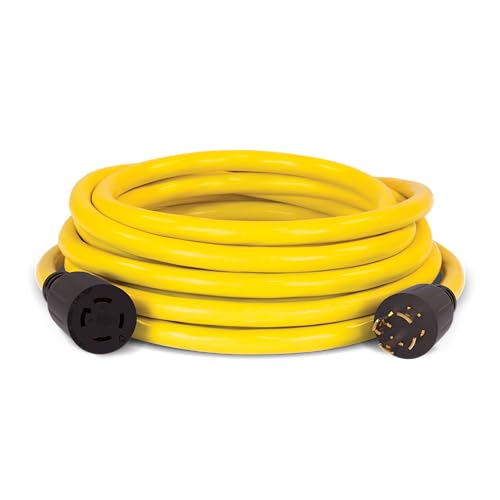
    SJTW and STW are weather-resistant service jackets, and the EP cord lists a minus 40 to 140 degree Fahrenheit range. Cold stiffness matters in winter outages. A bright colour such as the EP's yellow is a safety bonus.

  5. 05

    Locking design

    Twist-lock ends stop a cord pulling out under wind or foot traffic. The CircleRiver adds a sealing ring on the female end. A non-locking cord has no place on a transfer inlet.

  6. 06

    Listing and marks

    ETL or UL marks, such as on the POWGRN cord, show a third party looked at the construction. Unmarked cords are common, and many are fine, but an inspector or insurer may care. Ask the seller for the mark when the listing is vague.

Detailed reviews

The 7 best generator cords for transfer switches, explained

01
Champion 25-ft 30A L14-30 generator power cord
25 ft30A 250V10-gaugeSJTW
Check price on Amazon
Best for: Most 30A portable generator setups with a standard L14-30 inlet.

The conductor is 10 gauge, which is the size a 30 amp, 7,500 watt circuit calls for, and the jacket is a service-grade SJTW compound rated for cold, heat and abrasion. A 25 foot length lets the generator sit well away from walls and windows while staying inside the copper size limits for the run.

Next to the 15-foot EP cord, the extra ten feet make a practical difference in placement. Next to the PlugSaf 50-foot cord, it avoids the voltage drop and bulk of a long run you may not need. The locking ends twist in and hold through wind and vibration.

Ownership is simple. Coil it loosely, keep the plug faces dry, and replace it at the first sign of a cracked jacket or a discoloured blade. A cord this size is heavy, so store it on a hook rather than a tight ring. Pair it with a generator whose outlet is also an L14-30, and run the engine for a few minutes before you plug the cord in so the output has stabilised. Many owners leave one cord permanently labeled for the transfer inlet, which stops a mix-up with a similar-looking cord in a stressful outage.

What works

  • 10-gauge conductor sized for 30A loads
  • Locking L14-30 ends resist pull-out
  • Flexible jacket for hot and cold seasons
  • 25 ft length suits most yard layouts

Watch out for

  • Heavy and stiff when coiled cold
  • Not usable with a 50A inlet

Spec sheet

Length
25 ft
Amp rating
30A, 250V
Gauge
10 AWG
Jacket
SJTW service grade
Plugs
L14-30P to L14-30R
02
EP 15-ft 10/4 30A L14-30 outdoor cord, yellow
15 ft30A 250V10/4 SJTW-40F to 140F
Check price on Amazon
Best for: Compact yards where the generator can sit close to the inlet.

This cord uses oxygen-free copper conductors in a vinyl jacket rated for a wide temperature span, so it should stay flexible in winter work. The bright yellow colour is a quiet advantage, because a cord on a dark lawn is a trip hazard.

Fifteen feet is short beside the Champion 25-foot cord, so it only suits a layout where the inlet is on the side of the house nearest the generator spot. The tradeoff is that a short cord is cheaper, lighter and easier to store.

If you buy it, measure the path from the generator's planned position to the inlet, including the sideways run. Keep the engine exhaust pointing away from the house, and stay well clear of windows and doors. The bright jacket also helps when you are checking the run at night with a flashlight, and it makes the cord easy to spot in tall grass or snow. Compared with the POWGRN 15-foot cord the construction is similar, so the choice is about listing marks and the matching longer lengths on offer.

What works

  • Yellow jacket is easy to see in the dark
  • Wide temperature rating helps in winter
  • Light and easy to coil
  • Locking ends match standard 30A generators

Watch out for

  • Short reach limits safe generator placement
  • Not useful if the inlet is 50A

Spec sheet

Length
15 ft
Amp rating
30A, 250V, 7,500W
Conductors
10 gauge, 4 wire
Temperature
-40F to 140F
Colour
Yellow for visibility
03
PlugSaf 25-ft 30A 10-gauge L14-30 twist-lock cord
25 ft30A10 AWG STWTwist-lock
Check price on Amazon
Best for: Buyers comparing Champion with another 25 ft 30A cord.

The listing gives a split rating of 3,750 watts at 125 volts and 7,500 watts at 250 volts, which is the correct way to read a 30 amp cord. The same copper carries either number depending on how the generator is wired, and it is a useful reminder that watts depend on voltage.

It is nearly the Champion's twin on length and gauge. The decision rests on jacket details and the seller's ratings, and on how the product is documented. The weatherproof language describes the jacket, not the plug faces, so keep the connections out of puddles.

If you are new to this, use this cord as a straightforward match for a standard L14-30 inlet and generator. Check that both plugs lock in with a firm quarter turn. Over time the main wear is at the strain relief where the cable meets the plug, so flex the cable gently near the ends during your pre-season check and look for cracks. If you already own the Champion cord, a second PlugSaf length is a sensible way to build a pair for different yards.

What works

  • Clear split watt rating for 125V and 250V
  • Ten-gauge conductor for full 30A use
  • Twist-lock plugs hold during wind
  • Good mid-length for most setups

Watch out for

  • Same plug limits as any L14-30 cord
  • STW jacket is less rated than SJTW for cold flexibility

Spec sheet

Length
25 ft
Amp rating
30A, 125/250V
Load
3,750W or 7,500W
Jacket
STW
Plugs
L14-30P to L14-30R
04
PlugSaf 50-ft 30A 10-gauge L14-30 generator cord
50 ft30A10 AWGIP65 claim
Check price on Amazon
Best for: Owners who need distance between the generator and the house.

Fifty feet gives true distance between a noisy generator and a bedroom wall, which can matter for both noise and exhaust. The listing claims an IP65 weather rating and a twist-lock design to keep the plug seated.

Long cords have a cost. Voltage drop climbs with length, and 10 gauge copper over 50 feet at a full 30 amp load will lose a few percent, so it is better with loads well under the maximum. The cord is also heavy and awkward to reroll.

Compared with the Champion 25-foot cord it is a different tool: use it only if your layout needs the reach. If it does not, the shorter cord is simpler to handle and stow. Lay a fifty-footer out fully before use rather than running it coiled, because a coiled cord under load builds heat in the middle of the bundle. Practical owners also keep it on a reel with a rated hub, which makes the weight manageable for one person.

What works

  • Fifty feet keeps exhaust and noise away from walls
  • 10-gauge copper suits a 30A circuit
  • Twist-lock plugs stay put
  • Weatherproof claim for outdoor use

Watch out for

  • Voltage drop rises on long runs at full load
  • Heavy and slow to coil

Spec sheet

Length
50 ft
Amp rating
30A, 125/250V
Gauge
10 AWG STW
Weather
IP65 stated
Plugs
Twist-lock L14-30
05
POWGRN 15-ft 30A L14-30 ETL-listed generator cord
15 ft30AETL listedSTW
Check price on Amazon
Best for: Buyers who want an ETL-listed 30A cord in a short length.

The ETL certification claim is the key point: a third-party mark on a generator cord is worth more than a marketing line about durability. The brand also offers longer lengths up to 75 feet, so a family of matching cords is available.

Compared with the EP 15-foot cord the specs read alike, and the difference is the listing. That could matter for insurance or an inspector who asks about your hardware.

The same short-reach caution applies. Confirm the physical distance before you buy and decide whether to add a second length if you move the generator later.

What works

  • ETL certification stated in the listing
  • Heavy-duty STW jacket
  • Matching longer lengths are available
  • Locking 4-prong ends

Watch out for

  • Fifteen feet limits generator placement
  • Needs a 30A inlet

Spec sheet

Length
15 ft
Amp rating
30A, 4-prong
Listing
ETL certified
Jacket
STW heavy duty
Options
Longer lengths to 75 ft
06
GEARit 30A generator cord, 2 m, L14-30
2 m30A10 AWG SJTW7,500W
Check price on Amazon
Best for: Short hops where the inlet and generator are close.

At about six and a half feet this is a patch cord, not a placement cord. It is built for reaching a nearby pedestal or inlet, with a 10 gauge SJTW pure copper cable that can carry the full 30 amp load.

Beside the Champion 25-foot, it solves a different problem. It suits a trailer, a transfer box on a garage wall, or a generator that sits directly under the inlet, which is a bad placement indoors but fine on an open porch-free pad outdoors.

Never use a short cord as a reason to run a generator close to the house. Exhaust has to travel away from openings, and a longer cord is the right fix.

What works

  • Pure copper 10-gauge SJTW cable
  • Light and easy to store
  • Rated for the full 30A load
  • Locking L14-30 ends

Watch out for

  • Too short for safe generator placement at most homes
  • Not usable with 50A systems

Spec sheet

Length
2 m (about 6.5 ft)
Amp rating
30A, 120/250V
Gauge
10 AWG SJTW
Load
7,500W
Conductor
Pure copper
07
CircleRiver 50A 25-ft 14-50P to SS2-50R cord
50A25 ft6/3+8/1 STWSS2-50R
Check price on Amazon
Best for: 50A generators and inlets in the SS2-50 family.

This is the 50 amp option, with 6-gauge hot conductors and an 8-gauge ground, and a locking ring on the female end that keeps dust and water out of the connection. It matches a 50 amp generator outlet and a SS2-50 inlet.

It is a larger cable, with less flex than the 30 amp cords above. That is a fair trade for a generator that can feed about 12,000 watts at 240 volts.

Buy it only if both ends are 50 amp. A 30 amp inlet cannot use it, and an adapter between sizes is an overload hazard, not a fix. Since the cable is heavier, lift it rather than dragging it across gravel, which wears the jacket. In practice a 25-foot length is plenty for most 50 amp setups, because a larger generator is normally parked a few steps from the inlet on a level pad.

What works

  • 6-gauge conductors for 50A loads
  • Twist-lock ring seals the connection
  • Matches 50A generator outlets
  • Heavy-duty STW jacket

Watch out for

  • Stiff and heavy compared with 30A cords
  • Useless with a 30A inlet

Spec sheet

Length
25 ft
Amp rating
50A, 125/250V
Plugs
14-50P to SS2-50R
Conductor
6/3 plus 8/1 AWG STW
Seal
Twist-lock ring at female end

Spec sheet decoder

What the numbers on the box really mean

The specs manufacturers lead with, translated into what they tell you about real-world performance.

L14-30

A 4-prong locking 30 amp plug for 125/250 volts. It is the standard portable generator outlet.

Watch forThe Champion, PlugSaf, EP, POWGRN and GEARit cords all use it.

SS2-50 and 14-50

The 50 amp inlet and plug pairing for larger generators.

Watch forThe CircleRiver cord is the only 50 amp cord in this lineup.

10/4 SJTW

Ten gauge, four conductors, with a flexible weather-resistant jacket.

Watch forThe EP and GEARit cords state this construction.

3,750W and 7,500W

A 30 amp cord carries about 3,750 watts at 125 volts or 7,500 at 250 volts.

Watch forPlugSaf lists both figures in the title.

IP65

A dust-tight, water-jet-resistant ingress claim.

Watch forThe PlugSaf 50-foot cord states it; keep connectors out of standing water anyway.

Methodology

How We Evaluated These Generator Cords for Transfer Switches

Conductor sizing

We read the gauge in every listing and compared it with the amp rating. The 10-gauge Champion and GEARit cords match 30 amps. The CircleRiver uses heavier conductors for 50 amps.

Length versus use

We looked at how each length fits typical layouts. The 25-foot Champion is the common compromise, with the 2 m GEARit at one end and the 50-foot PlugSaf at the other. Longer is not better if you do not need the reach.

Plug match

We separated 30 amp L14-30 cords from the 50 amp cord so buyers compare like with like. Mismatched plugs were the most common error we saw in listings. A cord must match both ends.

Listing evidence

We gave weight to ETL claims such as on the POWGRN cord and to stated temperature ranges such as the EP cord. Marketing adjectives counted for little. Our read comes from published specs and recurring owner comments.

Handling

We considered jacket flexibility and colour, as on the yellow EP cord. Cords that kink in the cold are annoying on outage night. Heavier 50 amp cable is stiffer by design.

Decision guide

How to Choose the Right Generator Cords for Transfer Switches

By Inlet Type

SituationPickWhy
30A L14-30 inlet, typical yardChampion 25-ftKnown-fit 10-gauge cord
30A inlet, close placementEP 15-ftShort and visible
50A SS2-50 inletCircleRiver 50A 25-ftMatched plug and gauge
Need ETL listingPOWGRN 15-ftCertification stated

By Budget

TierPickWhy
Lowest cost for short runEP 15-ftBasic 10/4 build
Mid-range 30AChampion 25-ftBalanced length and gauge
Mid-range alternativePlugSaf 25-ftComparable specs
Higher cost for reachPlugSaf 50-ftLong reach for placement

Short Cord vs Long Cord

Short cord

The GEARit 2 m and EP 15-foot cords are light and cheap and lose almost no voltage. They force the generator close to the house, which is often the wrong place for exhaust.

Long cord

The PlugSaf 50-foot cord puts distance between the engine and the house. It costs some voltage at full load and is heavy to move.

Pick the shortest cord that still keeps exhaust and noise clear of openings.

By Load Level

SituationPickWhy
Near full 7,500W loadChampion 25-ft10-gauge, moderate length
Light load, long distancePlugSaf 50-ftDrop is small at low load
Up to 12,000W on 50ACircleRiver 50A6-gauge conductors
Occasional use, trailer hopGEARit 2 mLight patch cord

For Winter Outages Specifically

Look for

A jacket rated for cold, bright colour for snow visibility and a locking plug that works with gloves on.

In this comparison

The EP 15-foot cord states a minus 40 degree Fahrenheit rating and a yellow jacket, and the Champion SJTW cord is built for cold flexibility.

When to Spend More

Spend more if

You need 50 amp capacity, the ETL mark or a long reach, pointing to the CircleRiver, POWGRN or PlugSaf 50-foot cords.

Save if

The generator sits near the inlet and you have a standard 30 amp setup, where the EP 15-foot cord is enough.

Ownership

Maintenance schedule

The upkeep that decides whether this machine lasts two seasons or ten.

TaskIntervalWhy it matters
Inspect the jacketBefore each useCuts and flat spots expose conductors. Retire a damaged cord instead of taping it.
Check plug facesBefore each useDiscoloured blades signal heat from a loose connection. Clean and replace as needed.
Coil looselyAfter each useTight coils kink the conductors. A hook or wide loop keeps the copper intact.
Keep connectors dryEvery useWater in a plug causes tracking and corrosion. Lift connectors off the ground.
Test under loadEvery 3 monthsRun the cord with a real load for ten minutes and feel for warm spots. Warmth means a poor connection.

FAQ

Frequently Asked Questions

What cord do I need for a 30 amp transfer switch inlet?

A 30 amp, 4-prong locking cord with L14-30P and L14-30R ends and 10-gauge conductors. The Champion 25-foot cord fits that description. Match your inlet before ordering.

Can I use a longer cord to keep the generator farther away?

Yes, within reason. Voltage drop climbs with length at full load, so a 50-foot 10-gauge cord suits moderate loads best. Exhaust and noise management are good reasons to use the extra length.

Is a 30 amp cord safe on a 50 amp inlet?

No. The cord carries less current than the inlet circuit can supply, so overload can occur without a breaker tripping. Always match the cord to the inlet.

What does STW or SJTW mean?

They are cable jacket codes for weather-resistant service cord. SJTW is a lighter-duty rating than STW, and both are rated for outdoor use. Check the gauge as well, since the code does not tell you the conductor size.

Do I need a listed cord?

It is wise. ETL or UL marks show a third party reviewed the construction. Inspectors and insurers can ask, so buy marked cords where possible.

Can I run the generator in the garage with a short cord?

No. Generators produce carbon monoxide and must run outdoors, well away from windows, doors and vents. Use a longer cord, not a closer generator.

Bottom line

The short version

Browse more generator cords for transfer switcheson Amazon →
James Miller, Lead Machine Editor

About the author

James Miller

Lead Machine Editor, MachineFanatic

James Miller leads MachineFanatic's buying guides, turning spec sheets, manuals and owner feedback into clear verdicts on power tools, outdoor power equipment, shop machines and kitchen machines.

More from James →