
Amazon affiliate links - we earn a commission.Affiliate disclosure

Buying guide · 13 min read · Updated 2026-11-18

Best Generator Transfer Switches with a Lock (2026)

Five lockable or lock-out generator transfer options compared: a panel interlock plate, a key-lock ATS and manual double-throw switches for house use.

James MillerBy James MillerLead Machine Editor5 machines comparedSpec-sheet verified
Best Generator Transfer Switches with a Lock

At a glance

Our top picks

A lock on a transfer arrangement does one of two jobs. It either physically prevents the main breaker and the generator breaker being on together, or it stops someone from changing the switch position without a key. Shoppers often search for one and receive the other.

The products below cover both meanings, plus a plain manual option. Because the word lock is used loosely in listings, each entry says exactly what is being locked and who installs it.

Before you buy

6 Criteria to Look For Before Buying a Generator Transfer Switch with a Lock

  1. 01

    Which kind of lock you need

    A lock-out interlock plate, like the LATING, stops a main breaker and a generator breaker being on together. A key lock, as on the GAOYIJINKE, stops someone changing a switch position without a key. A double-throw lever, as on the Tzechkii, prevents dual feed by its design. These solve different problems, so pick the one that matches the risk you are worried about. If the danger is a family member plugging a generator into the house while the main is closed, you want a lock-out plate or a double-throw lever. If the danger is a curious child or a visitor flipping a switch, you want a key or a locking cover. Many households need both, which is why some installers combine a plate with a lockable cover.

  2. 02

    Panel compatibility

    An interlock plate depends on your panel's make, orientation and breaker spacing. The LATING Square D vertical model lists a 3-1/4 to 4 inch gap between the main and the generator breaker. Measure yours, confirm the model and read the panel manufacturer's instructions. A plate that nearly fits is a plate that does not lock out. Take a photo of the breaker layout and the panel label, including the model number printed inside the door, and compare it with the listing. If the listing mentions horizontal rather than vertical mounting, or a different brand, it is not your part, however similar the name.

  3. 03

    Key lock versus padlock hasp

    Only the GAOYIJINKE mentions a key lock, and the lever boxes do not describe a hasp. If you need to stop a child or a visitor from throwing a lever, ask the installer whether a padlockable cover or a locking handle exists for your box. Do not drill an enclosure yourself, since that can void a rating. A cable tie or a thin wire loop is not a lock and will not stop a determined hand, so treat any improvised fix as a label rather than a safeguard. A real padlock hasp, correctly installed, is a better answer.

  4. 04

    Service-level versus panel-level

    A plate works inside a 150 or 200 amp panel, and the Tzechkii and LNEUIE boxes switch a 200 amp service. The GEYA is a small DIN-rail component. Matching scale to need avoids over-buying: a plate costs little but needs a compatible panel, a box costs more but works anywhere.

  5. 05

    Automatic versus manual

    The GAOYIJINKE offers an automatic mode that senses a power loss. The others are manual. Automation helps if nobody is home, but it adds electronics and a starting signal for the generator, and the unit is a generic industrial component, so involve an electrician before choosing it. Automatic operation also means the switch can move at three in the morning without a person present, so confirm that the generator's own start behaviour and the household's loads are ready for that. A manual lever keeps a human in the loop, which many owners prefer.

  6. 06

    Permits and inspection

    Any device that connects a generator to house wiring is regulated electrical work in most places, and some jurisdictions require a listed interlock kit specific to the panel. This guide repeats listing statements without confirming code compliance. Ask the local inspector before buying, and keep the permit paperwork. A transfer arrangement also changes how the house is wired at the service, so tell your insurer and, where required, your utility once it is done.

Detailed reviews

The 5 best generator transfer switches with a lock, explained

01
LATING Generator Interlock for Square D Vertical 150/200A Panels
Square D vertical150 or 200A3-1/4 to 4in spacingAnodized aluminum
Check price on Amazon
Best for: Owners of a matching Square D vertical panel who want a physical lock-out for a backfed generator breaker.

This is an interlock plate rather than a switch: a machined aluminum piece that slides behind the panel cover so the main breaker and a dedicated generator breaker cannot both be on. The listing says it suits Square D vertical 150 or 200 amp panels where the gap between the main and the generator breaker is 3-1/4 to 4 inches.

That fitment line is the whole story. Check your panel's make, orientation and the exact spacing before ordering, because a plate that does not match will not lock out correctly. Compared with the Tzechkii disconnect box, the plate costs little and adds no new enclosure, but it needs a spare breaker slot, a dedicated generator breaker and a proper inlet wired by an electrician.

The listing describes corrosion resistance and anodizing. Over years of ownership, the main thing to watch is a loose mounting screw. Verify the interlock is accepted by your inspector, as some jurisdictions want a listed kit for the panel. The plate also asks something of the household: the generator breaker has to be switched on only after the main is off, in that order, every time. A laminated card taped inside the panel door, written in plain steps, turns that rule into a habit for anyone who might use the generator in an emergency.

What works

  • Physically stops both breakers being on
  • Anodized aluminum construction
  • No separate enclosure to mount
  • Targets Square D vertical 150/200A panels

Watch out for

  • Fits only a specific panel and spacing
  • Needs a dedicated breaker and inlet
  • Inspector may want a listed kit

Spec sheet

Fits
Square D vertical 150 or 200 amp panels
Spacing
3-1/4 to 4 inches between main and generator breaker
Material
Aluminum alloy, anodized
Function
Interlock between main and generator breaker
Finish
Blue
02
Tzechkii 200A Manual Double-Throw Transfer Switch, NEMA 3R
200A 120/240VDouble throwNEMA 3R48,000W listed
Check price on Amazon
Best for: Whole-service switching where the owner wants a stand-alone box instead of a panel modification.

A double-throw lever is an inherent lock between sources: it can sit on utility or generator, never both. The Tzechkii does this in a galvanized NEMA 3R enclosure at 200 amps and a listed 48,000 watts, suitable for a whole service.

The listing says nothing about a padlock hasp or key lock, so if you want to keep the lever from being moved, ask the installer to confirm the cover and handle can be secured. Compared with the LATING plate, it is a larger, outdoor-rated and more expensive component, and it does not rely on your main panel's layout.

Treat it as electrician-only work. Service-entrance connections can be lethal and often need utility involvement. Label the lever positions clearly for the household. Because it is a stand-alone box, the installer can place it where the generator cord arrives with the shortest run, and that freedom is its quiet advantage over a plate, which must live inside the panel. Plan for a concrete pad or a solid wall mount, since 200 amp enclosures are heavy and vibration from a nearby generator will loosen cheap anchors.

What works

  • Cannot connect both sources by design
  • 200A rating suits full residential service
  • Galvanized NEMA 3R enclosure
  • Independent of panel brand

Watch out for

  • No lock hasp described in the listing
  • Service-entrance work, electrician only
  • Far beyond portable generator output

Spec sheet

Rating
200 amp, 120/240 volt
Capacity
48,000W as listed
Enclosure
Galvanized steel, NEMA 3R
Action
Manual lever, double throw
Lock note
Listing does not describe a padlock hasp
03
LNEUIE 200A Manual Double-Throw Transfer Switch, 48,000W
200A 120/240VDouble throw48,000W listedAluminum lugs
Check price on Amazon
Best for: Whole-house lever switching where the installer prefers this model.

LNEUIE sells the same kind of box as the Tzechkii, with aluminum connections, no electronics and a coated galvanized case. For lock purposes it offers the same inherent two-position lever with no stated padlock feature.

The tie-breaker between the two is installer familiarity and the physical handle arrangement. If your electrician can fit a padlock or a locking cover over either, the choice becomes mostly about stock and support.

Aluminum lugs need correct torque and a yearly look. Keep the cover closed, and consider a lockable cover plate so children and visitors cannot change the position. If the box lives outdoors, a vertical mount with the lever at chest height keeps the handle clear of snow and splash. After any storm, open the cover and look for moisture or insect nests, since both can bridge contacts and defeat a safe lever design.

What works

  • Mechanical lever cannot close both sources
  • Aluminum lugs reduce cost of wire termination
  • Coated galvanized case
  • No electronics to fail

Watch out for

  • No lock feature stated
  • Aluminum lugs need torque discipline
  • Service-level install only

Spec sheet

Rating
200 amp, 120/240 volt
Capacity
48,000W as listed
Connections
Aluminum, no electronics
Enclosure
Galvanized steel with coating
Action
Manual double throw
04
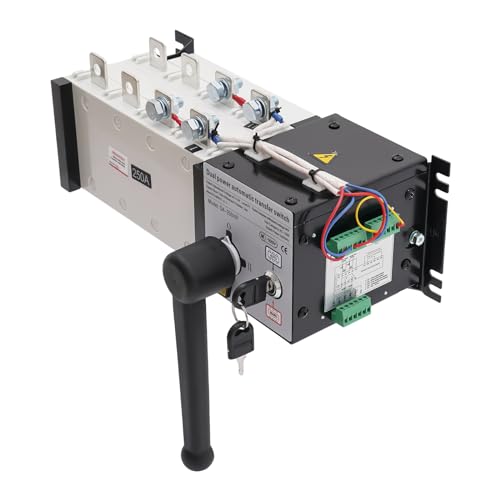
GAOYIJINKE 4P 250A Dual-Power ATS with Key Lock
4P 250AAutomaticKey lockDual mode
Check price on Amazon
Best for: Installers specifying a keyed automatic changeover for a non-standard service.

This is the only unit here with a key lock named in its title. It is a generic four-pole dual-power automatic transfer switch rated up to 250 amps, with a self-activating mode and manual control. It is not a residential kit, and the listing does not describe a listing mark.

A four-pole switch is built for three-phase or neutral-switching applications, so confirm with an electrician whether the pole count and the 110 volt coil voltage fit your service. Compared with the Tzechkii, it adds automation and a key, and takes away the clear residential positioning.

Expect to spend more on engineering than on the switch. Use it only if an electrician specifies it for your installation, and check the labels for any certification you need. A key lock is only useful if the key is accessible in an emergency, so store the spare in a place the whole household knows, and test the cylinder yearly. Remember that a keyed switch protects against casual tampering, not against wiring faults, which only a correct install can prevent.

What works

  • Key lock named in the listing
  • Automatic and manual modes
  • Handles up to 250A
  • Four-pole switching

Watch out for

  • Generic industrial unit, not a home kit
  • Four-pole design may not suit a house
  • Little residential documentation

Spec sheet

Poles
4-pole
Current
100A to 250A handling
Operation
Automatic with manual dual-mode
Lock
Key lock per title
Class
Generic dual-power changeover switch
05
GEYA DIN-Rail Manual Dual-Power Transfer Switch
Manual handleDIN railOverload protectionDual circuit
Check price on Amazon
Best for: Panel builders and electricians putting a small manual changeover inside an enclosure.

GEYA's manual unit mounts on a DIN rail and moves between grid and generator by turning a handle. The listing notes that the common supply must be city grid power and suggests adding a voltage protector, which tells you this is a component for panel builders and electricians.

It is the smallest and simplest item in the guide, with no key and no hasp, so it does not answer the lock question directly. It earns a place because a manual handle between two sources is itself a form of lock-out when installed in a proper enclosure.

Buy it only if a licensed installer plans the enclosure and the wiring. The overload and short-circuit mention is a feature, not a certification. In use it behaves like a rotary isolator: you turn the handle, and the unit connects one source and isolates the other. Because it is small, it can be tucked into a tidy sub-enclosure beside an inlet, giving a compact and inexpensive build for an RV, workshop or shed that has its own small panel.

What works

  • Simple manual handle changeover
  • DIN-rail mounting suits custom panels
  • Overload and short-circuit mention
  • Compact body

Watch out for

  • Component, not a ready home kit
  • No lock mechanism described
  • Needs a separate enclosure and inlet

Spec sheet

Operation
Manual handle rotation
Mounting
DIN rail
Protection
Overload and short-circuit per listing
Source rule
Common supply must be city grid power
Use
Residential, commercial, RV dual circuits

Spec sheet decoder

What the numbers on the box really mean

The specs manufacturers lead with, translated into what they tell you about real-world performance.

Interlock plate

A slotted metal piece behind the panel cover that lets only one of two breakers be on.

Watch forThe LATING lists a specific panel and spacing.

Double throw

A lever with two source positions and no overlap.

Watch forUsed by the Tzechkii and LNEUIE.

Key lock

A keyed barrier that prevents moving the switch without the key.

Watch forNamed only for the GAOYIJINKE.

4P

Four poles, including a switched neutral. Common on three-phase and commercial gear.

Watch forCheck whether a house needs it before choosing the GAOYIJINKE.

DIN rail

A standard metal rail used to mount small electrical components inside enclosures.

Watch forThe GEYA mounts this way and needs an enclosure.

Methodology

How We Evaluated These Generator Transfer Switches with a Lock

Lock meaning

We split products by what is actually locked: breaker interlock, lever action or key. The LATING, the lever boxes and the GAOYIJINKE represent the three.

Fitment clarity

We checked whether each listing says what it fits. The LATING names a panel and spacing, which makes it the clearest.

Residential fit

We separated products meant for homes from generic industrial units. The GAOYIJINKE and GEYA are components, not kits, and we say so plainly. Their inclusion reflects that shoppers searching for a lock often land on them, and a clear warning helps more than leaving them out.

Install burden

A plate needs a panel and an inlet, a lever box needs service wiring, and a DIN switch needs an enclosure. We weighed those jobs. We also noted that a plate leaves you with a dedicated breaker and an inlet to buy, so its low price is only one part of the true cost.

Claim caution

We repeat only what listings state. No listing mark, code compliance or amperage rating is confirmed on a product's behalf.

Decision guide

How to Choose the Right Generator Transfer Switches with a Lock

By Panel Situation

SituationPickWhy
Square D vertical 150/200A panelLATING Interlock for Square D VerticalMatches spacing 3-1/4 to 4 in
No compatible panelTzechkii 200A Double-ThrowStand-alone enclosure
Custom enclosure buildGEYA DIN-Rail Manual SwitchComponent for panel builders

By Budget

SituationPickWhy
Lowest tierGEYA DIN-Rail Manual SwitchSmall component
Low-mid tierLATING Interlock PlateNo enclosure needed
Higher tierTzechkii 200A Double-ThrowFull service box

Interlock Plate vs Lever Box

Interlock plate

The LATING works inside a compatible panel and costs little, but needs a spare slot, a generator breaker and an inlet.

Lever box

The Tzechkii and LNEUIE sit beside the panel and work with any brand. Larger, pricier and a service-level job.

Choose a plate if your panel matches; choose a lever box if it does not.

By Operation Style

SituationPickWhy
Fully manualLNEUIE 200A Double-ThrowLever with no electronics
Automatic with keyGAOYIJINKE 4P 250A ATSKey lock named, automatic mode
Small manual handleGEYA DIN-Rail SwitchRotary manual changeover

For Preventing Accidents Specifically

Look for

A physical interlock, a clear label for each position and a cover that can be secured. Ask the installer about a locking cover.

In this comparison

The LATING plate blocks dual breaker operation, and the Tzechkii lever cannot close both sources.

When to Spend More

Spend more if

You want a stand-alone service switch such as the Tzechkii, independent of your panel brand.

Save if

You own a matching Square D panel. The LATING plate is the economical way to get a mechanical lock.

Ownership

Maintenance schedule

The upkeep that decides whether this machine lasts two seasons or ten.

TaskIntervalWhy it matters
Check the plate mountingYearlyA loose screw can let a plate shift. Tighten it and confirm the slot still blocks one breaker.
Cycle the leverEvery 6 monthsContacts stiffen when idle. Operate with the generator off.
Check lug torqueYearlyAluminum lugs loosen with heat cycles. An electrician should tighten to the label torque.
Test the key lockYearlyKeys and cylinders can seize. Lock and unlock the key switch and store a spare key safely.
Re-read the labelsAfter panel changesA new breaker changes spacing. Check that the interlock still matches.

FAQ

Frequently Asked Questions

Is an interlock plate the same as a transfer switch?

It does the safety part of the job, preventing both breakers being on, but it is not a complete switch. You still need a generator breaker and an inlet.

Will the LATING fit my panel?

Only if you have a Square D vertical 150 or 200 amp panel with a 3-1/4 to 4 inch gap between main and generator breaker. Measure first. If your panel is horizontal, a different brand or a different spacing, look for the plate made for that exact layout, because a nearly matching plate does not guarantee the lock-out. Ask the panel manufacturer which kit it approves.

Does the GAOYIJINKE suit a house?

It is a generic four-pole industrial unit. A house on single-phase service may need a different pole count, so ask an electrician. Even a perfect pole count would not make it a home kit, since you would still need an enclosure, an inlet and a compliant install.

Can I lock the lever on the Tzechkii?

The listing does not describe a hasp. Ask your installer whether a locking cover or handle can be added without altering the enclosure.

Do I need a permit?

Most places require one for a generator tie-in, and some demand a listed interlock kit. Ask the local authority first.

What is the difference between lock and lockout?

Lock usually means a key or padlock on a switch position. Lockout means a mechanical interlock that stops two breakers being on together.

Bottom line

The short version

Browse more generator transfer switches with a lockon Amazon →
James Miller, Lead Machine Editor

About the author

James Miller

Lead Machine Editor, MachineFanatic

James Miller leads MachineFanatic's buying guides, turning spec sheets, manuals and owner feedback into clear verdicts on power tools, outdoor power equipment, shop machines and kitchen machines.

More from James →