
Amazon affiliate links - we earn a commission.Affiliate disclosure

Buying guide · 13 min read · Updated 2026-11-09

Best Hammer Drills Under $150 (2026)

Five hammer drills priced under $150, from a 7.5 amp corded 1/2 inch drill to SDS-plus rotary hammers, with the masonry limits cheap units hide.

James MillerBy James MillerLead Machine Editor5 machines comparedSpec-sheet verified
Best Hammer Drills Under $150

At a glance

Our top picks

A hammer drill adds a rapid tapping action to a spinning bit so carbide can chip through brick, block and soft concrete. At a modest budget the confusing part is that the same category name covers two very different mechanisms, and the amp rating on the box says little about how fast a hole actually gets made.

This guide explains what a limited budget really buys in masonry drilling, which compromises matter and which do not, and how to avoid paying for a feature you will never use. The picks are listed above, and the reviews below add the ownership detail a spec chip cannot show. Listing prices move, and the cap reflects prices when this guide was updated.

Before you buy

6 Criteria to Look For Before Buying a Hammer Drill Under $150

  1. 01

    Cam action versus SDS piston

    A conventional hammer drill ratchets two serrated discs against each other, so each tap is light but frequent. An SDS-plus rotary hammer uses a piston to strike the bit with real energy, measured in joules. For occasional brick anchors, the Hammerhead HAHD075 is enough; for cured concrete, the Seesii at 3J or the DEKOPRO at 5.5J do the same hole in a fraction of the time. A common mistake is buying a high amp conventional drill expecting rotary hammer results.

  2. 02

    Impact energy in joules

    Joules measure how hard each blow lands, and they matter more than amps for masonry. Anything under about 2 joules is light-duty, 2 to 3 is a handyman range and 5 or more is serious drilling. The Seesii lists 3J and the DEKOPRO 5.5J, so the DEKOPRO should break concrete faster per strike. Do not compare a joule rating to an amp rating, because they measure different things.

  3. 03

    Chuck type and bit access

    A 1/2 inch keyless chuck grips round shank bits for wood, metal and masonry, while an SDS shank only takes SDS bits. If you drill mostly wood and occasionally masonry, the Hammerhead's chuck is more flexible. If you plan to run a lot of masonry bits, SDS-plus bits cost about the same and last longer. Buyers often forget that SDS machines need an adapter to hold a plain twist bit.

  4. 04

    Safety clutch and wrist risk

    A bit that hits rebar stops instantly, and the tool body keeps spinning around your wrist unless something intervenes. The ENEACRO and DEKOPRO list safety clutches that slip under overload. The Hammerhead has none, and the DEWALT uses an anti-rotation system that senses the twist. Skipping this feature on a budget SDS drill is the most common injury risk in this class.

  5. 05

    Corded or cordless economics

    A corded tool delivers steady power without batteries, and the four corded picks cost far less than a cordless kit with a comparable battery. The DEWALT bare tool only works if you own 20V packs, since the battery and charger often cost as much as the drill. Match the tool to how often you will need it away from an outlet.

  6. 06

    Weight, balance and vibration

    Heavier machines with more joules tire your arms during overhead work. The Seesii is lighter and better balanced, while the DEKOPRO's higher energy brings more recoil. A vibration-damped handle, like the one on the ENEACRO, lets you work longer between breaks. Pick the tool you can hold at head height for ten minutes, not the one with the biggest number.

Detailed reviews

The 5 best hammer drills under $150, explained

01
Hammerhead HAHD075 7.5 Amp 1/2 Inch Corded Hammer Drill
7.5 amp motor1/2 inch keyless chuckVariable speedCorded
Check price on Amazon
Best for: Homeowners who drill occasional masonry anchors and mostly wood or metal, and want a no-fuss corded drill.

This is a conventional hammer drill, meaning two ribbed cams ratchet against each other behind the chuck so the bit taps forward as it spins. That mechanism is simple and cheap to build, and at 7.5 amps it moves enough energy to drive a 3/16 inch to 1/4 inch masonry bit through brick and block at a patient pace. A switch on the body flips the tool between plain drilling and hammer drilling, so the same drill handles pilot holes in framing lumber and anchor holes in a basement wall.

The tradeoff is impact energy. The cam action pounds far less per blow than the piston in the SDS-plus machines in this roundup, so the Seesii 9 amp drives a similar bit through concrete noticeably faster. It also lacks a clutch, so a sheared or jammed bit can twist the handle against your wrist, and a firm two-hand grip matters when the bit snags. For a renter hanging a TV bracket into brick or a homeowner setting a few fence post anchors, the simplicity is an advantage because there is nothing to adjust beyond the mode switch.

Ownership is easy. The keyless chuck should be retightened after the first minute of hammer drilling because vibration walks it loose, and the cam faces wear faster if you leave it in hammer mode while drilling wood. Keep the bit set in its case and replace dull masonry bits, since a rounded carbide tip does more damage to the drill than a hard wall does.

What works

  • Cam hammer action handles brick and block anchors at a patient pace
  • Full 1/2 inch keyless chuck accepts the larger bits cheap drills skip
  • Corded power means no battery platform to commit to
  • One mode switch keeps setup simple for first-time users

Watch out for

  • Impact energy is far below any SDS-plus machine for cured concrete
  • No clutch or torque limiter, so a jammed bit kicks hard
  • Cord length limits reach on outdoor jobs without an extension

Spec sheet

Motor
7.5 amp corded
Chuck
1/2 inch keyless, metal
Modes
Drill and hammer drill
Speed control
Variable trigger
Included
6 piece bit set
02
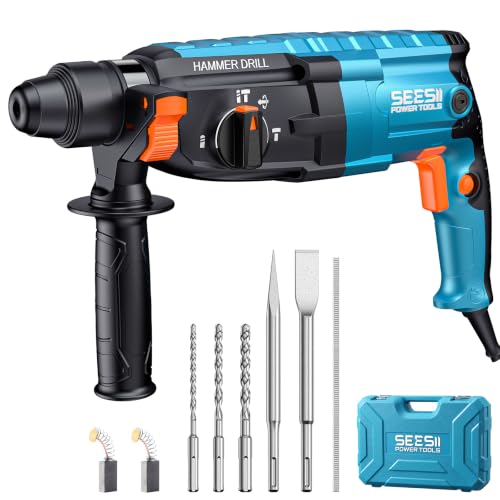
Seesii 9 Amp 850W SDS-Plus Rotary Hammer Drill
850W, 9 amp3J impact energy1300 RPM, 5500 BPM4 modes
Check price on Amazon
Best for: Anyone drilling concrete anchors regularly who wants real piston hammering at a moderate budget.

A rotary hammer drives the bit with an electropneumatic piston instead of ratcheting cams, which is why a 3 joule SDS-plus tool outworks a conventional hammer drill with a bigger amp number. The SDS shank slides in the chuck instead of being clamped, so the bit can float and the piston can strike it without the chuck absorbing the shock. Four modes cover drilling, hammer drilling, chiseling in a locked position and a Vario-Lock position that lets you index the chisel angle.

At 3 joules this is the lightest-hitting SDS machine in the roundup. The DEKOPRO 12.5 amp is rated at 5.5 joules, so it will be faster in concrete and better for 3/4 inch holes, but the Seesii is easier on the forearm and better balanced for overhead anchors. The listing states capacity up to 1-1/32 inch in concrete, a realistic ceiling for this class, and it is a better fit for a handyman who drills into masonry weekly than for someone chasing channels in a block wall.

Ownership centers on the SDS chuck. Grease the bit shank lightly before each session, because dry shanks wear the chuck pockets and the dust boot, and the tool slows noticeably when they do. Buy a second set of SDS-plus bits, as the bundled bits are best treated as starters, and keep the case closed to keep concrete dust out of the selector.

What works

  • Piston mechanism hits harder than any cam-style hammer drill here
  • Four modes include chisel positions for light demolition
  • Lighter machine balances better for overhead drilling
  • SDS-plus bits are inexpensive and widely stocked

Watch out for

  • Lowest impact energy among the SDS tools in this roundup
  • Plastic housing flexes under heavy chiseling loads
  • Cannot grip a regular round shank bit without an adapter

Spec sheet

Motor
850W, 9 amp corded
Impact energy
3 joules
No-load speed
1300 RPM, 5500 BPM
Modes
Drill, hammer drill, chisel, Vario-Lock
Max in concrete
1-1/32 inch
03
ENEACRO ENRH3201 13 Amp 1-1/4 Inch SDS-Plus Rotary Hammer
13 amp motor1-1/4 inch capacitySafety clutch4 functions
Check price on Amazon
Best for: People who drill into rebar-reinforced concrete and want a clutch for safety.

This machine pairs a 13 amp motor with a safety clutch, which is the feature that separates a pleasant rotary hammer from a wrist-twister. When a bit hits rebar and stops, the clutch slips instead of letting the housing spin in your hands, and that matters more than extra joules for anyone drilling into reinforced slab. The listing also describes a vibration control system, meaning a damped handle that cuts the felt buzz over long sessions.

It sits between the Seesii at 9 amps and the DEKOPRO at 12.5 amps on paper, but the practical difference is the 1-1/4 inch capacity, which lets it core larger anchor holes than the Seesii will manage. It is heavier than the Seesii, so overhead work tires you sooner, and the larger frame is awkward for tight spots between studs. If your jobs are a mix of 1/4 inch tapcon holes and the occasional 3/4 inch hole for a wedge anchor, this is the sensible middle.

Ownership: expect to replace the bit chuck dust seal before the motor wears out, since dust ingress is the common failure on budget SDS tools. Run it a few minutes per hole instead of leaning on it, because the piston benefits from letting the bit do the work. Store it in the supplied case, and wipe the selector ring so grit does not stiffen the mode change.

What works

  • Safety clutch slips instead of spinning the housing when a bit binds
  • Vibration-damped handle reduces fatigue on long drilling sessions
  • 1-1/4 inch capacity handles larger anchor holes
  • 13 amp motor holds speed under sustained load

Watch out for

  • Heavier than the Seesii, which tires arms on overhead work
  • Larger body is awkward in tight stud bays
  • Bundled accessories are basic, so budget for better bits

Spec sheet

Motor
13 amp corded
Capacity
1-1/4 inch concrete
Safety
Overload clutch
Functions
4 selectable
Vibration
Vibration control handle
04
DEKOPRO 12.5 Amp SDS-Plus Rotary Hammer, 5.5J
12.5 amp motor5.5J impact energy0 to 1000 RPM4 functions
Check price on Amazon
Best for: DIYers who need to chisel tile or drill larger holes in cured concrete and accept the weight.

The 5.5 joule rating is the headline here, and it is the highest impact energy in this roundup. More joules per blow means the carbide tip fractures more concrete per strike, so holes in cured slab go noticeably quicker than with the 3 joule Seesii. The blow rate tops out at 4,600 per minute, lower than the Seesii at 5,500, which shows how manufacturers trade strike frequency for strike force.

The four-function side selector and a safety clutch cover the same ground as the ENEACRO, but this one leans toward demolition work, with enough force for chiseling out tile or a light chase in block. The cost is weight and a heavier recoil impulse, so a firm stance and a side handle are mandatory.

Ownership: pay attention to the cord and housing heat during long chiseling, because budget motors lose power as they warm up. Let it idle for 20 seconds after heavy use so the fan cools the windings. Replace worn chisels instead of forcing dull ones, and keep a tube of SDS grease handy, since this class of tool depends on it.

What works

  • Highest joule rating in the lineup breaks concrete fastest
  • Four-function selector adds a chisel mode for light demolition
  • Safety clutch protects the wrist during rebar strikes
  • 1-1/4 inch SDS-plus capacity handles most anchor sizes

Watch out for

  • Slower blow rate than the Seesii, which affects finish quality
  • Heavier recoil makes overhead drilling tiring
  • Rating is a peak figure, so sustained output is lower

Spec sheet

Motor
12.5 amp corded
Impact energy
5.5 joules
No-load speed
0 to 1000 RPM
Blow rate
0 to 4600 BPM
Functions
4 with side selector
05
DEWALT DCD806B 20V MAX XR Brushless 1/2 Inch Hammer Drill (Bare Tool)
20V MAX XRBrushless motor2-speedBare tool
Check price on Amazon
Best for: Existing 20V MAX owners who want a capable hammer drill without buying a battery.

This is the only cordless drill in the roundup, and the bare tool listing is how it lands under the cap. You are buying the drill body and nothing else: battery and charger are separate, so it only makes sense if you already own 20V MAX packs. The brushless motor and two-speed gearbox give strong drilling torque, while the hammer mode is a conventional cam action that is mild next to any SDS machine here.

The feature worth noting is the anti-rotation system, which senses sudden twist from a jammed bit and cuts power before the handle spins. That safety logic is more refined than the plain clutch on the corded SDS tools, and it is why this model suits a ladder or overhead jobs better than a corded drill. The compromise is that cordless hammer action is lighter than the Hammerhead at full cord power for sustained masonry work.

Ownership: the real cost is the battery platform. If you own compatible packs, this is the easiest pick of the five. If you do not, the battery and charger can cost more than the drill, and you would be better off with a corded tool. Keep the chuck clear of dust and store batteries cool and partly charged.

What works

  • Brushless motor runs cooler and lasts longer than brushed
  • Anti-rotation system cuts power when a bit binds
  • Two-speed gearbox suits both driving and drilling
  • Cordless freedom for ladders and roofs

Watch out for

  • Battery and charger are not included in the bare tool listing
  • Cam hammer action is far weaker than SDS machines for concrete
  • Makes little sense if you own no 20V packs

Spec sheet

Platform
20V MAX
Motor
Brushless
Chuck
1/2 inch
Gearbox
2-speed
Special
Anti-rotation system

Spec sheet decoder

What the numbers on the box really mean

The specs manufacturers lead with, translated into what they tell you about real-world performance.

Amps

Amps measure electrical current draw, not output. A higher amp motor can produce more power, but efficiency and gearing change the result, so two 9 amp tools can perform very differently.

Watch forA 13 amp rating on the ENEACRO does not mean it hits harder than the DEKOPRO at 12.5 amps.

Joules (impact energy)

Joules express the energy of one blow from the piston, calculated at the bit. This is the best single figure for judging masonry drilling speed.

Watch forThe listing may quote a peak joule value, so expect sustained output to be lower, especially on the 5.5J DEKOPRO.

BPM (blows per minute)

BPM counts how many times the hammer mechanism fires each minute at no load. Higher BPM gives a smoother cut, while higher joules give a harder hit.

Watch forThe Seesii's 5,500 BPM sounds better than the DEKOPRO's 4,600, but the DEKOPRO strikes harder with each blow.

No-load RPM

RPM is bit rotation speed when nothing resists it. Hammer drills spin slower under load, and masonry drilling should happen at lower speed with firm pressure.

Watch forThe Seesii's 1,300 RPM is a no-load number; speed drops sharply once the bit is in concrete.

Bare tool

Bare tool means the drill body only, without battery or charger. It is how cordless listings reach a lower price.

Watch forThe DEWALT DCD806B listing is bare, so add the cost of a battery and charger before comparing it with corded tools.

Methodology

How We Evaluated These Hammer Drills Under $150

Mechanism fit for masonry

We separated cam-action hammer drills from piston rotary hammers because the mechanism determines real speed in concrete. We compared the stated joule values, with the DEKOPRO at 5.5J and the Seesii at 3J, and then looked at how each tool handles load. Conventional drills were scored on versatility instead.

Safety features

We checked each listing for clutches or anti-rotation systems, since a jammed bit is the main injury risk in this category. The ENEACRO and DEKOPRO both list safety clutches, and the DEWALT adds sensing logic. The Hammerhead has no such protection.

Chuck and accessory access

Chuck design decides which bits you can use and how much each costs. We rated the Hammerhead's 1/2 inch keyless chuck against SDS-plus designs, which need adapters for round shank bits. Included accessories were checked for realistic starter value.

Ownership burden

We looked at the parts that commonly fail at this price: chucks, dust seals, selector rings and cords. Cordless ownership included the battery platform cost on the DEWALT. Maintenance effort was weighed against typical use.

Price tier and real value

We used relative price tier to compare what extra spending buys. The cheapest corded drill gives basic masonry capability, while mid-priced SDS tools deliver far more impact energy.

Decision guide

How to Choose the Right Hammer Drills Under $150

By Masonry Workload

SituationPickWhy
A few brick or block anchors per yearHammerhead HAHD075Cam action is enough and the chuck also works for wood
Weekly concrete anchors up to 1 inchSeesii 9 Amp SDS-PlusPiston hammering with a lighter body
Rebar-reinforced slab or wedge anchorsENEACRO ENRH3201Safety clutch and larger capacity
Chiseling tile and drilling cured concreteDEKOPRO 12.5 AmpHighest joule rating in the lineup
Ladder work with existing 20V packsDEWALT DCD806BCordless with anti-rotation protection

By Budget

TierPickWhy
Cheapest here, mostly wood plus light masonryHammerhead HAHD075Lowest cost, flexible chuck
Lower-middle, concrete on a budgetSeesii 9 Amp SDS-PlusSDS power for little more
Upper-middle, safety and capacityENEACRO ENRH3201Clutch plus 1-1/4 inch capacity
Upper-middle, maximum impactDEKOPRO 12.5 Amp5.5J for faster holes
Highest, but only with batteriesDEWALT DCD806BPremium bare tool for existing owners

Cam Hammer Drill vs SDS Rotary Hammer

Cam hammer drill

Serrated discs tap the chuck while it spins, so the action is light and the tool also drills wood and steel with round bits. The Hammerhead HAHD075 and the DEWALT DCD806B fall in this group. They suit occasional masonry and general drilling.

SDS rotary hammer

A piston strikes the bit shank, and the bit slides in the chuck so the shock never reaches your hand. The Seesii, ENEACRO and DEKOPRO use this system. Holes in concrete go far faster, but the tool is heavier and less useful for wood.

Pick cam action if masonry is occasional; pick SDS if you drill concrete more than a few times a year.

Corded vs Cordless

PreferencePickWhy
Never want a battery to die mid-jobSeesii 9 AmpCorded and lighter
Need freedom from an outletDEWALT DCD806BOnly cordless option here
Want one tool for wood, steel and brickHammerhead HAHD075Round shank chuck
Prefer low recoilSeesii 9 AmpLowest impact energy of SDS tools
Need maximum forceDEKOPRO 12.5 Amp5.5J piston

For Drilling Into Brick and Block Specifically

Look for

Brick and block are softer than poured concrete, so even modest impact energy works. Look for variable speed so you can start a hole slowly, and a depth stop or rod to keep holes consistent.

In this comparison

The Hammerhead HAHD075 handles brick and block with a 1/4 inch masonry bit, while the Seesii 9 Amp does it faster. The ENEACRO and DEKOPRO are overkill for most brick work.

When to Spend More

Spend more if

You drill concrete daily, use bits above 3/4 inch, or need a tool that survives rebar. A trade-grade SDS-plus unit costs more but keeps its clutch and chuck for years, and the DEKOPRO and ENEACRO show where this class starts to strain.

Save if

You drill under a dozen masonry holes a year. The Hammerhead HAHD075 or the Seesii 9 Amp covers those jobs, and the money saved buys good carbide bits.

Ownership

Maintenance schedule

The upkeep that decides whether this machine lasts two seasons or ten.

TaskIntervalWhy it matters
Retighten the keyless chuckAfter the first minute of each hammer sessionVibration loosens a keyless chuck during hammer drilling. A slipping bit scars the jaws and can fly out.
Grease SDS shanksBefore each useDry shanks wear the chuck pockets and dust seal. A light film keeps the piston coupling smooth.
Clean dust from vents and selectorAfter every concrete sessionConcrete dust packs into vents and stiffens the mode selector. Blow it out with compressed air to avoid overheating.
Inspect the cord and strain reliefMonthlyA frayed cord drops voltage and heats the motor. Replace or repair it before the next job.
Replace dull carbide bitsWhen progress slows noticeablyA rounded tip forces more pressure and heat. That shortens motor life more than a hard wall does.

FAQ

Frequently Asked Questions

Is a hammer drill or rotary hammer better under this cap?

For occasional brick anchors, a cam hammer drill like the Hammerhead HAHD075 is enough and also drills wood. For concrete, an SDS-plus unit such as the Seesii 9 Amp is much faster. Choose based on how often you hit real concrete.

What does the cap mean for quality?

At this level you get functional machines with basic housings and limited accessories. Expect fewer included bits and plastic parts that flex under heavy chiseling. Listing prices move, so check the live cost before buying.

How long should an SDS tool last?

With regular grease, clean vents and sharp bits, a budget SDS machine can serve a homeowner for years. Heavy daily use shortens the clutch and chuck life. A trade-grade tool is a better fit for professional workloads.

Do more amps mean faster drilling?

Not directly. Impact energy in joules and the mechanism decide masonry speed. The 13 amp ENEACRO is not necessarily faster than the 12.5 amp DEKOPRO rated at 5.5J.

Is it safe to use these without a side handle?

No. Rotary hammers can twist hard when a bit catches, so use the side handle and a firm stance. Tools with a clutch such as the ENEACRO reduce, but do not remove, that risk.

Can I use SDS bits in the Hammerhead?

No, the Hammerhead has a round-shank chuck and cannot take SDS bits. Use standard carbide-tipped masonry bits instead. An SDS-plus machine needs SDS bits or an adapter for round shanks.

Bottom line

The short version

Browse more hammer drills under $150on Amazon →
James Miller, Lead Machine Editor

About the author

James Miller

Lead Machine Editor, MachineFanatic

James Miller leads MachineFanatic's buying guides, turning spec sheets, manuals and owner feedback into clear verdicts on power tools, outdoor power equipment, shop machines and kitchen machines.

More from James →

Keep reading

Related guides