
Amazon affiliate links - we earn a commission.Affiliate disclosure

Buying guide · 12 min read · Updated 2026-11-07

Best Immersion Blenders for Mashed Potatoes (2026)

Which stick blenders can handle mashed potatoes without turning them to glue: blade shape, speed control and masher attachments compared across six models.

James MillerBy James MillerLead Machine Editor6 machines comparedSpec-sheet verified
Best Immersion Blenders for Mashed Potatoes

At a glance

Our top picks

Side by side

Spec comparison

Mashed potatoes are the hardest everyday job to give a stick blender. A spinning blade does not crush a potato, it shears the cells, and the starch that spills out turns the mash from fluffy to glue within seconds. Anyone who has ruined a Thanksgiving batch knows how fast it happens.

That makes this a guide about restraint more than power. The right stick has a gentle low speed, a blade or attachment that mashes rather than slices, and a design that lets you work in short pulses. Where the blade is the wrong tool, a masher head is the honest fix.

Before you buy

6 Criteria to Look For Before Buying an Immersion Blender for Mashed Potatoes

  1. 01

    Blade versus masher

    A rotating blade shears potato cells and releases free starch, which is why blended potatoes turn gluey. The SUNVIVI lists a potato attachment that compresses instead of cutting. If you mash weekly, a masher head is the best feature you can pay for.

  2. 02

    Low-end speed

    The Ganiza starts at the bottom of sixteen steps and the VEVOR at 4,000 rpm on a stepless dial, both useful for gentle mixing. A stick with only two speeds, like the Braun MultiQuick 5 at 350W, must be pulsed. Choose a stick that lets you run slowly.

  3. 03

    Blade count

    The Consciot has four blades and the Ganiza six, which cut faster than a two-blade foot. That is an advantage in soup and a hazard in potato. For mash, fewer blades and a lower speed are safer.

  4. 04

    Trigger or dial

    The Consciot's AccelPress trigger stops the instant you release it, which is the best protection against overshoot. A dial like the Ultra-Stick's eight steps requires you to find the setting first. Pick the control you can stop quickly.

  5. 05

    Shaft length and pot size

    The VEVOR's 16 inch shaft suits a deep stockpot, while the Braun and Mueller sticks suit a normal pan. Measure your pot before you buy. A short shaft in a deep pot forces you to tilt it.

  6. 06

    Honest expectations

    Even the best stick will not make fluffy mash from a whole pot. The workable approach is to mash by hand and cream the last portion with short pulses. If classic mash is your goal, a ricer is a better tool than any blender.

Detailed reviews

The 6 best immersion blenders for mashed potatoes, explained

01
SUNVIVI 10-in-1 1000W stick blender set with potato attachment
12 speeds10 attachmentsPotato masherSplash guard
Check price on Amazon
Best for: Families who mash potatoes regularly and want a proper masher head.

The SUNVIVI is the stick on this list that actually brings a mashing tool. The kit has ten attachments, and the listing title names a potato attachment alongside a 600 ml beaker, an 860 ml chopper with a 500 ml working capacity and a whisk. That is the part that separates it from the other sticks, which only have blades.

A masher compresses cooked potato through holes or ribs instead of cutting it. That keeps the starch cells mostly intact, so the texture stays fluffy and the potatoes do not turn gummy. The stick also has twelve speeds, a splash guard and semi-wrapped stainless blades, so you can use the blade side for soup and the masher for the potatoes.

It is a 1000 watt headline stick with up to 15,000 rpm, which is more speed than potatoes need. Treat the number as a ceiling and keep the setting low. Ten attachments mean a crowded drawer and plenty to wash, so check the masher for dried potato between uses, since starch hardens into a cement-like film. It is the right choice if you make mash often.

What works

  • Potato attachment mashes without shearing starch
  • Twelve speeds with a low setting for control
  • Splash guard and semi-wrapped stainless blades
  • Beaker, chopper and whisk included

Watch out for

  • Ten attachments crowd a drawer
  • Headline wattage far exceeds what mash needs

Spec sheet

Listed power
1000W, up to 15,000 rpm
Speeds
12
Attachments
10 pieces including a potato tool
Chopper
860 ml, 500 ml working capacity
Guard
Splash guard and semi-wrapped blades
02
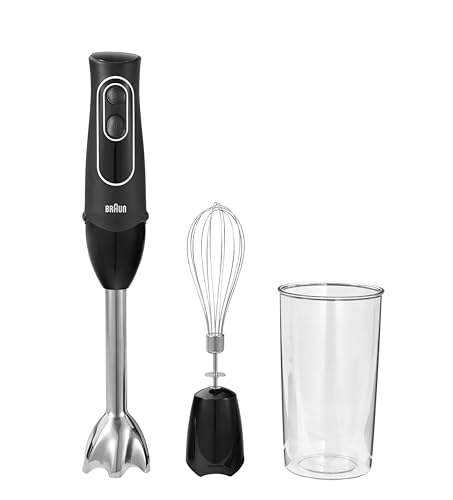
Braun MultiQuick 5 350W dual speed with beaker and whisk
350W2 speedsPowerBellSplashControl
Check price on Amazon
Best for: Cooks who blend potato in pulses and want a low-power, controlled stick.

The MultiQuick 5 at 350 watts is the opposite of the SUNVIVI: a plain stick whose virtue is restraint. A bell shaped PowerBell shaft with the blades set deep inside it limits how violently the food moves, and two speeds mean you cannot accidentally run it at a glue-making pace. Its beaker and whisk are included.

For mashed potatoes the usable technique is to blend a portion of the cooked potatoes with warm milk and butter, then fold that into the rest mashed by hand. The bell and the low-power motor suit that role. It is also the cheapest stick in this guide by price tier, which matters if you only blend potatoes once or twice a year.

It will not mash a whole pot cleanly and you should not ask it to. Rinse the bell immediately, since potato starch dries to a hard film in the slots. Use short pulses of two seconds, stop when lumps remain and finish with a fork. This is the stick for a cook who wants control over power.

What works

  • Bell shaft shields the blade and cuts splatter
  • Two simple speeds prevent over-processing
  • Beaker and whisk included
  • Lowest price tier in the group

Watch out for

  • Cannot mash a full pot cleanly
  • 350W stalls on thick, dry potato

Spec sheet

Motor
350W
Speeds
2
Bell
PowerBell shaft
Splash
SplashControl
Included
Beaker and whisk
03
MuellerLiving Ultra-Stick 500W 8-speed hand blender
500W8 speedsTurbo3 attachments
Check price on Amazon
Best for: Cooks who want a slim, flexible stick and will pulse carefully.

The Ultra-Stick offers eight speeds and a turbo mode on a 500 watt motor, and the lowest of those speeds is the one you want for potatoes. It comes with a blending shaft, a whisk and a frother. There is no masher, so the blade is the only tool for the job.

The approach that works is to use it to loosen and cream a partly mashed batch rather than to do the whole job. Mash roughly by hand, add warm milk and butter and then run the stick for two or three seconds on the lowest speed. A slender body makes it easy to steer around a pot without catching the sides.

The risk is turbo. Avoid pressing the turbo button on cooked potatoes, since that is exactly what produces glue. Rinse the shaft after each use, wipe the whisk and keep the three heads together. It is a flexible kitchen stick that can contribute to mash, but only if you restrain it.

What works

  • Eight speeds give a gentle low setting
  • 500W motor has reserve for soups
  • Slim body steers easily in a pot
  • Whisk and frother included

Watch out for

  • No masher attachment
  • Turbo button is a trap for potatoes

Spec sheet

Motor
500W heavy duty
Speeds
8 plus turbo
Attachments
Blending shaft, whisk, frother
Grip
Non-slip ergonomic handle
Use
Shakes, soups, baby food
04
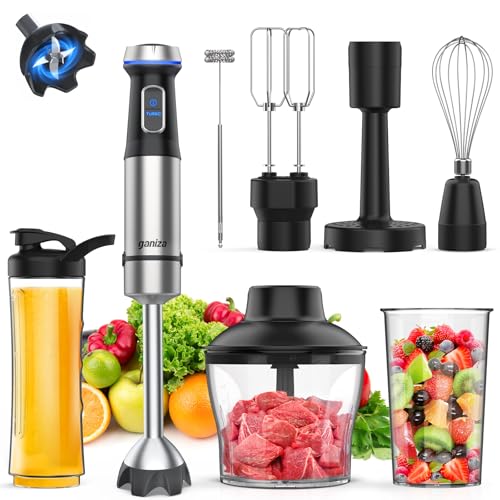
Ganiza 8-in-1 1000W corded stick blender, 16 speeds
16 speeds6-blade headVortexShear8-in-1 kit
Check price on Amazon
Best for: Cooks who want to start at the very bottom of the speed range.

The Ganiza 8-in-1 has the longest speed ladder of the sticks here, sixteen steps from gentle to full. It uses a six-blade stainless cutting head and a VortexShear design that the listing says eliminates most of the suction and splash. The kit includes a beaker, a chopper and more.

Sixteen speeds are useful for potatoes because they let you start almost at a stir. A six-blade head is more aggressive than a two-blade foot, though, so the margin for error is slimmer. Keep the setting at the bottom of the range, pulse for a second or two and stop early.

It costs more than the cheapest sticks and carries more parts. Rinse the head straight after use and dry the kit before storing it. The 1000 watt figure is a headline rather than a working rating, so pay attention to feel, not the number. It is a good choice for people who value fine speed control over a masher.

What works

  • Sixteen speeds with a very gentle low end
  • VortexShear anti-suction design
  • Six-blade stainless head
  • Beaker and chopper in the kit

Watch out for

  • Six blades are aggressive on cooked potato
  • Headline 1000W is not a working rating

Spec sheet

Listed power
1000W pure copper
Speeds
16
Blade
6-blade stainless
Anti-suction
VortexShear
Kit
Beaker, chopper and more
05
Consciot 7-in-1 1100W trigger-control stick blender
Trigger speedAccelPressDual shaft7-in-1 kit
Check price on Amazon
Best for: Cooks who prefer a trigger and will stop at the first sign of gumminess.

The Consciot uses a trigger instead of a dial. Its AccelPress control ramps speed with finger pressure, which gives the most natural control for potato work: a light touch for a gentle pulse and release to stop. It drives two straight and two sub blades and a dual shaft design, and the kit includes seven pieces with double frothers.

The trigger is the reason it earns a place. With potatoes the dangerous moment is overshoot, and a trigger lets you stop the instant you see the mash tighten. The four-blade head cuts faster than a two-blade foot, so keep each pulse to a second or two.

The 1100 watt maximum is a headline figure. The dual shaft design is meant for speed and thorough blending, which is not what mash needs. Wash the heads right after use, and keep the trigger area dry. It is the pick for cooks who like to feel the tool rather than read a dial.

What works

  • AccelPress trigger gives natural control
  • Stops the instant you release
  • Four-blade head blends quickly
  • Seven-piece kit

Watch out for

  • Four blades overwork potato fast
  • Headline wattage is a maximum

Spec sheet

Listed power
1100W maximum, full copper
Control
AccelPress trigger
Blades
2 straight and 2 sub blades
Shaft
Dual shaft design
Kit
7-in-1 set with double frothers
06
VEVOR 350W 16 inch commercial stepless variable-speed blender
350W16 inch shaftStepless4,000-16,000 rpm
Check price on Amazon
Best for: Holiday and catering cooks mashing potatoes in a deep pot.

The VEVOR is the pick for cooks who mash a very large pot. A 16 inch shaft reaches to the bottom of a deep stockpot, and a stepless knob runs from 4,000 to 16,000 rpm, so you can set a very low speed and leave it there. The 350 watt copper motor is modest, which suits potatoes better than a huge motor does.

For mash, the low end of the range is what matters. At 4,000 rpm the blade moves slowly enough to blend in butter and cream without turning the batch gluey. The long shaft also keeps your hand well away from a steaming pot, which is a comfort when you are mashing for a crowd.

It is a big tool: the overall length is 31 inches, so storage is awkward. Rinse the shaft immediately and detach it if the design allows. This is a niche pick, best for holiday cooking for twenty rather than a Tuesday dinner.

What works

  • 16 inch shaft reaches deep pots
  • Stepless knob from 4,000 to 16,000 rpm
  • Low 350W motor suits gentle work
  • Keeps hands away from steam

Watch out for

  • 31 inch overall length is awkward to store
  • Overkill for a family-sized batch

Spec sheet

Motor
350W pure copper
Shaft
16 inch
Speed range
4,000 to 16,000 rpm
Control
Stepless knob
Overall length
31 inch

Spec sheet decoder

What the numbers on the box really mean

The specs manufacturers lead with, translated into what they tell you about real-world performance.

Free starch

Starch released when potato cells burst. It makes mash sticky and gummy.

Watch forA rotating blade releases more starch than a masher or ricer.

Stepless speed

A knob with no fixed steps that runs the whole range. It lets you set a very slow speed.

Watch forThe VEVOR runs from 4,000 to 16,000 rpm.

AccelPress trigger

A trigger that ramps speed with finger pressure and stops on release. It gives the best overshoot protection.

Watch forThe Consciot uses this control.

VortexShear

A blade and guard design meant to cut suction and splash. It helps keep the head from sticking to the pot floor.

Watch forThe Ganiza 8-in-1 lists this feature.

Headline wattage

A maximum or peak figure, not a sustained rating. It says little about how well the stick mashes.

Watch forThe SUNVIVI, Ganiza and Consciot all quote 1000W or more.

Methodology

How We Evaluated These Immersion Blenders for Mashed Potatoes

Starch handling

We looked at whether each stick offers a masher or a way to avoid shearing starch. The SUNVIVI is the only kit with a potato attachment. Blade-only sticks were judged on how gently they run.

Low-speed control

We compared the lowest usable setting on each stick, from the 4,000 rpm floor of the VEVOR to the sixteen steps of the Ganiza. A gentle start is critical for potato. Owner feedback patterns on gluey mash shaped the weighting.

Blade design

We counted blades, from the two-blade foot to the six-blade Ganiza head. More blades cut faster and overwork potato sooner. We favoured fewer blades for this task.

Reach and batch size

We compared shaft lengths and pot fit. The VEVOR reaches deep pots, the others suit a normal pan. Batch size decides which you need.

Value for a seasonal job

We ordered the six by relative price tier, with the Braun MultiQuick 5 lowest and the SUNVIVI mid-range. Mash is often a seasonal job, so cost per use matters.

Decision guide

How to Choose the Right Immersion Blenders for Mashed Potatoes

By Mash Style

SituationPickWhy
Fluffy mash with a masher headSUNVIVI 10-in-1Potato attachment compresses instead of cutting
Creaming the last portionBraun MultiQuick 5 350WLow power and a bell shaft
Fine control from the lowest speedGaniza 8-in-1Sixteen steps
Mash for a crowdVEVOR 350W 16 inchLong shaft and a 4,000 rpm floor

By Budget

Budget tierPickWhy
LowestBraun MultiQuick 5 350WCheapest stick with a bell shaft
Low-midGaniza 8-in-1Sixteen speeds and a kit
MidSUNVIVI 10-in-1Masher head and ten attachments
UpperVEVOR 350W 16 inchCommercial reach

Blade vs Masher

Blade

The Ultra-Stick, Ganiza and Consciot rely on rotating blades. They suit cooks who cream the last portion of a hand-mashed batch.

Masher

The SUNVIVI includes a potato attachment that compresses cooked potato. It suits cooks who want a classic texture from a stick.

Choose the masher if you mash often, a blade stick if you only cream.

Control Axis

PreferencePickWhy
TriggerConsciot 7-in-1AccelPress stops on release
Many stepsGaniza 8-in-1Sixteen speed steps
Eight stepsMueller Ultra-StickGentle low setting
Stepless knobVEVOR 350W4,000 to 16,000 rpm

For Large Batches Specifically

Look for

A long shaft, a low speed floor and a motor that does not overpower the pot. Work in small portions and stop early.

In this comparison

The VEVOR 350W with its 16 inch shaft suits large batches best, while the SUNVIVI masher helps a normal pot.

When to Spend More

Spend more if

You mash often and want a real masher head, as with the SUNVIVI, or you cook for crowds, as with the VEVOR.

Save if

You cream potatoes once a year. The Braun MultiQuick 5 does the job with short pulses.

Ownership

Maintenance schedule

The upkeep that decides whether this machine lasts two seasons or ten.

TaskIntervalWhy it matters
Rinse starch off at onceEvery usePotato starch dries to a hard film in blade slots and masher holes. Rinse in warm water straight after use, since cold water leaves a paste.
Clean the masher plateEvery useHoles in a masher clog with dried potato. A soft brush and warm soapy water clear them.
Wipe the control areaWeeklyButter and milk splash into dials and triggers. A damp cloth keeps them moving.
Check the guard and sealsMonthlySplash guards crack with heat. Replace any that no longer seat firmly.
Store attachments togetherAfter washingTen-piece kits lose parts quickly. A small bag keeps the masher with the stick.

FAQ

Frequently Asked Questions

Why do blended potatoes turn gluey?

A spinning blade bursts the starch cells and releases free starch, which makes the mash sticky. A masher or ricer compresses the potato without breaking as many cells, so the texture stays fluffy.

Can an immersion blender make good mashed potatoes?

Only with care. Use short pulses on the lowest speed, stop while a few lumps remain and finish by hand, or choose a stick with a masher attachment. Waxy potatoes tolerate more handling than floury ones, so a blender is less likely to ruin a batch made from a waxy variety, though the texture will not be fluffy.

Does more wattage help?

No. A bigger motor overprocesses potato faster. Control and a low speed floor matter far more than a headline number. The gentlest stick here is the one that runs slowest, which is why the 350W models earn their place in a guide about restraint.

Should I add milk and butter first?

Add warm milk and butter before blending, because extra liquid reduces the strain and the risk of glue. Cold liquid cools the potato and can make the texture heavy. Fold the dairy in with a spatula first so it coats the potato before any blade touches it.

Is a ricer better than a stick blender?

For classic mash, yes. A ricer or hand masher is cheaper and gives a more reliable texture. Press the potatoes while they are still hot and dry them in the pot for a minute first, since excess water also dilutes the flavour and makes the mash heavy.

Can I use the stick for potato soup?

Yes, and that is a better use. Potato soup tolerates a smooth blend, though it can still turn slimy if you overwork it. Blend most of the soup, leave a few chunks for texture and stop as soon as the colour becomes uniform.

Bottom line

The short version

Browse more immersion blenders for mashed potatoeson Amazon →
James Miller, Lead Machine Editor

About the author

James Miller

Lead Machine Editor, MachineFanatic

James Miller leads MachineFanatic's buying guides, turning spec sheets, manuals and owner feedback into clear verdicts on power tools, outdoor power equipment, shop machines and kitchen machines.

More from James →

Keep reading

Related guides