
Amazon affiliate links - we earn a commission.Affiliate disclosure

Buying guide · 14 min read · Updated 2026-11-15

Best Infrared Patio Heaters (2026)

Seven electric infrared patio heaters compared from 1500W plug-in towers to 6000W fixtures, with element type, IP rating and mounting height explained.

James MillerBy James MillerLead Machine Editor7 machines comparedSpec-sheet verified
Best Infrared Patio Heaters

At a glance

Our top picks

Side by side

Spec comparison

Infrared patio heaters send radiant energy from a glowing element straight onto people and furniture, instead of heating the surrounding air. That is why they work outdoors, where warmed air blows away within seconds. They also run silently, burn no fuel and leave no smell, which suits dinner outside on a cool evening.

The category runs from plug-in 1500W towers to hardwired fixtures several times that size, and the bigger models behave more like a building system than an appliance. What separates them is element type, ingress rating, mounting height and how much electrical work the installation demands. Reading those four things in the listing tells you more than the headline wattage.

Before you buy

6 Criteria to Look For Before Buying an Infrared Patio Heater

  1. 01

    Voltage and wiring

    A 1500W heater like the Dr. Infrared plugs into a standard 120V outlet. The 3000W DR-239, the 4500W ThermoMate and the 6000W Infratech need larger circuits, often 240V, and an electrician. Confirm the requirement before you buy. A common mistake is ordering a 3000W heater and discovering that the patio outlet is on a shared 15A circuit. A quick call to an electrician before checkout costs far less than a return, and many owners find a dedicated 20A or 240V line is a small job.

  2. 02

    Element type

    Carbon elements start in seconds and look softer than quartz. The Infratech uses dual quartz elements and the others use carbon. Carbon fiber is typical of consumer units, quartz of commercial ones. Both radiate similar infrared, so the difference shows in warm-up behavior, glare and durability. Quartz tubes are more fragile if struck, while carbon fiber tolerates vibration better, which matters on a wall that gets bumped.

  3. 03

    Ingress rating

    IPX5 on the 42 inch tower tolerates water jets, IP55 on the hykolity and DR-239 adds dust protection, and IP67 on the ThermoMate low-glare unit is the highest rating. Match the rating to your exposure. A heater under a roof rarely needs more than IP44, but an open pergola should have IP55 or better. Plugs and connectors are not covered by the body rating, so keep them out of puddles.

  4. 04

    Mounting height

    Radiant heat falls with distance, so mounting too high wastes output. Aim for the heater to sit a few feet above head height and angle it toward the seats. Follow the clearance in the manual. Mounting heights between seven and nine feet are common for residential fixtures, but a ceiling below that needs a lower-output unit. If you can reach it without a ladder, it is probably too low for high wattage.

  5. 05

    Coverage honesty

    The ThermoMate low-glare unit lists about 80 sq ft at 1500W while the 4500W model lists about 170 sq ft. A rule of thumb is about 10 watts per square foot in a sheltered area, and less in wind. Treat the number as a ceiling and divide it by a wind factor if the patio is open. A snug pergola with a wall behind the heater will outperform a bigger open space with the same unit.

  6. 06

    Controls and timers

    Nine levels on the ThermoMate IP67 and the 42 inch tower let you dial down output. A timer, such as 24 hours on the hykolity, prevents an all-night burn. A remote is useful on a wall mount, since the unit sits above reach. If a heater has no remote, a wall switch with a timer is a sensible substitute.

Detailed reviews

The 7 best infrared patio heaters, explained

01
Dr. Infrared 1500W portable infrared heater, freestanding or mounted
1500W900/1200/1500W3-way mountRemote
Check price on Amazon
Best for: Most patios, with room to grow into wall or ceiling mounting.

The Dr. Infrared 1500W uses a carbon infrared element and a weighted base with easy-roll wheels. The listing stresses that it does not waste energy heating the air, which is the defining trait of the category. Three mounting options make it equally at home on a deck, a garage wall or a ceiling bracket.

It has power steps of 900W, 1200W and 1500W through a remote. At 1500W it produces roughly 5,120 BTU per hour, the ceiling for a 120V 15A plug-in. Because it warms bodies and surfaces directly, you feel the effect within seconds, even though the air stays cool.

Next to the 3000W DR-239 from the same brand it is easier to install, since it needs no electrician. The tradeoff is reach, since 1500W warms a seating nook and not a full patio. Plan on a weather-rated outlet and keep the cord short. Wipe dust from the reflector when cool, check the wheel bolts each season and store it dry.

What works

  • Plugs into a standard outlet with no wiring
  • Three power steps with a remote
  • Weighted wheeled base or wall and ceiling mount
  • Carbon element warms people directly

Watch out for

  • 1500W reach is limited to a small seating area
  • Needs a weather-rated outlet and short cord

Spec sheet

Power
900W, 1200W or 1500W
Element
Carbon infrared
Mounting
Freestanding, wall or ceiling
Base
Weighted, easy-roll wheels
Control
Remote
02
hykolity 1500W infrared wall-mount patio heater, 35.5 in, IP55
1500WIP55Wall mountETL
Check price on Amazon
Best for: Covered patios with a fixed seating spot.

The hykolity wall-mount is 35.5 inches long with dual carbon tubes and a 1500W infrared system. It carries an IP55 rating, which means dust protected and resistant to water jets, and ETL certification with three layers of protection. A 24 hour timer and remote give it the same convenience as freestanding units.

Mounting on a wall puts the heater at the height where radiant heat covers a seating area from above. That frees the floor and keeps a heater out of the way of foot traffic. It also fixes the heat to one spot, which suits a covered porch or a pergola.

Compared with the Dr. Infrared it loses the ability to move, but it gains a sealed IP55 housing and a permanent install. Owners should choose the mounting height carefully, because a heater too high wastes heat and one too low is uncomfortable. Wipe the housing with a damp cloth and check the mounting bolts yearly. Because the IP55 rating covers the body and not the plug, route the cord so that water drips away from the outlet.

What works

  • IP55 housing is dust and jet resistant
  • Dual carbon tubes with 1500W output
  • ETL certification and layered protection
  • Wall mount keeps floor space clear

Watch out for

  • Fixed in one place once mounted
  • Needs wall studs and a nearby outlet

Spec sheet

Power
1500W
Rating
IP55 waterproof and dustproof
Element
Dual carbon tubes
Safety
Tip-over, overheat, ETL certified
Timer
24 hour with remote
03
Dr. Infrared DR-239 3000W infrared heater, wall or ceiling mount, IP55
3000W10,260 BTUIP55Wall or ceiling
Check price on Amazon
Best for: Large covered patios and workshops with proper wiring.

The DR-239 delivers 3000W, which the listing converts to 10,260 BTU per hour, twice a 1500W heater. It comes with wall and ceiling brackets, a remote and an IP55 weatherproof rating. That output reaches a larger seating group or a garage workshop.

A 3000W load exceeds what a standard 120V 15A plug can supply, so check the voltage and wiring requirements in the listing before you order. In many homes this means a dedicated circuit installed by an electrician. Skipping that step is the usual reason owners are disappointed.

It is a better fit for a large covered area than the 1500W units, though it costs more to run. At 3 kWh per hour it is a tool for specific use, not an all-night warm-up. Keep the mounting height and clearance within the manual. Inspect the brackets after the first season. A heater this powerful makes the wall behind it hot, so check what it is made of before mounting.

What works

  • 3000W doubles the 1500W output
  • 10,260 BTU per hour by the listing
  • IP55 weatherproof rating
  • Wall and ceiling brackets included

Watch out for

  • Needs suitable voltage and often an electrician
  • Costs more to run per hour

Spec sheet

Power
3000W
Heat output
10,260 BTU/hr
Rating
IP55 weatherproof
Mounting
Wall or ceiling brackets
Control
Remote
04
ThermoMate 4500W carbon fiber infrared patio heater with remote
4500WCarbon fiber170 sq ft24H timer
Check price on Amazon
Best for: Large sheltered spaces that need serious wattage.

The ThermoMate lists 4500W of carbon fiber heating with a claim of coverage near 170 square feet, and instant heat in about 3 seconds. It includes a 24 hour timer and a full-function remote with several heat modes. The output is three times a standard plug-in tower.

A 4500W load is well beyond a household plug, so this is a wired fixture. Confirm the voltage and circuit rating before purchase. The coverage claim assumes calm air and an enclosed or sheltered space.

For a large garage or a screened pavilion it is a strong performer. For a small patio it is excess. Mount it at the recommended height and keep combustibles clear.

What works

  • 4500W is three times a typical plug-in heater
  • Carbon fiber element heats in seconds
  • 24 hour timer and remote
  • Listed coverage near 170 sq ft

Watch out for

  • Needs dedicated wiring
  • Too much output for a small patio

Spec sheet

Power
4500W
Element
Carbon fiber
Coverage
About 170 sq ft (listing)
Timer
24 hour
Warm-up
About 3 seconds
05
Infratech WD-6024 6000W stainless dual-element patio heater, 240V
6000W240V304 stainlessDual quartz
Check price on Amazon
Best for: Hardwired restaurant-style installs.

The Infratech WD-6024 is a 61.25 inch fixture with two quartz infrared elements, 6000W at 240 volts and a 304 stainless steel body. The listing says it converts over 90 percent of input energy to radiant heat, a typical claim for quartz. It is the commercial-grade option here.

A 240V fixture needs hardwiring by an electrician, and it is not a plug-in item. In exchange it can cover restaurant patios and large residential porches with a long, even pattern.

For a home buyer it is a major project. Treat it as a permanent fixture, plan the mounting height, and use only licensed wiring.

What works

  • Dual quartz elements at 6000W
  • 304 stainless body resists corrosion
  • Long 61.25 inch pattern covers wide areas
  • Efficient radiant output

Watch out for

  • Requires 240V hardwiring
  • Overkill for a typical home patio

Spec sheet

Power
6000W at 240V
Element
Dual quartz infrared
Length
61.25 in
Body
304 stainless steel
Efficiency
Over 90 percent radiant
06
ThermoMate 1500W low-glare infrared heater, IP67
1500WIP67Low glare9 levels
Check price on Amazon
Best for: Exposed decks where glare and rain both matter.

The ThermoMate IP67 pairs 1500W with a low-glare black ceramic glass screen and nine heat levels. The IP67 rating, dust tight and able to survive immersion, is the highest weather rating in this lineup. It claims coverage of up to 80 square feet.

A low-glare panel is less harsh to look at in the evening than an exposed bright tube. The tradeoff is that glass can fog or collect dirt.

The weather rating suits exposed decks. Listed coverage of 80 square feet is a fair, honest number for 1500W. Keep the glass clean with a soft cloth.

What works

  • IP67 is the highest rating here
  • Low-glare ceramic glass screen
  • Nine levels and a 24 hour timer
  • Honest 80 sq ft coverage figure

Watch out for

  • Glass needs regular wiping
  • 1500W is a small-area heater

Spec sheet

Power
1500W, 9 levels
Rating
IP67
Screen
Black ceramic glass
Coverage
About 80 sq ft (listing)
Timer
24 hour
07
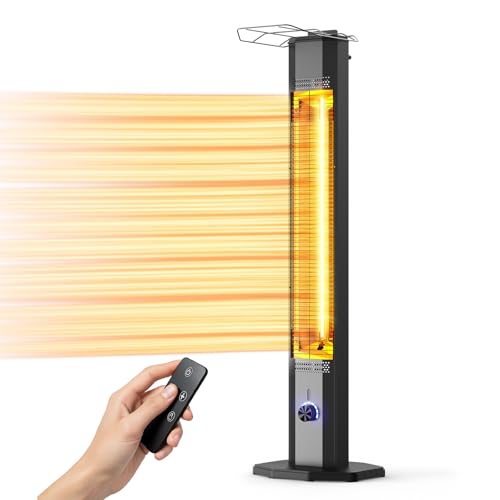
42 in 1500W infrared tower with 9 heat settings and 9 hour timer
1500W9 settings9H timerIPX5
Check price on Amazon
Best for: Renters and small decks that need to move the heater.

This 42 inch tower offers 620W to 1500W in nine levels with a 9 hour timer and a remote. It carries an IPX5 rating and uses a carbon infrared tube that extends over much of the height. The listing promises instant cozy heat.

The long tube spreads heat from head to waist, a good match for seated guests. A timer and a remote make it easy to use without reaching up to the tower.

Compared with the hykolity wall mount it can be moved, but it takes up floor space. It suits renters and small decks. Keep it on a level surface. A tower also moves easily between seasons, which is its main advantage over a fixed fixture.

What works

  • Nine levels from 620W to 1500W
  • IPX5 rating tolerates water jets
  • Tall tube covers seated guests
  • Remote and timer included

Watch out for

  • Floor-standing tower takes up space
  • IPX5 has no dust rating

Spec sheet

Power
620W to 1500W, 9 levels
Height
42 in
Rating
IPX5
Timer
9 hour
Control
Remote

Spec sheet decoder

What the numbers on the box really mean

The specs manufacturers lead with, translated into what they tell you about real-world performance.

Watts

Electric input. About 3.4 BTU per hour per watt.

Watch for1500W is about 5,120 BTU; 3000W is 10,260 BTU by the listing.

IP rating

Dust and water protection codes.

Watch forIP55, IP67 and IPX5 all appear here.

Voltage

Standard plug-ins use 120V. Large heaters often need 240V.

Watch forInfratech WD-6024 is 240V.

Element

The hot part that emits infrared.

Watch forCarbon on consumer units, quartz on the Infratech.

Radiant efficiency

Share of input converted to radiant heat.

Watch forInfratech claims over 90 percent.

Methodology

How We Evaluated These Infrared Patio Heaters

Electrical fit

We compared wattage and voltage with household wiring. Plug-in units earned a convenience score, while hardwired ones were rated on their output. We counted the cost and effort of electrical work as a real hurdle, because it is the step where most buyers stall. Listings that were clear about voltage scored higher than vague ones.

Weather protection

We ranked IP ratings and sealed housings, with IP67 leading and IPX5 trailing. The ThermoMate IP67 unit scored best here, and the hykolity IP55 wall unit followed. Ratings are a design claim, so we also looked at housing materials such as stainless and aluminum.

Mounting

We compared freestanding, wall and ceiling options for flexibility. A heater that can move between a deck and a garage earns more use than one fixed to a wall, which is why the Dr. Infrared ranks first here. Permanent fixtures made up for it with a cleaner look and no floor footprint.

Controls

We looked at power steps, timers and remotes. The nine-level ThermoMate IP67 and the 42 inch tower stood out for fine control. A simple remote that works from a seated position counted more than a long list of presets.

Ownership

We considered glass, brackets and elements, which age first. Glass screens collect film and elements dim over years of use, so we preferred designs with replaceable parts. This section reflects the spec sheet and owner feedback patterns, not a lab measurement.

Decision guide

How to Choose the Right Infrared Patio Heaters

By Space

SituationPickWhy
Small seating nookDr. Infrared 1500WPlug-in and portable
Covered patio, fixed spothykolity wall mountIP55 wall unit
Large sheltered pavilionThermoMate 4500WAbout 170 sq ft listed
Restaurant-style patioInfratech WD-60246000W stainless

By Budget

SituationPickWhy
Lowest outlay42 inch 1500W towerNine levels
Mid-range valuehykolity wall mountIP55 and ETL
Feature spendThermoMate IP67Low glare
Higher spend for outputInfratech WD-6024Hardwired fixture

Plug-In vs Hardwired

Plug-in

The Dr. Infrared, hykolity, ThermoMate IP67 and the tower use a standard 120V plug and are the easiest to own.

Hardwired

The DR-239, ThermoMate 4500W and Infratech need larger circuits and professional wiring.

Most homes choose plug-in; hardwired suits large or commercial spaces.

By Weather Exposure

SituationPickWhy
Exposed deckThermoMate IP67Highest rating
Covered porchhykolity IP55Dust and jets
Windy corner42 inch tower IPX5Jet tolerant
GarageDr. Infrared 1500WPortable

For Large Groups Specifically

Look for

Higher wattage, wide coverage and sheltered air.

In this comparison

The ThermoMate 4500W and Infratech WD-6024 cover large groups when properly wired.

When to Spend More

Spend more if

You host often or have a large covered area: the DR-239 or Infratech reach farther.

Save if

You warm two or three seats: the Dr. Infrared or tower is enough.

Ownership

Maintenance schedule

The upkeep that decides whether this machine lasts two seasons or ten.

TaskIntervalWhy it matters
Inspect wiring and plugBefore each seasonA warm plug signals a poor connection. Replace damaged cords.
Clean the glass or reflectorEach month in useDust and film reduce output. Wipe when cool with a soft cloth and a mild cleaner, never on a hot surface.
Check bracketsEach seasonVibration loosens bolts. Tighten hardware and look for any rust at the mounting points.
Test the timer and remoteEach seasonBatteries fail in cold. Replace cells.
Cover when idleOff seasonMoisture ruins controls. Cover or store dry.

FAQ

Frequently Asked Questions

How does infrared differ from propane?

Infrared warms people directly with no flame or exhaust. Propane heats a larger open area but needs ventilation. Infrared is usually the better choice for covered porches and small seating areas, while propane suits large open patios.

Will it work in wind?

Better than convection heat, since it warms people and furniture directly, but strong wind still cools you. A wall behind the heater and a screen on the windy side make a bigger difference than extra wattage.

Do I need an electrician?

Only for 240V or high-wattage models such as the DR-239 and Infratech. The 1500W units plug into a standard outlet. Hardwiring should always be done by a licensed electrician, with the breaker size matched to the heater.

What mounting height is right?

A few feet above head height, angled toward the seats. Follow the manual's clearances. Too high wastes heat on the ceiling and too low is uncomfortable, so mock it up with a ladder before drilling.

Is it safe near a covered porch?

Electric infrared adds no exhaust and no flame, so it suits covered spaces, with proper clearances. Check the ceiling material above the heater, because radiant output can scorch vinyl or thin paint over time.

How much does it use?

A 1500W heater uses 1.5 kWh per hour at full power. A 3000W model uses twice that, so the timer matters on the larger units.

Bottom line

The short version

Browse more infrared patio heaterson Amazon →
James Miller, Lead Machine Editor

About the author

James Miller

Lead Machine Editor, MachineFanatic

James Miller leads MachineFanatic's buying guides, turning spec sheets, manuals and owner feedback into clear verdicts on power tools, outdoor power equipment, shop machines and kitchen machines.

More from James →

Keep reading

Related guides