

Amazon affiliate links - we earn a commission.Affiliate disclosure

Buying guide · 12 min read · Updated 2026-11-13

Best Inverter Generator for Camping (2026)

Six inverter generators for camping, ranked by pack weight, weekend runtime and campsite load, from a 25-pound lunchbox unit to a dual fuel 3,800 watter.

James MillerBy James MillerLead Machine Editor6 machines comparedSpec-sheet verified
Best Inverter Generator for Camping

At a glance

Our top picks

Side by side

Spec comparison

MachineFuelOutputWeightNoiseRuntime
AIVOLT 1600W Super Quiet Inverter, 28 lbBest for Tent CampingAIVOLT 1600W Super Quiet Inverter, 28 lbGasoline1,600W peak, 1,260W running28 lb57 dBA at 23 feet8 hours at 25% load, 2 hours at full
GENMAX GM1200i 1,200W Ultra-Quiet InverterLightest PickGENMAX GM1200i 1,200W Ultra-Quiet InverterGasolinen/a25.3 lbAs low as 58 dBA at 25% load, 23 feetUp to 6.5 hours at 50% load on 0.66 gallon
PowerSmart 2500W Quiet Camping Inverter GeneratorBest Value Mid-SizePowerSmart 2500W Quiet Camping Inverter GeneratorGasoline2,500W starting, 1,900W runningn/a59 dBA at 23 feet7.5 hours at 25% load
Oxseryn 2800W Inverter, 79.8cc, Camping ReadyBest Light Power OptionOxseryn 2800W Inverter, 79.8cc, Camping ReadyGasoline2,800W peak, 2,000W runningn/an/an/a
GENKINS 4200W Inverter Generator, 46 lb, THD under 2%Best OverallGENKINS 4200W Inverter Generator, 46 lb, THD under 2%Gasolinen/a46 lb58 dBA at 23 feetn/a
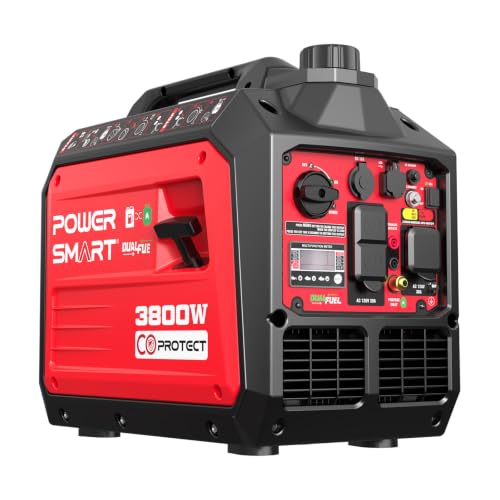
PowerSmart 3800W Dual Fuel Camping Inverter, CO SensorBest Dual Fuel CamperPowerSmart 3800W Dual Fuel Camping Inverter, CO SensorGasoline or propanen/an/a59 dBA at 25% load in Eco Mode8 hours at 25% on gas, up to 24 hours on a 20-lb propane tank

Camping asks a generator to do something unusual: be carried, be quiet and run for a weekend on a single tank. Most buyers compare watts first, but at a campsite the order is weight, noise and runtime, with watts last.

This guide is written from the campsite backwards. Instead of asking how much power a machine can make, it asks what you will carry, what you will plug in and how long you need to run, and then matches six models to those answers.

Before you buy

6 Criteria to Look For Before Buying an Inverter Generator for Camping

  1. 01

    Pack weight first

    A generator that is hard to carry stays in the garage. The GENMAX GM1200i at 25.3 pounds and the AIVOLT 1600 at 28 pounds are one-hand carries, while the Genkins 4200 at 46 pounds is a two-handed lift. Decide how far you carry it from the vehicle before you decide on watts.

  2. 02

    Add up the camp load

    Lights, phone chargers, a fan and a CPAP draw under 500 watts together, which fits the AIVOLT 1600 or GENMAX 1200 easily. A trailer air conditioner needs 1,500 to 2,000 running watts plus a start surge, which points at the PowerSmart 2500 or larger. The mistake is buying for the air conditioner when you only ever run lights.

  3. 03

    Runtime at your real load

    A runtime claim at a quarter load says little about a coffee maker plus a heater. The AIVOLT 1600 quotes eight hours at 25% but two at full load, which shows how fast runtime collapses. Take the half-load figure for planning and keep a spare can for the last night.

  4. 04

    Campground noise rules

    Many campgrounds limit generator noise to around 60 dBA at a set distance and restrict the hours. The Genkins 4200 at 58 dBA, the AIVOLT 1600 at 57 and the PowerSmart models at 59 sit under that line at part load. Check the rules, because a loud unit is often asked to shut down.

  5. 05

    Propane versus gasoline at camp

    Propane stores for years and burns cleaner, which suits a trailer with a tank already on board. The PowerSmart 3800 dual fuel gives up to 24 hours on a 20-pound cylinder at light load. Gasoline units offer more output and simpler fuel, so decide by how you already carry fuel.

  6. 06

    Placement and carbon monoxide

    Tent campers die each year from generator exhaust drifting into sleeping areas. Place the machine downwind and at least 20 feet away from tents and windows, with the exhaust pointing away. A CO sensor like the PowerSmart dual fuel carries is a backup, not an excuse.

Detailed reviews

The 6 best inverter generator for camping, explained

01
AIVOLT 1600W Super Quiet Inverter, 28 lb
1,600W peak1,260W running28 lb57 dBA at 23 ft
Check price on Amazon
Best for: Tent and car campers who want the lightest machine for lights and chargers.

Twenty-eight pounds makes this the machine you can hand to a teenager. It carries 1,260 running watts, enough for a camp stove igniter, lights, chargers, a small fan or a CPAP machine overnight. The listing is honest about runtime in an unusual way, stating eight hours at a quarter load but only two hours at full load.

That two-hour figure is the real planning number if you hope to run a coffee maker and a heater. For tents and small vans, you are using a fraction of the capacity and the eight-hour number applies. Against the 1,350-watt AIVOLT 1750 that is lighter still, the 1600 gives up a few watts but is easier to find and compare on the same panel layout.

Camp-specific upkeep is about dirt and dust. Keep the air intake clear of pine needles and sand, wipe the case before you pack it, and close the fuel valve and run the carburetor dry at the end of every trip.

What works

  • Only 28 pounds for easy carrying
  • 57 dBA stated at 23 feet
  • Low THD for phones and CPAP
  • Honest runtime at both light and full load

Watch out for

  • Two hours at full load limits heavy use
  • Cannot run a trailer air conditioner

Spec sheet

Fuel
Gasoline
Output
1,600W peak, 1,260W running
Weight
28 lb
Noise
57 dBA at 23 feet
Runtime
8 hours at 25% load, 2 hours at full
02
GENMAX GM1200i 1,200W Ultra-Quiet Inverter
1,200W starting57cc engine25.3 lb58 dBA
Check price on Amazon
Best for: Backpack-to-trunk campers who run lights, phones and a small fan.

A 57cc engine and a 25.3-pound frame make this the lightest unit in the group. GENMAX describes it as one of the lightest thousand-watt inverters, and that claim fits the weight. The 0.66-gallon tank and a listed 6.5 hours at half load tell you what kind of weekend it is built for: a quiet campsite, a few devices and an early bedtime.

The tradeoff against the AIVOLT 1600 is a lower output ceiling, so a hair dryer or a coffee maker is out of reach. The noise figure of 58 dBA at a quarter load and 23 feet is a fair number, though the AIVOLT lists 57 on the same terms.

Because the tank is small, a long weekend means a refill on Saturday. Carry the fuel in an approved can, fill with the engine cold and away from the tent, and keep the unit on level ground so the oil sensor does not shut it off.

What works

  • 25.3 pounds is the lightest here
  • Economy mode trims fuel and noise
  • Quoted 6.5 hours at half load
  • Easy to store in a car trunk

Watch out for

  • 1,200 watts cannot run heating loads
  • Small tank needs a mid-weekend refill

Spec sheet

Fuel
Gasoline
Engine
57cc four-stroke OHV
Weight
25.3 lb
Noise
As low as 58 dBA at 25% load, 23 feet
Runtime
Up to 6.5 hours at 50% load on 0.66 gallon
03
PowerSmart 2500W Quiet Camping Inverter Generator
2,500W starting1,900W running7.5 hr at 25%59 dBA
Check price on Amazon
Best for: Pop-up trailers and vans that need a few thousand watts for short periods.

This one lives in the sweet spot for a pop-up trailer or a van. With 1,900 running watts and a 1.06-gallon tank, it lasts through a typical overnight at part load and can start a small roof air conditioner on the right day. The 59 dBA figure is stated at 23 feet, consistent with the other listings.

Compared with the AIVOLT 1600 it carries about 640 more running watts and a bigger tank, at the cost of more weight to carry. Compared with the 4,200-watt Genkins, it gives up two-thirds of the capacity but stays far easier to lift.

Run it for twenty minutes before you pack up and check the oil level against the dipstick mark. A level pad matters on a sloped site because the low-oil shutdown reads the sump angle, and a tilted unit will stop with a full crankcase.

What works

  • 1,900 running watts for midsize camping
  • 7.5 hours at quarter load
  • 59 dBA stated at 23 feet
  • Clean power for sensitive electronics

Watch out for

  • Heavier than the lunchbox units
  • No dual fuel flexibility

Spec sheet

Fuel
Gasoline
Output
2,500W starting, 1,900W running
Tank
1.06 gallons
Runtime
7.5 hours at 25% load
Noise
59 dBA at 23 feet
04
Oxseryn 2800W Inverter, 79.8cc, Camping Ready
2,800W peak2,000W running79.8cc engineTHD under 3%
Check price on Amazon
Best for: Campers who want a small step up in power without a large weight penalty.

Two thousand running watts from a 79.8cc engine is a respectable ratio, and this Oxseryn offers two household outlets and a 12 volt DC port. It is the unit to look at if you want a little more headroom than the PowerSmart 2500 without paying for the larger machines. Clean power under three percent THD keeps laptops and drone chargers safe.

The weakness is that its listing is thinner on weight and noise details than the AIVOLT or GENMAX, so verify the noise at 23 feet before buying if you camp in tight sites. It also lacks a 30 amp outlet, which means no direct trailer plug without an adapter.

Treat the 12 volt port as a convenience, not a battery charger, and use a proper charger for any larger battery. Keep the unit upright, covered from rain, and give it a short monthly run when it is off-season.

What works

  • 2,000 running watts from a small engine
  • Two household outlets plus a 12V port
  • THD under 3% for electronics
  • Compact for trunk storage

Watch out for

  • No 30A RV outlet on the panel
  • Listing gives limited noise detail

Spec sheet

Fuel
Gasoline
Engine
79.8cc four-stroke OHV
Output
2,800W peak, 2,000W running
Outlets
Two 120V AC and one 12V DC
Power quality
THD under 3%
05
GENKINS 4200W Inverter Generator, 46 lb, THD under 2%
4,200W peak149.3cc engine46 lb58 dBA at 23 ft
Check price on Amazon
Best for: Trailer and RV campers who want an air conditioner plus lights and a coffee maker.

What makes the 4200 the best camping choice is that it combines serious capacity with a weight a person can still handle. A 149.3cc engine, a 1.45-gallon tank and a listed nine-hour runtime cover a long weekend and a camper air conditioner. THD under two percent is lower than most rivals and is useful for sensitive equipment.

At 46 pounds, it is nearly twice the weight of the AIVOLT 1600, so it belongs to a trailer or a truck bed rather than a backpack. It sounds like a conversation at 58 dBA from 23 feet, a figure level with the lighter units.

The larger engine rewards a seasonal oil change and a fresh plug. Store it upright with the fuel valve closed, and run it under a real load once before each trip so you find problems in the driveway.

What works

  • 4,200 peak watts at 46 pounds
  • THD under 2% for sensitive gear
  • Nine-hour runtime on 1.45 gallons
  • 58 dBA stated at 23 feet

Watch out for

  • Too heavy for a long carry from the car
  • Gasoline only

Spec sheet

Fuel
Gasoline
Engine
149.3cc four-stroke OHV
Weight
46 lb
Tank
1.45 gallons, up to 9 hours
Noise
58 dBA at 23 feet
06
PowerSmart 3800W Dual Fuel Camping Inverter, CO Sensor
3,800W gas starting3,300W gas runningGas or propane59 dBA Eco
Check price on Amazon
Best for: Trailer campers who already carry propane and want fewer gas can trips.

A standard 20-pound propane cylinder can run this machine for up to 24 hours at a quarter load, according to the listing, which turns a refueling chore into a swap of a grill tank. On gasoline, the 1.3-gallon tank gives eight hours at the same load. That flexibility is the reason to pay for dual fuel at a campsite.

Propane output is slightly lower than gasoline, with 3,500 starting watts against 3,800, so plan around the smaller number. Against the Genkins 4200 it costs about the same weight class but trades a little power for the fuel choice and a CO protection system.

Campers with a propane trailer already own half the system. Check the hose and regulator for cracks, connect with the valve closed, and open it slowly so the regulator is not slammed.

What works

  • Up to 24 hours on a 20-lb propane tank
  • CO protection built in
  • Gas and propane in one machine
  • 59 dBA in Eco Mode

Watch out for

  • Propane output is lower than gas
  • Heavier than the single-fuel lunchbox units

Spec sheet

Fuel
Gasoline or propane
Gas output
3,800W starting, 3,300W running
Runtime
8 hours at 25% on gas, up to 24 hours on a 20-lb propane tank
Noise
59 dBA at 25% load in Eco Mode
Safety
CO protection

Spec sheet decoder

What the numbers on the box really mean

The specs manufacturers lead with, translated into what they tell you about real-world performance.

Running watts

The continuous output the machine can sustain, as opposed to the brief peak. Camp loads should be summed against this number.

Watch forThe AIVOLT 1600 lists 1,260 running watts, noticeably lower than its 1,600 peak.

Runtime at 25% load

How long a full tank lasts when the engine is only lightly loaded. Real-world camp use is often higher.

Watch forThe PowerSmart 2500 gives 7.5 hours on 1.06 gallons, which shortens fast with an air conditioner.

Tank size

The fuel capacity decides how many refuels a weekend needs. Larger tanks add weight when full.

Watch forThe GENMAX holds just 0.66 gallon while the Genkins 4200 holds 1.45.

dBA at 23 feet

A sound level at a standard distance, usually at a quarter load. It lets you compare units on one footing.

Watch forThe Oxseryn listing does not state noise clearly.

Dual fuel rating

Propane output is usually lower than gasoline output on the same engine. The listing should show both.

Watch forThe PowerSmart 3800 drops from 3,800 on gas to 3,500 on propane starting watts.

Methodology

How We Evaluated These Inverter Generator for Camping

Carry weight and handle design

We compared the listed weights and handles, since camping starts at the vehicle. The GENMAX at 25.3 pounds and the AIVOLT at 28 pounds lead, and the Genkins at 46 pounds is the heaviest single-fuel unit. A machine that needs a cart ranks lower.

Weekend runtime

We looked at how far a tank goes at the load you will actually run, not only at quarter load. The Genkins quotes nine hours and the PowerSmart dual fuel adds a propane path. Machines that give two load points were rated more honestly.

Campsite noise

We checked each noise claim for a distance and a load. The AIVOLT, GENMAX and Genkins state 23 feet. Units that omit the distance lost ground.

Camp load fit

We matched each unit to typical loads: lights and chargers, a pop-up air conditioner or a heater. The lunchbox units cover the first, the PowerSmart 2500 the second and the Genkins 4200 the third.

Safety and fuel handling

We looked for CO protection, low-oil shutdown and tank design that helps with refueling. The dual fuel PowerSmart lists CO protection, while several others list only overload and low-oil features.

Decision guide

How to Choose the Right Inverter Generator for Camping

By Camp Setup

SituationPickWhy
Backpack-to-trunk tent campingGENMAX GM1200i25.3 pounds and a quiet floor
Car camping with a CPAP and lightsAIVOLT 1600W28 pounds and 1,260 running watts
Pop-up trailer with a small air conditionerPowerSmart 2500W1,900 running watts
Truck-bed camper with toolsOxseryn 2800W2,000 running watts and two outlets
Large trailer with an air conditionerGENKINS 4200W4,200 peak watts and nine-hour tank

By Budget

TierPickWhy
Lowest costGENMAX GM1200iSmall engine and a low price
Low cost with more headroomAIVOLT 1600WBetter runtime and weight balance
Mid-tier valuePowerSmart 2500WGood watts per cost
Upper mid for trailersGENKINS 4200WLarge capacity at 46 pounds
Premium for flexibilityPowerSmart 3800W Dual FuelTwo fuels and CO protection

Gasoline vs Propane at Camp

Gasoline

The GENKINS 4200 and AIVOLT 1600 give the most output per pound and the simplest fueling. You must carry a can and the fuel ages in a few months.

Propane

The PowerSmart 3800 dual fuel runs up to 24 hours on a 20-pound cylinder at light load. Output on propane is lower, and the hose and regulator need attention.

Choose gasoline for the lightest kit and propane if a tank is already part of your camp.

Weight Class

PreferencePickWhy
Under 30 poundsGENMAX GM1200i25.3 pounds
Under 30 pounds with more powerAIVOLT 1600W28 pounds and 1,260 running watts
Around 40 poundsPowerSmart 2500W1,900 running watts
Around 46 poundsGENKINS 4200WHighest capacity here

For Quiet Hours Specifically

Look for

A noise figure at 23 feet and a quarter load under 60 dBA, plus an eco mode. Place the unit on a mat, away from neighbors and facing away from tents.

In this comparison

The AIVOLT 1600 at 57 dBA, the GENMAX at 58 and the Genkins 4200 at 58 are the quietest stated figures. The PowerSmart models sit at 59.

When to Spend More

Spend more if

You run a trailer air conditioner or want propane. The Genkins 4200 and PowerSmart 3800 dual fuel justify the extra weight and cost.

Save if

You camp in a tent. The GENMAX GM1200i or AIVOLT 1600 cover lights, phones and a fan with ease.

Ownership

Maintenance schedule

The upkeep that decides whether this machine lasts two seasons or ten.

TaskIntervalWhy it matters
Clean intake and vents of debrisAfter every tripPine needles, sand and dust choke the cooling air. A clogged intake raises engine temperature and noise.
Run dry and close the fuel valveEnd of every tripFuel left in the bowl gums jets while the unit rides in a hot trunk. A dry carburetor starts first pull next time.
Change the oilAfter the first 20 hours, then yearlySmall engines run hot and oil breaks down fast. Level ground at the campsite also prevents false low-oil shutoffs.
Inspect the propane hose and regulatorEvery season on dual fuel unitsRubber hardens and cracks with sun and cold. Replace any hose with visible cracks.
Check spark plug and air filterEvery 100 hours or yearlyDusty campsites clog the filter faster than a garage does. Replace parts before a trip, not during it.

FAQ

Frequently Asked Questions

How many watts do I need for camping?

Lights, phones and a fan fit under 1,000 watts, while a trailer air conditioner needs about 1,500 to 2,000 running watts plus a start surge. Add up your loads before picking a size.

Can I run a generator overnight?

Many campgrounds forbid it, so check the rules first. Where allowed, place it well away from tents, and use a CO alarm in the sleeping area.

Are inverter generators better than conventional ones for camping?

Yes for most campers. They are lighter, quieter and produce clean power for phones, laptops and CPAP machines.

Is dual fuel worth it for a tent camper?

Usually not, since a tent camper rarely needs more than the lunchbox units provide. It is worth it for trailer campers who already carry propane.

How long will a tank last for a weekend?

At light loads, eight to nine hours per tank is typical for the units here. A weekend with an air conditioner needs a spare can.

Can I put a generator in a truck bed while running?

Only if it is secured, ventilated and not touching flammable material. Running it on the ground is safer and prevents the machine from sliding.

Bottom line

The short version

Browse more inverter generator for campingon Amazon →
James Miller, Lead Machine Editor

About the author

James Miller

Lead Machine Editor, MachineFanatic

James Miller leads MachineFanatic's buying guides, turning spec sheets, manuals and owner feedback into clear verdicts on power tools, outdoor power equipment, shop machines and kitchen machines.

More from James →

Keep reading

Related guides