
Amazon affiliate links - we earn a commission.Affiliate disclosure

Buying guide · 14 min read · Updated 2026-11-07

Best Label Printer Applicators (2026)

Bottle and jar label applicators for printed labels compared: semi-automatic electric units and manual rollers, with speeds, diameters and setup limits.

James MillerBy James MillerLead Machine Editor6 machines comparedSpec-sheet verified
Best Label Printer Applicators

At a glance

Our top picks

Side by side

Spec comparison

A label applicator is the machine that takes the labels your printer makes and puts them on the container straight and bubble free. Printing is the easy half of labeling. Placing a wrap-around label on a round bottle at the same height and angle every time is where hand work falls apart.

The choice sits between manual rollers and semi-automatic electric units. Manual machines are cheap and slow, and they depend on the operator. Electric units set label position and speed, which is what a small food or cosmetics maker needs once volume passes a few hundred a week.

Before you buy

6 Criteria to Look For Before Buying a Label Printer Applicator

  1. 01

    Volume and speed

    A person with a manual roller applies perhaps 15 to 20 labels per minute, like the VEVOR rating, but fatigue and straightness drop that fast. Electric applicators such as the Primera AP360 rate up to 1200 containers per hour and the AP380 up to 1500. Match the machine to your weekly count: under a few hundred, manual is fine, above that an electric unit saves hours.

  2. 02

    Container shape and diameter

    Most applicators handle cylindrical containers only. The Hanchen covers about 0.6 to 4.7 inches and the VEVOR about 0.78 to 4.72 inches, while the Sumeve covers 0.6 to 4 inches. Tapered bottles, square jars and flat bottles need different machines. Measure your container before buying, and check for any taper.

  3. 03

    One label or two

    Products with a front and back label need either two passes or an applicator that places both. The Primera AP380 applies one or two labels per container, while the AP360 and AP362 apply one. A second pass costs time and risks misalignment. Count the labels per container before choosing. A second pass also doubles handling, so a product that needs both labels adds roughly twice the labor on a manual or single-label machine.

  4. 04

    Label roll requirements

    Applicators need die-cut labels on a roll with the right core size, winding direction and gap. The Sumeve and Hanchen list core and size requirements. A roll wound the wrong way will not feed. Check roll specifications with your label printer before buying, or the applicator will sit unused. Label gap, label length and liner width also matter, so send your label converter the applicator's manual before ordering a large roll.

  5. 05

    Sensor and alignment

    Electric machines use a sensor, such as the Hanchen's optical eye, to detect the label gap and place it consistently. A dirty sensor causes skipped or doubled labels. Plan to clean it and run a short test strip each session.

  6. 06

    Support and parts

    Primera has a long record in label equipment, while budget brands have thinner support. Rubber rollers and belts are consumables, so check spare availability. A machine that cannot be repaired is a poor investment for a daily user.

Detailed reviews

The 6 best label printer applicators, explained

01
Primera AP380 semi-automatic bottle labeling machine
1500 containers per hour1 or 2 labelsSemi-automaticAdjustable
Check price on Amazon
Best for: Small production lines that need front and back labels.

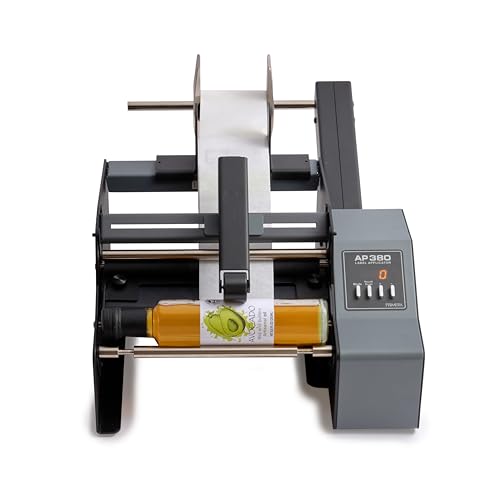
The AP380 is an adjustable semi-automatic applicator that places one or two labels on a cylindrical container at up to 1500 containers per hour. Two-label placement matters for products with a front and back label, such as sauces or candles, and it avoids running each bottle through twice. Quick setup and adjustment mean you can switch between container sizes without a long changeover.

The tradeoff is cost and bench space. It is an electric machine that needs power and a place on a table, and it is overkill for a handful of bottles. Compared with the Primera AP360, it adds the two-label option and a higher rated speed, and against the Hanchen it comes from a company with a longer track record in label equipment.

Ownership is mostly about label roll quality. Labels must be wound on the correct core and with the right orientation, because a wrongly wound roll will not feed. Clean the roller and sensor of adhesive buildup and keep spare belts or rollers if you run daily. A small business that outgrows hand application will usually feel the pain at the point where labeling eats an hour of every production day, and that is when this machine pays for itself.

What works

  • Applies one or two labels per container
  • Up to 1500 containers per hour
  • Quick setup for changing container sizes
  • Semi-automatic placement stays consistent

Watch out for

  • Electric unit needs power and bench space
  • Overkill for low volumes
  • Labels must be on the right core and orientation

Spec sheet

Throughput
Up to 1500 per hour
Labels per container
One or two
Type
Semi-automatic
Containers
Cylindrical
Setup
Quick adjustable
02
Primera AP360 label applicator for cylindrical containers
5.3 in per second1200 per hourOne labelEasy setup
Check price on Amazon
Best for: Makers applying a single wrap label to jars and tubes.

The AP360 applies labels at 5.3 inches per second, which the maker rates for up to 1200 containers per hour. It places one label accurately on a cylindrical container, so it suits single-label products such as jars and tubes. Setup is quick and operation is simple, which makes it a gentle first step into electric applicators.

The tradeoff is the single label. If your product needs a front and back label, you run it twice or step up to the AP380. Against the Primera AP362, it is a similar class with a slightly different feature set, so check which fits your container shape.

Ownership is simple: keep the sensor and roller clean, store the machine covered and use quality labels. Poorly cut labels with ragged edges cause misfeeds, and a roll wound the wrong way will not work at all. Ask your label printer or converter for rolls wound with the label face out or in as the applicator requires, and write the orientation on the box so reorders match.

What works

  • Labels applied at 135 mm per second
  • Up to 1200 containers per hour
  • Accurate placement of one label
  • Quick setup and easy operation

Watch out for

  • Single label only, no front and back mode
  • Needs power and bench space
  • Misfeeds with poorly cut label rolls

Spec sheet

Label speed
5.3 in (135 mm) per second
Throughput
Up to 1200 per hour
Labels per container
One
Containers
Cylindrical
Type
Semi-automatic
03
Primera AP362 semi-automatic cylindrical label applicator
Semi-automatic1200 per hourBottles, cans, jarsTubes
Check price on Amazon
Best for: Small businesses labeling mixed cylindrical containers.

The AP362 is a semi-automatic applicator for cylindrical containers, and the maker lists bottles, cans, jars and tubes as suitable, at up to 1200 containers per hour. Quick setup and easy operation are its selling points. For a small business that labels a mix of container shapes, that breadth is useful.

The tradeoff is that it overlaps heavily with the AP360 and AP380, so the choice comes down to features. It is a single-label machine in the data, and the AP380 adds two labels. For a maker with one product and one label, the AP362 is enough.

Ownership centers on label rolls and cleaning. Keep the sensor free of adhesive, use labels with clean die-cut edges and store spare rollers. As with any applicator, the first batch will teach you the exact label orientation needed. Mark the correct container position on the table with tape so every operator loads the same way, and keep a few scrap bottles aside for the first run of each shift.

What works

  • Handles bottles, cans, jars and tubes
  • Up to 1200 containers per hour
  • Quick setup for changeovers
  • Semi-automatic for consistent placement

Watch out for

  • Overlaps with the AP360 in features
  • Single label placement
  • Needs power and bench space

Spec sheet

Type
Semi-automatic
Throughput
Up to 1200 per hour
Containers
Bottles, cans, jars, tubes
Setup
Quick
Operation
Easy
04
Hanchen semi-automatic round bottle labeling machine, aluminum body
Optical eye sensorAluminum alloy body0.6 to 4.7 inSemi-automatic
Check price on Amazon
Best for: Small makers moving from manual to electric labeling on a budget.

The Hanchen applicator is a semi-automatic round bottle labeler with a pure aluminum alloy body and a sensitive optical eye that detects the label automatically. It handles container diameters from about 0.6 to 4.7 inches, so small vials and large jars both fit. The maker says its output is much larger than a manual labeler's.

The tradeoff is brand support. Documentation and parts supply are thinner than for a long-established maker like Primera, so check spare parts before buying. Against the Primera AP360, it is a lower-cost route into electric labeling with a similar concept.

Ownership is about alignment and sensor care. Keep the optical eye clean, and run a short test strip before a full batch. A solid aluminum body resists wear, but the rubber drive parts are consumables. Order a spare drive roller with the machine rather than after it wears, because shipping delays on a niche part can idle a production day.

What works

  • Optical eye detects labels automatically
  • Aluminum alloy body is solid
  • Wide 0.6 to 4.7 inch diameter range
  • Far faster than a manual roller

Watch out for

  • Thinner support and parts supply
  • Rubber drive parts wear
  • Needs power and a stable bench

Spec sheet

Container diameter
About 0.6 to 4.7 in
Sensor
Automatic optical eye
Body
Pure aluminum alloy
Type
Semi-automatic
Use
Round bottles
05
VEVOR manual round labeling machine, 15-20 pcs per minute
15-20 per minute0.78 to 4.72 inPress barRubber roller
Check price on Amazon
Best for: Craft makers labeling bottles in small batches without power.

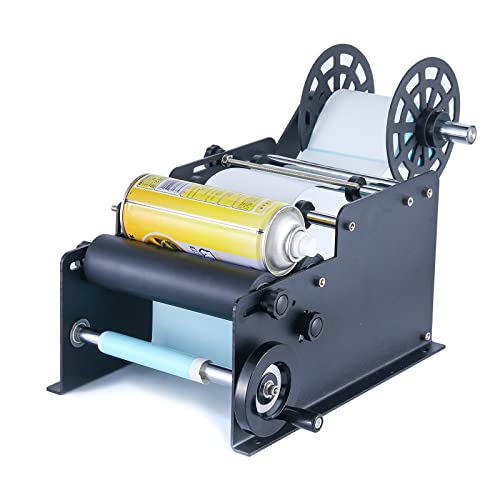
The VEVOR manual labeler rolls the bottle across a label with a round bottle press bar and a rubber roller to push out bubbles. It is rated for 15 to 20 containers per minute, which is a decent pace for a person, and it adjusts for diameters from about 0.78 to 4.72 inches. There is no motor, so it needs no power and sits on any bench.

The tradeoff is that the operator sets quality. Straightness depends on how steadily you roll the bottle, and the pace is limited by your hands. Against the Hanchen, it costs less and never needs power, but it cannot match the electric machine's consistency over a long run.

Ownership is minimal. Wipe the rubber roller to remove adhesive, keep the bar clean and store it dry. It works best with pre-cut labels that peel easily. Slow, even rolling with the bottle seated square against the guide gives the straightest result, and most people find their rhythm after the first twenty bottles.

What works

  • No power needed, sits on any bench
  • 15 to 20 containers per minute by hand
  • Wide diameter range of 0.78 to 4.72 inches
  • Press bar and roller reduce bubbles

Watch out for

  • Straightness depends on the operator
  • Pace is limited by the person
  • Not suited to large production runs

Spec sheet

Speed
15 to 20 per minute
Diameter
0.78 to 4.72 in
Features
Press bar and rubber roller
Operation
Manual
Use
Round bottles
06
Sumeve manual round bottle label applicator, 0.6 to 4 in
0.6 to 4 in bottlesLengthened bodyManualGlass, cans, plastic
Check price on Amazon
Best for: Sellers with several label sizes on round bottles.

The Sumeve is a purely manual round bottle applicator with a lengthened body designed to handle more label sizes. It suits glass bottles, cans and plastic bottles from about 0.6 to 4 inches in diameter. For a seller with different labels across several products, the longer body gives more flexibility than a short unit.

The tradeoff is that it is not meant for conical or square containers, and like any manual machine it relies on operator skill. Compared with the VEVOR, it has a similar concept with a longer reach, and it shares the same pace limits.

Ownership requires checking the label roll inner diameter, because the machine lists a requirement. Keep the roller clean, store it flat and use quality die-cut labels so they peel cleanly. Because it has few moving parts, it is also the easiest to repair or replace, which matters for a seller who only labels in seasonal bursts.

What works

  • Lengthened body suits more label sizes
  • Works on glass, cans and plastic
  • No power needed
  • Simple mechanism with few wear parts

Watch out for

  • Not for conical or square containers
  • Pace depends on the operator
  • Label roll core size must match

Spec sheet

Bottle diameter
0.6 to 4 in
Body
Lengthened for more label sizes
Operation
Purely manual
Containers
Glass, cans, plastic
Label roll
Inner diameter requirement

Spec sheet decoder

What the numbers on the box really mean

The specs manufacturers lead with, translated into what they tell you about real-world performance.

Containers per hour

A rated throughput for ideal conditions. Real rates depend on loading speed.

Watch forThe AP380 lists up to 1500 per hour and the AP360 up to 1200.

Semi-automatic

A machine that applies the label but needs the operator to load each container.

Watch forThe Primera and Hanchen units are semi-automatic.

Optical eye

A sensor that detects the label edge or gap. It sets placement accuracy.

Watch forThe Hanchen uses an automatic optical eye.

Label core size

The inner diameter of the roll the machine accepts. A mismatch prevents loading.

Watch forThe Sumeve lists an inner diameter requirement.

Press bar and roller

Parts that press the label flat on a rolled bottle. They remove bubbles.

Watch forThe VEVOR includes both.

Methodology

How We Evaluated These Label Printer Applicators

Throughput

We compared rated speeds and typical operator limits. The Primera units rate 1200 to 1500 per hour, while manual machines rate 15 to 20 per minute. We treated ratings as ceilings.

Container range

We checked diameter ranges and shapes. The Hanchen and VEVOR cover wide ranges, while the Sumeve is slightly narrower. All are cylindrical-only.

Placement quality

We looked at sensors and mechanisms that keep labels straight. Electric units with sensors scored higher than manual rolling. Operator skill was noted for manual machines.

Setup and changeover

We weighed how quickly a unit adjusts between container sizes. The Primera machines list quick setup. Manual machines need less setup but more skill.

Cost and support

We compared price tiers against support and parts supply. Primera scored well on support, while budget brands scored higher on price. We marked down machines with thin documentation.

Decision guide

How to Choose the Right Label Printer Applicators

By Weekly Volume

SituationPickWhy
A few dozen a weekVEVOR manual labeler15 to 20 per minute by hand
Several label sizes, light volumeSumeve manual applicatorLengthened body
Hundreds a weekHanchen semi-automaticOptical eye placement
Single wrap label, steady linePrimera AP360Up to 1200 per hour
Mixed cylindrical containersPrimera AP362Bottles, cans, jars, tubes
Front and back labelsPrimera AP380One or two labels

By Budget

Budget tierPickWhy
Lowest costSumeve manual applicatorSimple mechanism
LowVEVOR manual labelerPress bar and roller
MidHanchen semi-automaticLower-cost electric
Upper midPrimera AP360Established electric unit
UpperPrimera AP362Mixed container range
HighestPrimera AP380Two-label mode

Manual vs Semi-Automatic

Manual rollers

The VEVOR and Sumeve need no power and cost little. Straightness depends on your hands, and the pace tops out near 15 to 20 per minute for a short time.

Semi-automatic units

The Primera AP360, AP362 and AP380 and the Hanchen place labels consistently and fast. They need power, a bench and clean label rolls.

Choose manual under a few hundred containers a week and electric above that.

One Label vs Two Labels

PreferencePickWhy
Front and back in one passPrimera AP380One or two labels
Single wrap labelPrimera AP360Accurate single placement
Single label, many shapesPrimera AP362Cylindrical containers
Budget single labelHanchen semi-automaticOptical eye
Manual single labelVEVOR manual labelerPress bar

For Craft Bottles Specifically

Look for

A diameter range that covers your bottles, a roll core that matches your printed labels and a way to keep labels straight. A test strip before each run saves labels.

In this comparison

The VEVOR manual labeler suits small batches of craft bottles, and the Hanchen fits a growing shop that needs consistency.

When to Spend More

Spend more if

You label hundreds of containers a week or need front and back labels. The Primera AP380 and AP360 justify their cost in time saved.

Save if

You label a few dozen a week. A manual VEVOR or Sumeve does the job without power.

Ownership

Maintenance schedule

The upkeep that decides whether this machine lasts two seasons or ten.

TaskIntervalWhy it matters
Clean the sensorEvery sessionAdhesive and dust cause skipped or doubled labels. Wipe it with isopropyl alcohol and a lint-free cloth.
Wipe the rollersWeeklyAdhesive buildup makes labels stick to the roller. Clean with alcohol and let it dry.
Check the label rollEvery rollWrong core size or winding direction prevents feeding. Verify before loading.
Inspect drive partsMonthlyRubber rollers and belts wear and slip. Replace them before they cause misfeeds.
Store coveredAfter each runDust on the sensor and rollers causes misalignment. Cover the machine and keep rolls sealed.

FAQ

Frequently Asked Questions

Do I need an applicator if I already have a label printer?

Only if you label many containers. A printer makes the label, while an applicator places it. For a few dozen bottles, hand application is fine.

How much should I budget for an applicator?

Manual units cost little, electric units cost more, and the Primera machines cost the most. Include label rolls and spare rollers. Count weekly volume to decide.

How long do applicators last?

Metal-bodied units like the Hanchen last for years with care. Rubber rollers and belts are consumables. The Primera line has a long service record.

Can they label square or tapered bottles?

Most here are for cylindrical containers only. Tapered bottles need a conical machine. Measure your bottle and check the diameter range.

Why are my labels crooked?

Common causes are a dirty sensor, a wrongly wound roll or inconsistent loading. Clean the sensor, check the roll direction and run a test strip.

Can a manual machine keep up with a market stall?

For batches of a few dozen, yes, at about 15 to 20 per minute. Beyond that, fatigue and straightness drop, and an electric unit helps.

Bottom line

The short version

Browse more label printer applicatorson Amazon →
James Miller, Lead Machine Editor

About the author

James Miller

Lead Machine Editor, MachineFanatic

James Miller leads MachineFanatic's buying guides, turning spec sheets, manuals and owner feedback into clear verdicts on power tools, outdoor power equipment, shop machines and kitchen machines.

More from James →