
Amazon affiliate links - we earn a commission.Affiliate disclosure

Buying guide · 13 min read · Updated 2026-11-07

Best Large Format 3D Printers (2026)

Six large build volume FDM printers compared on bed size, heated chamber, speed and multi-material support, from QIDI and Creality to Prusa and Anycubic.

James MillerBy James MillerLead Machine Editor6 machines comparedSpec-sheet verified
Best Large Format 3D Printers

At a glance

Our top picks

Side by side

Spec comparison

Large format printers earn their place when a part will not fit on a standard bed: helmets, armor plates, storage bins, fixtures and enclosures. They also let you batch many small parts in one run, which can be a better use of time than printing in series.

Bigger is not free. A large gantry is heavier, a large bed takes longer to heat, and any warp or bed flatness issue is magnified across the plate. This guide looks at those realities before it looks at the headline volume.

Before you buy

6 Criteria to Look For Before Buying a Large Format 3D Printer

  1. 01

    Build volume versus real use

    The Kobra 3 Max V2 offers 420 x 420 x 500 mm, the Ender 5 Max 400 mm cubed and the QIDI Max4 390 x 390 x 340 mm. Check which axis matters for your parts, because a tall cosplay piece needs Z height while a flat tray needs X and Y. Remember that skirts and brims eat edge space, so the usable area is smaller than the spec.

  2. 02

    Heated chamber for engineering filaments

    Large ABS and ASA parts warp because the outer layers cool faster than the core. The QIDI Max4's chamber up to 65 C reduces that gradient, while open machines like the Kobra 3 Max V2 depend on drafts staying away. If you print only PLA and PETG, a chamber is optional and can even overheat PLA in a closed enclosure.

  3. 03

    Bed flatness and leveling

    A large plate is harder to keep flat than a small one, and a 0.2 mm variation can ruin a first layer. Machines with automatic leveling help, but they cannot fix a warped plate. Check how the machine probes the bed and how often you will need to rerun it, especially after moving the printer.

  4. 04

    Motion system and speed

    CoreXY machines like the Sovol SV08 Max and Ender 5 Max keep the moving mass low, which lets them reach 700 mm/s on paper. Real speed depends on acceleration, cooling and hotend flow, so a big print will rarely sustain the headline figure. Judge speed by how well the printer holds quality on large parts.

  5. 05

    Multi-material approach

    The Creality K2 Plus uses a CFS system to swap spools, the Prusa XL uses two toolheads and the Kobra 3 Max V2 can add an ACE 2 Pro. Spool-swapping systems waste purge filament, while toolheads are cleaner but more complex. Decide whether you want colors or true multi-material before buying.

  6. 06

    Space, power and filament cost

    A large printer needs a sturdy table and room for the enclosure to open. Big prints can use a kilogram of filament in a single job, so running cost scales with volume. Add up a typical week of printing before choosing a machine that tempts you to print big all the time.

Detailed reviews

The 6 best large format 3d printers, explained

01
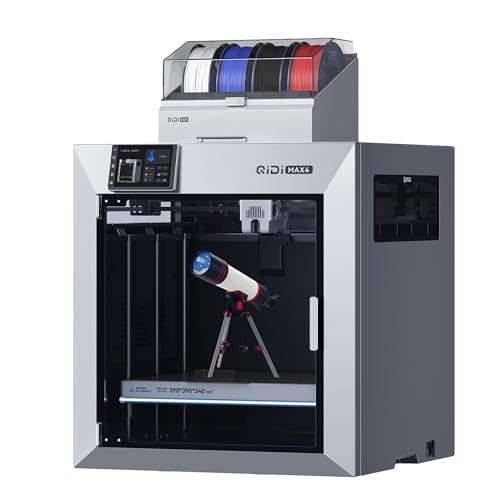
QIDI Max4 Combo 390x390x340 Heated Chamber Printer
390x390x340 mm65C chamber370C nozzleClosed-loop X/Y
Check price on Amazon
Best for: Makers printing large ABS, ASA or nylon parts that must stay flat.

The Max4 is an enclosed large-format machine, and the enclosure is not decoration. A heated chamber up to 65 C keeps the air around a big part warm, which slows the cooling gradient that makes ABS, ASA and nylon curl away from the plate. Combined with a 370 C nozzle, it can handle engineering filaments that open-frame machines struggle to print flat at this size.

Its 390 x 390 x 340 mm volume is about 55% larger than the model it replaces, according to the maker. Closed-loop motors on the X and Y axes let the machine detect missed steps and correct them, a useful safety net when the toolhead is whipping a heavy gantry across a wide plate. Against the Anycubic Kobra 3 Max V2, the QIDI gives up some height but adds the heated chamber and a higher nozzle ceiling.

Ownership is more involved than with a simple open printer. Chamber heating takes time, filters and vents need cleaning, and a big enclosed volume stores heat that can soften PLA if you print it with the door shut. Leave the lid cracked for PLA, and plan on a clean plate wash before every long run.

What works

  • Heated chamber up to 65 C reduces warping on big parts
  • 370 C nozzle opens the door to engineering filaments
  • Closed-loop X and Y motors catch missed steps
  • Large 390 x 390 x 340 mm build volume

Watch out for

  • Enclosure complicates PLA printing without venting
  • Heavier and bulkier than open-frame machines
  • Chamber warm-up adds time before each print

Spec sheet

Build volume
390 x 390 x 340 mm
Heated chamber
Up to 65 C
Max nozzle temp
370 C
Motors
Closed-loop on X and Y
Volume gain
55% larger than predecessor
02
Anycubic Kobra 3 Max V2 420x420x500 Large Printer
420x420x500 mmFull-metal hotendACE 2 Pro optionOpen frame
Check price on Amazon
Best for: Makers who want the most volume for PLA and PETG prints.

The Kobra 3 Max V2 has the largest volume in this group at 420 x 420 x 500 mm, and that tall Z height is what makes it attractive for cosplay pieces and vertical prints. It uses a full-metal hotend, which tolerates higher temperatures than PTFE-lined designs, and it can accept an Anycubic ACE 2 Pro to print in four colors, with two units linked for more.

The open frame is the trade-off. Without an enclosure, tall prints sway slightly as they grow, and drafts across a large bed can lift corners on ABS. Compared with the QIDI Max4, it has more raw volume but no heated chamber, so it is best used with PLA and PETG, where open-air printing is forgiving. For those materials, it is a lot of capacity for the money.

Plan on a sturdy table and a good level of tuning. A tall machine amplifies any frame twist, and a large bed can have slight warp. Run the leveling routine often, keep belts and rails clean, and print the biggest parts in a quiet corner where nobody bumps the table.

What works

  • Largest build volume in the group at 420 x 420 x 500 mm
  • Full-metal hotend handles higher temperature filaments
  • Optional ACE 2 Pro adds four-color printing
  • Tall Z height suits vertical cosplay and props

Watch out for

  • Open frame is less suited to ABS and ASA
  • Tall gantry can wobble on tall prints
  • Needs a large, stable table

Spec sheet

Build volume
420 x 420 x 500 mm
Hotend
Full-metal
Multi-color
ACE 2 Pro, up to 2 units
Colors
4-color with one ACE 2 Pro
Frame
Open frame
03
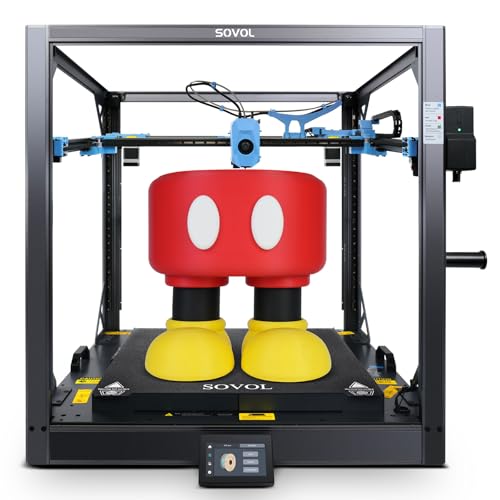
Sovol SV08 MAX CoreXY 3D Printer
CoreXYVoron 2.4 based700 mm/sLarge bed
Check price on Amazon
Best for: Tinkerers who want Voron-style CoreXY performance at large size.

The SV08 Max follows the Voron 2.4 pattern, a CoreXY design where the toolhead moves in X and Y on belts while the bed moves in Z. CoreXY keeps moving mass low, which is how it can claim speeds up to 700 mm/s, and the maker pitches it as shaving print time on big parts. That lineage matters because Voron-style machines have a strong tuning community.

It differs from the QIDI Max4 in philosophy. The QIDI is a ready, closed-loop enclosed printer for engineering materials, while the Sovol is a performance-oriented machine for people who like to tune. Against the Creality Ender 5 Max, which also quotes 700 mm/s, the Sovol leans on its Voron heritage, though you should treat the speed as a ceiling rather than a sustained rate.

Ownership rewards patience. A CoreXY with a big bed benefits from belt tensioning, frame squaring and good input shaping. Keep the Z leadscrews or rails lubricated, and expect to learn about tuning if you want the fastest quality prints.

What works

  • Voron 2.4 based CoreXY with a tuning community
  • Quoted 700 mm/s speed for shorter prints
  • Low moving mass keeps the gantry responsive
  • Large build volume for big batches

Watch out for

  • Rewards tuning rather than plug-and-play use
  • Top speed is a ceiling on big, detailed parts
  • Less polished software than the leading ecosystems

Spec sheet

Kinematics
CoreXY
Design lineage
Voron 2.4 based
Top speed
700 mm/s
Print time claim
Shorter times on large parts
Category
Large-format CoreXY
04
Creality K2 Plus Combo Multi-Color 3D Printer
CFS multi-color600 mm/sEnclosedLarge volume
Check price on Amazon
Best for: Buyers who want large multi-color prints with minimal manual swaps.

The K2 Plus is Creality's flagship large machine, sold as a combo with the CFS multi-color filament system. It is enclosed, targets 600 mm/s top speeds and is described by the maker as larger than the K2 and K2 Pro. The CFS lets you load several spools and swap automatically, so big multi-color prints do not need constant intervention.

Its selling point against the Anycubic Kobra 3 Max V2 is the finished experience: enclosed frame, automatic features and a dedicated filament system rather than an optional add-on. It is smaller than the Kobra in raw volume but better contained for materials that dislike drafts. Compared with the QIDI Max4, both are enclosed, but the Creality leans toward multi-color workflow.

In year three, watch the multi-color system. Purge waste and filament path care matter, and multi-color prints use more material than single-color ones. Keep the chamber vents clear and wipe the plate regularly.

What works

  • CFS system swaps filaments automatically
  • Enclosed frame for more stable large prints
  • 600 mm/s top speed for faster large parts
  • Fully automatic workflow reduces fiddling

Watch out for

  • Multi-color printing wastes purge filament
  • Smaller raw volume than the Kobra 3 Max V2
  • More complex filament path to maintain

Spec sheet

Multi-color
New CFS system
Top speed
600 mm/s
Size note
Larger than K2 and K2 Pro
Automation
Fully automatic operation
Package
Combo with filament system
05
Creality Ender 5 Max 400x400x400 CoreXY Printer
400x400x400 mmCoreXY700 mm/sHigh-torque motors
Check price on Amazon
Best for: Makers who want a 400 mm cube on a mainstream platform.

The Ender 5 Max offers a true cube at 400 x 400 x 400 mm, which suits both tall objects and wide batch runs. It uses a CoreXY structure and high-torque motors, with a quoted top speed of 700 mm/s. The maker pitches it for people who want to make bigger models or print multiple parts at once.

In the group, it sits between the open Kobra and the enclosed QIDI. The CoreXY layout keeps the moving head light for a machine of this size, but without a full chamber it is best suited to PLA and PETG. Against the Sovol SV08 Max, it is a more conventional product from a larger manufacturer, with wider parts availability.

Ownership is typical Creality: simple to assemble, easy to find parts and community support, and a steady need for belt and bed care. Keep the build plate clean, tighten belts when ringing appears, and plan for a bigger filament budget since large prints consume spools quickly.

What works

  • True 400 mm cube build volume
  • CoreXY keeps the toolhead light
  • Widely available parts and community support
  • 700 mm/s top speed for faster batches

Watch out for

  • No heated chamber for ABS or ASA
  • Less polished than premium enclosed machines
  • Large prints consume filament quickly

Spec sheet

Build volume
400 x 400 x 400 mm
Kinematics
CoreXY
Top speed
700 mm/s
Strength
Batch and oversize printing
Maker
Creality
06
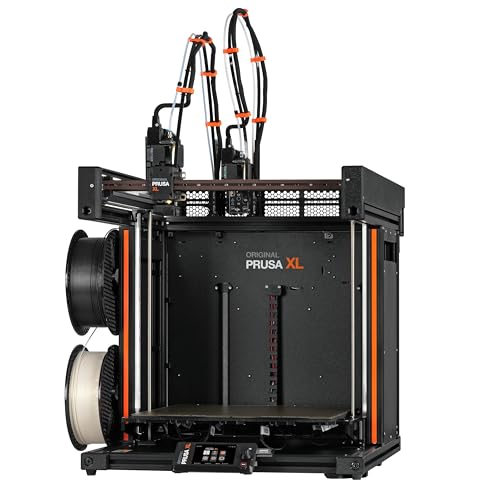
Original Prusa XL 2-Toolhead CoreXY Printer
2 toolheadsCoreXYMulti-materialLarge-format
Check price on Amazon
Best for: Studios and engineers who need dependable multi-material parts.

The Prusa XL is built for teams and studios that need reliable multi-material prints. Two toolheads let it switch between materials without a purge-heavy swap, and the maker emphasizes soluble supports and functional prototypes. It uses a CoreXY design in a large-format footprint.

It is the most professional option here and also the most considered. Where the Creality K2 Plus uses a filament system to switch spools, the Prusa uses separate toolheads, which is cleaner for tricky material pairs. Against the QIDI Max4, it trades heated-chamber printing for multi-material capability. The result is a machine geared toward precise, repeatable prints rather than the raw volume of the Kobra.

Expect a longer setup and steeper learning curve than the consumer machines. In return you get strong documentation, an active community and spare parts through the maker. Keep the toolheads maintained and clean, and plan for a dedicated workspace.

What works

  • Two toolheads enable clean multi-material printing
  • Soluble supports suit complex functional parts
  • CoreXY design in a large footprint
  • Strong documentation and parts support

Watch out for

  • Higher complexity than consumer machines
  • Larger and heavier than typical home printers
  • Longer setup and learning curve

Spec sheet

Toolheads
Two
Kinematics
CoreXY
Strength
Multi-material and soluble supports
Audience
Engineering teams, studios
Maker
Prusa Research

Spec sheet decoder

What the numbers on the box really mean

The specs manufacturers lead with, translated into what they tell you about real-world performance.

Build volume (mm)

The maximum X, Y and Z size of a print. The Kobra 3 Max V2 lists 420 x 420 x 500 mm.

Watch forUsable space is smaller once brims, skirts and purge lines are added.

Heated chamber

An actively warmed enclosure slows cooling on large parts. The QIDI Max4 reaches 65 C.

Watch forA hot chamber can soften PLA, so open the lid for low-temperature filaments.

CoreXY

A belt layout where two motors move the toolhead in X and Y while the bed moves in Z, keeping moving mass low.

Watch forBelt tension and frame squareness matter more on large CoreXY printers.

700 mm/s top speed

The fastest travel the printer can reach, quoted by Sovol and Creality for their large CoreXY machines.

Watch forAcceleration and hotend flow limit sustained print speed well below that number.

Closed-loop motors

Motors with encoders that detect missed steps and correct them, as on the QIDI Max4 X and Y axes.

Watch forThey improve reliability but do not replace proper belt tension.

Methodology

How We Evaluated These Large Format 3D Printers

Usable volume

We evaluated build volume on all three axes, comparing the Kobra 3 Max V2's 420 x 420 x 500 mm with the QIDI Max4's 390 x 390 x 340 mm and the Ender 5 Max's 400 mm cube. Raw volume was weighed against enclosure and rigidity.

Material range

We checked which filaments each machine can handle. The QIDI Max4's heated chamber and 370 C nozzle support engineering filaments, while the open-frame Kobra and Ender suit PLA and PETG.

Multi-color capability

We compared the Creality K2 Plus CFS, the Prusa XL's two toolheads and the Kobra's optional ACE 2 Pro. Waste, complexity and reliability were considered.

Motion and speed

We looked at CoreXY machines such as the Sovol SV08 Max and Ender 5 Max against the Kobra. Quoted speeds were treated as ceilings, not sustained performance.

Ownership burden

Based on owner feedback patterns, big machines need more bed care, belt tuning and bench space. We favored makers with good documentation and parts access.

Decision guide

How to Choose the Right Large Format 3D Printers

By Material

SituationPickWhy
Large ABS, ASA or nylon partsQIDI Max4Heated chamber and 370 C nozzle
PLA and PETG propsAnycubic Kobra 3 Max V2Tall 500 mm Z height at open-frame simplicity
Soluble supports and multi-materialPrusa XLTwo toolheads switch cleanly

By Budget

Budget tierPickWhy
Lowest outlay for volumeAnycubic Kobra 3 Max V2Biggest volume per unit of spend
Middle groundCreality Ender 5 Max400 mm cube on a mainstream platform
Highest outlayPrusa XLProfessional multi-material and support

Enclosed vs Open Frame

Enclosed

The QIDI Max4 and Creality K2 Plus hold heat and block drafts, which helps large ABS prints and keeps noise down. The cost is venting needs for PLA and less access.

Open frame

The Kobra 3 Max V2 and Ender 5 Max are easier to reach and cheaper per cubic inch. They suit PLA and PETG, but large flat parts in ABS will warp.

Choose enclosed for engineering filaments; choose open for PLA volume.

Single Color vs Multi-Color

PreferencePickWhy
Simple single-color batchesSovol SV08 MAXCoreXY speed without a filament changer
Automatic multi-colorCreality K2 PlusCFS handles spool changes
Optional add-on colorsAnycubic Kobra 3 Max V2ACE 2 Pro can be added later

For Oversized Props Specifically

Look for

Height of at least 400 mm, a rigid frame and reliable bed leveling. Segment parts when they exceed the plate and plan for joints.

In this comparison

The Kobra 3 Max V2's 500 mm height and the Ender 5 Max's 400 mm cube are the best fits, while the QIDI Max4 suits flat, warp-prone engineering parts.

When to Spend More

Spend more if

Your parts must hold dimension or you print for a business. The QIDI Max4 and Prusa XL justify the cost through chamber control and multi-material support.

Save if

You print PLA props for fun. The Kobra 3 Max V2 and Ender 5 Max give huge volume for less.

Ownership

Maintenance schedule

The upkeep that decides whether this machine lasts two seasons or ten.

TaskIntervalWhy it matters
Clean the build plateBefore long printsFinger oils cause first-layer failures. Wash with soap or isopropyl alcohol.
Check belt tensionEvery few monthsLoose belts cause ringing on fast prints. Tighten evenly on both sides.
Lubricate rails and leadscrewsEvery 3 to 6 monthsDry rails add noise and wear. A light machine oil keeps motion smooth.
Replace the nozzleAs neededAbrasive filaments wear brass nozzles. Swap when extrusion becomes inconsistent.
Clean chamber vents and filtersQuarterly, enclosed modelsDust blocks airflow and reduces temperature control.

FAQ

Frequently Asked Questions

Do I need an enclosed large printer?

Only for ABS, ASA and nylon. The QIDI Max4 and K2 Plus handle those well, while open frames like the Kobra 3 Max V2 are fine for PLA and PETG.

Is a bigger printer slower?

A larger bed takes longer to heat and big prints take longer overall. CoreXY machines like the Ender 5 Max reduce that by keeping moving mass low.

How much filament does large printing use?

A large part can use hundreds of grams to a kilogram in one run. Budget for spools as part of ownership cost.

Is 700 mm/s real?

It is a top travel speed. Acceleration, cooling and hotend flow limit sustained speed, so expect much lower averages on large detailed prints.

Can I print multi-color on a large machine?

Yes. The K2 Plus has CFS, the Prusa XL has two toolheads and the Kobra 3 Max V2 accepts an ACE 2 Pro.

Where should a large printer sit?

On a sturdy table with room around it. Vibration and drafts affect large prints more than small ones.

Bottom line

The short version

Browse more large format 3d printerson Amazon →
James Miller, Lead Machine Editor

About the author

James Miller

Lead Machine Editor, MachineFanatic

James Miller leads MachineFanatic's buying guides, turning spec sheets, manuals and owner feedback into clear verdicts on power tools, outdoor power equipment, shop machines and kitchen machines.

More from James →

Keep reading

Related guides