
Amazon affiliate links - we earn a commission.Affiliate disclosure

Buying guide · 14 min read · Updated 2026-11-07

Best Large Resin 3D Printers (2026)

Large resin printers print oversized figures and batches of parts in one go. Four big-vat machines compared on volume, heated vats, release systems and upkeep.

James MillerBy James MillerLead Machine Editor4 machines comparedSpec-sheet verified
Best Large Resin 3D Printers

At a glance

Our top picks

Side by side

Spec comparison

MachineBuild volumeScreenPixel sizeLeveling
Anycubic Photon P1 Max, 18.3L, 12K screen, heated vatBest OverallAnycubic Photon P1 Max, 18.3L, 12K screen, heated vat285.5 x 214 x 300 mm14 inch 12K, 11520 x 864024.8 micron squareAutomatic
Elegoo Saturn 4 Ultra 16K, 10 inch screen, tank heatingBest ValueElegoo Saturn 4 Ultra 16K, 10 inch screen, tank heatingn/a10 inch 16K mono LCDn/aSmart automatic
Anycubic Photon Mono M7 Max, 298 x 164 x 300 mm, 7KBest Large-Volume Mid-RangeAnycubic Photon Mono M7 Max, 298 x 164 x 300 mm, 7K298 x 164 x 300 mm13.6 inch 7K, 6480 x 360046 micronn/a
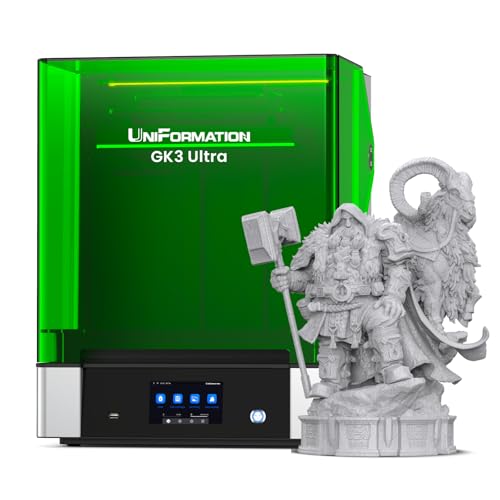
UniFormation GK3 Ultra, 300 x 160 x 300 mm, 16K, resin heatingBest for Cold RoomsUniFormation GK3 Ultra, 300 x 160 x 300 mm, 16K, resin heating300 x 160 x 300 mmn/an/an/a

A large resin printer hardens liquid photopolymer with a masked ultraviolet screen, one layer at a time. Its appeal is surface detail, and the large versions add oversized figures, helmets and batches of dozens of small parts on one plate.

Size changes the physics. A big flat layer creates strong suction against the vat film, resin volume rises, and a failed print wastes real money. Release technology, vat heating and a wide tolerance for orientation matter far more than the pixel count on the box.

Before you buy

6 Criteria to Look For Before Buying a Large Resin 3D Printer

  1. 01

    Build volume and plate shape

    Volume numbers hide shape, since a 300 mm tall plate that is 160 mm deep fits a tall figure but not a wide one. The Anycubic P1 Max offers 285.5 by 214 by 300 millimeters, while the Photon Mono M7 Max offers 298 by 164 by 300. Compare the footprint to your largest planned part and remember that models are usually tilted, which uses more height. Tilting reduces suction because each layer is smaller, but a tilted model needs more supports and a taller plate. A buyer who prints standing helmets should add a few centimeters of margin to every dimension.

  2. 02

    Pixel size and screen resolution

    Pixel size sets the finest detail you can print. The P1 Max lists about 24.8 microns and the M7 Max about 46 microns, which is why miniature work favors the sharper machine. On a large plate, a coarser pixel keeps costs down and rarely matters for props.

  3. 03

    Vat heating

    Resin thickens in the cold, which raises the pull on the film and slows flow back under the plate. A vat heater, as on the P1 Max at up to 35 degrees and the Saturn 4 Ultra at about 30, makes prints more reliable. If you work in a cool garage, treat heating as essential.

  4. 04

    Release technology

    On a big flat layer, peel force can crack supports or tear a print loose. Machines now use tilting or flexing vats and light compensation to reduce force. Anycubic claims its Wave Release on the Photon P1 cuts release force by 60 percent, and the M7 Max uses Intelligent Release 2.0.

  5. 05

    Failure detection and monitoring

    A failed large print can foul the vat and ruin a bottle of resin. An AI camera, as on the Saturn 4 Ultra, can warn you early. Cheap insurance is worth the cost on a machine that you leave running overnight. Without a camera, you will only see the problem when you open the lid in the morning to a plate stuck to the film. Place the printer where you can hear and see it, and always check the first few layers by hand.

  6. 06

    Resin handling and safety

    Liquid resin irritates skin and its fumes need ventilation, so wear nitrile gloves and use a respirator in a closed room. Wash in isopropyl alcohol and cure under UV, and dispose of waste resin by curing it first. A flip-up lid and an easy-reach vat make these chores less messy.

Detailed reviews

The 4 best large resin 3d printers, explained

01
Anycubic Photon P1 Max, 18.3L, 12K screen, heated vat
285x214x300 mm12K 14 inch screenHeated vat to 35CAuto leveling
Check price on Amazon
Best for: Makers who want oversized prints or full plates of parts with strong detail and fewer failures.

The Photon P1 Max is a large-format resin machine with an 18.3 liter build envelope of 285.5 by 214 by 300 millimeters. Its 14 inch 12K screen packs 11520 by 8640 pixels at about 24.8 micron square pixels, which keeps detail sharp across a wide plate. A thermal-controlled vat holds resin near 35 degrees, which matters because cold resin thickens and increases suction on every layer.

Heating and release technology are the reasons to pay for a machine this size. A large flat cross-section pulls hard on the vat film as the plate lifts, and a warm vat thins resin so it flows back faster and peels more gently. Auto leveling removes the old fuss of paper-and-screw leveling that would be painful across a big plate. Against the Photon Mono M7 Max, the P1 Max adds more pixels, a heated vat and a more modern release approach.

Ownership centers on resin and cleanup. A big vat holds a lot of resin, so a spilled vat is expensive, and the screen and film are consumables you will replace. Filter resin between big jobs, wash parts in isopropyl alcohol and cure them under UV, and wear nitrile gloves throughout. Keep the machine in a ventilated space and out of direct sun, because stray ultraviolet light can cure resin in the vat.

What works

  • 285 x 214 x 300 mm build with a 14 inch 12K screen
  • Heated vat to 35C keeps resin flowing
  • 24.8 micron pixels hold detail across a wide plate
  • Automatic leveling saves setup time

Watch out for

  • Large vat makes a spill or failed print expensive
  • Resin handling needs gloves, ventilation and washing
  • Higher cost tier than most mid-size resin printers

Spec sheet

Build volume
285.5 x 214 x 300 mm
Screen
14 inch 12K, 11520 x 8640
Pixel size
24.8 micron square
Vat heating
Thermal-controlled, up to 35C
Leveling
Automatic
02
Elegoo Saturn 4 Ultra 16K, 10 inch screen, tank heating
16K 10 inch screenTank heating to 30CAI cameraFlip-up lid
Check price on Amazon
Best for: Buyers who want very fine detail and failure alerts on a mid-large resin printer.

The Saturn 4 Ultra 16K is the sharpest of the screens in this guide, built for fine detail rather than for the very biggest volume. Its 10 inch 16K mono LCD resolves small features, and an intelligent tank heater keeps the resin at about 30 degrees so layers peel cleanly. A flip-up lid makes it easier to reach the vat, and an AI camera sends alerts for an empty plate or a warped model.

The camera is the standout for a machine that runs long jobs unattended. A resin print that fails halfway, with a model stuck to the film, can ruin the vat, so early alerts pay for themselves. Compared with the Anycubic P1 Max, the Saturn 4 Ultra has a smaller build area and a lower cost tier, which makes it a more economical way into mid-large prints.

In ownership terms, expect the usual resin rhythm. Replace the release film when it clouds or scratches, filter the resin after a failed print and clean the screen with a soft cloth. The 12K sibling in the same range uses the same body at a lower resolution, so choose the 16K model only if fine detail is your priority. Keep gloves and a bottle of isopropyl alcohol near the machine.

What works

  • 10 inch 16K screen resolves very fine detail
  • Smart tank heating at 30C improves resin flow
  • AI camera alerts for warped or missing models
  • Flip-up lid makes the vat easy to reach

Watch out for

  • Smaller build area than the P1 Max and M7 Max
  • Resin handling is messy and needs ventilation
  • 16K detail only shows on small, intricate models

Spec sheet

Screen
10 inch 16K mono LCD
Tank heating
Intelligent heating at 30C
Monitoring
AI camera
Lid
Flip-up
Leveling
Smart automatic
03
Anycubic Photon Mono M7 Max, 298 x 164 x 300 mm, 7K
298x164x300 mm7K 13.6 inch46 micron pixelsTemperature control
Check price on Amazon
Best for: Prop makers and cosplayers who want a tall, wide plate at a middle cost tier and care more about size than the finest surface detail.

The Photon Mono M7 Max gives you a very tall and wide build space of 298 by 164 by 300 millimeters on a 13.6 inch 7K screen. The pixels are about 46 microns, coarser than the P1 Max or Saturn 4 Ultra, which suits large figures and props better than tiny details. Intelligent Release 2.0 and dynamic light-off compensation are the features aimed at reducing peel force and keeping edges crisp.

The compromise is detail at the high end. A 46 micron pixel is visible on smooth curved surfaces and fine text, so a miniatures painter will prefer the Saturn. A prop maker or a cosplay builder will care more about height and width, and the M7 Max delivers both for a lower cost tier than the P1 Max. Temperature control in the listing helps the resin stay consistent in cooler rooms.

Ownership follows the usual resin pattern. Check the film and the vat for cloudiness after large jobs, clean the screen, and keep resin sealed away from light. Because the pixels are bigger, it is also more forgiving of slightly dirty optics. Think of it as a larger-volume workhorse rather than a precision tool.

What works

  • 298 x 164 x 300 mm build for tall props
  • Intelligent Release 2.0 reduces peel force
  • Dynamic light-off compensation sharpens edges
  • Lower cost tier than the P1 Max

Watch out for

  • 46 micron pixels show on fine detail
  • Narrower in depth than the P1 Max
  • Fewer smart features than the Saturn 4 Ultra

Spec sheet

Build volume
298 x 164 x 300 mm
Screen
13.6 inch 7K, 6480 x 3600
Pixel size
46 micron
Release
Intelligent Release 2.0
Temperature
Temperature control
04
UniFormation GK3 Ultra, 300 x 160 x 300 mm, 16K, resin heating
300x160x300 mm16K resolutionAuto resin heatingKK60 module
Check price on Amazon
Best for: Experienced resin users who want large volume with 16K detail and cold-room printing.

The GK3 Ultra is the largest and most expensive printer in this guide, with a build of 300 by 160 by 300 millimeters on a 13.5 inch 16K screen. Its smart heating system lets it print in cold climates, and the listing mentions automatic resin heating and feeding. The integrated KK60 module is described as improving mechanical rigidity and smooth motion on the Z-axis, which matters for a tall, heavy plate.

The pairing of 16K detail with a large screen is rare, since most large machines drop resolution to control cost. That makes the GK3 Ultra attractive to someone who wants big and fine in the same print. The price is the top of the cost scale among these four, and the brand is less established than Anycubic or Elegoo, so parts and support deserve a closer look before you buy.

Expect the same resin chores as every other machine. Automatic feeding reduces the number of times you pour, but you must still filter the vat, wash and cure parts and wear gloves. Check what the warranty covers for the screen, since a large LCD is a pricey replacement. If you print in a garage or cold room, the heating is a real advantage.

What works

  • 300 x 160 x 300 mm build with a 16K screen
  • Smart heating suits cold climates
  • Automatic resin heating and feeding
  • KK60 Z-module aims for stable, rigid motion

Watch out for

  • Top cost tier among these four printers
  • Less established brand and parts network
  • Large LCD is an expensive consumable to replace

Spec sheet

Build volume
300 x 160 x 300 mm
Resolution
16K
Heating
Automatic resin heating and feeding
Z-axis
Integrated KK60 module
Screen size
13.5 inch class

Spec sheet decoder

What the numbers on the box really mean

The specs manufacturers lead with, translated into what they tell you about real-world performance.

Pixel size

The width of one screen pixel at the build plate, in microns. Smaller pixels mean finer detail.

Watch forThe P1 Max lists about 24.8 microns and the M7 Max about 46 microns.

Screen resolution

The total pixel count of the LCD, written as 7K, 12K or 16K. More pixels across a large screen improve detail and smoothness.

Watch forThe Saturn 4 Ultra is 16K, the P1 Max 12K and the M7 Max 7K.

Vat temperature

Heating the resin keeps its viscosity low so each layer flows evenly. Cold resin raises peel force.

Watch forThe P1 Max reaches 35C and the Saturn 4 Ultra heats at 30C.

Build volume

The box the printer can fill, quoted as width, depth and height. Orientation and tilting use more of it than you might expect.

Watch forThe GK3 Ultra lists 300 x 160 x 300 mm.

Release force reduction

Percentage claims describe how much a design cuts peel force compared with a standard film. They are manufacturer figures, not independent measurements.

Watch forAnycubic quotes 60 percent for Wave Release on the Photon P1.

Methodology

How We Evaluated These Large Resin 3D Printers

Volume and usable shape

We compared stated build volumes and their shapes. The P1 Max, M7 Max and GK3 Ultra all offer about 300 mm of height. Depth and width decide how many parts fit.

Detail and screen quality

We looked at resolution and pixel size, from 24.8 microns on the P1 Max to 46 microns on the M7 Max. Detail matters most for figures and less for props.

Reliability features

We weighed heating, release technology and monitoring. The Saturn 4 Ultra's AI camera and the P1 Max's heated vat scored high. Failed large prints cost the most money.

Safety and workflow

We considered lids, vat access and the cleanup workflow. Resin remains hazardous on every machine, so we valued designs that reduce spills.

Value and support

We compared cost tiers and brand support. The GK3 Ultra is the most expensive tier, while the Saturn 4 Ultra costs the least. Established brands scored higher for spares.

Decision guide

How to Choose the Right Large Resin 3D Printers

By Project Type

SituationPickWhy
Tall props and helmetsAnycubic Photon Mono M7 Max298 x 164 x 300 mm
Mixed large parts and detailAnycubic Photon P1 Max285 x 214 x 300 mm and 12K
Fine miniatures in batchesElegoo Saturn 4 Ultra 16K16K screen, camera
Big and fine togetherUniFormation GK3 Ultra16K with 300 mm volume
Cold garage printingUniFormation GK3 UltraSmart resin heating

By Budget

SituationPickWhy
Lowest cost tierElegoo Saturn 4 Ultra 16KMid-large volume, sharp screen
Middle tierAnycubic Photon Mono M7 MaxLarge volume for less
Upper tierAnycubic Photon P1 MaxHeated vat and 12K
Top tierUniFormation GK3 UltraLargest and sharpest
Best volume per costAnycubic Photon Mono M7 MaxTall plate at mid price

Heated Vat vs Unheated Vat

Heated vat

The P1 Max and Saturn 4 Ultra warm the resin to about 35 and 30 degrees, which lowers viscosity and peel force. This improves reliability on big plates and in cool rooms.

Unheated or ambient

A machine without active heating relies on room temperature. It works fine in a warm workshop but struggles in a cold garage.

Choose a heated vat if your room drops below about 20 degrees.

Detail First vs Volume First

SituationPickWhy
Painted miniaturesElegoo Saturn 4 Ultra 16KSmallest pixels here
Dental or jewelry style detailElegoo Saturn 4 Ultra 16K16K resolution
Cosplay armorAnycubic Photon Mono M7 MaxTall and wide
Full plates of mixed partsAnycubic Photon P1 MaxDeep plate and 12K
Large detailed display piecesUniFormation GK3 Ultra16K at 300 mm

For Cosplay Props Specifically

Look for

Props need height, a forgiving release system and strong resin. Plan to print in sections and join them, and choose resin that is tough, not brittle.

In this comparison

The Photon Mono M7 Max fits best with a 298 x 164 x 300 mm plate at a lower cost tier. The P1 Max suits wider parts and a deeper plate.

When to Spend More

Spend more if

You print weekly, sell parts or run long unattended jobs. The Photon P1 Max and GK3 Ultra cut failures through heating, release design and rigidity.

Save if

You print a few large pieces per month. The Saturn 4 Ultra 16K gives sharp detail and camera alerts for less.

Ownership

Maintenance schedule

The upkeep that decides whether this machine lasts two seasons or ten.

TaskIntervalWhy it matters
Filter resinAfter each failed print or weeklyCured bits in the vat tear film and scar parts. A paper filter keeps the resin clean.
Replace release filmEvery 20 to 40 printsFilm clouds and scratches over time, which hurts release and detail. Replace it before it tears.
Clean the screenEvery few printsResin residue blocks light. A soft cloth and isopropyl alcohol on the glass keeps exposure even.
Wash and cure partsEvery printUncured resin stays tacky and irritating. Wash in alcohol and cure under UV.
Check the screen hoursEvery 500 hoursLCD screens fade after about a couple of thousand hours. Track usage and plan a replacement.

FAQ

Frequently Asked Questions

Is a large resin printer harder to use than a small one?

It is messier more than harder. A big vat holds more resin, so spills and failures cost more, and large flat layers pull harder on the film. Heated vats and release systems help.

Do I need ventilation for resin printing?

Yes. Liquid resin releases fumes, so print in a ventilated room and keep the machine away from sleeping areas. Wear nitrile gloves and avoid skin contact.

Is 16K worth it over 12K?

Only for tiny, detailed models. On big props the difference is hard to see. Pixel size, not the K number, tells you how fine the detail is.

Why does my large print fail halfway?

Common causes are weak supports, cold resin and high peel force. Tilt the model, add supports, warm the vat and use the release settings recommended by the maker. Check that the resin bottle was shaken well, since pigment settles and changes how each layer cures.

How long does a resin screen last?

Mono LCDs often last about a couple of thousand hours of exposure before fading. Keep exposure times sensible and keep the screen clean.

Can I print large parts with a small resin printer?

You can split a model into pieces and glue them. That works for figures but not for parts that need strength across a joint. Large printers also let you batch many small parts on one plate, which saves time compared with running a small machine repeatedly.

Bottom line

The short version

Browse more large resin 3d printerson Amazon →
James Miller, Lead Machine Editor

About the author

James Miller

Lead Machine Editor, MachineFanatic

James Miller leads MachineFanatic's buying guides, turning spec sheets, manuals and owner feedback into clear verdicts on power tools, outdoor power equipment, shop machines and kitchen machines.

More from James →

Keep reading

Related guides