
Amazon affiliate links - we earn a commission.Affiliate disclosure

Buying guide · 13 min read · Updated 2026-11-07

Best Lawn Mowers for Uneven Ground (2026)

Six mowers for bumpy, sloped and rough lawns, from rear-drive walk-behinds to all-wheel-drive robots and tracked remote machines, compared by traction.

James MillerBy James MillerLead Machine Editor6 machines comparedSpec-sheet verified
Best Lawn Mowers for Uneven Ground

At a glance

Our top picks

Side by side

Spec comparison

Uneven ground punishes mowers in ways that flat lawns never do. Bumps scalp the grass when the deck bottoms out, slopes make wheels slip, and rough patches make a heavy machine hard to hold. The mowers that cope are those with the right drive layout, big wheels and a way to keep the deck riding smoothly.

Walk-behind machines solve the problem with rear-wheel drive and large rear wheels, while robots and tracked remote mowers solve it by taking you out of the equation. Which route is right depends on how steep and how rough your lawn is, and how much of the walking you are willing to do.

Before you buy

6 Criteria to Look For Before Buying a Lawn Mower for Uneven Ground

  1. 01

    Wheel size and drive layout

    On bumpy ground a larger wheel rolls over a dip that traps a small one. The SENIX 201cc has 11-inch rear wheels and the PowerSmart has 10-inch wheels, both rear-drive. Rear drive keeps traction as weight shifts back when you lean on the handle.

  2. 02

    Slope rating and its limits

    A rated slope is a maximum on dry, firm grass. The Navimow X430 claims 84 percent and the Sunseeker X5 30 degrees, but wet grass cuts the usable figure sharply. Never mow a slope wet with any machine, and cross it only if the maker allows.

  3. 03

    Deck ride and scalping

    On uneven lawns the deck bottoms out on mounds, scalping the grass. Higher cutting-height settings and a floating or well-supported deck reduce this. Set the blade a notch higher than normal for the first cut of the season.

  4. 04

    Weight and tip risk

    A heavy steel deck is harder to hold on a side slope. The 22-inch SENIX is a heavier machine than the EGO LM2135SP. If you must traverse across a slope, prefer the lighter machine or a robot.

  5. 05

    Self-propel control

    A drive that eases off when you release is safer on rough ground. The EGO Touch Drive handle does that by sensing your palm, whereas a fixed lever can lurch. Variable speed on the SENIX helps you slow for a rough patch.

  6. 06

    Robot versus walk-behind

    Robots like the Navimow X430 and Sunseeker X5 remove the walking, but they need mapping, a clear path and a lawn without large obstacles. A walk-behind such as the EGO or PowerSmart needs you, but it adapts instantly to what you see on the ground.

Detailed reviews

The 6 best lawn mowers for uneven ground, explained

01
EGO Power+ LM2135SP 21-inch self-propelled mower
Touch Drive7.0 ft-lbsUp to 60 min21-inch deck
Check price on Amazon
Best for: Bumpy or gently sloped lawns where smooth drive control and strong torque matter.

On uneven ground the LM2135SP makes its case through control rather than brute force. The Touch Drive handle senses your palm, so when a wheel drops into a dip and you instinctively let off, the drive eases out instead of continuing to shove the mower forward. A fixed-speed bar can lurch at exactly the wrong moment on a rough lawn.

EGO rates the motor at up to 7.0 ft-lbs of cutting torque, which helps keep the blade turning when the deck rides into a mound and bogs in a clump. Compared with the PowerSmart gas models, it gives up runtime on a very large lot, with a claimed 60 minutes, but it avoids a pull start and the weight of fuel. Compared with the robot mowers, it needs you present.

Ownership on rough ground means checking the blade for nicks from stones, since uneven lawns hide more debris, and clearing packed grass from the rear wheel hubs after wet cuts. Keep the battery indoors in winter. For slopes up to moderate pitch it is a sound daily driver.

What works

  • Palm-sensing drive eases off when you let go
  • Brushless motor rated up to 7.0 ft-lbs
  • Quiet with no fuel or pull cord
  • 21-inch deck cuts fewer passes

Watch out for

  • Claimed runtime assumes easy conditions
  • Not suited to steep banks

Spec sheet

Deck
21 inch
Drive
Touch Drive self-propel
Torque
Up to 7.0 ft-lbs
Claimed runtime
Up to 60 min
Power
56V battery
02
PowerSmart 21-inch 170cc rear-drive mower with 10-inch wheels
170cc OHVRear-wheel drive10-inch wheels3-in-1
Check price on Amazon
Best for: Hilly gas-mowing lawns where large wheels and rear drive matter more than quiet.

This PowerSmart is sold explicitly for hills and uneven ground, and the hardware backs it: rear-wheel drive, 10-inch wheels that roll over bumps instead of dropping into them, and a 170cc overhead-valve engine with the torque to keep the blade turning in thick grass. Switching between bagging, mulching and side discharge needs no tools.

Larger wheels matter on rough ground because a bigger radius rolls over a hole that would trap a small wheel. Compared with the SENIX 201cc, it has a smaller engine but gives similar traction, and against the EGO it is heavier and louder but never runs out of charge. The listing states it starts in a pull or two, but a recoil start still takes effort on a cold engine.

Gas upkeep is the price. Use fresh stabilized fuel, change the oil each season and clean the air filter, which sees a lot of dust on rough, patchy lawns. Sharpen the blade at least once a year, because stones and roots dull it faster on uneven ground.

What works

  • 10-inch wheels roll over bumps and dips
  • Rear-wheel drive grips slopes
  • Tool-free switch between bag, mulch and discharge
  • Engine has no runtime limit

Watch out for

  • Recoil start and fuel upkeep
  • Louder and heavier than battery rivals

Spec sheet

Deck
21 inch
Engine
170cc OHV
Drive
Rear-wheel self-propel
Wheels
10-inch large wheels
Modes
Bag, mulch, side discharge
03
SENIX 201cc 22-inch variable-speed rear-drive mower
201cc OHV22-inch deck11-inch rear wheelsVariable speed
Check price on Amazon
Best for: Large rough lawns where wheel size and an engine with plenty of torque win.

SENIX takes the largest engine and the largest rear wheels in this gas group: a 201cc four-cycle with 11-inch rear wheels under a 22-inch steel deck. On rough ground the bigger the wheel, the less the mower pitches when it meets a dip, so this one rides more smoothly than the 10-inch PowerSmart.

The cost is mass. A 22-inch steel deck with an engine of this size is heavy, and on a bumpy lawn a heavy machine is harder to catch when it starts to tip sideways. Variable-speed drive helps, since you can slow to a walk across a rough patch. Against the EGO, it offers unlimited runtime but demands fuel and noise tolerance.

Keep the gas routine tight: stabilized fuel, an annual oil change and a clean air filter. Check the drive cable and wheel gear for packed debris, since uneven ground throws more grass and soil into the drive. Choose it if the lawn is big and the surface is rough.

What works

  • 11-inch rear wheels roll over bumps best in the group
  • 201cc engine for thick, rough turf
  • Variable speed for slow rough patches
  • Wide 22-inch deck

Watch out for

  • Heavy to hold on side slopes
  • Fuel, oil and filter care

Spec sheet

Deck
22 inch steel
Engine
201cc 4-cycle OHV
Drive
Rear-wheel, variable speed
Rear wheels
11 inch
Modes
3-in-1
04
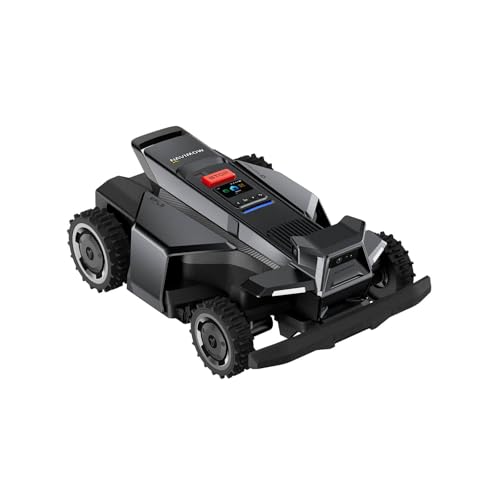
Segway Navimow X430 wire-free all-wheel-drive robot mower
4WD84% slopes claimedZero-turnUp to 1 acre
Check price on Amazon
Best for: Large lawns with steep or rough sections where you would rather not walk at all.

This robot is the answer if the real problem is that you do not want to walk the slope at all. Navimow gives it all-wheel drive with a dual suspension tuned for rough terrain, a claimed 84% slope capability and zero-turn steering with eccentric wheels that limits turf damage when turning. Dual 180W motors turn the cutting discs.

The slope claim is a maximum, and the practical limit will depend on grass wetness and surface. Treat a rated 84% as proof the drivetrain is serious, not as permission to mow wet ground at the extreme. Compared with the Sunseeker X5, the Navimow claims a bigger area and a steeper slope, while the Sunseeker is cheaper and rated for half an acre.

A robot has different ownership chores: keep the blades sharp, clean the charging contacts, and clear stones and sticks from the path since it cannot see them as well as you can. Software updates and app mapping are part of the routine. It also leaves no stripes on a bumpy lawn, but it keeps cutting every day.

What works

  • All-wheel drive with tuned suspension for rough ground
  • Claimed 84% slope ability
  • Zero-turn steering limits turf damage
  • Wire-free mapping avoids a buried boundary

Watch out for

  • Slope claim is a maximum, not an everyday figure
  • Highest outlay and needs app setup

Spec sheet

Drive
All-wheel drive, dual suspension
Slope rating
Up to 84% claimed
Steering
Zero-turn
Coverage
Up to 1 acre
Boundary
Wire-free
05
Sunseeker X5 AWD wire-free robot mower, 0.5 acre
AWDRTK and visionUp to 0.5 acre30 degree slopes
Check price on Amazon
Best for: Half-acre lawns with moderate slopes where a robot should handle the weekly cut.

Sunseeker's X5 sits one step below the Navimow X430, built for yards up to about half an acre, with all-wheel drive, rugged tires and independent front suspension that the listing says improves stability on bumps and slopes up to 30 degrees. Navigation mixes satellite positioning, visual mapping and AI so it can plan systematic paths without a buried wire.

The tradeoff is area and slope. At half an acre and 30 degrees it handles most suburban hills but not the very steep banks the X430 targets. Compared with a walk-behind like the EGO, it removes the walking but adds software, a base station and a lawn that must be reasonably obstacle-free.

Expect to spend time on setup: mapping the lawn, defining no-go zones around flowerbeds and keeping the antenna clear. Blades need regular changing, and the contacts need a wipe. It works best on lawns where weekly cutting has already tamed the worst bumps.

What works

  • All-wheel drive with independent front suspension
  • Rated for slopes up to 30 degrees
  • Combines RTK and vision mapping
  • Covers up to about 21,780 sq ft

Watch out for

  • Slope limit is lower than the Navimow X430
  • Needs mapping and a clear sky view for RTK

Spec sheet

Drive
All-wheel drive
Coverage
Up to 21,780 sq ft
Navigation
RTK, VSLAM and Vision AI
Slope
Up to 30 degrees claimed
Suspension
Independent front suspension
06
HISATORX 21.7-inch tracked remote-control mower with plow
Crawler tracksDual 800W motors21.7-inch cutPlow and tow hitch
Check price on Amazon
Best for: Steep banks and rough ground where wheels slip and you want to stay beside the machine.

A tracked machine is a different animal. Heavy crawler tracks spread the weight over a long contact patch and keep the machine from sinking or sliding on rough, steep terrain, while the dual 800W brushless drive motors give responsive steering. A remote lets you walk beside the mower, not behind it.

The 21.7-inch deck is wide for a remote machine and it can push a plow or tow a small load, which is a bonus for those who want one machine for several jobs. The tradeoffs are cost, weight and the fact that a remote-controlled machine still needs you to stand there and drive it. Compared with the robots, you stay in control but keep working.

Track machines need track tension checks, debris cleanout and regular battery care, and you must keep the remote charged. It is a niche choice for banks and rough ground that no walk-behind will manage, and not a general-purpose lawn mower for tidy suburban turf.

What works

  • Crawler tracks grip steep, loose ground
  • Remote control keeps you off the slope
  • Dual 800W drive motors respond smoothly
  • Plow and hitch add a second job

Watch out for

  • Heavy and expensive for a lawn mower
  • Needs you present with the remote

Spec sheet

Cut width
21.7 inch
Drive
Rubber crawler tracks
Motors
Dual 800W brushless drive
Control
Remote control
Extras
Front plow and tow hitch

Spec sheet decoder

What the numbers on the box really mean

The specs manufacturers lead with, translated into what they tell you about real-world performance.

Slope rating

The steepest incline the maker says it can handle, in degrees or percent. Percent and degrees are different scales: 100 percent is 45 degrees.

Watch forThe X430 claims 84 percent, the X5 claims 30 degrees; they are not directly comparable without converting.

Rear wheel diameter

Larger wheels roll over bumps and holes more easily and keep the deck steadier.

Watch forSENIX uses 11-inch rear wheels and the PowerSmart uses 10-inch.

Drive layout

Which wheels are driven. Rear drive keeps traction under load; all-wheel drive adds grip on robots.

Watch forThe Navimow and Sunseeker are all-wheel drive, the gas walk-behinds are rear drive.

Cutting torque

How hard the blade pushes through grass without slowing. Higher is better in thick, rough turf.

Watch forEGO quotes up to 7.0 ft-lbs for the LM2135SP.

Track versus wheel

Crawler tracks spread weight and grip loose or steep ground better than wheels, at a cost in weight and price.

Watch forThe HISATORX uses tracks, everything else uses wheels.

Methodology

How We Evaluated These Lawn Mowers for Uneven Ground

Traction

We compared drive layouts, wheel sizes and tracks, from the 10-inch PowerSmart to the all-wheel-drive Navimow. Larger wheels and tracks scored higher on rough ground. We read maker slope claims as ceilings.

Control on rough ground

We looked at how each machine's drive responds when you let go or when a wheel drops. The EGO's palm sensor and variable speed on the SENIX scored well. Controls were judged from spec sheets and owner feedback patterns.

Stability and weight

We considered weight and deck design for tipping risk on side slopes. The lighter EGO scored better than the heavier SENIX. Robots and tracked machines avoid the issue by taking you off the slope.

Cut quality on bumps

We looked at height ranges and deck ride, since scalping is the main complaint on uneven lawns. Machines with more height options scored higher. Torque ratings such as 7.0 ft-lbs counted for thick turf.

Ownership burden

We reviewed what each needs: fuel and oil for gas, mapping and blade changes for robots, track care for the tracked mower. The EGO scored simplest overall.

Decision guide

How to Choose the Right Lawn Mowers for Uneven Ground

By Terrain

SituationPickWhy
Mild bumps, half acreEGO LM2135SPSmooth Touch Drive and strong torque
Hilly gas lawnPowerSmart 21-inch10-inch wheels, rear drive
Big rough lawnSENIX 201cc11-inch rear wheels and a big engine
Moderate slopes, no walkingSunseeker X5All-wheel drive robot
Steep banks, big lawnNavimow X430Rated for steep slopes
Very rough bankHISATORX trackedCrawler tracks and remote control

By Budget

TierPickWhy
Lowest outlayPowerSmart 21-inchGas with large wheels
Low to midSENIX 201ccBigger engine and wheels
Mid tierEGO LM2135SPPremium walk-behind battery
Upper tierSunseeker X5Robot for half an acre
Highest outlayNavimow X430Biggest robot and steepest slope claim

Walk-Behind vs Robot

Walk-behind

The EGO, PowerSmart and SENIX adapt to what you see, and you can handle a stray branch or a wet spot. They need you on the lawn and, on slopes, hold-back effort.

Robot

The Navimow X430 and Sunseeker X5 mow without you, handle slopes with all-wheel drive and need only occasional attention. They need mapping, a clear path and regular blade changes.

Walk-behinds suit people who like to be in control, and robots suit people who want the lawn cut without effort.

By Power Source

PreferencePickWhy
Quiet, no fuelEGO LM2135SPBattery with Touch Drive
Unlimited runtimeSENIX 201ccLarge gas engine
Automatic mowingSunseeker X5Wire-free robot
Tracked gripHISATORXDual 800W drive motors

For Slopes Specifically

Look for

Rear or all-wheel drive, wheels that bite and a mower light enough to hold on a side slope. Never mow wet grass on an incline.

In this comparison

The Navimow X430 has the steepest claim, the PowerSmart and SENIX have rear drive and large wheels, and the HISATORX tracks hold loose ground. The EGO is best for moderate inclines.

When to Spend More

Spend more if

The slope is steep or the lawn is large and rough. A robot such as the Navimow X430 removes the effort and risk.

Save if

The lawn is mildly uneven. The PowerSmart or the EGO LM2135SP handle that without a robot's cost.

Ownership

Maintenance schedule

The upkeep that decides whether this machine lasts two seasons or ten.

TaskIntervalWhy it matters
Inspect the blade for stone nicksEvery few mowsRough lawns hide stones and roots. A nicked blade unbalances the mower and causes vibration.
Clear drive wheel hubsAfter wet cutsPacked grass stops wheel pawls from engaging and kills traction on slopes.
Change engine oilEach season (gas models)Dusty rough lawns load the engine harder. Fresh oil protects it.
Clean robot contacts and bladesMonthlyA robot with a worn blade or dirty charging contacts stops mowing and strands itself.
Check track tension and debrisStart of seasonA loose or clogged track slips on a slope. Clear debris and tension per the manual.

FAQ

Frequently Asked Questions

Is rear-wheel drive better than front on a slope?

Usually yes, because weight shifts back as you push down on the handle, improving traction. Front drive tends to slip on damp slopes and when the bag is full.

Can a robot mower really handle steep slopes?

Models with all-wheel drive such as the Navimow X430 and Sunseeker X5 can, within their rated limits. Wet grass reduces the usable slope, so treat the rating as a ceiling.

What is the difference between percent and degrees?

Percent slope is rise over run times 100, so 100 percent equals 45 degrees. An 84 percent slope is roughly 40 degrees, much steeper than a 30 degree rating.

Why does my mower scalp the lawn?

The deck bottoms out on mounds. Raise the cutting height a notch for the first cut and mow more often so you take off less grass each time.

Are tracked remote mowers practical?

For steep or rough ground that wheels cannot handle, yes. For a normal tidy lawn they are heavy, costly and overkill.

Should I mow across or up and down a slope?

Follow the maker's manual. In general walk-behind mowers are mown across a slope, while riding machines go up and down, and never mow wet grass on an incline.

Bottom line

The short version

Browse more lawn mowers for uneven groundon Amazon →
James Miller, Lead Machine Editor

About the author

James Miller

Lead Machine Editor, MachineFanatic

James Miller leads MachineFanatic's buying guides, turning spec sheets, manuals and owner feedback into clear verdicts on power tools, outdoor power equipment, shop machines and kitchen machines.

More from James →

Keep reading

Related guides