
Amazon affiliate links - we earn a commission.Affiliate disclosure

Buying guide · 12 min read · Updated 2026-11-12

Best Mini Wood Lathes (2026)

Six mini wood lathes from 8 x 12 pen turners to a 10 x 15 cast iron JET, compared on swing, motor, speed range and what small projects they handle.

James MillerBy James MillerLead Machine Editor6 machines comparedSpec-sheet verified
Best Mini Wood Lathes

At a glance

Our top picks

Side by side

Spec comparison

MachineSwing and lengthMotorSpeedClassUse
JET JWL-1015VS 10 x 15 in Variable Speed, Cast Iron 1/2HPBest OverallJET JWL-1015VS 10 x 15 in Variable Speed, Cast Iron 1/2HP10 x 15 in1/2 HP, 115V, 3.2AThree belt ranges, 200 to 3,600 RPMMini, 10 in swingn/a
WEN LA3421 8 x 13 in Mini Lathe, Variable SpeedBest ValueWEN LA3421 8 x 13 in Mini Lathe, Variable Speed8 x 13 inn/aVariableMini benchtopPens, bowls, cups, chess pieces
VEVOR 8 x 13 in Mini Lathe 1/3HP, 150 to 3200 RPMBest Wide Speed RangeVEVOR 8 x 13 in Mini Lathe 1/3HP, 150 to 3200 RPM8 x 13 in1/3 HP / 250WVariable 150 to 3,200 RPMEntry levelBeginners and hobbyists
CXRCY 8 x 12 in Mini Lathe 1/3HP, 750 to 3200 RPMBest Compact 8 x 12CXRCY 8 x 12 in Mini Lathe 1/3HP, 750 to 3200 RPM8 x 12 in1/3 HPInfinitely variable 750 to 3,200 RPMMini benchtopn/a
ArtyMaster WM101A-Plus Mini Wood Lathe, 24VDC 96WBest Tiny Pen LatheArtyMaster WM101A-Plus Mini Wood Lathe, 24VDC 96Wn/a96W high-torque, 24V DCn/aSmall benchtop latheHome DIY and small items
WEN 34035 14 x 20 in Variable Speed Benchtop LatheBest Step-Up SizeWEN 34035 14 x 20 in Variable Speed Benchtop Lathe14 x 20 in6 ampVariable 250 to 3,550 RPMBenchtop midiBowls and spindles

A mini wood lathe is a bench-top machine built for pens, bottle stoppers, ornaments, small bowls and spindle work. It is the cheapest way into woodturning and takes up a corner of a bench. The size limits what you can turn, but the skills are the same as on a big machine.

Mini does not mean toy. The best ones hold a steady spindle and a full-size tool rest, while the weakest are hobby machines with low torque and flimsy beds. The differences are in mass, motor torque and the speed range, not in the swing number alone.

Before you buy

6 Criteria to Look For Before Buying a Mini Wood Lathe

  1. 01

    Swing and what it allows

    An 8 inch swing lets you turn pens, stoppers, small vases and bowls up to about 6 inches. The JET JWL-1015VS at 10 inches reaches about 8 inch bowls. A tiny lathe like the WM101A-Plus at 96W cannot spin larger blanks safely. Pick the swing for the biggest piece you will turn often. Think about where you will use the machine, since a small bench can limit the size of lathe you can live with. Budget for a spare live centre.

  2. 02

    Motor torque

    Mini lathes use 1/3 HP motors, such as the VEVOR and CXRCY, or 1/2 HP like the JET. Torque at low speed matters more than peak horsepower, because a catch will stall a weak motor. The 96W WM101A-Plus is the weakest, and the JET the strongest in this lineup. A catch on a weak motor stalls it, which is gentler than a catch on a strong one, but you still need a face shield.

  3. 03

    Minimum speed

    Starting a rough blank at a high speed is dangerous. The VEVOR starts at 150 RPM and the JET at 200, while the CXRCY starts at 750. A low minimum lets you true up a blank safely before moving to cutting speed. Starting a rough blank at 150 or 200 RPM is far safer than starting at 750 RPM, and you can see the problem before it becomes dangerous. Add a stand if the bench is flimsy.

  4. 04

    Mass and bed

    A lathe vibrates when the blank is out of balance, and mass is what calms it. The JET's cast iron bed and headstock give it a clear advantage over lightweight minis. If you choose a light lathe, bolt it to a heavy bench and add sandbags. Add a bag of sand on a low shelf under the bench to damp vibration on any light lathe. Use a speed that matches blank size.

  5. 05

    Spindle thread and accessories

    Minis commonly use a 3/4 inch by 16 TPI spindle, and bigger ones 1 inch by 8 TPI. Check that chucks, faceplates and pen mandrels exist for your thread. Buy a four-jaw chuck early if you plan bowls. Pen mandrels, bushings and pen kits all depend on the spindle thread, so confirm it before you buy kits. Buy kits that match your thread.

  6. 06

    Tool rest and tailstock

    A loose tool rest or a tailstock that drifts is frustrating. Look for a rest that locks securely and a live centre with a smooth bearing. Two rests, as on the CXRCY, give flexibility. A live centre with a smooth bearing and a tool rest that clamps square are worth more than an extra inch of swing. Look for rests with a long contact face.

Detailed reviews

The 6 best mini wood lathes, explained

01
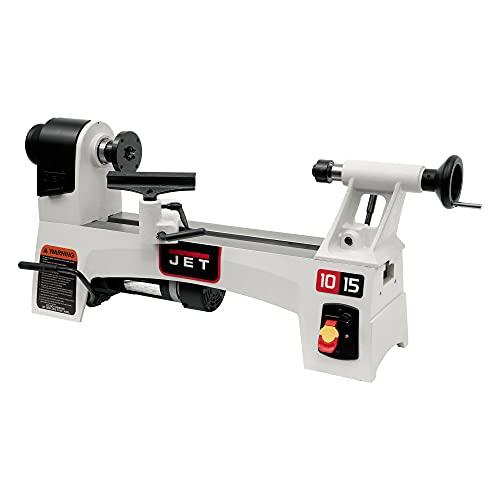
JET JWL-1015VS 10 x 15 in Variable Speed, Cast Iron 1/2HP
10 in swing15 in bed1/2HP200 to 3600 RPM
Check price on Amazon
Best for: Serious hobbyists who want a mini lathe with cast iron mass and bowl capacity.

The JWL-1015VS has a 10 inch swing and a 15 inch bed, a 1/2 HP motor and an electronic dial that fine-tunes speed within three belt-selected ranges, 200 to 3,600 RPM. The bed, headstock and tailstock are solid cast iron rather than stamped sheet metal.

Cast iron is what separates it from most mini lathes: mass absorbs vibration and keeps the work steady, which gives cleaner cuts and less fatigue. The 200 RPM minimum is fine for small blanks, though you must change belts to move between ranges. Compared with the WEN LA3421, it has more swing, more motor and much more mass.

It is the mini lathe you keep when you upgrade your skills. Budget for a chuck and a set of small tools. It is a sound investment for a long-term hobbyist. Check the spindle thread before buying a chuck, and keep a spare drive centre in the drawer, since both are cheap and easy to lose. Keep spare drive spurs on hand.

What works

  • Cast iron bed, headstock and tailstock
  • 10 in swing
  • 200 to 3,600 RPM range
  • Brand parts support

Watch out for

  • Belt changes to switch speed ranges
  • Higher price tier than other minis

Spec sheet

Swing and length
10 x 15 in
Motor
1/2 HP, 115V, 3.2A
Speed
Three belt ranges, 200 to 3,600 RPM
Build
Cast iron bed, headstock and tailstock
Class
Mini, 10 in swing
02
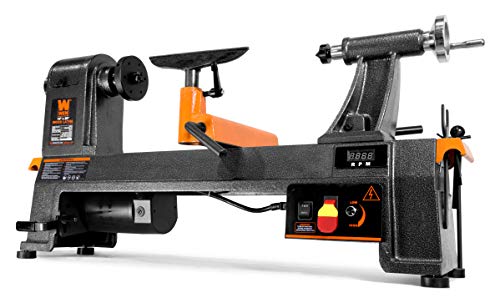
WEN LA3421 8 x 13 in Mini Lathe, Variable Speed
8 in swing13 in bedVariable speedPens and bowls
Check price on Amazon
Best for: Beginners who turn pens, stoppers and small items.

The WEN LA3421 is the straightforward mini: an 8 inch swing over the bed, a 13 inch distance between centres and variable speed, aimed at pens, bowls, cups and chess pieces. The listing gives no motor rating in the text we have, so confirm it on the product page.

An 8 by 13 inch machine is the standard small size, big enough for bottle stoppers, pens, small vases and short spindles. Variable speed means you dial the right RPM without belt changes. Compared with the JET 1015VS, it is lighter and cheaper but has less mass and refinement.

The tool rest and tailstock are basic, so expect to fine-tune them. Bolt it to a heavy bench to cut vibration. It is a sound first lathe from a recognised value brand. Keep the first projects short and light, with tight grain, until you learn how to feel a catch before it happens. Wax the bed every few weeks.

What works

  • 8 x 13 in capacity
  • Variable speed
  • Recognised value brand
  • Low price tier

Watch out for

  • Motor rating not stated in listing text
  • Light build needs a heavy bench

Spec sheet

Swing and length
8 x 13 in
Speed
Variable
Use
Pens, bowls, cups, chess pieces
Class
Mini benchtop
Brand
WEN
03
VEVOR 8 x 13 in Mini Lathe 1/3HP, 150 to 3200 RPM
8 x 13 in1/3HP, 250W150 to 3200 RPMVariable speed
Check price on Amazon
Best for: Beginners who want a low minimum speed for off-balance blanks.

The VEVOR mini lathe offers 8 by 13 inch capacity, a 1/3 HP, 250W motor and a variable speed range from 150 to 3,200 RPM. The low 150 RPM minimum is unusually low for a mini and helps when starting an off-balance blank or sanding at slow speed.

The wide range is the headline: most minis start at 700 to 750 RPM, which is fast for a rough bowl blank. A 1/3 HP motor is light, so large cuts will stall it, but for small spindles and pen blanks it is adequate. Compared with the CXRCY 8 by 12, it has the same motor class with a wider speed range and a slightly longer bed.

It is entry level, so expect to adjust the tool rest and tailstock and to replace the live centre if it is rough. It suits a beginner who wants low-speed control at a low price. Tighten every lock before starting the spindle, and give the blank a hand spin to make sure nothing hits the rest.

What works

  • 150 RPM minimum speed
  • 8 x 13 in capacity
  • 1/3 HP motor
  • Low price tier

Watch out for

  • 1/3 HP stalls on heavy cuts
  • Entry-level fit and finish

Spec sheet

Swing and length
8 x 13 in
Motor
1/3 HP / 250W
Speed
Variable 150 to 3,200 RPM
Class
Entry level
Use
Beginners and hobbyists
04
CXRCY 8 x 12 in Mini Lathe 1/3HP, 750 to 3200 RPM
8 x 12 in1/3HP750 to 3200 RPM2 tool rests
Check price on Amazon
Best for: Pen turners who want an 8 x 12 in machine with extra tool rests.

The CXRCY mini lathe has an 8 inch swing, 12 inches between centres, a 1/3 HP motor and infinitely variable speed from 750 to 3,200 RPM. It includes two tool rests.

The 750 RPM minimum is the weak spot: it is fast for rough blanks and for sanding, and it means you should only mount small, balanced blanks. For pens, bottle stoppers and small spindles it is fine. Compared with the VEVOR 8 by 13, it has a higher minimum speed and a slightly shorter bed.

Two tool rests give you flexibility with short and long rests. Expect basic finish and plan to tune the machine. It is a budget machine for pen turners. At a low price you are paying for the motor and bed, so spend on a good live centre and a sharp set of small gouges. Replace the tool rest if it warps.

What works

  • Infinitely variable speed
  • Two tool rests included
  • 8 x 12 in capacity
  • 1/3 HP motor

Watch out for

  • 750 RPM minimum is high for rough blanks
  • Basic build and finish

Spec sheet

Swing and length
8 x 12 in
Motor
1/3 HP
Speed
Infinitely variable 750 to 3,200 RPM
Included
Two tool rests
Class
Mini benchtop
05
ArtyMaster WM101A-Plus Mini Wood Lathe, 24VDC 96W
96W motor24V DCBenchtopDIY and pens
Check price on Amazon
Best for: Crafters turning beads, small pens and decorative items.

The WM101A-Plus is a small DIY lathe with a 96W, 24V DC motor, described as high torque. At 96W it has a fraction of the power of the 250W VEVOR, so it is the smallest machine here by a wide margin and suits very small items: pens, beads and small ornaments.

That low power is both its limit and its safety margin. It will stall on anything large, which makes it forgiving for beginners and children under supervision, but it will not rough out a bowl blank. It uses a DC power supply, so it is quiet and compact. Compared with the VEVOR 1/3 HP, it has less than half the power.

Buy it for small, light projects and crafts. Do not expect to turn a bowl on it. It is an inexpensive introduction to turning. Small DC lathes like this are forgiving, but they teach bad habits if you force cuts, so let the tool do the work. Stay below the rated speed.

What works

  • Very compact and quiet
  • 24V DC motor with low power draw
  • Low price tier
  • Safe stall behaviour on small items

Watch out for

  • 96W is too weak for bowls
  • Not for heavy or large blanks

Spec sheet

Motor
96W high-torque, 24V DC
Class
Small benchtop lathe
Use
Home DIY and small items
Power
24V DC supply
Included
Wood turning accessories
06
WEN 34035 14 x 20 in Variable Speed Benchtop Lathe
14 in swing20 in bed6A motor250 to 3550 RPM
Check price on Amazon
Best for: Beginners who want bowl capacity and are willing to go beyond mini size.

The WEN 34035 sits above the minis in this guide, with a 14 inch swing and 20 inch bed, a 6 amp motor and variable speed of 250 to 3,550 RPM. It is included as the step-up option if you suspect an 8 inch swing will be too small.

The larger swing lets you turn bowls and platters beyond the capacity of the other machines here, and the 6 amp motor has enough power for moderate cuts. It is heavier and takes more bench space. Compared with the JET 1015VS, it has more swing at a lower price, but less mass and refinement.

If you already know you want bowls, it may be a better buy than a true mini. Bolt it to a heavy bench. It is a flexible budget step-up. If you start in the mini class and keep turning, the step up to a midi will feel natural because the skills transfer directly. Add a work light over the lathe.

What works

  • 14 in swing
  • Variable speed 250 to 3,550 RPM
  • 6 amp motor
  • Lower price tier than cast iron lathes

Watch out for

  • Heavier and larger than a true mini
  • Lighter build than the JET

Spec sheet

Swing and length
14 x 20 in
Motor
6 amp
Speed
Variable 250 to 3,550 RPM
Class
Benchtop midi
Use
Bowls and spindles

Spec sheet decoder

What the numbers on the box really mean

The specs manufacturers lead with, translated into what they tell you about real-world performance.

Swing

The maximum diameter that clears the bed. Take the number as a hard limit.

Watch forThe 8 in swing on the WEN LA3421 and VEVOR is a hard limit.

Distance between centres

The longest workpiece the lathe can hold. Short beds limit spindles.

Watch forThe CXRCY's 12 in is the shortest among the 8 inch models.

Motor wattage

250W is 1/3 HP. The WM101A-Plus's 96W is about 1/8 HP. Wattage is easier to compare than HP.

Watch forLow wattage stalls under catches.

RPM range

The slowest and fastest spindle speeds. A low floor is safer.

Watch forThe VEVOR 150 RPM floor is the lowest here.

Cast iron vs aluminum

Cast iron adds mass and damps vibration, while aluminum is light. Cast iron is heavier but steadier.

Watch forOnly the JET lists a cast iron bed.

Methodology

How We Evaluated These Mini Wood Lathes

Capacity

We compared swing and bed length, from 8 x 12 on the CXRCY to 10 x 15 on the JET and 14 x 20 on the WEN 34035. We treated a low minimum speed as a real safety feature.

Speed range

We compared minimum speeds, from 150 RPM on the VEVOR to 750 RPM on the CXRCY, because low speed is a safety feature. Wattage was converted to horsepower to compare the small motors.

Motor power

We compared motor power from 96W on the WM101A-Plus to 1/2 HP on the JET. We noted tool rests and accessories included.

Build and mass

We credited cast iron and noted lighter machines need a heavy bench. Mass was a significant factor for stability.

Evidence base

This is based on spec sheets and owner feedback patterns, not our own bench time. Capacity numbers are manufacturer claims. We did not claim any turning results.

Decision guide

How to Choose the Right Mini Wood Lathes

By Project

SituationPickWhy
Pens and stoppersWEN LA34218 x 13 and variable speed
Small bowlsJET JWL-1015VS10 in swing and cast iron
Rough blanks at low speedVEVOR 8 x 13150 RPM minimum
Beads and ornamentsArtyMaster WM101A-PlusCompact and low power
Bowls over 8 inWEN 3403514 in swing

By Budget

Budget tierPickWhy
LowestArtyMaster WM101A-PlusCheapest tier
LowCXRCY 8 x 12Two tool rests
Lower middleVEVOR 8 x 13Low-speed control
MiddleWEN LA3421Value brand
UpperJET JWL-1015VSCast iron build

Mini vs Midi

Mini

The WEN LA3421, VEVOR and CXRCY fit a small bench and handle pens, stoppers and small bowls.

Midi

The WEN 34035 and larger machines handle bigger bowls but need more bench space and money.

Choose mini for small work and midi if you want to grow into bowls.

Light vs Cast Iron

PreferencePickWhy
Most massJET JWL-1015VSCast iron bed
PortableWEN LA3421Light and compact
SmallestArtyMaster WM101A-PlusTiny and quiet
Budget capacityWEN 3403514 in swing

For Pen Turning Specifically

Look for

A 3/4 inch by 16 TPI spindle, good live centre and a tool rest that sits at centre height. Pen blanks are small and light, so power matters little.

In this comparison

The WEN LA3421 and CXRCY suit pens well, and the WM101A-Plus can handle small blanks. The JET is overkill but excellent.

When to Spend More

Spend more if

You plan to turn bowls or stay with the hobby. The JET JWL-1015VS keeps its value.

Save if

You want to try turning. The WEN LA3421 or CXRCY is enough.

Ownership

Maintenance schedule

The upkeep that decides whether this machine lasts two seasons or ten.

TaskIntervalWhy it matters
Wax the bedWeeklyPaste wax keeps the tailstock and tool rest sliding smoothly. Do it every session.
Check the live centreMonthlyA rough bearing causes vibration. Replace it when it feels gritty. Replace when gritty.
Inspect the beltEvery 3 monthsA cracked belt slips and loses torque. Replace when glazed.
Tighten the tool rest lockEach sessionA loose rest is dangerous. Test it before starting. Check by hand.
Clean dust from the motorEvery 6 monthsDust overheats small motors. Use a soft brush.

FAQ

Frequently Asked Questions

Can I turn bowls on a mini lathe?

Small ones, up to the swing limit. The 8 inch minis handle bowls to about 6 inches, and the JET 1015VS to about 8 inches. Keep the first bowls small and shallow. Practise on scrap pine first.

How much should I spend?

The WM101A-Plus and CXRCY sit at the low end, the VEVOR and WEN in the middle and the JET at the top. Pay more for mass and motor. A set of five small gouges is plenty to start. Wear a dust mask when sanding.

How long do mini lathes last?

Many years with care. Cast iron units last decades, light ones depend on the motor and bearings. Used minis are plentiful, so check the bearings. Buy sharpening gear early.

Is more horsepower always better?

Only if it holds torque at low speed. A weak motor stalls on a catch, which can actually be safer for beginners. Face shields matter more than the lathe. Hold tools firmly against the rest.

Do I need a chuck?

For bowls and boxes, yes. For pens and spindles, a mandrel and live centre are enough. Sharp tools reduce catches. Keep spare belts.

Is it safe?

With a face shield and correct tool rest height, yes. Start at low speed and keep loose clothing away. Pen kits are the cheapest first projects. Turn off power before adjusting the rest.

Bottom line

The short version

Browse more mini wood latheson Amazon →
James Miller, Lead Machine Editor

About the author

James Miller

Lead Machine Editor, MachineFanatic

James Miller leads MachineFanatic's buying guides, turning spec sheets, manuals and owner feedback into clear verdicts on power tools, outdoor power equipment, shop machines and kitchen machines.

More from James →

Keep reading

Related guides