
Amazon affiliate links - we earn a commission.Affiliate disclosure

Buying guide · 13 min read · Updated 2026-11-15

Best Patio Heaters for Screened Porches (2026)

Seven electric heaters for screened porches compared by infrared and ceramic design, footprint, weather rating, noise and power draw. No propane fumes indoors.

James MillerBy James MillerLead Machine Editor7 machines comparedSpec-sheet verified
Best Patio Heaters for Screened Porches

At a glance

Our top picks

A screened porch is the trickiest place to heat. The screens block insects but not drafts, the roof is low, and the space is semi-enclosed enough that burning fuel is a real hazard.

That narrows the field to electric heaters, and the question becomes which delivery style suits a draft-prone, low-ceiling room. Footprint, cord reach, noise and the weather rating all matter more here than raw output.

Before you buy

6 Criteria to Look For Before Buying a Patio Heater for Screened Porches

  1. 01

    Fuel type

    A screened porch has a roof and screens that trap exhaust, so propane and other fuel heaters are not suitable. Electric heaters add no flame or exhaust. This guide lists only electric models for that reason. Carbon monoxide has no smell, so the rule is about the room, not how the heater feels. Many manuals state outright that fuel-burning heaters are for open, ventilated spaces, and a screened room is not one.

  2. 02

    Infrared or ceramic

    An infrared tower such as the Haimmy warms people directly, which holds up in a draft. A ceramic fan heater such as the Buyplus warms the air and works best in a closed three-season porch. If your porch is breezy, choose infrared. A quick test is to hold a lit candle at the seating spot on a windy evening, and if the flame bends, a ceramic heater will struggle. Infrared keeps working because the heat is aimed, not carried in moving air.

  3. 03

    Circuit and wattage

    A 1500W heater draws about 12.5 amps at 120V, most of a 15A circuit. The SereneLife at 900W leaves room for a fan and lights on the same circuit. Check what else shares the porch outlet. Many older homes put porch lights, a fan and a speaker on one 15A circuit, so a 1500W heater can trip the breaker the first night. A dedicated outlet is the real fix, and an electrician can often add one for a modest cost.

  4. 04

    Footprint and clearance

    A porch is small, so a 42 inch tower or a ceramic box needs room. Keep any heater about three feet from furniture, screens and curtains. The Dr. Infrared can mount on a wall to free floor space. Measure the walking path before you place anything, because a porch with a heater in the middle feels crowded. Mark the three foot clearance zone with painter's tape on the first evening.

  5. 05

    Weather rating

    The SereneLife has IP65, the hykolity IP44 and ceramic units are indoor-style. A roofed porch rarely needs IP65, but blowing rain through the screens can reach the floor. Match the rating to how wet your porch gets. A porch that sees rain across the floor in storms deserves IP65, while a dry porch under a deep roof can use less. Plugs are the weak point, so keep them off the floor and under a cover.

  6. 06

    Noise

    Infrared towers are silent, while ceramic fan heaters produce a fan hum. On a porch where you want to talk or hear nature, that difference matters. A fan hum around 40 to 55 decibels is typical for ceramic heaters and is noticeable on a quiet night. If the porch is for reading or conversation, silent infrared is the better fit.

Detailed reviews

The 7 best patio heaters for screened porches, explained

01
Haimmy 42 in infrared patio heater, 9 levels, 9 hour timer
1500W9 levels9H timer42 in
Check price on Amazon
Best for: Porches with a seating group in front of the heater.

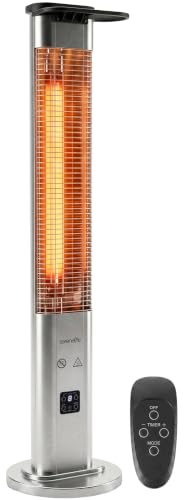
The Haimmy is a 42 inch infrared tower whose heating tube spans about two-thirds of the height. That long tube warms a seated person from head to waist, which suits porch furniture. It offers nine heat modes from 620W to 1500W, so you can hold a gentle output on a mild night.

Infrared heat does not depend on warming the air, which is a major advantage on a porch where a draft can sweep warm air away. It adds no exhaust and no flame, so it is safe in a semi-enclosed room. A timer from 1 to 9 hours means the heater turns itself off if you head inside.

Against a fan heater it is silent and gives direct warmth. Place it at arm's length from seating and keep it away from the screen and curtains. Wipe the tube housing with a dry cloth once it is cool, and keep the cord short and off the floor path. The nine steps pay off most in shoulder seasons, when a full 1500W blast would be too much for a small porch. A tower this tall can tip if a pet or child leans on it, so a clear corner is better than a walkway.

What works

  • Nine power levels from 620W to 1500W
  • Long tube warms seated guests from head to waist
  • No flame, fuel or exhaust
  • Remote and timer included

Watch out for

  • Tower footprint takes floor space
  • 1500W cannot heat a large porch in wind

Spec sheet

Power
620W to 1500W, 9 modes
Height
42 in
Timer
1 to 9 hours
Element
Tube about two-thirds of height
Control
Remote
02
SereneLife 900W infrared heater, IP65, aluminum reflector
900WIP65ETLReflector
Check price on Amazon
Best for: Small porches with a shared circuit.

The SereneLife uses 900W, which is about 3,070 BTU per hour, with an aluminum reflector and an IP65 rating. IP65 means dust tight and protected against water jets, and ETL certification is named in the listing. On a screened porch where rain blows through the screens, the rating is a practical comfort.

A 900W draw is gentle on a shared circuit, so it can run alongside a ceiling fan and a few lights without tripping a breaker. That is the best reason to pick it on an older house with a limited porch circuit.

It will not heat a large porch. Treat it as a warm spot for one or two chairs. Keep it aimed at the seats and away from the screens. Many owners pair a small heater like this with a lap blanket, which feels warmer than a bigger heater on a windy night. The aluminum frame resists rust where damp air collects around a porch floor, and the remote means you never need to reach it.

What works

  • IP65 resists dust and water jets
  • 900W is easy on a shared circuit
  • ETL certification named in the listing
  • Aluminum alloy frame resists rust

Watch out for

  • Too little heat for large groups
  • Fewer controls than the nine-level towers

Spec sheet

Power
900W
Rating
IP65
Certification
ETL
Frame
Aluminum alloy
Control
Remote
03
hykolity 38.5 in 1500W infrared heater, dual tubes, IP44
1500WDual tubesIP4424H timer
Check price on Amazon
Best for: Roofed porches where two levels are enough.

The hykolity stands 38.5 inches tall with dual carbon heating tubes and two heat levels. It has an IP44 rating, a 0 to 24 hour timer and a remote. IP44 resists splashes, which is enough for a roofed porch where rain rarely reaches the floor.

Two levels keep the choice simple: low for a mild evening and high for a cold one. A porch that is roofed and screened does not usually need IP65, so the lower rating is acceptable.

Compared with the Haimmy it has fewer steps but a longer timer. Keep it a few feet from the screen and furniture. Check the cord and plug each season. The timer is the quiet safety feature here, so set it every evening so the heater does not run empty. A dual-tube design also lets one tube stay lit if the other fails, though the listing does not promise that behavior.

What works

  • Dual carbon tubes spread warmth
  • Two simple heat levels
  • 0 to 24 hour timer
  • Remote included

Watch out for

  • IP44 is only splash resistant
  • Only two power levels

Spec sheet

Power
1500W, 2 levels
Element
Dual carbon tubes
Rating
IP44
Timer
0 to 24 hours
Height
38.5 in
04
Dr. Infrared 1500W heater, freestanding, wall or ceiling
1500W3-way mount900/1200/1500WRemote
Check price on Amazon
Best for: Porches that need a heater off the floor.

The Dr. Infrared 1500W offers three mounting modes: freestanding with a weighted wheeled base, wall mounted or ceiling mounted. On a porch with a low roof, mounting on a wall or beam can free the floor. It has three power steps of 900W, 1200W and 1500W with a remote.

Carbon infrared heat warms people directly, which helps in a drafty porch. At 1500W it makes about 5,120 BTU per hour, which is the practical ceiling for a plug-in on a 15A circuit.

Against the Haimmy it has fewer power steps but more ways to place it. If your porch has a rafter or a wall with space, mounting is a clean solution. Keep the cord short and off the walkway. Plan the mounting height before drilling, because a heater too high on a low porch ceiling wastes heat and one too low is uncomfortable. Check the clearance the manual lists for the ceiling above it.

What works

  • Three mounting options
  • Three power steps with a remote
  • Weighted wheeled base when freestanding
  • Direct infrared warmth in drafts

Watch out for

  • Fewer steps than the nine-level tower
  • Needs a safe mounting point if hung

Spec sheet

Power steps
900W, 1200W, 1500W
Mounting
Freestanding, wall or ceiling
Base
Weighted with wheels
Control
Remote
Use
Indoor and outdoor
05
Buyplus 1500W PTC ceramic outdoor heater, 3 modes, overheat shutoff
1500W PTC3 modes3S heatOverheat
Check price on Amazon
Best for: Closed three-season porches with little draft.

The Buyplus uses PTC ceramic heating, which warms the air that a fan blows past the element, with three output modes and a self-resetting overheat breaker. A non-slip base steadies it. Ceramic fan heaters warm a small enclosed zone quickly.

On a porch the weakness of a fan heater is that moving air is lost to drafts. It works best in a porch with solid walls on the windy side or storm windows. It is compact, which helps on a tight porch.

Against an infrared tower it heats the air rather than the person, so it feels less direct. It is a decent choice for a closed three-season room. Keep it dry and away from curtains. The self-resetting breaker means it can cycle off and on if the vents are blocked, so keep the grille clear of cushions and throws. Dust in the fan is the usual cause of a burning smell at the start of the season.

What works

  • PTC ceramic element self-limits temperature
  • Self-resetting overheat breaker
  • Three output modes
  • Compact footprint

Watch out for

  • Warm air is lost in drafty porches
  • Fan noise compared with infrared

Spec sheet

Power
1500W PTC ceramic
Modes
3 output modes
Warm-up
About 3 seconds
Safety
Self-resetting overheat breaker
Base
Non-slip
06
Aarcinhke 1500W PTC ceramic heater, 20W/750W/1500W
1500W PTC20/750/1500W160 sq ftOverheat
Check price on Amazon
Best for: Porches that want a fan mode as well as heat.

The Aarcinhke is a 1500W PTC ceramic heater with three modes of 20W, 750W and 1500W. The 20W mode is a fan-only setting that moves air without heat. The listing claims coverage of about 160 square feet and an overheat shutoff.

A 750W middle step uses half the power of the top step, which suits a mild evening. A 160 square foot claim is generous for 1500W in a screened porch, so treat it as a ceiling for a closed room.

Against the Buyplus it adds a fan-only mode and a clearer coverage claim. It needs the same protection from wind and rain. Use the fan-only setting on warm evenings so the same machine earns its place in summer. Keep the intake grille clean, because lint and pollen choke ceramic heaters faster than most owners expect.

What works

  • 20W fan mode for summer air movement
  • 750W middle step saves power
  • Overheat shutoff included
  • Listed coverage about 160 sq ft

Watch out for

  • Coverage claim assumes a closed room
  • Warm air is lost in drafts

Spec sheet

Power steps
20W, 750W, 1500W
Coverage
About 160 sq ft (listing)
Warm-up
About 3 seconds
Element
PTC ceramic
Safety
Overheat shutoff
07
1500W PTC ceramic outdoor heater, 2 second warm-up, 3 modes
1500W PTC3 modes2S heatSilent
Check price on Amazon
Best for: Closed porches where quiet matters.

This 1500W PTC ceramic unit warms up in about two seconds and offers three output modes, overheat protection and a quiet fan. It is marketed as a garage and greenhouse heater as well as an outdoor patio heater. Quiet operation matters on a porch where you want to hear the evening.

A ceramic unit warms the air, so it fits a closed porch better than an open one. Its small size keeps it unobtrusive.

Against the other ceramic units it is the quieter and simpler pick. Keep it dry and out of the rain, since indoor-style ceramic heaters are not made for direct weather. Pull the plug when a storm blows rain through the screens, and move the unit to a dry corner. A small handle or low profile makes that easy, which is another reason to favor compact units on a porch.

What works

  • Quiet fan operation
  • About two second warm-up
  • Three modes and overheat protection
  • Compact body

Watch out for

  • Not rated for direct rain
  • Warms air, so drafts reduce its effect

Spec sheet

Power
1500W PTC ceramic
Modes
3 output modes
Warm-up
About 2 seconds
Noise
Quiet operation
Safety
Overheat protection

Spec sheet decoder

What the numbers on the box really mean

The specs manufacturers lead with, translated into what they tell you about real-world performance.

Infrared

Radiant heat that warms objects and people directly.

Watch forHaimmy, hykolity, Dr. Infrared and SereneLife.

PTC ceramic

A self-limiting element with a fan that warms the air.

Watch forBuyplus, Aarcinhke and the quiet ceramic unit.

Wattage

Electric input at about 3.4 BTU per watt.

Watch for900W versus 1500W.

IP rating

Dust and water protection.

Watch forIP65, IP44.

Fan-only mode

Moves air without heat.

Watch forAarcinhke lists a 20W mode.

Methodology

How We Evaluated These Patio Heaters for Screened Porches

Safety in a semi-enclosed room

We limited the lineup to electric heaters and checked overheat and tip protection. Fuel heaters were excluded because screens trap exhaust. The SereneLife ETL listing and the ceramic units' overheat shutoffs earned credit.

Draft tolerance

We favored infrared for drafty porches and ceramic for closed ones. A porch with open screens loses moving warm air quickly, so direct radiant heat ranked higher. The ranking would flip for a fully glazed room.

Circuit fit

We compared wattage with typical porch circuits. A 900W heater leaves room for a fan and lights, while 1500W takes most of a 15A circuit. Units with several steps earned credit for lowering the load on mild nights.

Footprint

We looked at height, mounting options and base size. The 42 inch Haimmy takes more floor than a wall-mounted Dr. Infrared. Porches are small, so footprint carried real weight in the ranking.

Ownership

We considered cords, fans and remotes, which fail first. Ceramic fans collect dust and wear bearings, while infrared elements are simpler. This section reflects the spec sheet and owner feedback patterns.

Decision guide

How to Choose the Right Patio Heaters for Screened Porches

By Porch Type

SituationPickWhy
Breezy screened porchHaimmy 42 inInfrared holds in drafts
Closed three-season porchBuyplus ceramicQuick warm-up
Shared small circuitSereneLife 900WLower draw
Tight floor spaceDr. Infrared mountedOff the floor

By Budget

SituationPickWhy
Lowest outlaySereneLife 900WSimple and rated
Mid-rangehykolity 38.5 inTwo levels
Feature spendHaimmy 42 inNine levels
Ceramic valueAarcinhkeFan mode

Infrared vs Ceramic

Infrared

The Haimmy, hykolity, Dr. Infrared and SereneLife warm people directly and are silent. They suit drafty porches.

Ceramic

The Buyplus, Aarcinhke and the quiet ceramic unit warm the air quickly but lose heat in drafts and add fan noise.

Breezy porches pick infrared; closed porches can pick ceramic.

By Control Style

SituationPickWhy
Fine controlHaimmy nine levels620W to 1500W
Fan in summerAarcinhke 20W modeAir movement
Simple two levelshykolityLow and high
QuietQuiet ceramic unitLow noise

For Cold Evenings Specifically

Look for

Direct infrared warmth, a safe cord path and a clear spot away from screens.

In this comparison

The Haimmy and Dr. Infrared give the best evening warmth.

When to Spend More

Spend more if

You use the porch nightly: the Haimmy adds control.

Save if

You use it occasionally: the SereneLife is enough.

Ownership

Maintenance schedule

The upkeep that decides whether this machine lasts two seasons or ten.

TaskIntervalWhy it matters
Inspect the cordEach seasonA warm plug signals a poor connection or a thin cord. Replace damaged cords and keep the plug off the floor.
Clean grillesEach seasonDust and pollen cook on elements and clog fans. Vacuum the grille with the heater unplugged and cool.
Check clearanceEach seasonFurniture, cushions and throws creep toward heaters over a season. Re-measure the three foot zone each spring.
Test the remoteEach seasonBatteries fail in cold weather. Replace cells at the start of the season and keep a spare.
Store dryOff seasonMoisture ruins electronics and corrodes plugs. Cover or store the heater indoors if the porch is left open all winter.

FAQ

Frequently Asked Questions

Can I use a propane heater on a screened porch?

No. Screens and a roof trap exhaust, and carbon monoxide has no smell. Choose an electric heater and keep a battery alarm in any enclosed space.

Infrared or ceramic?

Infrared for drafty porches, ceramic for closed ones. Infrared warms you directly and stays silent, while ceramic warms the air and hums. Pick by how much wind your porch sees.

How much power does it use?

1500W uses 1.5 kWh per hour at full power. Lower steps use less, so a 900W or 750W setting suits a mild evening.

Do I need a rain rating?

IP44 for a roofed porch, IP65 for blowing rain. Neither covers the plug, so keep it dry. Move a ceramic unit indoors if storms blow through the screens.

Can I use an extension cord?

Only a heavy outdoor cord rated for the load. A thin cord overheats at 1500W, so keep the run short and the plug cool.

How far from furniture?

About three feet from furniture, screens and curtains. Follow the exact clearances in the manual for your model.

Bottom line

The short version

Browse more patio heaters for screened porcheson Amazon →
James Miller, Lead Machine Editor

About the author

James Miller

Lead Machine Editor, MachineFanatic

James Miller leads MachineFanatic's buying guides, turning spec sheets, manuals and owner feedback into clear verdicts on power tools, outdoor power equipment, shop machines and kitchen machines.

More from James →

Keep reading

Related guides