
Amazon affiliate links - we earn a commission.Affiliate disclosure

Buying guide · 13 min read · Updated 2026-11-12

Best Portable Charcoal Grills (2026)

Six portable charcoal grills from a 14 inch kettle to a rectangular carry-on compared by vents, lid fit, grate area and ash handling for trips and patios.

James MillerBy James MillerLead Machine Editor6 machines comparedSpec-sheet verified
Best Portable Charcoal Grills

At a glance

Our top picks

Side by side

Spec comparison

Charcoal is the fuel people choose when they care about flavour and sear, and a portable charcoal grill is the cheapest way to get that into a trunk. The trade is that you are the thermostat: the vents, the lid and the amount of coal decide the heat. Think of it as a small fire you manage, not a machine you switch on.

Because the bodies are small and often thin, airflow and lid fit matter more than any headline size. A grill that seals well and has adjustable vents holds a steady fire, while a loose one swings with every gust.

Before you buy

6 Criteria to Look For Before Buying a Portable Charcoal Grill

  1. 01

    Vents and airflow

    Charcoal heat is controlled by air. Top and bottom vents, as on the Weber kettles and the Cuisinart's dual system, let you open up for sear or choke down for low cooking. Cheap thin-walled grills swing with the wind, so lid fit and vent quality decide whether you can hold a steady temperature at all. The most common error is lighting too much charcoal at once, which makes a small kettle run too hot to control.

  2. 02

    Body material and finish

    Porcelain-enamel on the Weber kettles resists rust and holds heat, while thinner painted steel dents and rusts. A dent affects lid seal and airflow. Choose the enamel if you will keep the grill for years. Rust inside the bowl is the quiet killer of small grills, so look for enamel or a coating that reaches the inside surface.

  3. 03

    Grate area that counts

    Use primary area, not totals. The Jumbo Joe lists 240 square inches, the Cuisinart 196 and the CD1519 303 including a warming rack. Allow about 70 to 80 square inches of primary grate per person eating. A larger figure is useless if you cannot keep the whole grate at a usable temperature, which is harder on small fires.

  4. 04

    Lid lock and carry

    A lid that locks keeps ash inside while you move. The Weber Tuck-N-Carry and the Cuisinart's three locks serve this. A grill you cannot carry with the lid shut will fill your trunk with ash. Also check that the handle is cool to the touch, since a lid lock that doubles as a handle can still get hot.

  5. 05

    Fire adjustment

    The Rambler's height-adjustable tray changes the fire without moving the food. Vents change airflow. Both approaches work, but mechanical adjustment is more precise on a small grill. Buyers who rarely adjust anything are fine with vents, while those who like to experiment will enjoy the tray.

  6. 06

    Ash and fuel handling

    Ash catchers and front doors reduce cleanup and let you add coals. The Jumbo Joe has an ash catcher, the CD1519 a front door. Plan the whole cook, including cleanup. Check the disposal rules where you camp, as many sites demand fully cooled ash before it leaves the fire ring.

Detailed reviews

The 6 best portable charcoal grills, explained

01
Weber Jumbo Joe 18 Inch Portable Charcoal Grill, 240 sq in
18 inch240 sq inPorcelain-enameledLid lock
Check price on Amazon
Best for: Small families who want real temperature control in a carry-along kettle.

The Jumbo Joe is a small kettle with a porcelain-enameled bowl and lid, an 18.5 inch plated steel grate and rust-resistant aluminum dampers. Porcelain enamel is the key material choice here, because it resists rust and holds a steadier temperature than thin painted steel.

The Tuck-N-Carry lid lock doubles as a handle and keeps the lid on during transport, which is the feature that makes it genuinely portable. At 240 square inches you can cook for three or four people, which is a small family, but not a party.

Vents at the top and bottom let you steer the fire: open them for sear heat, close them down for a low cook. An ash catcher keeps cleanup manageable. Compared with the 14 inch Smokey Joe it adds roughly a quarter more grate and a better pot for fuel. Ownership is simple: empty the ash, wipe the grate and keep it dry. Light it with a chimney starter rather than fluid, and give the coals about fifteen minutes to ash over before the food goes on. That habit gives cleaner flavour and a steadier first ten minutes of heat.

What works

  • Porcelain-enameled bowl and lid resist rust
  • Top and bottom vents control the fire
  • Lid lock doubles as a carry handle
  • 240 square inches suits three or four people

Watch out for

  • Too small for a crowd
  • Ash must be emptied before the next cook

Spec sheet

Cooking area
240 sq in
Grate
18.5 inch plated steel
Body
Porcelain-enameled bowl and lid
Dampers
Rust-resistant aluminum
Carry
Tuck-N-Carry lid lock
02
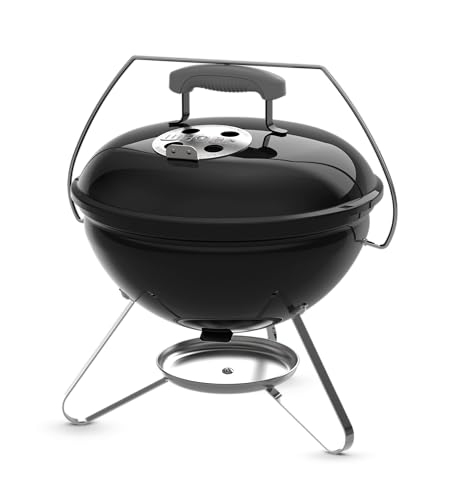
Weber Smokey Joe 14 Inch Portable Charcoal Grill
14 inchPorcelain-enamelLid lockLightweight
Check price on Amazon
Best for: Solo campers and couples who need the lightest kettle.

The Smokey Joe is the smallest kettle in the Weber line, with a porcelain-enamel finish that the listing describes as scratch and rust resistant. It is lightweight and compact, with the same lid lock that doubles as a lid holder.

At 14 inches it cooks for two comfortably, three with some patience. The bowl holds enough coal for a burger session, but a long cook needs a refill and the smaller volume means less thermal mass than the 18 inch.

The kettle shape and vents give the same airflow control as larger Weber grills, which is why even tiny ones can hold a steady fire. Against the Jumbo Joe, you give up grate area for packability. It is the one for a solo camper or a couple who value weight and trunk space above capacity. Because the bowl is shallow, keep the coals in a tight pile rather than a thin spread, or the fire will burn through in half the time you expect.

What works

  • Porcelain-enamel finish resists scratches and rust
  • Lightweight and compact for carrying
  • Lid lock holds the lid in transit
  • Kettle vents give real fire control

Watch out for

  • Small coal volume means more refills
  • Only enough grate for two

Spec sheet

Size
14 inch kettle
Finish
Porcelain-enamel, scratch and rust resistant
Lid
Tuck-N-Carry lid lock
Weight class
Lightweight
Use
Camping, tailgating
03
Oklahoma Joe's Rambler Portable Tabletop Charcoal Grill, 218 sq in
218 sq inAdjustable trayCast ironSteel body
Check price on Amazon
Best for: Cooks who want sear-to-low control from a tabletop grill.

The Rambler is built around a height-adjustable charcoal tray, which lets you raise the coals toward the food for sear heat or lower them for gentler cooking. That mechanical adjustment is a real asset on a small grill, where vents alone give limited range.

The cooking area is 218 square inches, slightly smaller than the Jumbo Joe, with cast iron grates and a heavy-duty steel body. Cast iron holds heat for searing and is easy to season.

Steel is stronger than a thin pan but heavier to carry. A small grill with a heavy body is more stable in wind but less pleasant on a long walk. Compared with the Weber kettles, it trades the round lid and enamel for a more adjustable fire and a sturdier build. It suits cooks who like to manage their fire precisely. Set the tray low for a first sear, then raise it away from the food, or lower it for a second cook, which is something a fixed-tray grill cannot do.

What works

  • Height-adjustable charcoal tray for sear or low heat
  • Cast iron grates hold heat
  • Heavy-duty steel body is stable
  • 218 square inches suits two to four

Watch out for

  • Heavier than the Weber kettles
  • Cast iron needs seasoning care

Spec sheet

Cooking area
218 sq in
Fire control
Height-adjustable charcoal tray
Grate
Cast iron
Body
Heavy-duty steel
Style
Tabletop
04
Cuisinart CCG-190RB 14 Inch Portable Charcoal Grill, 196 sq in
14 inch196 sq inDual vents3 lid locks
Check price on Amazon
Best for: Budget-minded campers who want a small kettle-style grill.

The Cuisinart is a 14 inch tabletop with a chrome-plated 196 square inch grate, a dual vent system and three lid locks. The three locks matter, because a lid that stays shut in a car keeps ash in the bowl and out of the trunk.

Dual vents give you the same basic fire control as a kettle. At 196 square inches it suits two to three people, which is slightly smaller than the Jumbo Joe's 240.

The listing positions it for BBQ and camping. As a lower-cost option, expect thinner steel than the Weber and take care not to dent the bowl, since a dented bowl affects lid seal and airflow. It is the choice when you want the format of a kettle without the premium price. Treat it as a good starter grill rather than a decade-long investment. Tighten the lid locks and check the handle bolts on arrival, since small grills sometimes ship slightly loose.

What works

  • Three lid locks keep ash contained
  • Dual vent system for fire control
  • Chrome-plated grate resists rust
  • 196 square inches suits two or three

Watch out for

  • Thinner steel than the Weber range
  • A dent can spoil lid seal

Spec sheet

Cooking area
196 sq in
Grate
Chrome-plated
Vents
Dual air vent system
Lid
3 lid locks
Body
14 inch tabletop
05
Weber Go-Anywhere Portable Charcoal Grill
Rectangular2 to 4 peopleLightweightCompact
Check price on Amazon
Best for: Travellers who value flat packing over kettle versatility.

The Go-Anywhere breaks from the kettle shape. Its rectangular body is described as easy to carry, pack and store, and the listing says it suits two to four people.

A rectangular body packs flatter in a trunk or a car, which is its whole reason for existing. It also lets you bank coals to one side for a two-zone fire, something a round kettle does less naturally.

Without the kettle lid dome, it does not trap heat the same way, so expect less smoke-roasting ability and more direct cooking. It is for burgers, sausages and skewers rather than a pork shoulder. Compared with the Jumbo Joe it is flatter and lighter in the trunk but less versatile for roasting. Pick it for packability. Bank the coals to one side to make a hot and a cool zone, and keep the food over the hot side only for the searing minutes.

What works

  • Rectangular shape packs flat
  • Suits two to four people
  • Lightweight and easy to carry
  • Easy to bank coals for a two-zone fire

Watch out for

  • Less able to roast or smoke than a dome kettle
  • Fewer vent options than a kettle

Spec sheet

Shape
Rectangular, efficient
Capacity
2 to 4 people
Weight class
Lightweight
Use
Camping, tailgating
Storage
Easy to pack
06
Royal Gourmet CD1519 Portable Charcoal Grill with Warming Rack, 303 sq in
303 sq inWarming rackSide handlesFront access door
Check price on Amazon
Best for: Cooks who need to add coals mid-cook and want a warming rack.

The CD1519 lists 303 square inches, a warming rack, two handles and a front charcoal access door. That access door lets you add coals during a long cook without lifting the grate.

The listed figure includes the warming rack, so the primary grate is smaller than 303. Research warns against padding totals with surfaces you cannot sear on, so compare primary area only.

A tabletop with two handles is easy to carry across a campsite. The warming rack is useful for buns and finished food. Compared with the Rambler it offers more nominal area and an access door, but without the adjustable tray. It is the one for cooks who stretch a burger session over an hour. Remember that the warming rack is not for cooking raw food, only for holding what is already done.

What works

  • Front door adds coals without lifting the grate
  • Warming rack keeps food hot
  • Two handles for carrying
  • Larger nominal area for groups

Watch out for

  • Total area includes the warming rack
  • No height-adjustable fire

Spec sheet

Cooking area
303 sq in
Extras
Warming rack
Handles
Two side handles
Access
Front charcoal door
Style
Tabletop

Spec sheet decoder

What the numbers on the box really mean

The specs manufacturers lead with, translated into what they tell you about real-world performance.

Cooking area

Square inches of grate where food sits. Warming racks are not searing area. It governs how many people you can feed in one pass.

Watch forThe CD1519's 303 includes a warming rack.

Porcelain-enamel

A glassy coating over steel that resists rust and wear. It is the difference between a ten year grill and a two year grill.

Watch forThe Weber kettles use it; chips expose steel.

Dampers

Vents that regulate airflow to the coals. Dampers that stick lose their purpose.

Watch forThe Jumbo Joe lists rust-resistant aluminum dampers.

Lid lock

A latch that keeps the lid shut in transit. It is also your ash containment.

Watch forThe Cuisinart lists three.

Adjustable tray

A coal tray that moves up and down. It gives you a second control beyond the vents.

Watch forThe Rambler offers it.

Methodology

How We Evaluated These Portable Charcoal Grills

Airflow and lid seal

We weighted vent design and lid fit highest, since they decide whether a charcoal grill can hold a temperature. Kettles with porcelain lids and dual vents ranked highest. Grills with loose lids ranked lower. Enamel and a tight lid counted for more than a handsome design.

Portability

We considered weight class, lid locks, handles and shape. The Smokey Joe and Go-Anywhere led here. Heavier steel grills lost marks for carry. Where weights were missing we judged from the form factor.

Cooking area

We compared stated areas and noted when a total included a warming rack. The Jumbo Joe's 240 and the Rambler's 218 are honest figures. Padded totals scored lower. We did not treat a warming rack as cooking area.

Ownership

We looked at rust risk, ash handling and dent risk. Enamel scored well and thin steel poorly. Cleanup features such as ash catchers were credited. Ash catchers and front doors were credited.

Owner feedback patterns

We read listings for repeat themes such as rust and warped lids. Those shaped the cons and the order, not any numeric score. Cons reflect repeat themes only.

Decision guide

How to Choose the Right Portable Charcoal Grills

By Group Size

GroupPickWhy
One or twoWeber Smokey Joe 14Lightest kettle
Two to fourWeber Go-AnywhereFlat-packing rectangle
Three or fourWeber Jumbo Joe 18240 sq in
Long cooksRoyal Gourmet CD1519Front coal door
Precise heatOklahoma Joe's RamblerAdjustable tray

By Budget

TierPickWhy
LowestCuisinart CCG-190RBThin steel, dual vents
Lower middleRoyal Gourmet CD1519303 nominal sq in
MiddleWeber Go-AnywhereRectangular carry
UpperWeber Smokey Joe 14Enamel finish
TopWeber Jumbo Joe 18 or RamblerLarger kettle or adjustable tray

Kettle vs Rectangular

Kettle

The Jumbo Joe, Smokey Joe and Cuisinart use a dome lid. They roast and smoke better and hold heat well.

Rectangular

The Go-Anywhere lays out a long grate and the Rambler a flat tabletop body. They pack flat and suit direct grilling.

If you want to roast, take a kettle. If you want to pack flat, take the Go-Anywhere.

Vents vs Adjustable Tray

PreferencePickWhy
Standard ventsWeber Jumbo Joe 18Top and bottom dampers
Dual ventsCuisinart CCG-190RBDual vent system
Move the coalsOklahoma Joe's RamblerAdjustable tray
Add coals mid-cookRoyal Gourmet CD1519Front door

For Camping Trips Specifically

Look for

A locking lid, light weight and a body that tolerates being tossed in a car. Ash containment matters more on a trip than at home.

In this comparison

The Smokey Joe and Go-Anywhere are the lightest. The Cuisinart has three locks. Camping rules on fires and coals vary by site, so check them.

When to Spend More

Spend more if

You want a grill that lasts, so the Weber enamel kettles or the Rambler's steel body earn their place.

Save if

You camp twice a year. The Cuisinart does the job for a fraction of the cost.

Ownership

Maintenance schedule

The upkeep that decides whether this machine lasts two seasons or ten.

TaskIntervalWhy it matters
Empty the ashAfter every cookAsh holds moisture and corrodes the bowl. Always let it cool fully before disposing. Use a metal container and a lid.
Brush and wipe the grateAfter every cookBurnt residue builds up fast. A quick scrub while warm keeps it easy. A stiff brush does the job.
Dry the bowlAfter rain or washingMoisture rusts the inside of the bowl. Leave the vents open to dry it. A towel dries faster than air.
Check vents and lid fitEach seasonA warped lid or stuck vent ruins temperature control. Tune them before the first cook. Oil the damper pivots lightly if they stick.
Cover the grillWhen stored outdoorsEven enamel benefits from a cover. Keeping rain out is the cheapest rust prevention. Make sure the grill is cool before the cover goes on.

FAQ

Frequently Asked Questions

Is charcoal better than gas for portability?

Charcoal needs no tank and is cheap, but you must light and dispose of coals. Gas is faster. Choose charcoal for flavour and low cost. It is a matter of time and flavour more than convenience.

How much charcoal do I need?

A small kettle holds enough for a burger session. Longer cooks need a refill, which a front door like the CD1519's makes easier. Start with a modest pile and add as needed.

Do I need a lid lock?

For carrying, yes. It keeps ash in the bowl. The Weber Tuck-N-Carry and Cuisinart locks serve this. It also makes the grill easier to carry safely.

Can I use one on a balcony?

Rules depend on local fire code, your lease and HOA. Charcoal grills are often banned on balconies, so check first. Many municipalities treat charcoal as an open flame.

Can I use it indoors?

No. Charcoal produces carbon monoxide and sparks. It belongs outdoors only. Keep it away from tents, decks and dry grass.

How do I put out the coals?

Close the vents and let the coals burn out. Never dump live coals, and let ash cool fully before disposal. Soak nothing and pour no water on a hot enamel bowl.

Bottom line

The short version

Browse more portable charcoal grillson Amazon →
James Miller, Lead Machine Editor

About the author

James Miller

Lead Machine Editor, MachineFanatic

James Miller leads MachineFanatic's buying guides, turning spec sheets, manuals and owner feedback into clear verdicts on power tools, outdoor power equipment, shop machines and kitchen machines.

More from James →

Keep reading

Related guides