
Amazon affiliate links - we earn a commission.Affiliate disclosure

Buying guide · 13 min read · Updated 2026-11-09

Best Power Tool Battery Chargers (2026)

Cordless tool battery chargers compared by charge time, cooling, multi-bay design and platform compatibility for DeWalt, Milwaukee and Makita batteries.

James MillerBy James MillerLead Machine Editor6 machines comparedSpec-sheet verified
Best Power Tool Battery Chargers

At a glance

Our top picks

Side by side

Spec comparison

A cordless tool charger does more than push current into a pack. It talks to a chip in the battery, watches cell temperature and voltage, and tapers the current so the cells charge fast without being damaged. A good charger shortens downtime and extends battery life, while a poor one leaves you waiting.

Charge speed, cooling and bay count decide how well a charger keeps up with a working crew.

Before you buy

6 Criteria to Look For Before Buying a Power Tool Battery Charger

  1. 01

    Charge speed

    Speed depends on the charger's current and the pack's capacity. The Makita DC18RC charges a 5.0Ah pack in 45 minutes, and the Milwaukee Super Charger takes an XC6.0 to 80 percent in about 15 minutes by Milwaukee's figure. A 4 amp DeWalt charger takes closer to an hour. Fast charging costs more but saves downtime. Add up the minutes you spend waiting each week to decide how much speed is worth.

  2. 02

    Battery cooling

    Heat is what limits fast charging and ages cells. The Milwaukee Super Charger has active Cool-Cycle cooling and the Makita DC18SD has a fan. A charger without cooling must slow down to protect the pack. If you charge in a hot garage, cooling is worth paying for. Hot batteries cannot charge fast, so cooling is where the best chargers differ.

  3. 03

    Number of bays

    A single-bay charger, like the Makita DC18RC, charges one pack at a time. The Milwaukee Super Charger charges two at once, and the PACKOUT unit holds six. Count how many packs you use in a day and choose accordingly. Think about how many packs you own, not only how many you use.

  4. 04

    Platform compatibility

    Chargers match their platform. The DeWalt DCB1104 covers 12V MAX, 20V MAX and FLEXVOLT, and the Milwaukee 48-59-1812 covers M12 and M18. A charger for one brand will not charge another's packs. Check your battery model, not only the voltage. A charger for a different generation of the same brand may not fit, so verify the battery family.

  5. 05

    Battery communication

    Good chargers talk to the chip in the battery to monitor temperature and voltage. Makita and Milwaukee describe this feature. Third-party chargers may lack it. Communication protects the pack from overcharge and extends its life. Reading the pack chip lets the charger stop at the right moment.

  6. 06

    Genuine versus third-party

    Cheap replacement chargers, such as those listed for Makita and Bauer, may skip safety circuits. A poor charger can overheat a lithium pack. For safety, use the maker's charger. If a price looks too good, check that the charger is genuine.

Detailed reviews

The 6 best power tool battery chargers, explained

01
Milwaukee 48-59-1815 M18 Dual Bay Simultaneous Super Charger
M18 dual bay15 min to 80% (XC6.0)Charge AdaptCool-Cycle cooling
Check price on Amazon
Best for: M18 crews that need to turn packs quickly.

The 48-59-1815 is a dual-bay M18 charger that charges two packs at the same time. Milwaukee says it takes an M18 REDLITHIUM FORGE XC6.0 battery to 80 percent in about 15 minutes. Charge Adapt technology distributes power between the two bays for optimized simultaneous charging, and a Cool-Cycle active cooling system reduces charge time.

Active cooling matters because heat is the limit on fast charging. A pack that gets hot has to charge slowly or it degrades, so a fan that pulls heat out lets the charger push more current. Simultaneous charging is also a time saver for a crew with two tools on the go. Compared with the older Milwaukee 48-59-1812, the Super Charger is faster and charges two packs at once, while the 1812 is a sequential, multi-voltage charger.

It only charges M18 batteries. Keep the fan intake clear of dust, and use it on a hard surface, not a rug. Because it is a fast charger, expect some fan noise, and place it where it can pull in cool air. A rack or shelf near a workbench keeps the cord off the floor.

What works

  • Charges an XC6.0 to 80 percent in about 15 minutes
  • Two bays charge simultaneously
  • Charge Adapt splits power between packs
  • Active cooling shortens charge time

Watch out for

  • M18 batteries only
  • Costs more than basic chargers

Spec sheet

Platform
M18
Bays
Two, simultaneous
Speed
XC6.0 FORGE to 80% in 15 minutes (maker)
Power sharing
Charge Adapt
Cooling
Cool-Cycle active cooling
02
Makita DC18RC 18V LXT Rapid Optimum Charger
18V LXT3.0Ah in 30 min5.0Ah in 45 minOptimum charging
Check price on Amazon
Best for: LXT owners who want a fast, reliable single-bay charger.

The DC18RC is Makita's Rapid Optimum Charger for 18V LXT batteries. It charges a 3.0Ah pack in 30 minutes, a 4.0Ah pack in 40 minutes and a 5.0Ah pack in 45 minutes.

Those figures show how the charger scales: charge time grows with capacity, but not linearly, because the charger pushes more current into larger packs. An optimum charging system communicates with the battery's chip to protect cell life. It is a single-bay charger, so you charge one pack at a time, which is fine for a home shop but slow for two or three batteries in a row.

It is a simple, reliable charger. Compared with the Makita DC18SD, which also lists 25 minutes for 2.0Ah, the DC18RC is the standard LXT charger, and the DC18SD adds 7.2V compatibility. Lithium packs like to be charged at room temperature, so let a hot pack cool a few minutes after heavy use before docking it. Wipe the terminals now and then.

What works

  • 3.0Ah in 30 minutes
  • 5.0Ah in 45 minutes
  • Optimum charging protects cells
  • Simple and compact

Watch out for

  • Single bay only
  • No cooling fan on this model per the listing

Spec sheet

Platform
18V LXT
3.0Ah pack
30 minutes
4.0Ah pack
40 minutes
5.0Ah pack
45 minutes
Bays
Single
03
Makita DC18SD 7.2V to 18V Battery Charger
7.2-18V2.0Ah in 25 minBuilt-in fanChip communication
Check price on Amazon
Best for: Shops with a mix of older and newer Makita batteries.

The DC18SD charges Makita batteries from 7.2V to 18V and lists charge times from 25 minutes for a 2.0Ah pack to 45 minutes for a 5.0Ah pack. A built-in fan cools the battery during charging, and the charger communicates with the battery's chip to optimize battery life.

Cooling is the difference between this charger and the DC18RC listed here: the fan lets the DC18SD keep current high for longer. A 7.2 to 18V range covers older Makita packs, which suits shops with legacy tools. It is a single-bay design.

Keep the fan intake clean. Heat makes batteries age, so a charger with a fan is worth it if you charge in a warm garage. If you charge many packs in a row, the fan on this model keeps temperature in check. Replace the charger if the fan seizes, since a hot charge shortens battery life.

What works

  • Built-in cooling fan
  • 7.2V to 18V range
  • 25 minutes for a 2.0Ah pack
  • Communicates with the battery chip

Watch out for

  • Single bay
  • Fan adds noise

Spec sheet

Voltage range
7.2 to 18V
2.0Ah pack
25 minutes
5.0Ah pack
45 minutes
Cooling
Built-in fan
Communication
Reads the battery chip
04
DEWALT DCB1104 12V MAX / 20V MAX 4 Amp Charger
4 amp12V and 20V MAXFLEXVOLT compatible15% smaller
Check price on Amazon
Best for: DeWalt owners who want one compact charger for every pack.

The DCB1104 is a 4 amp charger that handles DeWalt 12V MAX, 20V MAX and FLEXVOLT batteries, with a two-stage LED state of charge indicator. DeWalt says it is 15 percent smaller than the DCB115 4A charger.

A 4 amp charger charges a typical 5.0Ah pack in roughly an hour or a little more, which is slower than rapid chargers but gentler on cells. Because it fits three DeWalt platforms, it is the one charger you need for a mixed collection. The small size helps on a truck seat.

It does not list active cooling, so heavy-use crews may want a faster option. For home use it is a good all-rounder. For a collection with several voltages, this single charger replaces three, and its compact size fits a truck console. Do not expect the speed of a dedicated rapid charger.

What works

  • Charges 12V MAX, 20V MAX and FLEXVOLT
  • 4 amp charge rate
  • 15 percent smaller than the DCB115
  • Two-stage LED indicator

Watch out for

  • Slower than rapid chargers
  • Single bay, no cooling fan listed

Spec sheet

Current
4 amp
Compatibility
12V MAX, 20V MAX and FLEXVOLT
Indicator
Two-stage LED
Size
15 percent smaller than DCB115
Bays
Single
05
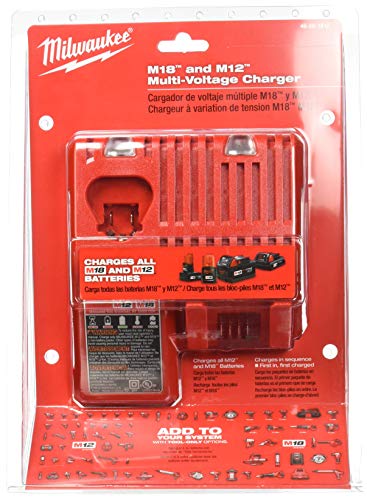
Milwaukee 48-59-1812 M12/M18 Multi-Voltage Charger
M12 and M18Dual chargingSequentialFuel gauge
Check price on Amazon
Best for: Owners who use both M12 and M18 Milwaukee tools.

The 48-59-1812 charges both 12V and 18V Milwaukee batteries and can hold one of each at the same time. It charges them one after the other and communicates with a chip in each battery to track how much charge it has received.

Sequential charging means you do not manage charge cycles: the charger finishes one pack, then starts the next. An onboard fuel gauge shows status. It is a flexible charger for owners who run both M12 and M18 tools, since a single unit replaces two.

The tradeoff is speed. It is not a rapid charger, so two big packs take a while. For a crew, the Super Charger is faster. Keep both batteries clean and seated fully, because a poor connection stops charging and flashes an error. Check which battery the charger prefers when two are loaded.

What works

  • Charges M12 and M18 batteries
  • Holds two packs at once
  • Sequential charging, no management
  • Onboard fuel gauge

Watch out for

  • Slower than the Super Charger
  • Packs charge one at a time

Spec sheet

Platform
M12 and M18
Bays
Holds one of each at once
Charging
Sequential
Communication
Reads battery chip
Display
Onboard fuel gauge
06
Milwaukee M18 PACKOUT Six Bay Rapid Charger
Six baysTwo at a time40% fasterM18 only
Check price on Amazon
Best for: Crews with many M18 batteries who want an organized charging station.

The PACKOUT six bay rapid charger holds six M18 batteries and charges two at once at a rapid rate that Milwaukee says is up to 40 percent faster than standard chargers. After the first two, it automatically moves to the next pair.

Sequential pair charging is useful for a shop or truck that owns many batteries, since you can load all six at the end of the day and have them ready in the morning. It fits M18 batteries only and mounts into the PACKOUT system. A six-bay unit is overkill for someone with two batteries.

It is a storage and charging station in one, and the real benefit is organization. Do not stack it where heat can build up. Plan the layout before you mount it, since a six-bay unit is large, and give it clear space for airflow. Load all six packs at the end of the day and they will be ready in the morning.

What works

  • Holds six M18 batteries
  • Charges two at once, then the next pair
  • Up to 40 percent faster than standard chargers
  • Mounts into PACKOUT

Watch out for

  • Overkill for a few batteries
  • M18 batteries only

Spec sheet

Bays
Six
Charging
Two simultaneously, then next pair
Speed
Up to 40% faster than standard (maker)
Platform
All M18 batteries
System
PACKOUT mounting

Spec sheet decoder

What the numbers on the box really mean

The specs manufacturers lead with, translated into what they tell you about real-world performance.

Charge current (amps)

Amps are how much current the charger pushes into the pack. A 4 amp charger delivers 4 amp-hours per hour at best. It matters most when you own several battery sizes.

Watch forReal charge time depends on the pack's size and temperature.

Minutes to full or 80 percent

Charge time is often quoted to 80 percent, because the last part of the charge is slow. Milwaukee quotes 15 minutes to 80 percent for an XC6.0. It matters most when you own several battery sizes.

Watch forCompare like with like, since full-charge times are longer.

Simultaneous vs sequential

Simultaneous chargers charge several packs at once, and sequential chargers charge them one after another. It matters most when you own several battery sizes.

Watch forA six-bay sequential charger still takes hours to fill six packs.

Active cooling

A fan or airflow path cools the battery during charge. Cooler cells can accept higher current. It matters most when you own several battery sizes.

Watch forFans can clog with dust.

Voltage range

Voltage range shows which platforms a charger accepts, such as 7.2V to 18V on the Makita DC18SD. It matters most when you own several battery sizes.

Watch forA matching voltage does not guarantee compatibility. Check the battery family.

Methodology

How We Evaluated These Power Tool Battery Chargers

Charge time

We compared stated times, from the Milwaukee Super Charger at about 15 minutes to 80 percent to the Makita DC18RC at 45 minutes for a 5.0Ah pack. These factors decide how much time you lose waiting and how long your batteries last.

Cooling and protection

We looked at active cooling, battery chip communication and indicators. The Milwaukee Super Charger and Makita DC18SD stand out. These factors decide how much time you lose waiting and how long your batteries last.

Bay count

We counted bays and charging mode, from single-bay Makita and DeWalt to the six-bay PACKOUT. These factors decide how much time you lose waiting and how long your batteries last.

Compatibility

We checked which platforms each charger supports, such as the DeWalt DCB1104 covering three. These factors decide how much time you lose waiting and how long your batteries last.

Ownership

We considered size, mounting and whether the charger is a genuine maker part. These factors decide how much time you lose waiting and how long your batteries last.

Decision guide

How to Choose the Right Power Tool Battery Chargers

By Brand and Platform

ScenarioPickWhy
M18 crew needing speedMilwaukee 48-59-1815Fast with active cooling
M12 and M18 mixMilwaukee 48-59-1812Dual voltage
LXT home shopMakita DC18RCRapid optimum charger
Mixed Makita packsMakita DC18SD7.2V to 18V with fan
DeWalt 12V, 20V and FLEXVOLTDEWALT DCB1104One charger for all

By Budget

TierPickWhy
EntryDEWALT DCB1104Compact and universal
ValueMakita DC18RCFast and simple
Mid-rangeMilwaukee 48-59-1812Dual voltage
UpperMakita DC18SDFan cooling
ProMilwaukee 48-59-1815 or PACKOUTSpeed or capacity

Single Bay vs Multi-Bay

Single bay

Charges one pack at a time. The Makita DC18RC, DC18SD and DeWalt DCB1104 are single bay.

Multi-bay

Charges several packs with less handling. The Milwaukee Super Charger and PACKOUT are multi-bay.

Pick single bay for a home shop and multi-bay for a crew.

Speed vs Gentleness

PreferencePick
FastestMilwaukee 48-59-1815
Fast and simpleMakita DC18RC
Gentle 4 ampDEWALT DCB1104
Cooled fast chargeMakita DC18SD

For Job-Site Trucks Specifically

Look for

Look for fast charging, mounting options and compatibility with all your packs.

In this comparison

The Milwaukee PACKOUT six bay and Super Charger are the best fits.

When to Spend More

Spend more if

Spend more on the Milwaukee Super Charger if downtime costs you money.

Save if

Save with the DeWalt DCB1104 or Makita DC18RC if you charge overnight.

Ownership

Maintenance schedule

The upkeep that decides whether this machine lasts two seasons or ten.

TaskIntervalWhy it matters
Keep vents clearMonthlyDust blocks airflow and slows charging. Blow out fans with air.
Check the contactsEvery few monthsDirty contacts cause poor charging. Wipe them with a dry cloth.
Charge in a cool placeAlwaysHeat slows charging and ages cells.
Inspect the cordQuarterlyA frayed cord is a fire risk. Replace damaged chargers.
Do not leave packs on foreverAs neededLong storage at full charge ages cells. Remove packs after charging.

FAQ

Frequently Asked Questions

Can I use a different brand's charger?

No. Chargers match their own battery platform. Third-party chargers may not communicate with the pack. Using a mismatched charger can void warranties and risk fire.

Are fast chargers bad for batteries?

Not if they have cooling and communication. Heat is the real enemy. A charger that tapers current and watches temperature protects cells better than raw speed.

How long should a charge take?

A 5.0Ah pack takes about 45 minutes on a rapid charger or an hour on a 4 amp charger. Capacity matters, since a 2.0Ah pack charges quicker than a 6.0Ah pack on the same charger.

Can I leave a battery on the charger?

Modern chargers stop at full, so it is safe overnight. Long storage at full charge ages cells over months. Do not leave packs charging in direct sun or an unventilated enclosure.

Do I need a multi-voltage charger?

Only if you run two voltages of one brand. A single-voltage charger is simpler. Check the model number on your battery before you buy any charger.

Is a six-bay charger worth it?

Only for crews with many packs. A home shop rarely needs more than two bays. For a small shop, one good single-bay charger and a spare pack work better.

Bottom line

The short version

Browse more power tool battery chargerson Amazon →
James Miller, Lead Machine Editor

About the author

James Miller

Lead Machine Editor, MachineFanatic

James Miller leads MachineFanatic's buying guides, turning spec sheets, manuals and owner feedback into clear verdicts on power tools, outdoor power equipment, shop machines and kitchen machines.

More from James →