
Amazon affiliate links - we earn a commission.Affiliate disclosure

Buying guide · 14 min read · Updated 2026-11-07

Best QIDI 3D Printers (2026)

QIDI Q2, Q2C, Plus5 and Max4 printers compared: heated chambers, 370 degree nozzles, build volumes and the engineering materials each one really suits.

James MillerBy James MillerLead Machine Editor4 machines comparedSpec-sheet verified
Best QIDI 3D Printers

At a glance

Our top picks

Side by side

Spec comparison

MachineChamberNozzleSpeedLevelingFrame
QIDI Q2 enclosed 3D printer, 65 C chamber, 370 C nozzleBest OverallQIDI Q2 enclosed 3D printer, 65 C chamber, 370 C nozzleHeated to 65 C370 C, PPS-CF capableUp to 600 mm/sNozzle as sensorFull-metal CoreXY with linear rails
QIDI Q2C 3D printer, 370 C bimetal hotend, no chamber heaterBest ValueQIDI Q2C 3D printer, 370 C bimetal hotend, no chamber heaterNo active heatingn/aUp to 600 mm/sFully automatic, nozzle sensorFull-metal CoreXY with linear rails
QIDI Plus5 3D printer, 320x320x300 mm, 65 C chamber, 370 C nozzleBest Mid SizeQIDI Plus5 3D printer, 320x320x300 mm, 65 C chamber, 370 C nozzleHeated to 65 C370 Cn/an/an/a
QIDI Max4 3D printer, 390x390x340 mm, 65 C chamber, dual Z screwsBest Large FormatQIDI Max4 3D printer, 390x390x340 mm, 65 C chamber, dual Z screwsHeated to 65 Cn/an/an/an/a

This maker focuses on enclosed CoreXY printers that can run engineering plastics at home prices, and the range is easy to confuse. Several models look alike, and the differences sit in three places: whether the chamber is actively heated, how large the plate is and what the hotend can reach in temperature.

Reading the lineup means separating headline claims from the parts that change results. A heated chamber, a hardened nozzle and rigid linear rails matter for nylon and carbon fiber filled filaments, while a larger plate matters only when your parts need it. The four machines below cover the compact, mid and large ends of the range.

Before you buy

6 Criteria to Look For Before Buying a QIDI 3D Printer

  1. 01

    Chamber heat or passive enclosure

    The Q2, Plus5 and Max4 hold a chamber near 65 degrees Celsius, which stops warping on ABS, ASA, nylon and carbon fiber filaments. The Q2C does not heat its chamber, so it suits PLA, PETG and TPU. A heated chamber also softens PLA near the toolhead, so low-temperature filaments sometimes need the lid open. Buy chamber heat only if you will print the materials that need it. A buyer who prints PLA toys all year pays for a heater and warm-up time that never helps, while a buyer who prints nylon gears on a passive frame fights warping on every plate. Write down your three most common filaments and let them decide.

  2. 02

    Build volume versus space

    The Q2 and Q2C have compact plates, the Plus5 offers 320 by 320 by 300 millimeters and the Max4 reaches 390 by 390 by 340. Bigger plates make large parts possible but need more bench space, longer warm-ups and more filament per failure. Measure your biggest regular part and add margin, because most hobby parts fit on the smaller machines. A single big part is also better split into two pieces and glued than risked on a thirty hour print, so volume is worth paying for only when parts truly cannot be split, such as a one-piece enclosure or a long guide rail.

  3. 03

    Hotend temperature and nozzle wear

    A 370 degree hotend, listed on all four machines, can print PPS-CF, PPA-CF and polycarbonate. Filled filaments wear soft nozzles quickly, so hardened or bimetal nozzles matter. The Max4 lists a hardened steel nozzle and the Q2C a bimetal hotend. Plan to replace nozzles as a regular consumable. A carbon fiber roll can chew through a soft nozzle in a few kilograms, so check the nozzle material before you buy abrasive filament, and keep a spare of the right diameter in the drawer before a long job begins. Swapping nozzles while the hotend is still warm is easier and prevents stripped threads, so plan the swap at the end of a print rather than from cold.

  4. 04

    Leveling method

    The Q2 and Q2C use the nozzle itself as the leveling sensor, so first-layer accuracy does not depend on the bed surface. That matters because beds wear and dirty plates confuse probes. A reliable first layer is the biggest factor in beginner success, so favor machines with this design. When the probe is the nozzle, residue on the tip can still throw the measurement off, so clean the nozzle before each calibration and keep a brass brush near the machine for quick wipes.

  5. 05

    Speed ceilings

    The Q2 and Q2C list up to 600 millimeters per second, and the Max4 lists a 40 cubic millimeter per second hotend flow. These are ceilings. Real print time depends on acceleration, flow and part shape, so do not expect average speeds near the headline numbers. Faster motion also adds noise and can cause ringing on thin walls, and a strong print at a moderate speed is usually better than a rough print at maximum speed.

  6. 06

    Multi-filament options

    The Combo versions add a multi-filament box for multi-color or multi-material printing. These systems add purge waste and more parts to jam. Choose a Combo only if you will print color often, and expect extra filament use for each color change. If you only need two colors, a manual swap at a chosen layer costs nothing and avoids the extra hardware entirely, which is worth testing before you buy the box.

Detailed reviews

The 4 best qidi 3d printers, explained

01
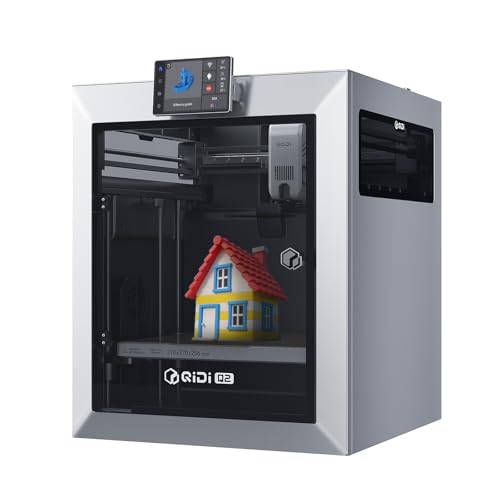
QIDI Q2 enclosed 3D printer, 65 C chamber, 370 C nozzle
65 C chamber370 C nozzle600 mm/sAir filtration
Check price on Amazon
Best for: Buyers who want a heated chamber without a large footprint.

The Q2 is built around a full-metal CoreXY frame with precision linear rails, a heated chamber that holds 65 degrees Celsius and a hotend rated to 370 degrees. That combination lets it print engineering filaments, including carbon fiber filled PPS, that cheaper open-frame machines cannot handle. The maker also lists an air filtration system, which helps with fumes from ABS and ASA.

The nozzle doubles as the leveling sensor, which means first-layer accuracy does not depend on the bed surface. That removes one of the biggest sources of beginner failures, since a dirty plate or a worn sheet no longer confuses the probe. Speed is listed at up to 600 millimeters per second, which is a ceiling rather than a typical print speed, because corners and short moves never reach it.

The tradeoff is size and cost. The Q2 has a smaller build plate than the Plus5 or Max4, and the heated chamber adds weight and warm-up time. Against the Q2C, it adds chamber heat at a higher price, and against the larger models it gives up volume. In ownership, the hardened parts last well, but nozzles wear on filled filaments, so keep spares. Dry nylon and PETG before long prints, and replace filters on the maker's schedule.

What works

  • Heated 65 C chamber stops warping
  • 370 C hotend handles filled filaments
  • Nozzle-based leveling ignores bed surface
  • Air filtration for ABS and ASA fumes

Watch out for

  • Smaller plate than the Plus5 and Max4
  • Chamber adds weight and warm-up time
  • Speed headline is a ceiling, not typical

Spec sheet

Chamber
Heated to 65 C
Nozzle
370 C, PPS-CF capable
Speed
Up to 600 mm/s
Leveling
Nozzle as sensor
Frame
Full-metal CoreXY with linear rails
02
QIDI Q2C 3D printer, 370 C bimetal hotend, no chamber heater
370 C hotendNo chamber heat600 mm/sAuto leveling
Check price on Amazon
Best for: Hobbyists printing PLA, PETG and TPU who want speed and accuracy.

The Q2C is the Q2 without the chamber heater, and the maker is explicit that the two are different machines. It keeps the 370 degree bimetal hotend, the full-metal CoreXY frame, linear rails and fully automatic leveling through a nozzle-integrated sensor. The result is a fast, accurate printer for PLA, PETG, TPU and other low-temperature materials.

The tradeoff is clear. Without chamber heating, materials such as ABS, ASA and nylon are far harder to print without warping, so the Q2C is a better match for hobby work than for engineering parts. Compared with the Q2, it costs less and heats up faster, but you lose the thermal stability that makes technical plastics reliable.

In year three, the Q2C's simplicity is an advantage. There are fewer parts to fail, and a passive enclosure still keeps drafts out. Keep the nozzle clean, lubricate the rails on schedule and avoid printing high-temperature filaments you cannot support. If you later need chamber heat, you must buy the Q2 or a larger machine instead.

What works

  • 370 C bimetal hotend with fast heat up
  • Fully automatic nozzle-sensor leveling
  • Linear rails and full-metal CoreXY frame
  • Lower cost than the heated-chamber Q2

Watch out for

  • No chamber heating for ABS or nylon
  • Smaller plate than large models
  • Cannot be upgraded to a heated chamber

Spec sheet

Hotend
370 C bimetal
Chamber
No active heating
Speed
Up to 600 mm/s
Leveling
Fully automatic, nozzle sensor
Frame
Full-metal CoreXY with linear rails
03
QIDI Plus5 3D printer, 320x320x300 mm, 65 C chamber, 370 C nozzle
320x320x300 mm65 C chamber370 C nozzleLinear rails
Check price on Amazon
Best for: Makers printing functional engineering parts that exceed a 250 mm plate.

The Plus5 offers a 320 by 320 by 300 millimeter build volume, which the maker says is 18 percent larger than the Plus4. It has a rigid CoreXY structure, X-axis linear guide rails and 9 millimeter 1.5GT timing belts, designed for stiff motion at speed. A heated chamber near 65 degrees and a 370 degree nozzle target materials such as PPS-CF, PPA-CF, polycarbonate and nylon.

The mid-size plate is the right answer for functional parts such as brackets, enclosures and jigs that outgrow a 250 millimeter machine. A larger plate also means longer prints and bigger failures, so it rewards good filament drying and a careful first layer. Compared with the Max4, it is smaller but easier to place on a bench, and against the Q2 it adds volume at a higher cost.

Ownership is about calibration and consumables. Large plates need careful leveling and a clean surface, and hardened nozzles still wear on filled filaments. Keep spare nozzles, replace belts when they fray and use a dry box for nylon. The combo version adds a multi-filament system for color, at the cost of purge waste.

What works

  • 320x320x300 mm volume for functional parts
  • Heated 65 C chamber for engineering plastics
  • Linear rails and 9 mm belts for stiff motion
  • Rated for PPS-CF, PPA-CF, PC and nylon

Watch out for

  • Larger plate makes failures more costly
  • Needs a dry box for nylon
  • More bench space than the Q2

Spec sheet

Build volume
320x320x300 mm
Chamber
Heated to 65 C
Nozzle
370 C
Belts
9 mm 1.5GT
Materials
PPS-CF, PPA-CF, PC, nylon
04
QIDI Max4 3D printer, 390x390x340 mm, 65 C chamber, dual Z screws
390x390x340 mm65 C chamber40 mm3/s hotendClosed-loop XY
Check price on Amazon
Best for: Workshops printing large parts in one piece.

The Max4 is the largest machine in the range, with a 390 by 390 by 340 millimeter plate that the maker says is 55 percent larger than the Max3. It combines closed-loop motors on the X and Y axes, dual Z lead screws and a high-flow 40 cubic millimeter per second hotend with a hardened steel nozzle. A heated chamber near 65 degrees supports standard materials such as PLA and ABS as well as engineering filaments.

The tradeoff is size, noise and time. A big plate takes longer to heat and print, and the machine needs a sturdy bench. Against the Plus5, it adds volume and faster flow, while against the Q2 it is far larger but not meaningfully simpler to run.

In ownership, treat it as a workshop tool. Calibrate the bed carefully, because a small error across 390 millimeters is visible, and dry filament before long jobs. Check belts and rails every few months and replace the hardened nozzle when its bore wears. The combined cost of filament for big parts is the real running expense. Because a failed twenty hour print wastes so much material, many owners add a camera or check the first layer carefully before leaving the machine unattended overnight.

What works

  • 390x390x340 mm plate for large parts
  • Closed-loop XY motors and dual Z screws
  • 40 mm3/s hotend with hardened nozzle
  • Heated 65 C chamber for engineering plastics

Watch out for

  • Large, loud and heavy for a desk
  • Long prints make failures expensive
  • Highest filament use in the range

Spec sheet

Build volume
390x390x340 mm
Chamber
Heated to 65 C
Flow
40 mm3/s hotend
Motors
Closed-loop X and Y
Z axis
Dual lead screws

Spec sheet decoder

What the numbers on the box really mean

The specs manufacturers lead with, translated into what they tell you about real-world performance.

Active chamber heat

A heater that raises the air temperature inside the enclosure. It prevents warping on engineering plastics.

Watch forThe Q2, Plus5 and Max4 list 65 C, while the Q2C has none.

Bimetal hotend

A heat break and nozzle assembly designed to resist wear and run at high temperature.

Watch forThe Q2C lists a 370 C bimetal hotend.

Nozzle as sensor

A leveling method where the nozzle detects the bed. It avoids a separate probe.

Watch forThe Q2 and Q2C use it.

Closed-loop motors

Motors with position feedback that correct missed steps. They improve accuracy at speed.

Watch forThe Max4 lists them on X and Y.

Volumetric flow

How much plastic the hotend can melt per second. It caps usable speed on big layers.

Watch forThe Max4 lists 40 mm3/s.

Methodology

How We Evaluated These QIDI 3D Printers

Material range

We compared chamber heat and hotend rating across the four machines. The Q2, Plus5 and Max4 cover engineering plastics, while the Q2C targets low-temperature materials. We judged each against the materials it claims.

Build volume

We compared plates from the compact Q2 to the 390 by 390 by 340 millimeter Max4. We weighed volume against bench space and failure cost. Bigger was not treated as better by default.

Motion and leveling

We looked at frames, rails and leveling methods. The nozzle-sensor design and linear rails earned credit. Speed ceilings were treated as ceilings.

Ease for beginners

We weighed automatic leveling, enclosure and setup. The Q2 and Q2C are friendlier than the large machines. Heavier machines need more calibration.

Cost and fit

We weighed price against capability. The Q2C is the value core, while the Max4 is the premium. We avoided recommending machines for features a buyer will not use, and we marked down any model whose price premium buys a plate size or chamber the typical hobby part never needs.

Decision guide

How to Choose the Right QIDI 3D Printers

By Material

SituationPickWhy
PLA, PETG, TPU hobby printsQIDI Q2CFast with no chamber heater
ABS, ASA and nylonQIDI Q2Heated 65 C chamber
Carbon fiber filled filamentsQIDI Plus5370 C nozzle and 65 C chamber
Large engineering partsQIDI Max4390x390x340 mm plate
Mixed everyday workQIDI Q2Chamber heat on a compact frame

By Budget

Budget tierPickWhy
Lowest costQIDI Q2CNo chamber heater
Mid rangeQIDI Q2Heated chamber
Upper midQIDI Plus5Larger plate
HighestQIDI Max4Largest plate
Best value for engineeringQIDI Q2Chamber heat at a modest cost

Heated Chamber vs Passive Enclosure

Heated chamber (Q2, Plus5, Max4)

A 65 degree chamber reduces warping and layer splits on ABS, ASA, nylon and carbon fiber filaments. It adds weight, warm-up time and cost, and it can soften PLA.

Passive enclosure (Q2C)

The Q2C keeps drafts out but does not heat the chamber. It is cheaper and quicker to start, and it suits PLA, PETG and TPU well.

Choose the heated chamber for engineering plastics and the Q2C for hobby filaments.

Plate Size

PreferencePickWhy
Small deskQIDI Q2Compact plate
Hobby deskQIDI Q2CCompact and quick
Functional partsQIDI Plus5320x320x300 mm
Biggest partsQIDI Max4390x390x340 mm
Mixed sizesQIDI Plus5Mid-size balance

For Engineering Filaments Specifically

Look for

A heated chamber, a hotend rated to at least 350 degrees and a hardened nozzle. Dry nylon and PETG before printing. Ventilate the room because fumes from some filaments are unpleasant.

In this comparison

The QIDI Q2 is the best balance, the Plus5 adds volume and the Max4 handles large parts. The Q2C is not suited to ABS or nylon.

When to Spend More

Spend more if

You print engineering plastics or large parts. The QIDI Q2, Plus5 and Max4 justify their cost with chamber heat and volume.

Save if

You print PLA and PETG. The QIDI Q2C delivers the same speed and leveling without chamber heat.

Ownership

Maintenance schedule

The upkeep that decides whether this machine lasts two seasons or ten.

TaskIntervalWhy it matters
Replace the nozzleEvery few months or on wearFilled filaments wear the bore and reduce quality. Keep spare nozzles on hand.
Dry the filamentBefore long printsNylon and PETG absorb moisture and cause stringing. Dry them in a dedicated box.
Lubricate railsEvery few monthsDry rails cause noise and ringing. Use the grease the maker recommends.
Replace filtersPer maker scheduleAir filters saturate over time. Old filters stop capturing fumes.
Check belt tensionEvery few monthsLoose belts cause layer shifts. Retension to the maker's guide.

FAQ

Frequently Asked Questions

What is the difference between the Q2 and Q2C?

The Q2 has an actively heated 65 degree chamber, while the Q2C has no chamber heating. Both share a full-metal CoreXY frame, linear rails and a 370 degree hotend. Choose the Q2 for ABS and nylon and the Q2C for PLA and PETG. The Q2C cannot be upgraded later, so if there is any chance you will move to engineering plastics within a year, buy the Q2 now.

How much should I budget for a QIDI printer?

The printer is the main cost, and the Q2C is the cheapest. Add filament, spare nozzles, filters and a dry box. Large machines also use more filament per part. A kilogram spool of nylon or carbon fiber filament costs several times a spool of PLA, so the running cost climbs quickly if you move to engineering plastics.

How long do these printers last?

Frames and rails last years with care. Nozzles, belts and filters wear and need replacing. A heated chamber ages plastic parts faster than an open frame. Run the chamber only when the material needs it, and let it cool before opening the lid to protect the electronics and your hands.

Do I need a heated chamber?

Only for ABS, ASA, nylon and carbon fiber filaments. PLA and PETG print fine without it. The chamber can soften PLA, so the Q2C is simpler for hobby work.

Is 600 mm/s the real speed?

No. It is a ceiling. Corners and short moves limit actual speed, so real prints are slower than the headline figure. Treat the number as a sign of frame quality and acceleration capability, then judge machines by reported print times for a part similar to yours.

Can I print multi-color?

The Combo versions add a multi-filament box. Color changes purge filament, so expect waste. Choose a Combo only if you will print color often.

Bottom line

The short version

Browse more qidi 3d printerson Amazon →
James Miller, Lead Machine Editor

About the author

James Miller

Lead Machine Editor, MachineFanatic

James Miller leads MachineFanatic's buying guides, turning spec sheets, manuals and owner feedback into clear verdicts on power tools, outdoor power equipment, shop machines and kitchen machines.

More from James →

Keep reading

Related guides