
Amazon affiliate links - we earn a commission.Affiliate disclosure

Buying guide · 15 min read · Updated 2026-11-09

Best Reciprocating Saws Under $100 (2026)

Five reciprocating saws under $100, four corded and one cordless, compared on amps, stroke length, pivoting shoes and the demolition jobs they can handle.

James MillerBy James MillerLead Machine Editor5 machines comparedSpec-sheet verified
Best Reciprocating Saws Under $100

At a glance

Our top picks

Side by side

Spec comparison

A reciprocating saw drives a blade back and forth through wood, nails, pipe and sheet metal, and it exists for jobs where a clean cut does not matter. The headline numbers, from strokes per minute to blade length, hide big differences in how hard each stroke bites and how the tool handles when the blade binds.

This guide explains what a spending cap of $100 buys, what you give up against a pro demolition saw, and how to read amps, stroke length and shoe design. Our top picks are above, with full reviews below. Prices move, and the cap reflects listing prices when this guide was updated.

Before you buy

6 Criteria to Look For Before Buying a Reciprocating Saw Under $100

  1. 01

    Motor power and reserve

    A reciprocating saw reverses its blade thousands of times a minute, so motor reserve decides whether it keeps cutting when the blade hits a nail or wet wood. The WEN at 10 amps leads, the Craftsman and SKIL at 7.5 amps follow and the DEKOPRO at 710 watts is the smallest. Buyers often look at strokes per minute, but a high rate with a weak motor only bogs faster. For reference, the WEN's rated 4-1/2 inch wood capacity needs a long blade, so the real limit is often the blade you fit rather than the motor.

  2. 02

    Stroke length

    Stroke length is the distance the blade travels forward and back. The Craftsman at 1-1/8 inch is the longest here, the DEKOPRO at 20 mm, about 3/4 inch, is the shortest. A longer stroke clears chips better and cuts faster in wood, but makes more vibration. A shorter stroke vibrates less in your hands but takes more passes to clear a 4x4, which is why pruning saws with short strokes feel smoother.

  3. 03

    Pivoting shoe or head

    A shoe that pivots or a head that rotates lets you cut flush against a wall or lean the blade for plunge cuts. The WEN has an eight-position head with stops every 45 degrees. For wall demolition and tight plumbing, this feature is worth paying for. Flush cutting a bolt off a wall or trimming a door jamb from the floor are the jobs where this feature earns its price.

  4. 04

    Gear housing and build

    A metal gear housing resists the shock of a blade binding, and a plastic one cracks. The SKIL 9206-02 lists heavy-duty metal. Check how a saw feels in your hand, since vibration is the main complaint with cheap saws. Another sign of a poor saw is a loose shoe, which rattles against the work and makes the blade chatter.

  5. 05

    Blade change system

    Tool-free blade change saves time and keeps fingers away from hot blades. The Craftsman, SKIL, DEKOPRO and SEESII all have quick release. Blades do most of the work, so budget for a pack of wood demolition and metal blades. A blade clamp that does not release with a gloved hand is a common complaint, so test it with work gloves on.

  6. 06

    Corded or cordless

    A corded saw runs all day and a cordless saw goes anywhere. The SEESII's two 4.0 Ah packs suit pruning and plumbing, while the corded saws suit demolition. For long jobs, corded wins. Cordless saws also lose power as the pack drains, so keep a second pack charged for any demolition job.

Detailed reviews

The 5 best reciprocating saws under $100, explained

01
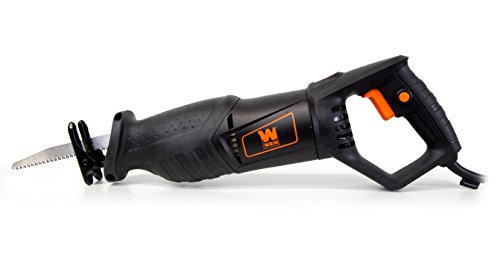
WEN 3630 10 Amp Reciprocating Saw with 8-Position Pivoting Head
10 amp motor0-2800 SPM8-position head4-1/2 in wood
Check price on Amazon
Best for: Demolition, pruning and plumbing cuts where motor reserve matters.

The WEN 3630 is the heaviest hitter in this roundup, built around a 10 amp motor that the maker says handles up to 4-1/2 inches of wood and about 3/5 inch of metal. A bigger motor matters in a reciprocating saw because the blade changes direction thousands of times a minute, and each reversal costs energy; a motor with reserve keeps the stroke rate up when the blade bites into a wet stud.

The head pivots to eight stops, one every 45 degrees, so you can reorient the shoe and the blade to cut flush against a wall or floor. The pressure-sensitive trigger gives 0 to 2800 strokes per minute, which means you can feather a start in thin metal and then push through. Compared with the Craftsman's 7.5 amps, the WEN has a third more current draw, and against the SKIL it shares the same type of design with more motor.

A saw this size vibrates hard, so use both hands and keep the shoe against the work. Check the brushes after a few demolition jobs, and replace blades when the teeth round off, because a dull blade turns into a heat source. Carry a spare set of demolition blades with thick bodies, because a flexing thin blade wanders and snaps when it hits a nail at full stroke.

What works

  • 10 amp motor has the most reserve in this roundup
  • Pivoting head with eight stops allows flush cuts in corners
  • Pressure-sensitive trigger gives 0 to 2800 strokes per minute
  • Rated for wood up to 4-1/2 inches thick

Watch out for

  • Heavier and more vibration than the 7.5 amp saws
  • Corded design needs an outlet or extension cord
  • Brand support is thinner than a major tool name

Spec sheet

Motor
10 amp corded
Stroke rate
0 to 2800 SPM
Trigger
Pressure-sensitive variable speed
Head
Pivots, 8 stops every 45 degrees
Wood capacity
Up to 4-1/2 inches
Metal capacity
Up to 3/5 inch
02
Craftsman CMES300 7.5 Amp Corded Reciprocating Saw
7.5 amp motor3200 SPM1-1/8 in strokeTool-free blade
Check price on Amazon
Best for: Faster wood cuts and pruning where a long stroke helps clear chips.

The CMES300 combines a 7.5 amp motor with a 1-1/8 inch stroke, which is the longest in the roundup. Stroke length is the distance the blade travels forward and back, and a longer stroke moves more of the blade through the cut on each cycle, clearing chips and making faster progress in wood. At up to 3200 strokes per minute it also leads on top speed.

The tradeoff is the motor. A 7.5 amp motor has less reserve than the WEN's 10 amps, so in a nail-embedded stud it slows sooner. Against the SKIL, which has the same amp rating and a metal gear housing, the Craftsman wins on stroke and speed, while the SKIL may offer a tougher gearbox.

The tool-free blade release saves a key and time. Keep the shoe pressed against the work to reduce vibration and replace blades when they dull. A Craftsman name also means blades and parts are easy to find. Pair it with a 6 inch wood blade at 6 teeth per inch for rough framing and a 12 inch pruning blade for branches, and the long stroke does the rest.

What works

  • 1-1/8 inch stroke is the longest here and clears chips faster
  • Top speed of 3200 strokes per minute is the highest
  • Variable-speed trigger helps start cuts on metal
  • Tool-free blade release saves time

Watch out for

  • 7.5 amp motor has less reserve than the 10 amp WEN
  • Nothing is stated about pivoting head or shoe adjustment
  • Vibrates noticeably when blade binds

Spec sheet

Motor
7.5 amp corded
Stroke rate
0 to 3200 SPM
Stroke length
1-1/8 inch
Trigger
Variable speed
Blade change
Tool-free release
Brand
Craftsman
03
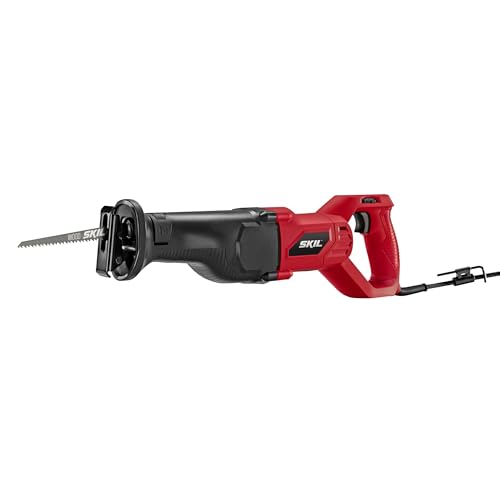
SKIL 9206-02 7.5 Amp Variable Speed Reciprocating Saw
7.5 amp motorMetal gear housingTool-less bladeVariable speed
Check price on Amazon
Best for: Homeowners who want a durable gearbox for occasional demolition.

SKIL's 9206-02 pairs the same 7.5 amp motor as the Craftsman with a heavy-duty metal gear housing, which is the part of a reciprocating saw that takes the most abuse. Plastic gear housings flex and crack under the repeated shock of a blade binding, so a metal housing is a durability signal that matters more than a half-amp of motor.

The tool-less blade change and variable speed are standard, and the maker publishes little else. Compared with the WEN, it has less motor and no pivoting head, and against the Craftsman it has a similar motor with fewer published specs. It is the saw for a homeowner who expects occasional demolition, a few pruned limbs and some PVC cuts.

Keep the vents clear and the cord untangled. Use fresh blades, since a dull blade drags the motor and makes the saw hot. Because a metal housing adds weight, expect it to feel a little more solid in the hand than the plastic-bodied DEKOPRO and to tire your forearm sooner.

What works

  • Heavy-duty metal gear housing resists cracks from blade binding
  • 7.5 amp motor handles pruning and light demolition
  • Tool-less blade change needs no key
  • Recognized brand with easy blade and parts access

Watch out for

  • Few published details on stroke length or shoe design
  • 7.5 amp motor has less reserve than the WEN
  • No pivoting head for flush cuts

Spec sheet

Motor
7.5 amp corded
Gear housing
Heavy-duty metal
Blade change
Tool-less
Speed
Variable
Brand
SKIL
Type
Corded full-size
04
DEKOPRO 710W Reciprocating Saw, 2800 SPM, 20 mm Stroke
710 W motor2800 SPM20 mm strokeQuick chuck
Check price on Amazon
Best for: Pruning, PVC and light cutting at a low cost.

The DEKOPRO quotes 710 watts, which equals about 6 amps at household voltage, with a 20 millimeter stroke and a variable speed up to 2800 strokes per minute. The stroke is about 3/4 inch, noticeably shorter than the Craftsman's 1-1/8 inch, which means each stroke clears less chip and cuts slower in thick wood.

Four blades come in the box, which helps a first-time buyer, and a quick chuck swaps them without a key. The tradeoff is that it is the smallest of the corded saws in motor and stroke, so it is better suited to pruning, plastic pipe and thin wood than to heavy demolition. Against the SKIL, it gives up about a stroke length and a metal housing, and against the WEN it has far less motor.

Treat it as a light-duty tool. Let the shoe ride on the work, avoid forcing the blade and replace blades often, since a short stroke saw wears blades fast. A short stroke is not a flaw for pruning, where the blade spends most of its time in green wood that cuts easily, but it will frustrate you in a 4x4 post.

What works

  • Four blades included in the box
  • Quick chuck swaps blades without a key
  • Variable speed up to 2800 strokes per minute
  • Light enough for one-handed pruning cuts

Watch out for

  • 20 mm stroke is the shortest of the corded saws
  • Motor is less powerful than the WEN or Craftsman
  • Not suited to heavy demolition

Spec sheet

Motor
710 W corded
Stroke rate
2800 SPM variable
Stroke length
20 mm (about 3/4 inch)
Blade change
Quick chuck
Blades
4 included
Type
Corded
05
SEESII 21V Cordless Reciprocating Saw with Two 4.0 Ah Packs
21V cordless3500 SPM2 lb body2 x 4.0 Ah packs
Check price on Amazon
Best for: One-handed pruning and tight plumbing cuts away from an outlet.

The SEESII is a compact cordless saw at 2.0 pounds, built for one-handed use. It has a variable speed up to 3500 strokes per minute, two 4.0 Ah packs and six blades in the box, which makes it a complete kit for pruning, plumbing cuts and trim removal.

A cordless reciprocating saw has to deliver its energy from a battery, and a compact saw gives up stroke length and power. Against the WEN, it has far less cutting capacity in thick lumber, but it fits into a gap behind a pipe where a full-size saw cannot swing. Two 4.0 Ah packs give you real run time for light work.

The platform is a lesser known one, so treat it as a stand-alone kit. Charge one pack while using the other, store the packs indoors and swap blades when the teeth round. Cordless reciprocating saws also lose power as the pack drains, so swap to the second pack before the stroke visibly slows.

What works

  • 2.0 lb body is easy to use one-handed
  • Two 4.0 Ah packs and six blades come in the box
  • Top speed of 3500 strokes per minute
  • Cordless, so it works up a ladder or in a crawlspace

Watch out for

  • Less cutting capacity in thick lumber than a corded saw
  • Small platform with few matching tools
  • Packs run out during long demolition sessions

Spec sheet

Voltage class
21V
Batteries
Two 4.0 Ah
Stroke rate
Variable, up to 3500 SPM
Weight
2.0 lb
Blades
6 included
Operation
One-handed

Spec sheet decoder

What the numbers on the box really mean

The specs manufacturers lead with, translated into what they tell you about real-world performance.

SPM (strokes per minute)

The number of back-and-forth cycles per minute. A higher number cuts faster in soft material, but on metal a lower speed prevents the blade from overheating and losing its temper.

Watch forThe Craftsman's 3200 SPM and the SEESII's 3500 SPM are no-load numbers that drop under load.

Stroke length

How far the blade travels each cycle. Longer strokes clear more material per cut.

Watch forThe DEKOPRO's 20 mm is about 3/4 inch, compared with the Craftsman's 1-1/8 inch.

Amps and watts

Current draw and power input. A 710 watt tool draws about 6 amps at 120 volts.

Watch forCompare amps with amps, since the DEKOPRO's 710 W is far less than the WEN's 10 amps.

Orbital action

A forward swing of the blade on the cutting stroke, found on higher-end saws. It speeds up wood cutting by lifting the blade away from the kerf on the return stroke.

Watch forNone of these saws publishes an orbital setting, so expect straight-line action.

Cutting capacity

The maximum thickness of material the saw can cut, based on blade length and stroke. Capacity figures assume a long, sharp blade and a firm shoe contact.

Watch forThe WEN's 4-1/2 inch wood and 3/5 inch metal claims depend on a long blade and a sharp edge.

Methodology

How We Evaluated These Reciprocating Saws Under $100

Motor power

We began with amps. The WEN at 10 led, the Craftsman and SKIL at 7.5 followed and the DEKOPRO at 710 watts was the smallest. We treated the 10 amp figure as the clearest differentiator, since stroke rate claims cluster between 2800 and 3500 across the group.

Stroke and speed

We compared stroke length and strokes per minute. The Craftsman's 1-1/8 inch stroke and 3200 SPM led the corded saws. The DEKOPRO's 20 mm stroke and the SEESII's compact stroke ranked lowest for wood.

Shoe and head

We looked at pivoting features. The WEN's eight-position head stood out.

Build quality

We considered gear housing and handle design. The SKIL's metal gear housing stood out.

Owner feedback patterns

We noted recurring themes such as vibration and blade binding. Lesser known labels were scored cautiously for parts support.

Decision guide

How to Choose the Right Reciprocating Saws Under $100

By Job

Pick by the toughest cut you expect to make, because demolition and pruning ask different things of a saw.

SituationPickWhy
Demolition and thick lumberWEN 363010 amps and a pivoting head
Faster wood cutsCraftsman CMES300Longest stroke at 1-1/8 inch
Occasional demolitionSKIL 9206-02Metal gear housing
Pruning and PVCDEKOPRO 710WFour blades included
Tight cuts and laddersSEESII Cordless2 lb and one-handed

By Budget

Budget tierPickWhy
CheapestDEKOPRO 710WLight-duty corded
LowSKIL 9206-02Durable gearbox
Low to midCraftsman CMES300Long stroke
MidSEESII CordlessTwo packs and six blades
HighestWEN 3630Most motor and features

Corded vs Cordless

Corded

The WEN, Craftsman, SKIL and DEKOPRO run without limit and have more cutting power. They need an outlet.

Cordless

The SEESII goes anywhere and is light, but it cuts less in thick lumber and runs out of charge.

Pick corded for demolition. Pick cordless for pruning and tight plumbing.

Stroke and Head Design

Design details decide how a saw feels at the end of a long cut, even when the spec sheets look alike.

PreferencePickWhy
Pivoting headWEN 3630Eight stops every 45 degrees
Long strokeCraftsman CMES3001-1/8 inch
Shorter stroke, light toolDEKOPRO 710W20 mm stroke
Metal housingSKIL 9206-02Heavy-duty gear housing
One-handedSEESII2 lb body

For Tree Pruning Specifically

Look for

A pruning blade with wide teeth, a light body and a variable-speed trigger. A cordless saw avoids a cord on a ladder.

In this comparison

The SEESII is the best fit for ladder work, and the WEN suits thick limbs on the ground.

When to Spend More

Spend more if

You demolish often. A pro saw with orbital action and a sturdier gearbox outlasts the WEN.

Save if

You cut a few times a year. The DEKOPRO or SKIL covers that.

Ownership

Maintenance schedule

The upkeep that decides whether this machine lasts two seasons or ten.

TaskIntervalWhy it matters
Replace bladesWhen cuts slow or smokeA dull blade strains the motor and heats the work, and a blade that smokes has already lost its temper. Fresh blades are the cheapest upgrade, and thicker demolition blades last longer in nail-embedded wood.
Check the shoe and clampEvery few jobsA loose shoe causes vibration and blade chatter, and a worn shoe pivot lets the blade wander. Tighten or replace worn parts before they damage the blade clamp.
Inspect the cordBefore each useA nicked cord is a shock hazard. Replace damaged cords.
Check brushesAfter several years of useWorn brushes cause weak power. Replace them in pairs.
Blow out dustAfter dusty jobsDust raises motor temperature. Compressed air keeps it cool.

FAQ

Frequently Asked Questions

Do I need a corded or cordless reciprocating saw?

Corded for demolition and sustained cutting, cordless for convenience. The SEESII suits pruning.

What does $100 buy in a reciprocating saw?

A 6 to 10 amp corded saw or a basic cordless kit. You give up orbital action and a pro gearbox. The cap reflects listing prices when this guide was updated.

Which blade should I use?

Use coarse blades with 6 teeth per inch for wood, fine blades with 14 to 18 teeth per inch for metal and bi-metal blades for lumber that may hide nails. Match the blade length to the thickness you are cutting, since the blade should extend at least an inch past the work.

Why does my saw vibrate so much?

A reciprocating saw vibrates by design because the blade reverses direction thousands of times a minute. Keep the shoe pressed against the work and let the saw cut at its own pace, which cuts vibration and blade wear.

Can I cut metal pipe?

Yes, with a metal blade and a lower speed. Clamp the pipe.

Do I need safety gear?

Yes. Wear eye protection and gloves, and check behind the cut for wires and pipes before you start. Keep both hands on the saw and let the blade stop before setting it down.

Bottom line

The short version

Browse more reciprocating saws under $100on Amazon →
James Miller, Lead Machine Editor

About the author

James Miller

Lead Machine Editor, MachineFanatic

James Miller leads MachineFanatic's buying guides, turning spec sheets, manuals and owner feedback into clear verdicts on power tools, outdoor power equipment, shop machines and kitchen machines.

More from James →

Keep reading

Related guides