
Amazon affiliate links - we earn a commission.Affiliate disclosure

Buying guide · 13 min read · Updated 2026-11-17

Best Rice Cooker Under $200 (2026)

Six rice cookers at or below $200 on their listing prices: a micom Zojirushi, a glass-lid 6-cup, fuzzy logic Cosori and AROMA digitals, with upkeep notes.

James MillerBy James MillerLead Machine Editor6 machines comparedSpec-sheet verified
Best Rice Cooker Under $200

At a glance

Our top picks

Side by side

Spec comparison

Two hundred dollars is where rice cookers stop being appliances and start being tools. The extra money over a budget cooker buys better temperature control, a pot that releases cleanly and a longer record of reliability, but it does not buy the induction and pressure flagships. We kept every pick at or below the cap on its listing price when this guide was updated, and prices move, so check the live listing.

Siblings under a lower cap already cover plain white rice. Here the question is which upgrade is worth paying for: a micom brain, a larger pot, a glass lid or a set of digital presets. We evaluated the six on that trade, not on how long the feature list is.

Before you buy

6 Criteria to Look For Before Buying a Rice Cooker Under $200

  1. 01

    What $200 adds over cheaper caps

    A lower cap already buys plain cookers and a few fuzzy logic models, such as the Cosori. At $200 you can add a micom controller from Zojirushi, the compact GABA brown cooker and a glass lid classic. The upgrade is reliability and control, not size.

  2. 02

    Micom versus digital program

    The Zojirushi micom cooker reads the pot and adjusts. The AROMA digital models follow programs, with the Professional adding moisture sensing. If you cook brown rice or small batches, micom or sensor control is the upgrade worth paying for.

  3. 03

    Capacity for your table

    The Zojirushi compact is 3 cups and the 6-cup Zojirushi serves three or four. The Cosori is 10 cups, and the AROMA digitals are 4 raw cups. Start from the number of people, not the feature list.

  4. 04

    Coating and pot

    The AROMA CoreCoat and Cosori use ceramic, the others use nonstick. All scratch under metal. Plan on a plastic paddle, and expect the pot to be the first wear item.

  5. 05

    GABA brown and special menus

    The compact Zojirushi lists GABA brown and steel-cut oats, and the AROMA digital lists risotto and oatmeal. Menus matter only if you cook those foods weekly. A menu you do not use adds nothing. Count the foods you cook in a normal month and match them to the menus listed, because a cooker with a missing menu is more annoying than one with a short list that fits your habits.

  6. 06

    Prices move

    The $200 cap reflects listing prices when this guide was updated. Rice cooker prices swing with promotions, so confirm the live price on the listing before you buy.

Detailed reviews

The 6 best rice cooker under $200, explained

01
Zojirushi Micom 3-Cup Compact Rice Cooker, GABA Brown Menu
3 cupsMicom controlGABA brownSteel-cut oats
Check price on Amazon
Best for: Singles and couples who want a micom cooker with GABA brown rice.

Under this cap the best purchase is the one that buys a better brain, and this compact Zojirushi does that. A microcomputer runs several menus, including a steel-cut oatmeal setting and a Brown Rice Activation (GABA brown) cycle that holds the grains at a gentle temperature before cooking begins. The maker says it can cook as little as half a cup of rice or oats, which few cookers can claim.

The constraint is size, because three cups is a small pot for one or two people. You are paying for refinement per cup, not for volume, and a family will outgrow it in a week. Compared with the Cosori 10-cup, which is larger and has more menus, the Zojirushi has fewer features and a more thorough engineering pedigree.

The built-in retractable cord is a quiet convenience, so keep the cord reel free of crumbs and never yank the plug. Wash the removable inner lid and steam cap after each use. When cooking a half cup, measure water with a level cup and add it slowly, since a small error in water is a large share of the total.

What works

  • Microcomputer control with several menus
  • Cooks from half a cup
  • GABA brown and steel-cut oat settings
  • Built-in retractable cord

Watch out for

  • Three cups only suits one or two people
  • Fewer features per size than larger cookers

Spec sheet

Capacity
3 cups, from half a cup
Control
Microcomputer, multiple menus
Brown rice
Brown and GABA brown settings
Oats
Steel-cut oatmeal menu
Cord
Built-in retractable
02
Zojirushi 6-Cup Rice Cooker, Steamer and Warmer
6 cupsGlass lidSteel steam trayWarm starts at once
Check price on Amazon
Best for: Households of three or four that like a see-through lid.

This is the Zojirushi for people who want to watch the pot. A see-through glass lid shows the water boiling down, a stainless steel tray steams fish or vegetables above the rice and the warmer begins the moment the food is done. The nonstick inner pan is removable and easy to clean.

It does not use a microcomputer, so the control is the thermal switch that has run simple cookers for decades. For a household cooking white rice for three or four people, that is enough, and the glass lid makes the cooking process visible. If you want delay timers or menus, the compact micom above or the Cosori below are the upgrades.

Glass lids can chip, so wash by hand and avoid dropping the lid on a hard sink edge. The stainless tray tolerates a stiffer brush than the nonstick pan. Leave the lid slightly ajar when you store the cooker so moisture can escape, and keep the heating plate free of rice grains. The warmer is gentle enough for a few hours of holding, so cook once and eat over an evening, but move leftovers to the refrigerator the same day. A level rice cup and the lines inside the pan give the best result, and a quick rinse of the grain reduces foaming at the vent considerably.

What works

  • See-through glass lid shows the cook
  • Stainless steel steaming tray
  • Warm mode starts right after cooking
  • Removable nonstick pan

Watch out for

  • Thermal switch with no timer
  • Costs more than lever cookers of the same size

Spec sheet

Capacity
6 cups
Lid
See-through glass
Steam tray
Stainless steel
Inner pan
Removable nonstick
Warm mode
Activates immediately after cooking
03
Cosori 10-Cup Fuzzy Logic Rice Cooker, Ceramic Pot
10 cupsFuzzy logic18 functionsCeramic pot
Check price on Amazon
Best for: Families who want fuzzy logic in a 10 cup pot.

Cosori is what the cap buys when you want volume. Ten cups, fuzzy logic, 18 functions and a ceramic pot cover a family of five, and the saute and slow cook modes turn the pot into a small multicooker. A delay start and a 24 hour keep warm complete the schedule.

What you trade against the Zojirushi is pedigree and size. Cosori is a newer name in rice cookers, and the compact Zojirushi is a much smaller pot. The larger Cosori suits a family, while the compact Zojirushi suits a single cook, so the choice is more about household size than quality.

Saute is a surprise in a rice cooker, and it works best for aromatics before a pilaf. Use plastic or wood tools in the ceramic pot, rinse the lid vent each time and let the pot cool before it meets water. Put the keep warm to work for a couple of hours, not overnight. Fuzzy logic cooks a half-full pot far better than a plain switch would, so cooking four cups in this 10 cup pot is fine, and the brown rice menu includes a soak that you should leave undisturbed. Keep the cooker away from the cabinet edge because the vent releases steam upward.

What works

  • 10 cup pot with fuzzy logic
  • 18 functions with saute and slow cook
  • Ceramic coated inner pot
  • Delay start and 24 hour warm

Watch out for

  • Newer name with a shorter track record
  • Ceramic needs gentle utensils

Spec sheet

Capacity
10 cups
Control
Fuzzy logic
Functions
18, including saute and slow cook
Pot
Ceramic coating
Timers
24 hour warm and delay start
04
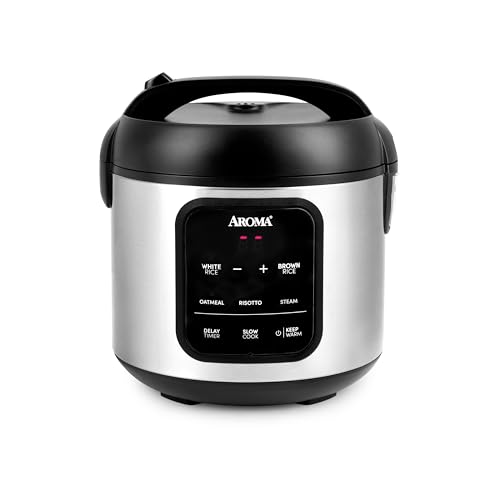
AROMA Digital 4-Cup Raw Rice Cooker, 7 Controls, 2 Qt
4 cups raw8 cups cooked7 controls2 qt
Check price on Amazon
Best for: Small households that want digital menus and risotto.

AROMA's digital 2 quart cooker uses seven automated controls that include white rice, brown rice, oatmeal, risotto and steaming. It is a pot for individuals and families of two to four, and the built-in steamer lets vegetables cook above the rice.

It has fixed digital programs rather than fuzzy logic, so rice quality tracks how carefully you measure. It is a sensible digital option that costs less than the Zojirushi compact while giving more menus, but the controller is less sophisticated and the pot is a conventional coating.

Treat the pot as a coated surface that wears. Wipe the digital panel with a damp cloth and keep the steam function's water level in mind. Risotto on a rice cooker works best with a small batch and an attentive stir at the halfway point. Oatmeal needs the lowest fill line of all the foods, because it foams and can climb the vent, and the pot should be soaked as soon as it is empty. If you want a steam basket for vegetables, check that the water in the pot is enough for both jobs.

What works

  • Seven automated controls
  • Risotto and oatmeal options
  • Built-in steam function
  • 2 quart size suits two to four

Watch out for

  • Fixed programs, not fuzzy logic
  • Conventional coating wears with use

Spec sheet

Raw capacity
4 cups
Cooked capacity
8 cups
Pot volume
2 quarts
Controls
7 automated, including risotto and oatmeal
Steamer
Built-in steam function
05
AROMA Professional 4-Cup Raw Digital Cooker, Sensor Logic
4 cups rawSensor Logic6 modesSlow cook
Check price on Amazon
Best for: Cooks who want moisture sensing and a small slow cooker.

AROMA Professional adds moisture sensing to the digital recipe. Sensor Logic technology tracks moisture and adjusts the heat as the rice cooks, and Sauté-then-Simmer lets you brown ingredients first. Six modes include slow cook in a 2 quart pot.

It sits between a plain digital cooker and a true fuzzy logic machine. For brown rice and grains it does better than a switch cooker, though it does not learn from previous cooks as the Zojirushi micom does. The size is small for a family.

Keep the lid collar clean, and rinse the vent after every cook. The sensor works best with a clean pot base, so wipe the underside dry before inserting it. Slow cook mode is best for one-pot dishes for two. Aim for beans, braised chicken thighs or steel-cut oats, and avoid recipes that need a lot of liquid, because the 2 quart pot fills quickly. Delay start should be used only with rice and water, never with raw meat, since food that sits at room temperature before cooking is a food safety risk.

What works

  • Sensor Logic tracks moisture
  • Saute-then-Simmer for one-pot meals
  • Six modes with slow cook
  • Compact 2 quart pot

Watch out for

  • Not true fuzzy logic
  • Four raw cups is small for families

Spec sheet

Raw capacity
4 cups
Cooked capacity
8 cups
Sensing
Sensor Logic tracks moisture
Modes
6, including slow cook
Cooking
Saute-then-Simmer
06
AROMA 6-Cup CoreCoat Ceramic Pot-Style Rice Cooker, 1.5 Qt
6 cups cooked1.5 qtCeramic potOne-touch
Check price on Amazon
Best for: Buyers who want a PFAS-free pot with minimal controls.

This is the simplest cooker in the list, and its point is the pot. A PFAS-free ceramic surface lines the 1.5 quart pot, a one-touch lever starts the cook and an LED switches to warm when it is done. It suits one to three people.

There are no menus, no timer and no fuzzy logic, so it is not a reason to spend near the cap. It earns its place for buyers who care about the coating chemistry more than the features, and it sits well below the cap in cost tier. A micom cooker will beat it on brown rice.

Ceramic wants gentle handling, so use a nylon paddle and a soft sponge. Dry the base before it goes into the housing, and wipe the lid collar after each meal. A dorm or office makes a fine home for it as a second cooker, though it will not replace a micom unit. Because the controls are minimal, the machine shines for people who want to press one lever and walk away, and it is easier to teach to a teenager or a guest than a menu-driven cooker. Leave the lid ajar after cooling to keep the ceramic pot dry.

What works

  • PFAS-free ceramic inner pot
  • One-touch lever
  • LED switches to Warm automatically
  • Well below the cap in cost tier

Watch out for

  • No menus, timer or fuzzy logic
  • Ceramic releases less cleanly with age

Spec sheet

Cooked capacity
6 cups
Pot volume
1.5 quarts
Pot surface
PFAS-free ceramic
Control
One-touch
Signal
LED switches to Warm

Spec sheet decoder

What the numbers on the box really mean

The specs manufacturers lead with, translated into what they tell you about real-world performance.

Micom

A microcomputer that reads temperature and adjusts heat through the cook. It copes with different rice types and batch sizes.

Watch forThe compact Zojirushi is the micom model in this lineup.

GABA brown

A brown rice cycle that holds the grain at a gentle temperature before cooking. It takes longer than a normal brown cycle.

Watch forListed on the compact Zojirushi.

Sensor Logic

A moisture tracking system that adjusts heat. It sits between a switch and full fuzzy logic.

Watch forThe AROMA Professional uses it.

Glass lid

A transparent lid that lets you watch the cook. It needs hand washing and careful handling.

Watch forThe Zojirushi 6-cup has one.

PFAS-free ceramic

A coating that avoids fluoropolymers. It still scratches under metal tools.

Watch forThe AROMA CoreCoat uses it.

Methodology

How We Evaluated These Rice Cooker Under $200

Cap compliance

We kept only cookers listed at or below $200 when this guide was updated, and we describe cost tiers, not product prices.

Control sophistication

We ranked micom, fuzzy logic, sensor logic and switch designs and weighed what each gives for brown rice and small batches.

Capacity honesty

We matched each listing to raw and cooked cups, from the 3 cup Zojirushi to the 10 cup Cosori.

Pot and lid design

We compared ceramic, nonstick and glass lid designs for wear and cleaning.

Value above the lower cap

We asked what each model adds beyond what a cheaper rice cooker already provides.

Decision guide

How to Choose the Right Rice Cooker Under $200

By Household Size

SituationPickWhy
One person, premium controlZojirushi Micom 3-CupHalf cup minimum and micom
Couple with brown riceAROMA Professional 4-CupMoisture sensing
Couple with risottoAROMA Digital 4-CupSeven controls
Family of three or fourZojirushi 6-CupGlass lid and steam tray
Family of fiveCosori 10-CupFuzzy logic and big pot
One to three, PFAS-freeAROMA CoreCoat 6-CupCeramic one-touch

By Budget Within the Cap

SituationPickWhy
Lowest tierAROMA CoreCoat 6-CupPlain ceramic cooker
Low to mid tierAROMA Professional 4-CupSensor Logic
Mid tierAROMA Digital 4-CupSeven controls
Upper tier, largeCosori 10-Cup10 cups with fuzzy logic
Upper tier, classicZojirushi 6-CupBrand and glass lid
Top of the capZojirushi Micom 3-CupMicrocomputer

Micom vs Digital Presets

Micom

The Zojirushi compact adapts to the cook and handles half a cup. It costs more per cup of capacity.

Digital presets

The AROMA models run fixed programs for rice types, with Sensor Logic on the Professional. They offer more menus for less money.

Pick micom for refinement in a small pot. Pick digital presets for more menus and low cost.

Lid and Pot Choices

SituationPickWhy
See the cookZojirushi 6-CupGlass lid
PFAS-free potAROMA CoreCoat 6-CupCeramic surface
Ceramic and fuzzyCosori 10-CupCeramic coating
Steam tray in steelZojirushi 6-CupStainless steel tray

For Brown Rice Specifically

Look for

A brown or GABA setting, or adaptive heat. The bran layer resists water, so soak and gentle heat matter.

In this comparison

The Zojirushi Micom 3-Cup with GABA brown is the most refined, and the Cosori and AROMA Professional follow.

When to Spend More

Spend more if

You cook rice daily and want pressure or induction. That moves you above this cap to the premium Zojirushi models.

Save if

You cook white rice for two or three. A cheaper cap covers it.

Ownership

Maintenance schedule

The upkeep that decides whether this machine lasts two seasons or ten.

TaskIntervalWhy it matters
Wash the inner lid and ventAfter every cookStarch builds in the lid collar. A clean lid avoids odors.
Dry the pot undersideEvery useMoisture upsets sensors and hisses on the plate.
Clean the glass lid by handAfter each useGlass can chip or crack from thermal shock. Hand washing avoids it.
Check the coatingEvery few monthsScratches mean wear. Replace flaking pots.
Wipe the cord reel and panelWeeklyCrumbs and splatter affect cord retraction and buttons.

FAQ

Frequently Asked Questions

What is the best rice cooker under $200?

The Zojirushi Micom 3-Cup for one or two people, and the Cosori 10-cup for families. Both give real control for the cap, and between them they cover the two most common household sizes without forcing a compromise on the controller.

Is $200 enough for a pressure or induction cooker?

Generally no. Those models sit above this cap. This range buys micom, fuzzy logic and digital cookers, which deliver most of the benefit for white and brown rice at a far lower cost than the pressure and induction flagships.

Why is the Zojirushi compact so small?

It is designed for one or two people and can cook from half a cup. The size is part of the engineering, because a small pot lets the controller manage a thin batch without scorching it, which a large pot cannot do.

Do prices stay under the cap?

They move with promotions. We used the cap as a filter when this guide was updated, so check the live listing.

Is a ceramic pot better?

It avoids fluoropolymers but scratches and can release less over time. Neither coating is better than careful handling, and a pot that is washed by hand and stored dry will outlast one that is scrubbed and left wet.

How long should a cooker last?

Several years with gentle care. The pot coating is the first wear part, so check the warranty terms and keep the receipt in case a replacement pot is needed in year three or four.

Bottom line

The short version

Browse more rice cooker under $200on Amazon →
James Miller, Lead Machine Editor

About the author

James Miller

Lead Machine Editor, MachineFanatic

James Miller leads MachineFanatic's buying guides, turning spec sheets, manuals and owner feedback into clear verdicts on power tools, outdoor power equipment, shop machines and kitchen machines.

More from James →

Keep reading

Related guides