
Amazon affiliate links - we earn a commission.Affiliate disclosure

Buying guide · 14 min read · Updated 2026-11-19

Best RV Air Conditioner and Heater Combos (2026)

Six RV air conditioner and heater combos compared by heat pump versus PTC element, cold-weather output, 12V versus 115V power and furnace-free comfort.

James MillerBy James MillerLead Machine Editor6 machines comparedSpec-sheet verified
Best RV Air Conditioner and Heater Combos

At a glance

Our top picks

Side by side

Spec comparison

An air conditioner and heater combo promises year-round comfort from one roof opening, and the promise comes in two quite different forms. A heat pump reverses the refrigeration cycle to move warmth indoors, while a resistive or PTC element simply turns electricity into heat.

Those two methods behave differently when the temperature drops and when the power source is a battery. One sips energy and weakens in the cold, the other works at any temperature and drinks current. We separate the picks by heating method first, then by capacity, noise and what each asks of your electrical system.

Before you buy

6 Criteria to Look For Before Buying a RV Air Conditioner and Heater Combo

  1. 01

    Heat pump or PTC element

    A heat pump such as the TOSOT's 12,500 BTU system moves heat at a fraction of an element's electrical cost, but its output drops as outdoor temperature approaches freezing. A PTC element like the Gidrox's heats at any temperature but draws the battery down quickly. Pick the method that matches both your climate and your power source. Owners who spend winters in the South can lean on a heat pump, while those who chase fall colors in the mountains usually want an element or a furnace within reach.

  2. 02

    Real heating capacity

    Heating BTU figures are quoted at mild outdoor temperatures. The Xenjum's 4,500 BTU takes the chill off a van, while the TOSOT's 12,500 BTU can warm a trailer in spring. Neither will carry a freezing night, so size the combo for shoulder seasons and keep a real furnace or heater for cold camps. Also remember that the stated heat is for the whole unit at its rated condition, and a leaky cabin with big windows will feel far colder than the number suggests.

  3. 03

    Power source for heat

    On shore power an element or a heat pump is simple. On a battery bank, heating is the most expensive load you can run, and a PTC element on a 12V unit can pull tens of amps. If you boondock, plan the heat on a diesel or propane source and use the combo for cooling and light warming.

  4. 04

    Compressor and efficiency

    Variable-speed or inverter designs, like the Everest VS-18's or the rotary combo's frequency control, make heat pumps efficient by letting them run gently. A fixed-speed compressor cycles and surges, which wastes energy and strains a generator. If you plan to heat often, the compressor is worth the premium.

  5. 05

    Voltage and wiring

    Combos come in 115V, which suit shore power and generators, and 12V DC, which suit vans and trucks. The Gidrox, Xenjum and 9,300 BTU unit are 12V and need heavy cable, a fuse and a cutoff. The Everest, TOSOT and 115V combo need an adequate pedestal and, for some, a 12V control feed.

  6. 06

    Noise when heating

    A combo often runs at night, when a quiet unit matters most. The TOSOT claims 43 dB, the Xenjum 35 dB and the Gidrox 40 dB in sleep mode. Heat pump defrost cycles can add noise in cold air, so a quieter claim is a minimum, not a guarantee.

Detailed reviews

The 6 best rv air conditioner and heater combos, explained

01
Coleman-Mach Everest VS-18 variable-speed heat pump, 18K
18,000 BTUVariable speedHeat pump360 airflow
Check price on Amazon
Best for: Large rigs that want smooth, efficient year-round comfort.

Coleman engineered the Everest VS-18 around a variable-speed compressor that adjusts its output to match conditions, and it reuses that same compressor in reverse for heating. That means the heat pump benefits from the same modulation: it can run gently for hours holding a temperature instead of cycling hard, which is the efficient way to use a heat pump.

A 360 degree airflow ceiling assembly spreads the discharge across the coach, avoiding the hot-and-cold spots a single louver creates. At 18,000 BTU it is aimed at large rigs, and like every heat pump its heating capacity falls as the outdoor air approaches freezing.

Compared with the TOSOT it is smoother but costs more, and the TOSOT claims a quieter sound figure. Keep the filter clean, let a technician handle refrigerant work and pair it with a stable power source for the electronics.

What works

  • Variable-speed compressor serves cooling and heat pump
  • 360 degree airflow ceiling assembly
  • Integrated heat pump for mild weather
  • Established brand with wide parts support

Watch out for

  • Premium price for a premium compressor
  • Heat pump output falls near freezing

Spec sheet

Capacity
18,000 BTU
Compressor
Variable speed
Heating
Integrated heat pump
Airflow
360 degree ceiling assembly
Shroud
White
02
TOSOT 16,000 BTU RV AC heat pump, 43 dB claim, white
16,000 BTU12,500 BTU heat43 dB claimHeat pump
Check price on Amazon
Best for: Spring and fall camping where quiet matters at night.

TOSOT quotes 12,500 BTU of heat pump heating against 16,000 BTU of cooling, a ratio that makes it a genuine combo and not an air conditioner with a token heater. The maker positions the heat pump for the transition seasons, spring and fall, when a full furnace is overkill and an electric warmup is enough.

The 43 dB claim, which the maker says is 32 percent quieter than a standard unit, is the quietest in this guide and a boon when the same box heats at night. The heat pump will not carry a freezing night, so a furnace or a heater stays on the plan.

Against the Everest it lacks variable speed but undercuts it on price. A fixed-speed 16,000 BTU compressor is a heavy generator load, so a soft start is worth fitting. A monthly filter wash and a roof gasket check each spring keep it healthy.

What works

  • 12,500 BTU heat pump alongside 16,000 BTU cooling
  • 43 dB claim is the quietest here
  • Works as a transition-season heater
  • Standard non-ducted roof fit

Watch out for

  • Fixed-speed compressor surges at startup
  • Heat pump will not carry a freezing night

Spec sheet

Cooling
16,000 BTU
Heating
12,500 BTU heat pump
Noise claim
43 dB
Operating range
Works across wide ambient temperatures
Shroud
White
03
115V RV AC and heater combo, 15,000 BTU, rotary compressor
15,000 BTURotary 20ccR-410AFrequency control
Check price on Amazon
Best for: Mid-size rigs wanting a frequency-controlled 115V combo.

This 115 volt combo uses a rotary compressor of about 20 cc with R-410A refrigerant and the maker says it adjusts its operating frequency to the environment, which suggests an inverter-style drive that reduces energy use. In a heater combo that matters, because heating draws more continuously than cooling.

At 15,000 BTU it covers most mid-size and larger trailers and vans with a high roof. The listing is a generic combo with thin documentation, so confirm the heating type and the control panel before buying. A rotary compressor tends to run smoother than a piston type, which helps noise and vibration.

Compared with the Arsenda it has a stated compressor design and a frequency control claim. Fit a soft start if you use a generator, wash the filter monthly and inspect the roof seal each spring.

What works

  • Rotary compressor runs smoothly
  • Adjusts operating frequency to the environment
  • 15,000 BTU suits mid-size and larger rigs
  • R-410A refrigerant is widely serviceable

Watch out for

  • Thin documentation on the heating method
  • Brand support is limited

Spec sheet

Capacity
15,000 BTU
Compressor
20cc rotary
Refrigerant
R-410A
Control
Adjusts operating frequency
Voltage
115V
04
Gidrox 10,000 BTU 12V DC RV AC with PTC heater
10,000 BTU12V DCPTC heater40 dB sleep
Check price on Amazon
Best for: Vans and small campers needing quick heat without shore power.

A PTC heater is a positive-temperature-coefficient element, a ceramic-based resistive heater that warms quickly and limits its own temperature. Gidrox builds one into a 12V rooftop unit so a van or small camper gets instant heat in freezing weather, powered by the same battery that runs the cooling.

That is the key trade: PTC heat works at any outdoor temperature, but it draws a lot of battery current, far more than a heat pump would. The cooling side is efficient, with a quoted average draw near 350 watts and a 40 dB sleep mode. At 10,000 BTU it suits compact rigs.

Compared with the Xenjum it offers a clear average draw and a quiet sleep claim. Treat the heater as a short-burst tool, size the battery bank accordingly and use a low-voltage cutoff.

What works

  • PTC element heats at any outdoor temperature
  • Runs on 12V with no inverter
  • Quoted average cooling draw near 350 watts
  • 40 dB sleep mode claim

Watch out for

  • PTC heating drains the battery quickly
  • 10,000 BTU suits only compact rigs

Spec sheet

Capacity
10,000 BTU
Voltage
12V DC
Heating
PTC element, instant warmth
Average draw claim
About 350W cooling
Sleep mode claim
40 dB
05
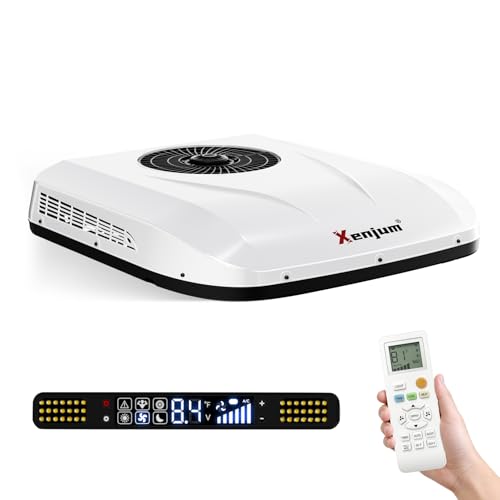
Xenjum 12V 11,000 BTU RV AC with heater, 43 lb
11,000 BTU4,500 BTU heat43 lb35 dB claim
Check price on Amazon
Best for: Light vans that want cooling and light heat at low weight.

Xenjum pairs 11,000 BTU of cooling with 4,500 BTU of heating in a unit that weighs about 43 pounds, a fraction of a typical rooftop box. It runs on 12V DC with an inverter scroll compressor, which keeps the cooling draw modest and avoids a hard start.

The heating figure is the honest limit: 4,500 BTU takes the edge off a cool morning in a van but will not heat a winter camp. A 35 dB claim for the quietest mode suits sleeping. It is a lighter, simpler combo than the Gidrox with less heat output.

The weight advantage matters for vans and truck campers. Pair it with heavy cable, a fuse and a low-voltage cutoff, and check the roof seal and terminals every season.

What works

  • Roughly 43 lb is easy on payload
  • Inverter scroll compressor trims draw
  • 11,000 BTU cooling with 4,500 BTU heat
  • 35 dB claim for sleeping

Watch out for

  • 4,500 BTU of heat is only a supplement
  • Needs heavy cable and a large bank

Spec sheet

Cooling
11,000 BTU
Heating
4,500 BTU
Weight
43 lb
Compressor
Inverter scroll
Noise claim
35 dB
06
9,300 BTU 12V rooftop RV AC and heater combo
9,300 BTU12V DCAC and heaterRooftop
Check price on Amazon
Best for: Truck cabs and small campers on a tight budget.

This is the entry-level 12V combo in the guide, a 9,300 BTU rooftop unit that cools and heats from vehicle battery power. The maker pitches economic comfort and quick regulation of temperature inside a truck or camper, with an inverter air conditioner design.

At 9,300 BTU it suits a truck cab, a small camper or a van, not a trailer. The listing is a generic combo with little detail on heating type or noise, so check the specification sheet before buying. Its main appeal is price, and its main risk is thin support.

Compared with the Xenjum it offers less capacity and less documentation. Use proper cable, a fuse and a cutoff, and inspect the roof seal and terminals every season.

What works

  • Lowest outlay of the 12V combos
  • Runs from vehicle battery power
  • Cooling and heating in one rooftop unit
  • Compact size suits trucks and small campers

Watch out for

  • Thin documentation on heat and noise
  • Limited support if it fails

Spec sheet

Capacity
9,300 BTU
Voltage
12V DC
Function
Cooling and heating combo
Mount
Rooftop
Targets
Campers, trucks, RVs

Spec sheet decoder

What the numbers on the box really mean

The specs manufacturers lead with, translated into what they tell you about real-world performance.

Heat pump BTU

Heating capacity from reverse-cycle operation, measured at mild outdoor temperatures. It falls as it gets colder.

Watch forThe TOSOT quotes 12,500 BTU; do not expect that near freezing.

PTC heater

A self-limiting ceramic resistive heater that warms quickly and works at any temperature.

Watch forThe Gidrox uses one; it is a heavy battery load.

Variable speed or frequency control

A compressor drive that changes speed instead of cycling on and off.

Watch forThe Everest is variable speed and the 115V combo claims frequency control.

Rotary compressor

A compact compressor type with fewer moving parts, often smoother and quieter than a piston type.

Watch forThe 115V combo lists a 20 cc rotary with R-410A.

Sleep mode dB

A maker claim for the quietest setting. Combos often run at night.

Watch forXenjum's 35 dB and Gidrox's 40 dB are sleep-mode figures.

Methodology

How We Evaluated These RV Air Conditioner and Heater Combos

Heating method

We separated heat pumps from resistive and PTC elements and judged each against climate and power source. Heat pumps scored for efficiency. Elements scored for cold-weather capability.

Heating capacity

We compared stated heating from 4,500 BTU on the Xenjum to 12,500 BTU on the TOSOT. We treated the figures as mild-weather numbers. Larger heating relative to cooling scored higher for a true combo.

Compressor design

We looked for variable-speed, inverter and rotary designs, placing the Everest first. Fixed-speed units were flagged for startup surge. Frequency control claims earned credit.

Electrical demand

We checked 12V DC, 115V and the 12V control feed on dual-power units. Battery-powered heat was flagged as the costliest load. Shore-power units were simpler.

Noise and documentation

We compared 35 to 43 dB maker claims and credited clear listings. Generic listings with thin detail were marked down. A combo runs at night, so quiet counted.

Decision guide

How to Choose the Right RV Air Conditioner and Heater Combos

By Rig Size

SituationPickWhy
Large coachColeman-Mach Everest VS-1818,000 BTU variable speed
Large trailer, quietTOSOT 16K43 dB and 12,500 BTU heat
Mid-size trailer or high-roof van115V 15,000 BTU comboFrequency control
Van or small camperXenjum 11,000 BTUAbout 43 lb

By Budget

SituationPickWhy
Lowest outlay9,300 BTU 12V comboEntry-level
Low outlay, documentedXenjum 11,000 BTUWeight and noise claims
Mid-range, 12VGidrox 10,000 BTUPTC heater
PremiumColeman-Mach Everest VS-18Variable speed and heat pump

Heat Pump vs PTC Element

Heat pump

The Everest and TOSOT heat efficiently in mild weather and fade near freezing. They suit shore power and generator camping.

PTC element

The Gidrox heats at any temperature but drains a battery quickly. It suits short warm-ups in a van.

Heat pump for shoulder seasons on shore power; PTC for short bursts off-grid.

Power Source

SituationPickWhy
Shore powerColeman-Mach Everest VS-18Efficient heat pump
Generator with soft startTOSOT 16KQuiet heat pump
Battery bankGidrox 10,000 BTU12V with PTC heat
Light van on batteriesXenjum 11,000 BTULow weight and draw

For Cold-Morning Camping Specifically

Look for

A heat pump with a high heating figure, a backup furnace and a quiet claim. Pre-warm before you wake with a timer.

In this comparison

The TOSOT's 12,500 BTU heat pump leads on shore power, and the Gidrox's PTC element leads off-grid.

When to Spend More

Spend more if

You camp in all seasons or heat often. The Everest repays in efficiency and smooth running.

Save if

You only need a light warm-up. The 9,300 BTU or Xenjum unit is enough.

Ownership

Maintenance schedule

The upkeep that decides whether this machine lasts two seasons or ten.

TaskIntervalWhy it matters
Wash filterMonthly in seasonA heat pump moves heat through the same coil, so a clogged filter hurts both modes. A clean filter keeps output up, and a quick look at the coil through the return grille every few weeks catches a problem before it becomes a repair.
Check condensate and defrost drainageBefore the cold seasonA heat pump produces water when it defrosts. A blocked drain can freeze and crack a pan.
Inspect DC terminalsEvery seasonA PTC heater pulls large current from 12V units. A loose lug runs hot.
Check roof sealEach springCracked sealant leaks cold air in winter and water in summer. Replace it before the heating season.
Test heating before winterStart of cold seasonA failed element or reversing valve is easier to find in autumn than on a freezing night. Run the unit in heat mode for twenty minutes with a thermometer at the vent, and compare the discharge temperature with what the maker promises.

FAQ

Frequently Asked Questions

Can an air conditioner heater combo replace my furnace?

Not in freezing weather. Heat pumps lose output as it gets colder, and elements drain batteries. It suits spring and fall mornings, with a furnace for real cold. A good rule is to count on the combo for temperatures above the low forties Fahrenheit and to treat anything colder as furnace weather.

Is a heat pump or a PTC heater better?

A heat pump is far more efficient in mild weather. A PTC heater works at any temperature but costs a lot of current. Choose by climate and power source. On shore power in mild weather the heat pump wins by a wide margin, while off-grid in a cold snap the element is the only one of the two that still works.

How much heat can a 12V combo give?

Small 12V units quote 3,400 to 4,500 BTU, enough to take the edge off in a van. A big bank is needed to run an element for long. For perspective, a heater drawing several hundred watts can use a quarter of a 100 amp-hour lithium bank in a couple of hours, which is why heating is best treated as a short pre-warm.

Do combos work in freezing weather?

Heat pumps weaken near freezing and may enter defrost cycles. PTC elements still work. Keep a diesel or propane heater for real cold. Frost on the outdoor coil is normal in cool damp air, but a unit that stays iced over for hours needs its drainage and its defrost cycle checked.

Will a combo run on shore power only?

The 115V units do, though some need 12V DC for controls. Check the listing for a dual-power requirement. A unit that wants both 115V AC and 12V DC will refuse to start with a dead house battery, which is a common surprise on a cold morning when batteries are weakest.

Are combos louder when heating?

Heat pumps can add defrost noise in cold air, and elements are quiet apart from the fan. Sleep modes reduce fan speed. If the unit shares a wall with the bedroom, a firm ceiling panel and a tight gasket reduce the thump that a reversing valve makes when it changes mode.

Bottom line

The short version

Browse more rv air conditioner and heater comboson Amazon →
James Miller, Lead Machine Editor

About the author

James Miller

Lead Machine Editor, MachineFanatic

James Miller leads MachineFanatic's buying guides, turning spec sheets, manuals and owner feedback into clear verdicts on power tools, outdoor power equipment, shop machines and kitchen machines.

More from James →

Keep reading

Related guides