
Amazon affiliate links - we earn a commission.Affiliate disclosure

Buying guide · 14 min read · Updated 2026-11-13

Best RV Inverter Chargers (2026)

Five 12V RV inverter chargers from 1000W to 3000W compared on charger current, transfer switching, battery chemistry settings and installation size.

James MillerBy James MillerLead Machine Editor5 machines comparedSpec-sheet verified
Best RV Inverter Chargers

At a glance

Our top picks

Side by side

Spec comparison

An inverter charger does two jobs that would otherwise need two boxes. It also removes a set of cables and a mounting spot from a crowded bay. It makes household power from the battery, and it recharges the battery when shore power or a generator is connected, switching between the two as the situation changes.

The difference between a good one and a frustrating one is rarely the inverter. Charger current, battery chemistry settings and the quality of the transfer switching decide how fast a bank recovers and whether the electronics ride through a power change without a hiccup.

Before you buy

6 Criteria to Look For Before Buying a RV Inverter Charger

  1. 01

    Charger current vs bank size

    Charge time in hours is roughly bank amp-hours divided by charger amps. The Renogy 3000W offers 100A, the ECO-WORTHY 55A, the Redodo 45A and the Ampinvt up to 35A. A 300Ah bank takes about three hours at 100A and about nine at 35A in theory. Match the charger to the bank and to how long you stay plugged in. A short overnight stop at a truck stop gives a charger very little time, so a fast unit matters most when stays are brief.

  2. 02

    Battery chemistry settings

    Lithium and lead acid charge to different voltages and need different float behavior. The ECO-WORTHY is tuned for LiFePO4, the Ampinvt offers SLA, AGM, GEL, Li-ion and custom profiles, and the VEVOR supports LiFePO4 and others. A wrong profile can shorten a battery's life. Lithium wants a defined absorb voltage and no long float, while lead acid wants a float stage to stay topped up.

  3. 03

    Transfer switching

    The changeover between shore power and the battery should be quick and safe. The ECO-WORTHY lists a 20ms switchover, and the Ampinvt has an auto-transfer switch. A unit with no stated transfer behavior is a question for the seller. Never let an inverter back-feed a pedestal. Follow the wiring diagram in the manual and have a qualified person check the work.

  4. 04

    Safety certification

    UL 458 covers power converters and inverters for vehicles and boats. The Renogy 3000W states UL 458 and CSA testing. The others do not mention certification in their listings. For equipment near a bed or inside a wall, certification is a reason to pay more. It means an outside lab checked the basics of electrical safety.

  5. 05

    Source limits and adjustability

    A weak pedestal or a small generator can trip under a big charger load. The Ampinvt lets you set 0 to 35A, and the VEVOR's ECO mode reduces idle draw. Adjustability protects the source and saves fuel. A generator running well below its limit is quieter and uses less fuel per hour.

  6. 06

    Size and mounting

    The Renogy's 110mm slim body suits tight bays, while the 3000W units overall need a ventilated space. A box that fits the bay is worth more than a slightly better spec on paper. Measure the bay before you buy. Leave a few inches around the case for airflow and for the cables to bend without strain.

Detailed reviews

The 5 best rv inverter chargers, explained

01
Renogy 3000W pure sine inverter charger, 100A charger, Bluetooth
3000W continuous100A chargerUL 458 and CSA safetyBluetooth
Check price on Amazon
Best for: Full-time RV owners with a large lithium bank who want certified safety and a slim body.

Passing UL 458 and CSA C22.2 No. 107.1 testing, the safety standards for RV and marine power equipment, is the credential that sets this Renogy apart. Those tests matter on a box that sits beside a mattress or inside a wall. It is described as a three-in-one power solution with a pure sine inverter, a battery charger and UPS backup.

The built-in charger delivers up to 100A, which refills a large lithium bank quickly when shore power or a generator is available. A 300Ah bank takes roughly three to four hours from a deep discharge, depending on the charge profile. The slim 110mm body is designed for tight, space-limited installations, which matters in a coach where bay depth is scarce.

Bluetooth gives you monitoring and settings from a phone. It sits near the top of the price tiers, and the extra cost buys the testing, the charger and the compact design. A 3000W inverter draws about 280A from a 12V bank, so heavy cable and a fuse near the battery are required. For a full-time coach with a lithium bank, it is the most complete solution here.

What works

  • 100A charger refills a big bank quickly
  • UL 458 and CSA C22.2 No. 107.1 testing
  • Ultra-slim 110mm body fits tight bays
  • Bluetooth monitoring and control

Watch out for

  • Near the top of the price tiers
  • Full inverter load draws about 280A
  • Transfer rating needs checking against your circuit

Spec sheet

Inverter output
3000W pure sine
Charger
100A built in
Safety testing
UL 458 and CSA C22.2 No. 107.1
Body
Ultra-slim 110mm
Control
Bluetooth
02
Ampinvt 3000W inverter charger, 9000W peak, adjustable 0-35A charging
3000W pure sine9000W peak0-35A adjustable chargeAuto-transfer switch
Check price on Amazon
Best for: Owners at weak campgrounds or with small generators who want to limit charge current.

Adjustable charging current is the Ampinvt's strong point. The maximum charge current can be set from 0 to 35A, and setting it to 0A turns charging off entirely. That is useful when a small generator or a weak pedestal cannot supply much power, because you can lower the charger instead of tripping the source.

The unit combines an inverter, a battery charger and an AC auto-transfer switch with a high transfer capability. Battery typesetting lets you choose SLA, AGM, GEL, lithium-ion or a custom profile, with support for LiFePO4, sealed gel, AGM and flooded batteries. A 9000W peak rating is an aggressive surge claim, so read it as a short allowance.

A 35A charger is on the slower side, taking about nine hours to refill 300Ah in theory, so it suits smaller banks or long shore-power stays. It sits at the middle of the price tiers, and an LCD shows what it is doing. If you want a fast charger for generator time, the Renogy is better. For a coach on a weak pedestal, the adjustable current is a smart feature.

What works

  • Charge current adjustable from 0 to 35A
  • Settings for SLA, AGM, GEL, Li-ion and custom profiles
  • Auto-transfer switch built in
  • Pure sine output at 3000W

Watch out for

  • 35A charger is slow for a big bank
  • 9000W peak is an aggressive claim
  • Middle price tier with a modest charger

Spec sheet

Inverter output
3000W pure sine
Peak output
9000W
Charge current
Adjustable 0 to 35A
Battery types
SLA, AGM, GEL, Li-ion and custom
Transfer
AC auto-transfer switch
03
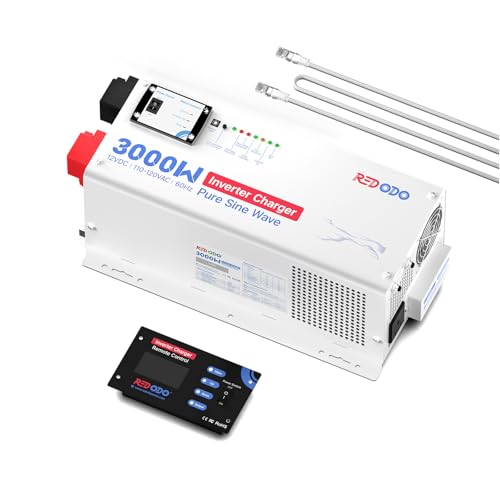
Redodo 3000W inverter charger, 9000W surge, 45A charger, LCD remote
3000W pure sine9000W surge45A chargerLCD remote
Check price on Amazon
Best for: Coaches that need strong motor-start surge and a mid-size charger in one box.

Surge up to 9000W is the number Redodo puts forward, with a 3000W continuous pure sine inverter and a 45A battery charger in one all-in-one unit. A surge of three times the continuous rating is useful for starting a compressor , and the 45A charger is a step above the Ampinvt's 35A. It is compatible with a range of battery types, including gel and AGM.

A remote and an LCD let you see and control the unit. The listing positions the unit as an all-in-one inverter charger, so it replaces a separate converter. That saves a box and a connection, which is where many RV electrical faults start.

It sits at the upper-middle tier. The 45A charger refills 300Ah in about seven hours in theory, so it suits a mid-size bank. The listing does not mention safety testing like the Renogy's UL 458, so look for certification before you buy. For a coach that needs heavy motor starts and a decent charger, it is a good balance.

What works

  • Surge up to 9000W for compressor starts
  • 45A built-in charger
  • LCD and remote control
  • Pure sine output at 3000W

Watch out for

  • No safety certification is mentioned
  • 45A charger is moderate for a big bank
  • Upper-middle price tier

Spec sheet

Inverter output
3000W pure sine
Surge
Up to 9000W
Charger
45A
Batteries
Gel, AGM and other types
Control
Remote and LCD
04
VEVOR 1200W pure sine inverter charger, 5 working modes, LCD remote
1200W pure sine5 working modesLCD and remote12V only
Check price on Amazon
Best for: Van and small-trailer owners with solar who want selectable working modes.

Five smart working modes, including unattended, AC priority, battery priority and ECO, are what VEVOR offers beyond a standard inverter charger. They let you decide whether the coach runs from shore power first or from the battery first, and ECO mode lowers idle draw when the load is small. That flexibility helps solar owners use the sun before the grid.

It is a 1200W pure sine unit designed for 12V batteries only, compatible with LiFePO4 and other chemistries. An LCD and a remote make it easy to monitor. The size suits a small coach with a TV, a laptop and a small microwave.

It sits at the lower-middle tier, which is attractive for the feature set. The listing is vague about charger current, so check the manual before you plan a bank around it. It is designed for 12V only, so do not connect it to a 24V system. For a van or small trailer with solar, it is a flexible and affordable choice.

What works

  • Five working modes including ECO and battery priority
  • Pure sine output at 1200W
  • LCD and remote included
  • Lower-middle price tier

Watch out for

  • Charger current is vague in the listing
  • 12V only, not for 24V systems
  • Limited capacity for a full kitchen

Spec sheet

Inverter output
1200W pure sine
Working modes
Unattended, AC priority, battery priority, ECO and more
Display
LCD
Control
Remote
Battery
12V only, LiFePO4 and others
05
ECO-WORTHY 1000W inverter charger, 55A LiFePO4 charger, 20ms UPS
1000W pure sine55A LiFePO4 charger20ms switchover2-in-1
Check price on Amazon
Best for: Van and small-trailer owners with a lithium bank who want a low-cost inverter charger.

Turning this ECO-WORTHY into a UPS for the coach is its 20 millisecond switchover. When shore power drops, the unit moves to battery power fast enough that most electronics do not notice, which is the behavior a TV and a router want. It combines a 1000W pure sine inverter with a 55A charger designed for LiFePO4 batteries.

That pairing suits a small coach with a modest lithium bank. A 55A charger refills a 200Ah bank in about four hours from empty, depending on the charge profile and the state of charge. The inverter runs a TV, a laptop and a small microwave, though not a heavy kitchen load.

It sits at the lowest tier among the five, which makes it the value pick. Full system protection is listed, and the unit is pure sine. It is not built for the dual legs of a 50 amp coach, so use it on a single circuit or in a smaller RV. Check the transfer switch rating before you connect it. For a van or small trailer with lithium, it is a sensible and inexpensive solution.

What works

  • 55A charger with a LiFePO4 profile
  • 20ms switchover acts like a UPS
  • Pure sine output at 1000W
  • Lowest price tier of the five

Watch out for

  • Not built for dual 50A legs
  • 1000W cannot run a heavy kitchen load
  • Listing gives little transfer rating detail

Spec sheet

Inverter output
1000W pure sine
Charger
55A, LiFePO4 profile
UPS switching
Within 20ms
Function
Inverter and charger in one
Protection
Full system protection

Spec sheet decoder

What the numbers on the box really mean

The specs manufacturers lead with, translated into what they tell you about real-world performance.

Charger amps

The current the built-in charger delivers to the battery. Higher means faster refills.

Watch forThe Renogy leads at 100A, and the Ampinvt tops out at 35A.

UPS switchover

The time to move from shore to battery power. Short times protect electronics.

Watch forThe ECO-WORTHY lists 20ms.

Working modes

Settings that decide whether the unit prefers grid or battery power.

Watch forThe VEVOR lists five.

Surge watts

A short startup allowance of a second or two.

Watch forThe Redodo and Ampinvt list 9000W.

UL 458

A safety standard for power converters and inverters used in vehicles and boats.

Watch forThe Renogy lists it.

Methodology

How We Evaluated These RV Inverter Chargers

Charger capability

We compared charger current from 35A on the Ampinvt to 100A on the Renogy and checked profile options. Charger current is the spec that varies most across this lineup. A fast charger earns points for large lithium banks.

Safety and certification

We credited UL 458 and CSA testing on the Renogy. Certification is a sign that an outside lab looked at the design. We also noted transfer-switch behavior on the ECO-WORTHY and Ampinvt. Units without stated safety details scored lower.

Chemistry flexibility

We checked how well each unit handles lithium and lead acid. A single profile is acceptable if you only run one chemistry. The Ampinvt and VEVOR offer broad settings and the ECO-WORTHY has a LiFePO4 profile.

Installation fit

We looked at size and wiring. A unit that fits the bay saves an expensive rebuild. The Renogy's slim body is the easiest to place. The 3000W units all need ventilation and heavy cable.

Ownership

We considered monitoring, adjustability and parts support. A unit you can read from a phone is easier to keep healthy. Bluetooth on the Renogy and the LCD remotes on the Redodo and VEVOR help with troubleshooting.

Decision guide

How to Choose the Right RV Inverter Chargers

By Bank Size

SituationPickWhy
400Ah or larger lithium bankRenogy 3000W100A charger
300Ah bankRedodo 3000W45A charger and big surge
200Ah lithium bankECO-WORTHY 1000W55A LiFePO4 charger
Weak pedestal, mid-size bankAmpinvt 3000WAdjustable 0 to 35A
Small solar coachVEVOR 1200WFive working modes

By Budget

SituationPickWhy
Lowest tierECO-WORTHY 1000WSimple 2-in-1
Lower-middleVEVOR 1200WWorking modes
MiddleAmpinvt 3000WCharge control
Upper-middleRedodo 3000WSurge and 45A charger
UpperRenogy 3000W100A and UL 458

Fast Charger vs Adjustable Charger

Fast charger

The Renogy 3000W at 100A refills a big bank in a few hours of generator time. It needs a source that can supply the power, such as a decent generator or a strong pedestal.

Adjustable charger

The Ampinvt lets you set 0 to 35A, which suits weak pedestals and small generators. It refills slowly but never trips the source.

Choose fast for generator charging, adjustable for weak sources.

Battery Chemistry

SituationPickWhy
LiFePO4 onlyECO-WORTHY 1000WLiFePO4 profile
Mixed or custom profilesAmpinvt 3000WSLA, AGM, GEL, Li-ion and custom
Gel or AGM bankRedodo 3000WCompatible with gel and AGM
LiFePO4 with solarVEVOR 1200WSupports LiFePO4 and others
Large lithium bankRenogy 3000W100A charging

For Generator Charging Specifically

Look for

A charger current that suits your generator and an adjustable limit if the generator is small. A 100A charger at 14V draws about 1400W from the AC side, so a 2000W generator handles it, while a 35A charger draws about 500W.

In this comparison

The Renogy 3000W suits a generator that can supply the power. The Ampinvt's adjustable 0 to 35A suits a small generator that might otherwise overload.

When to Spend More

Spend more if

You live in the coach, want certified equipment or have a large bank. The Renogy 3000W provides that.

Save if

You have a small bank and light loads. The ECO-WORTHY 1000W and VEVOR 1200W cover them at lower tiers.

Ownership

Maintenance schedule

The upkeep that decides whether this machine lasts two seasons or ten.

TaskIntervalWhy it matters
Check terminals and lugsEvery 3 monthsHigh current heats loose connections. A hot lug is a fire risk, so treat any warmth as a warning. Re-tighten and look for discoloration.
Verify charge settingsOnce a yearCheck that the charge profile matches your battery chemistry. A wrong profile is the most common cause of premature battery wear.
Clean the ventsEvery 3 monthsDust blocks airflow in a basement bay, and a charger section runs warm for hours at a time. Blow the fins out with compressed air rather than wiping them.
Test the transfer switchingOnce a yearConfirm the unit switches cleanly and isolates inverter output from shore power. Do it with a known load connected so you can watch the changeover.
Inspect fuses and cablesEvery 6 monthsCorroded holders and chafed insulation add resistance. Wipe the holder and look for green corrosion. Replace as needed.

FAQ

Frequently Asked Questions

What is an RV inverter charger?

A unit that makes AC power from the battery and recharges the battery from shore power or a generator, switching between the two. It replaces a separate inverter and converter. That means fewer boxes to mount and fewer connections to fail.

How fast will a charger refill my bank?

Roughly bank amp-hours divided by charger amps. A 100A charger refills 300Ah in about three hours in theory, and a 35A charger in about nine. Real times are longer as charging tapers. The last twenty percent of a charge takes disproportionately long.

Can I run lithium batteries on these units?

Yes, if the charge profile supports them. The ECO-WORTHY has a LiFePO4 profile, the Ampinvt and VEVOR offer lithium settings and the Renogy handles large lithium banks. Check the manual. Setting the wrong profile can shorten a battery's life.

Do I still need a converter?

Usually not, because the charger takes over its job. Check that the inverter charger supplies your coach's 12V loads and that the wiring plan covers them. A rewire is usually part of the job.

Is a transfer switch included?

Most units here include one. The ECO-WORTHY lists a 20ms switchover and the Ampinvt an auto-transfer switch. Confirm the rating against your shore circuit. A switch rated below your circuit will overheat.

Can an inverter charger run my air conditioner?

A 3000W unit can start a small air conditioner from shore power, but a 12V bank would drain quickly on battery. Most owners run air conditioning only on shore power or a generator. A soft-start kit helps the generator but does not change the battery math.

Bottom line

The short version

Browse more rv inverter chargerson Amazon →
James Miller, Lead Machine Editor

About the author

James Miller

Lead Machine Editor, MachineFanatic

James Miller leads MachineFanatic's buying guides, turning spec sheets, manuals and owner feedback into clear verdicts on power tools, outdoor power equipment, shop machines and kitchen machines.

More from James →

Keep reading

Related guides