
Amazon affiliate links - we earn a commission.Affiliate disclosure

Buying guide · 13 min read · Updated 2026-11-25

Best RV Surge Protectors for Generators (2026)

Four RV surge protectors for generator power compared on 30 and 50 amp fit, joule claims, fault detection and display, with generator-specific cautions.

James MillerBy James MillerLead Machine Editor4 machines comparedSpec-sheet verified
Best RV Surge Protectors for Generators

At a glance

Our top picks

Side by side

Spec comparison

MachineRatingSurge claimShutoffDisplay
Progressive Industries SSP-50XL 50 amp portable surge protectorBest OverallProgressive Industries SSP-50XL 50 amp portable surge protector50 amp, 120-240Vn/an/an/a
50 amp RV surge protector, 26,000 joules with auto shutoffBest 50 Amp Joule Claim50 amp RV surge protector, 26,000 joules with auto shutoff50 amp26,000 joulesAutomatic, with manual resetLED voltage, current and power
GEARGO 50 amp smart RV surge protector, 20,000 joulesBest Weather-Rated Display UnitGEARGO 50 amp smart RV surge protector, 20,000 joules50 amp20,000 joulesn/aReal-time LED line status
30 amp RV surge protector, 26,000 joules with auto shutoffBest 30 Amp Option30 amp RV surge protector, 26,000 joules with auto shutoff30 amp26,000 joulesAutomatic, manual resetLED voltage, current and power

A generator is not a utility, and an RV surge protector sees the difference. Generator power can sag when a load starts, swing when the engine hunts and arrive with a ground and neutral arrangement that a protector may read as a fault.

That makes a surge protector for generator use a slightly different shopping task than one for a pedestal. This guide compares four 30 and 50 amp protectors on what they detect, how they report it and what to check before you plug a generator into one.

Before you buy

6 Criteria to Look For Before Buying a RV Surge Protector for Generators

  1. 01

    30 amp or 50 amp match

    A 30 amp protector fits a TT-30 generator outlet and a 30 amp RV inlet, while a 50 amp unit fits a 14-50 outlet. The 30 amp 26,000 joule model and the 50 amp models are not interchangeable. Using the wrong size either does not fit or leaves the circuit unprotected. Check the rig inlet label and the generator outlet label, and write both ratings on a card in the cord bag so a rental or a borrowed generator does not cause a mismatch.

  2. 02

    Fault detection list

    On generator power, the faults that matter are open ground, open neutral, reverse polarity and low or high voltage. The Progressive SSP-50XL and GEARGO both list these checks. A protector that only clamps surges but ignores wiring faults is of limited value at a generator. A clamp can wear out after many surges, and a protector with no wiring checks will not warn you that the ground is missing.

  3. 03

    Joule ratings in context

    One listing claims 26,000 joules and notes that typical offers are 9,500 to 15,000, while the Progressive lists about 1,650. Without a shared test method, these numbers are marketing. Choose on fault detection, shutoff behavior and track record first. If two units are close, favor the one whose manual explains each light and each fault code in plain words.

  4. 04

    Display and diagnostics

    A live readout of voltage, current and power lets you see a generator sag when a load starts. The 26,000 joule models and the GEARGO provide one, while the Progressive relies on indicator lights. If you troubleshoot your own power, a display is valuable. A display also helps you tune the generator throttle and the order in which you start loads, because you can see the effect immediately.

  5. 05

    Generator ground and neutral behavior

    Some portable generators have a floating neutral and no ground rod, which a protector may read as an open ground or a reverse-polarity fault. Check your generator manual and use a proper grounding method if it asks for one. Do not bypass a protector that is flagging a real wiring fault. If a protector is reading reverse polarity or open ground on a campground pedestal, that is a safety message, and the right response is to move the rig or notify the campground.

  6. 06

    Weather and handling

    Generator power is usually used outdoors. The GEARGO claims IP68, which suggests a sealed enclosure, but plugs and cords still need to stay off wet ground. Hang the protector on the cord or a hook. A cord laid in a puddle and a plug resting in wet grass are the usual ways a protector gets blamed for a fault that is really a wet connection.

Detailed reviews

The 4 best rv surge protectors for generators, explained

01
Progressive Industries SSP-50XL 50 amp portable surge protector
50 amp120-240V12,000W capacity1,650 joules
Check price on Amazon
Best for: Generator users who want the strongest fault detection in a portable 50 amp unit.

The SSP-50XL is a portable 50 amp protector rated for 120 to 240 volts and 12,000 watts. It absorbs surges up to about 1,650 joules and its main job is fault detection: it watches for over and under voltage, open ground, open neutral, reverse polarity and surges, and cuts power when it sees one. On generator power, that watchdog behavior is more useful than a big joule number.

The tradeoff is the joule rating, which is far lower than the 20,000 and 26,000 joule claims on other listings. Makers do not measure joules the same way, so a small number does not mean weak protection, but it also does not mean a surge-eating design. Its reputation rests on how reliably it disconnects when wiring goes wrong, which is the more common danger on a campsite than a lightning-style spike. It also lacks a large display, so you read problems from indicator lights rather than live numbers.

Living with it is easy. Plug the protector into the generator outlet first, then the RV cord, and wait for its start-up delay to finish. If the unit refuses to close on your generator, check the generator's ground and neutral arrangement before blaming the protector. Many portable generators ship with a floating neutral, and the owner manual explains whether a bonding plug or a ground rod is needed for the protector to see a proper reference.

What works

  • Detects open ground, open neutral and reverse polarity
  • Rated 50 amp for 120-240V systems
  • 12,000 watt capacity for large rigs
  • Well-known fault detection design

Watch out for

  • Modest joule rating versus other listings
  • Indicator lights rather than a live display
  • May refuse to close on a floating-neutral generator

Spec sheet

Rating
50 amp, 120-240V
Capacity
12,000 watts
Surge absorption
Up to 1,650 joules
Faults detected
Over and under voltage, open ground and neutral, reverse polarity
Format
Portable, plug-in
02
50 amp RV surge protector, 26,000 joules with auto shutoff
50 amp26,000 joulesAuto shutoffLED display
Check price on Amazon
Best for: Generator users who like a live voltage and power display.

This 50 amp protector claims 26,000 joules of surge protection and contrasts that with typical offers of 9,500 to 15,000 joules. It disconnects power automatically on faults such as low voltage or overheating and uses a manual reset, and a large LED screen shows live voltage, current and power. Indicator lights add status at a glance.

The difference is the nature of the claim. A joule rating describes how much surge energy a protector can absorb over its life, and there is no common test standard, so a 26,000 figure from one maker and a 1,650 figure from another are not directly comparable. The live display is the genuine benefit for generator work, since it shows sag when a load starts.

Watch the voltage readout on startup and with a heavy load. A generator that drops below the low-voltage cutoff will trip the protector, which is the device doing its job rather than failing. If it trips often, the answer is usually a larger generator, a soft start on the air conditioner or fewer loads at once, not a protector without a cutoff.

What works

  • Live LED display of voltage, current and power
  • Automatic shutoff with manual reset
  • 26,000 joule claim
  • Indicator lights for quick status

Watch out for

  • Joule claims are not standardized
  • Newer brand with less track record
  • May trip on a generator with sagging voltage

Spec sheet

Rating
50 amp
Surge claim
26,000 joules
Shutoff
Automatic, with manual reset
Display
LED voltage, current and power
Faults
Low voltage and overheating shutoff
03
GEARGO 50 amp smart RV surge protector, 20,000 joules
50 amp20,000 joulesIP68 claimCircuit analysis
Check price on Amazon
Best for: Campers who want a weather-resistant unit with a live display.

GEARGO sells a 50 amp protector with a 20,000 joule claim, auto shutoff with reset and a real-time LED display. The listing highlights built-in circuit analysis that detects open ground, reverse polarity and high or low voltage, and it claims an IP68 rating, which implies protection against dust and continuous immersion. For a rig that sits out in rain at a campsite, a sealed enclosure is attractive.

The price of that is that an IP68 rating on a connector enclosure and the practical sealing of the plug joints are different things, so you still need to keep plugs off the ground and dry. Like other joule claims, 20,000 is not directly comparable to other makers. Beside the Progressive unit, it adds a display but lacks the long track record.

Use it where weather resistance and a readout matter. Hang the unit off the ground, keep connections dry and watch the line status when a generator starts a heavy load. Many owners also tape a small card to the cord with the normal voltage range, so a glance tells everyone whether the generator is behaving. A visible readout also helps when a guest plugs in a space heater and the voltage starts to fall.

What works

  • Circuit analysis for open ground and reverse polarity
  • Real-time LED line status
  • IP68 weather claim for a sealed enclosure
  • Automatic shutoff with reset

Watch out for

  • Newer brand with a shorter track record
  • Joule claim is not comparable across makers
  • Sealing depends on dry, off-ground connections

Spec sheet

Rating
50 amp
Surge claim
20,000 joules
Weather
IP68 claimed
Analysis
Open ground, reverse polarity, high and low voltage
Display
Real-time LED line status
04
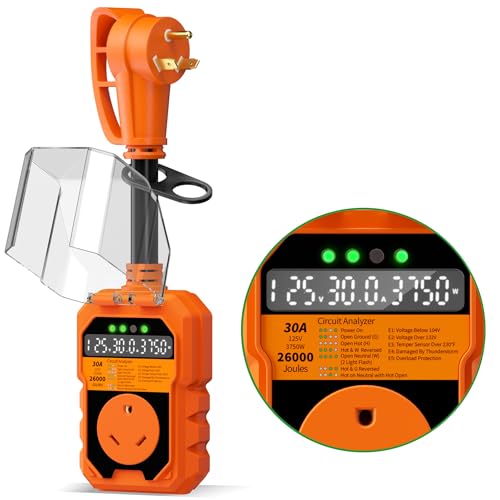
30 amp RV surge protector, 26,000 joules with auto shutoff
30 amp26,000 joulesAuto shutoffLED display
Check price on Amazon
Best for: Travel trailers and small coaches that use 30 amp generator outlets.

This is the 30 amp version of the 26,000 joule protector, with the same auto shutoff, manual reset and LED display of voltage, current and power. Many travel trailers and smaller coaches use a 30 amp service and a generator with a TT-30 outlet, so this is the size that fits them. It offers the same joule claim and the same live readout as the 50 amp model.

What you give up is that a 30 amp protector cannot be used on a 50 amp rig, and an adapter does not change the protector's rating. It also carries the same caveat about unstandardized joule claims and newer-brand support. A generator with floating neutral may trigger an open-ground reading until you provide a proper ground reference.

Match it to your rig before you buy. Plug it in at the generator, wait for the check to finish and confirm the voltage reads in the normal range before you connect the RV. Keep the generator in a well-ventilated place away from windows and slide-outs, and never run it inside a garage or compartment, because carbon monoxide is a real risk.

What works

  • 30 amp rating matches TT-30 generator outlets
  • Live LED display of voltage and current
  • Automatic shutoff with manual reset
  • Same 26,000 joule claim as the 50 amp unit

Watch out for

  • Cannot protect a 50 amp rig
  • Joule claim is not standardized
  • May read open ground on a floating-neutral generator

Spec sheet

Rating
30 amp
Surge claim
26,000 joules
Shutoff
Automatic, manual reset
Display
LED voltage, current and power
Use
30 amp RV circuits

Spec sheet decoder

What the numbers on the box really mean

The specs manufacturers lead with, translated into what they tell you about real-world performance.

Joules

A measure of the surge energy a protector can absorb. There is no common test standard across makers.

Watch forClaims here range from 1,650 to 26,000 joules.

Open ground

A wiring fault where the safety ground connection is missing. It can leave metal parts live in a fault.

Watch forGenerators with floating neutral may trigger this reading.

Reverse polarity

Hot and neutral are swapped. It is a hazard that a protector should detect and block.

Watch forSSP-50XL and GEARGO list it.

Low-voltage cutoff

The voltage below which the protector disconnects to protect motors. Generators can sag below it on heavy starts.

Watch forA trip under load is the protector working.

IP68

An ingress rating meaning dust-tight and suited to continuous immersion under stated conditions. It describes the enclosure, not the plug joints.

Watch forGEARGO claims it.

Methodology

How We Evaluated These RV Surge Protectors for Generators

Fault detection

We counted the faults each listing says it detects, including open ground, open neutral and reverse polarity. Generator use makes these checks the core feature. A generator is a small power plant with no utility ground behind it, so a protector that can sense the wiring is doing real work.

Shutoff and reset

We looked at how each unit disconnects and recovers, such as automatic shutoff and manual reset. A protector that restores power automatically after a fault can be risky at a generator. Generator output often recovers within seconds of a heavy load ending, and a protector that closes immediately into a still-unstable supply can stress motors.

Display and feedback

We compared live LED readouts to indicator lights. A display helps you see sag and load. We noted that a display can also scare a new owner, since normal sag during a compressor start can look alarming without context.

Rating fit

We matched 30 and 50 amp models to the common generator outlets. A fit that suits your rig matters more than a big claim. We also looked at cord handling, plug strain relief and how easy each unit is to hang or place off the ground.

Track record and claims

We weighed brand history and treated joule numbers as marketing. A long-standing design earns more trust than a newer one. Where a listing was vague about what it detects, we assumed the minimum and scored accordingly.

Decision guide

How to Choose the Right RV Surge Protectors for Generators

By Generator Outlet

SituationPickWhy
TT-30 outlet, travel trailer30 amp 26,000 joule model30 amp rating
14-50 outlet, large rigProgressive SSP-50XLStrong fault detection
14-50 outlet, want a display50 amp 26,000 joule modelLive LED readout
Wet campsite, 50 ampGEARGO 50 ampIP68 claim and display

By Budget

TierPickWhy
Lowest30 amp 26,000 joule modelSmaller rating
Low to mid50 amp 26,000 joule modelDisplay at a lower tier
MidGEARGO 50 ampDisplay and sealed enclosure
UpperProgressive SSP-50XLEstablished fault detection

Display vs Indicator Lights

Display

The 26,000 joule models and the GEARGO show live voltage and current. They help you see generator sag and load.

Lights

The Progressive SSP-50XL uses indicator lights. It is simple and proven but gives less detail.

Choose a display if you diagnose your own power; choose lights for simplicity.

Claim Axis

PreferencePickWhy
Highest joule claim50 amp 26,000 joule model26,000 joules
Middle claim and sealingGEARGO 50 amp20,000 joules and IP68
Detection over claimsProgressive SSP-50XLFault list
30 amp with a high claim30 amp 26,000 joule model26,000 joules

For Portable Inverter Generators Specifically

Look for

A protector that handles a TT-30 or 14-50 outlet and that you can read at a glance. Also check the cord length, because a protector plugged into a generator that sits twenty feet away needs a rated extension, not a household one. Confirm the generator ground or neutral arrangement.

In this comparison

The 30 amp 26,000 joule model matches TT-30 outlets, while the Progressive SSP-50XL pairs fault detection with a 50 amp rating.

When to Spend More

Spend more if

You run an expensive rig on generator power. The Progressive's fault detection and track record are worth it. An expensive coach has more to lose from one bad night of power than the price difference between protectors.

Save if

You camp occasionally on a 30 amp rig. The 30 amp model with a display is enough. Keep the money for a good extension cord and a generator service.

Ownership

Maintenance schedule

The upkeep that decides whether this machine lasts two seasons or ten.

TaskIntervalWhy it matters
Inspect plug bladesEvery tripBurn marks mean a loose connection. Clean or replace damaged plugs. A discolored plug blade is a warning that resistance is rising, and a hot connection can melt a housing before it trips anything.
Test the resetEvery seasonA protector that will not reset needs inspection. Check the manual for the reset sequence. Some units need the power cycled in a set order, so keep the instruction card in the cord bag.
Keep it dryEach useWater in a plug joint can trip a protector or cause a fault. Hang it off the ground.
Check generator groundEach seasonA missing ground reference can cause false faults. Follow the generator manual. If it calls for a ground rod or a bonding plug, do the job properly instead of improvising with a loose wire.
Store it cleanAfter each tripDirt in the plug causes poor contact. Wipe and cap the ends.

FAQ

Frequently Asked Questions

Do I need a surge protector on a generator?

A generator can produce voltage swings and wiring quirks, and a protector helps detect some of them. It does not replace a quality generator or good maintenance. A protector cannot fix a generator that hunts, runs out of fuel under load or is poorly grounded, and a clean fuel supply and an oil change do more for power quality than any accessory.

Why does my protector trip on the generator?

The most common causes are low voltage during a heavy start, a missing ground reference or a floating neutral. Check the voltage readout and the generator manual. If you see the voltage dip toward the low cutoff each time the air conditioner starts, the fix is a soft starter or a larger generator, not a different protector.

Are higher joules always better?

Not necessarily. There is no standard test, so choose on fault detection and track record first.

Can I use a 30 amp protector on a 50 amp rig?

No. The protector must match the circuit rating, and an adapter does not change that.

Does a protector stop a generator overload?

It will disconnect on fault conditions it detects, but it is not an overload breaker. Size the load to the generator. Add up the running watts of everything you plan to use, add the starting surge of the largest motor and compare the total to the generator rating.

Should I plug the protector in first?

Plug it into the generator outlet, wait for the checks to finish, then connect the RV. Turn off big loads before connecting, and bring them back one at a time so you can watch the voltage settle between each.

Bottom line

The short version

Browse more rv surge protectors for generatorson Amazon →
James Miller, Lead Machine Editor

About the author

James Miller

Lead Machine Editor, MachineFanatic

James Miller leads MachineFanatic's buying guides, turning spec sheets, manuals and owner feedback into clear verdicts on power tools, outdoor power equipment, shop machines and kitchen machines.

More from James →