
Amazon affiliate links - we earn a commission.Affiliate disclosure

Buying guide · 14 min read · Updated 2026-11-07

Best Salt-Free Water Softeners (2026)

Six salt-free whole-house scale conditioners compared by TAC media, filtration stages, descaler design and the hardness range each really suits.

James MillerBy James MillerLead Machine Editor6 machines comparedSpec-sheet verified
Best Salt-Free Water Softeners

At a glance

Our top picks

Salt-free systems are often sold as softeners, but the honest description is scale conditioners. Instead of removing calcium and magnesium, they change how those minerals behave so they are less likely to stick to pipes and heating elements.

That difference matters because water stays hard in every other respect: soap still scums, and skin does not feel the way it does with soft water. What you gain is no salt, no brine drain, no regeneration cycle and no electricity for most designs, so the choice is a trade between protection and a different feel.

Before you buy

6 Criteria to Look For Before Buying a Salt-Free Water Softener

  1. 01

    Conditioner, not softener

    A salt-free system changes the form of hardness minerals so they are less likely to form scale, but the minerals stay in the water. Soap still scums, and the water does not feel the way softened water does. If your goal is protection for pipes, a water heater and a dishwasher, it can be enough. If you want the feel of soft water, buy a salt-based unit. Be wary of marketing that blurs the line, because a product described as a softener that uses no salt cannot be doing the same job as a resin tank, and the physics is different. The fair promise is less scale, not less hardness, and a well-run supplier will say so plainly.

  2. 02

    Hardness range

    Sources disagree about where these systems stop working, with figures from 7 to 25 grains per gallon. The iSpring ED2000 is rated for 10 to 19. A conservative approach is to use salt-free conditioners for moderate hardness and to treat very hard water with a salt-based softener. Always confirm your hardness with a lab analysis rather than a strip. Temperature matters too, because scale forms fastest where water is heated, so a conditioner that works adequately on cold lines may be overwhelmed at a tankless heater running very hot. Ask the maker how the media or device behaves above about 140 degrees F, and keep your water heater temperature sensible to reduce scale pressure on any system.

  3. 03

    TAC media versus electronic versus citrus

    TAC systems like the Tier1 have a physical mechanism and a stated capacity, 900,000 gallons. Electronic descalers like the ED2000 have no cartridge but a more mixed record. Citrus-based cartridges like NuvoH2O use a chemical scale inhibitor. Prefer a system whose mechanism you can explain in a sentence. For TAC, the sentence is that the media gives dissolved minerals a surface on which to form tiny stable crystals that rinse through the pipes. For a citrus cartridge it is that a mild acid holds minerals in solution, and for an electronic unit it is a changing field whose effect is the least well documented of the three, which is why it comes last.

  4. 04

    Flow rate and pressure

    A tank of media or a stack of fine cartridges restricts flow. A 0.5 micron stage loads quickly and drops pressure as it does. Check the maker's flow rating against your peak demand, and size the pipes at 3/4 inch or 1 inch to match. A system that starves a shower is a bad trade for scale prevention.

  5. 05

    Filtration extras

    The Kind E-3000UV adds sediment, carbon and UV stages, while the Kind sediment model adds a reusable cartridge. These extras are worth paying for only if you have the problem they solve: grit, chlorine taste or microbial risk on well water. Do not buy UV for a treated municipal supply. Equally, do not assume that a carbon stage removes everything the maker lists, because carbon performance depends on contact time and flow, and a cartridge run at a high flow rate does less than one run slowly. If water safety is the real concern, have the supply analysed and choose a system certified for the specific contaminant you found.

  6. 06

    Running costs and media life

    TAC media has a rated life, filters need replacement and UV lamps need yearly changes. A system with no consumables, like the ED2000, costs nothing to run but offers less certainty. Add up the yearly cost of cartridges and lamps, because a cheap upfront system with expensive filters is a poor trade.

Detailed reviews

The 6 best salt-free water softeners, explained

01
Tier1 900,000 Gallon Salt-Free Whole House TAC Scale Prevention System
TAC media900,000 gallonsUpflow designNo regeneration
Check price on Amazon
Best for: A home that wants scale protection without salt, drain lines or electrical service.

The Tier1 is a straightforward template-assisted crystallization system: a tank of TAC media converts dissolved hardness into tiny crystals that stay suspended in the water instead of building up as scale. It is rated for 900,000 gallons of use, which is the capacity of the media before replacement.

It operates without salt, backwashing or regeneration, so there is no drain to run, no electricity to power a valve and almost nothing to service. An upflow design helps the media stay evenly used. The honest limit is that it does not remove hardness, so soap and skin feel the same as before, and it suits moderate hardness better than very hard water.

Plan for media replacement at the end of its capacity, and fit a sediment pre-filter if your water carries grit. Install it on the main line, ahead of the water heater, so the whole house benefits. It is the most appliance-like choice here.

What works

  • No salt, backwashing or regeneration
  • 900,000 gallon media capacity
  • No electricity needed for the conditioner
  • Minimal maintenance beyond media replacement

Watch out for

  • Does not remove hardness, so soap scum remains
  • Media must be replaced at the end of its capacity

Spec sheet

Technology
Template-assisted crystallization
Capacity
900,000 gallons
Flow design
Upflow TAC
Salt
None
Backwash or regeneration
None
02
Kind Water Systems E-3000UV Salt-Free Softener, Filter and UV Combo
Sediment filterCarbon blockSalt-free conditioningUV treatment
Check price on Amazon
Best for: A home on well or mixed-quality water that wants conditioning and filtration together.

The E-3000UV is a combination system: sediment filtration, carbon block filtration, salt-free conditioning and ultraviolet treatment in one compact assembly. The maker says it targets up to 95 percent of sediment and more than 155 contaminants including chlorine, chloramine and VOCs.

That range makes it the most versatile machine here, but the conditioning stage is still a scale preventer, not a softener, and the other stages are what justify the price. UV is a useful addition for private well owners worried about microorganisms, though it does nothing for hardness. Against the Tier1 it trades a simple, single-purpose design for a multi-stage one with more parts to service.

Filter cartridges and the UV lamp are the ongoing costs, and the lamp needs replacing yearly to stay effective. Plan the electrical connection for the UV unit. It is the choice for a household with both scale and water quality concerns.

What works

  • Sediment, carbon, conditioning and UV in one system
  • Targets chlorine, chloramine and VOCs
  • Compact whole-house format
  • UV adds microbial protection

Watch out for

  • Filters and the UV lamp need regular replacement
  • Conditioning stage does not remove hardness

Spec sheet

Stages
Sediment, carbon block, salt-free conditioning, UV
Sediment removal
Up to 95% claimed
Contaminants
Over 155 targeted, incl. chlorine and chloramine
Disinfection
UV treatment
Format
Compact whole-house system
03
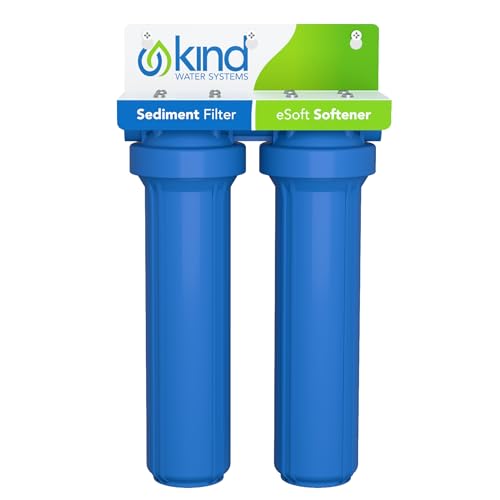
Kind Water Systems Salt-Free Softener Alternative with Sediment Filter
Salt-freeZero water wasteReusable sediment filterEasy install
Check price on Amazon
Best for: A home with sediment in the water that wants a low-effort scale conditioner.

This Kind system pairs a salt-free scale conditioner with a reusable sediment filter that catches dirt, sand, silt, clay and rust. The maker highlights zero water waste, since there is no regeneration cycle sending brine to a drain.

The reusable cartridge is the practical benefit: you rinse it rather than buy new ones, so a sediment-heavy supply costs less to run. It is simpler than the E-3000UV, with no carbon or UV stages, and it is aimed at an easy installation and low upkeep.

Rinse the sediment cartridge when the pressure drops, and replace the conditioning media on the maker's schedule. It suits a municipal home with some grit or a rural home with sand in the line.

What works

  • No water waste from regeneration
  • Reusable sediment cartridge
  • Catches dirt, sand, silt and rust
  • Easy installation and low upkeep

Watch out for

  • No carbon or UV stage
  • Does not remove hardness

Spec sheet

Type
Salt-free conditioner
Water waste
None
Pre-filter
Reusable sediment cartridge
Filters
Dirt, sand, silt, clay, rust
Upkeep
Low maintenance
04
NuvoH2O Citrus-Based Salt-Free Water Filter and Softener System
CitraChargeSalt-freeKeeps mineralsFiltration included
Check price on Amazon
Best for: A home with moderate hardness that wants a citrus-based conditioner and filtration.

The NuvoH2O uses a citrus-based conditioning cartridge, which the maker calls CitraCharge, with a filtration stage in the same system. Citric acid is a known scale inhibitor, which is the basis of the design, and the system keeps the healthy minerals in the water.

The maker also claims it removes existing scale over time. That is a plausible effect of any conditioner that keeps minerals in suspension, but results vary with the water and the pipes. It is a smaller, cartridge-based system rather than a large media tank, so it suits a house with moderate hardness and a modest flow rate.

The cartridges are consumables, so budget for replacements on the maker's schedule. Check the flow rating against your peak demand. It is a neat option for a home that wants a gentle approach.

What works

  • Citrus-based conditioning keeps healthy minerals
  • Filtration stage in the same system
  • No salt or drain required
  • Claims to reduce existing scale over time

Watch out for

  • Cartridge system with consumables to replace
  • Claims about existing scale vary with water and pipes

Spec sheet

Technology
CitraCharge citrus-based conditioning
Salt
None
Minerals
Retains healthy minerals
Filtration
Advanced filter stage
Claim
Prevents scale and removes existing scale
05
Salt-Free Whole House Softener System, 0.5 Micron PP+CTP Filtration, 3/4 In.
0.5 micron filtrationPP and CTP stages3/4 in. connectionSalt-free
Check price on Amazon
Best for: A home with clean supply water that wants very fine filtration and scale control.

This unbranded whole-house system stacks a polypropylene sediment stage and a carbon stage with a salt-free conditioner and a very fine 0.5 micron rating. The aim is scale prevention plus better-tasting water from one assembly with 3/4 inch connections.

A 0.5 micron filter is much finer than the usual 5 micron sediment cartridge and catches particles most household filters pass. The cost is faster loading, so the cartridges need changing more often and flow can drop in sediment-heavy water. Against the Kind sediment model it offers finer filtration but a shorter cartridge life.

Because it is an unbranded system, check the exact specifications, the warranty and the supply of replacement cartridges before buying. Keep a spare set on hand.

What works

  • 0.5 micron filtration is finer than typical cartridges
  • Polypropylene and carbon stages included
  • 3/4 inch connections suit standard plumbing
  • Salt-free conditioner

Watch out for

  • Fine cartridges load faster and need frequent changes
  • Unbranded, so support and parts need checking

Spec sheet

Filtration
0.5 micron
Stages
PP, CTP and conditioning
Connection
3/4 inch
Salt
None
Goal
Scale prevention and finer filtration
06
iSpring ED2000 Whole House Electronic Water Descaler
Electronic descalerNo salt or chemicals10 to 19 gpgNo maintenance
Check price on Amazon
Best for: A buyer who wants a low-cost, no-plumbing trial of scale reduction.

The ED2000 is a different technology: an electronic descaler that clamps around a pipe and sends a signal through the water. It uses no salt, no chemicals and no cartridges, and the maker rates it for very hard water in the range of 10 to 19 grains per gallon.

The benefit is that installation takes minutes and nothing needs replacing. The caution is that evidence for electronic descalers is mixed, results vary with pipe material and water chemistry, and independent reviews are less consistent than for TAC media. Treat it as a low-cost experiment rather than a guaranteed fix.

Install it on a metal pipe if you can and watch for scale on fixtures over a few months. If you see no change, a TAC system or a salt-based softener is the next step.

What works

  • Clamps on a pipe in minutes
  • No salt, chemicals or cartridges
  • Rated for 10 to 19 grains per gallon
  • No maintenance

Watch out for

  • Evidence is mixed and results vary
  • Does not remove hardness

Spec sheet

Type
Electronic descaler
Consumables
None
Intended hardness
10 to 19 grains per gallon
Installation
Clamps on the pipe
Claim
Reduces limescale and energy use

Spec sheet decoder

What the numbers on the box really mean

The specs manufacturers lead with, translated into what they tell you about real-world performance.

TAC

Template-assisted crystallization, a media that turns dissolved hardness into stable crystals that do not stick.

Watch forThe Tier1 system uses TAC media rated at 900,000 gallons.

Grains per gallon

A measure of water hardness. Salt-free systems are rated for limited ranges.

Watch forThe iSpring ED2000 is rated for 10 to 19 grains per gallon.

Micron rating

The smallest particle a filter stage captures. Smaller numbers filter more finely and load faster.

Watch forOne system quotes 0.5 micron filtration.

UV treatment

Ultraviolet light that inactivates microorganisms. It does not change hardness.

Watch forThe Kind E-3000UV is the one with a UV stage.

Zero water waste

No regeneration cycle, so no brine goes to a drain.

Watch forThe Kind sediment system and Tier1 TAC system both claim it.

Methodology

How We Evaluated These Salt-Free Water Softeners

Honesty of the claim

We checked whether each system calls itself a conditioner and states a hardness range. The Tier1 TAC and iSpring ED2000 listings are explicit about what they do and do not do.

Mechanism and capacity

We favoured systems with a stated mechanism and capacity, like the 900,000 gallon Tier1 media, over those with only broad claims.

Filtration value

We weighed the extra stages. The Kind E-3000UV adds sediment, carbon and UV, and the 0.5 micron system adds fine filtration.

Maintenance and cost

We counted cartridges, lamps and media replacement. Fewer consumables scored higher.

Evidence base

We placed the electronic descaler below the media-based systems because independent results are mixed.

Decision guide

How to Choose the Right Salt-Free Water Softeners

By Goal

SituationPickWhy
Scale protection, low maintenanceTier1 TAC900,000 gallons with no regeneration
Well water, scale and microbesKind E-3000UVSediment, carbon and UV stages
Grit and rust in the lineKind sediment systemReusable sediment cartridge
Gentle citrus-based approachNuvoH2OCitraCharge cartridge
Cheap trial on very hard wateriSpring ED2000Clamp-on, no plumbing

By Budget

TierPickWhy
LowestiSpring ED2000No plumbing and no consumables
LowKind sediment systemSimple, reusable cartridge
Lower mid0.5 micron comboFine filtration with conditioning
MidTier1 TACLarge media capacity
TopKind E-3000UVFour stages including UV

Salt-Free vs Salt-Based

Salt-free

A conditioner like the Tier1 or Kind systems prevents scale without salt, drains or electricity, but it does not remove hardness and the water feels the same.

Salt-based

A true softener swaps hardness for sodium and gives soft water, with a brine drain and salt to buy. It is the right tool for very hard water.

Choose salt-free to protect plumbing with no upkeep, and salt-based if you want soft water.

By Hardness Level

HardnessPickWhy
Moderate, under about 10 gpgTier1 TACMedia conditioner for moderate hardness
Moderate with sedimentKind sediment systemHandles grit and scale
Hard, 10 to 19 gpgiSpring ED2000Rated range, with mixed results
Very hard, above 20 gpgNone of theseA salt-based softener is better

For Protecting Appliances Specifically

Look for

Look for a system rated for your hardness and flow, installed ahead of the water heater, with a media or cartridge that you will actually replace on schedule. Scale protection is a long game, so low upkeep matters.

In this comparison

The Tier1 TAC is the most dependable pick for appliances, with the Kind E-3000UV the choice if filtration is also needed.

When to Spend More

Spend more if

Spend more if your supply has several problems: the Kind E-3000UV treats scale, sediment, chlorine and microbes in one system. A multi-stage unit replaces several separate installs.

Save if

Save if you only need scale control on moderately hard water. The Tier1 TAC or the Kind sediment system does that with little upkeep.

Ownership

Maintenance schedule

The upkeep that decides whether this machine lasts two seasons or ten.

TaskIntervalWhy it matters
Replace the media or cartridgePer the maker's ratingTAC media and cartridges have a stated capacity. Past it, scale protection fades.
Rinse reusable sediment filtersWhen pressure dropsA clogged sediment cartridge cuts flow. Rinse it clean and refit.
Replace the UV lampYearlyA UV lamp loses output over time even if it still glows. Change it on schedule.
Check for scale on fixturesMonthlyVisible scale on faucets and showerheads is the best sign of whether the system is working.
Inspect fittings for leaksQuarterlyHousings and fittings can weep after temperature changes. Tighten and wipe dry.

FAQ

Frequently Asked Questions

Are salt-free softeners real softeners?

Not in the strict sense. They condition water so scale forms less readily, but they do not remove calcium and magnesium. Hardness stays in the water, so soap scum remains.

Do they work on very hard water?

Results vary with hardness. Sources give limits from about 7 to 25 grains per gallon, so for very hard water a salt-based softener is the safer choice.

Will a salt-free system remove existing scale?

Some makers claim a gradual effect, but results vary. Do not expect an old, heavy deposit to vanish. A descaling treatment on the heater is a faster fix.

Do I need electricity?

TAC media systems need none, and electronic descalers use a small plug-in. UV combos need power for the lamp.

Is a salt-free system healthier?

It adds no sodium and retains minerals, which some people prefer. A salt-based softener adds a small amount of sodium that most people never notice. The practical difference is in the washing and the plumbing rather than the diet: salt-free water leaves soap scum and spotting on glass, while softened water does not. Many buyers who choose salt-free for the simplicity find they accept the spotting, and some add a small softener on the hot side later.

How do I know it is working?

Watch for scale on faucets, showerheads and the kettle over a few months. If it keeps forming at the same rate, the system is not suited to your water.

Bottom line

The short version

Browse more salt-free water softenerson Amazon →
James Miller, Lead Machine Editor

About the author

James Miller

Lead Machine Editor, MachineFanatic

James Miller leads MachineFanatic's buying guides, turning spec sheets, manuals and owner feedback into clear verdicts on power tools, outdoor power equipment, shop machines and kitchen machines.

More from James →

Keep reading

Related guides