
Amazon affiliate links - we earn a commission.Affiliate disclosure

Buying guide · 13 min read · Updated 2026-11-12

Best Snow Blowers (2026)

Six snow blowers compared across gas two-stage, battery two-stage, single-stage and corded designs, so you can match the machine to your driveway.

James MillerBy James MillerLead Machine Editor6 machines comparedSpec-sheet verified
Best Snow Blowers

At a glance

Our top picks

Side by side

Spec comparison

The first decision when buying a machine for clearing winter snow is not a brand but a design. Single-stage, two-stage, gas, battery and corded machines each suit a different drive, and most regrets come from buying the wrong type rather than the wrong model.

A good rule is to start with your longest driveway and your deepest typical storm, then pick the lightest machine that handles them. Everything beyond that, from path width to throw distance, is a refinement on a choice you have already made. It also helps to compare what is in each box before you pay.

Before you buy

6 Criteria to Look For Before Buying a Snow Blower

  1. 01

    Single-stage or two-stage

    A single-stage scrapes the pavement and throws snow with the auger, which suits paved drives and about 8 inches of snow. A two-stage adds an impeller and wheel drive, as on the Husqvarna ST124 and EGO SNT2425, and handles deeper snow and berms. Choose by your deepest typical storm, not the average. A drive that a plow buries at the end every storm usually calls for a two-stage, because a single-stage cannot lift a hard berm. Many buyers regret choosing a single-stage for a long driveway after the first heavy storm.

  2. 02

    Gas, battery or corded

    Gas gives unlimited runtime at the cost of fuel upkeep. Battery machines like the EGO models start with a button but run for limited time. Corded machines like the WSnow20 never run out but are tied to an outlet. A gas machine refuels in a minute, while a battery machine needs an hour to recharge, which is the real divide on a long clear. A corded machine never stops but is tethered to an outlet and a cord.

  3. 03

    Clearing width and intake

    Width sets the number of passes and intake height sets how deep a pile you can take. The Husqvarna has a 24-inch path and 21-inch intake, the Greenworks 16 inches and 10. Count your passes: a 12-foot drive takes six passes at 24 inches but nine at 16. Width matters less than intake height when drifts form against a garage door.

  4. 04

    Throw distance

    The EGO SNT2425 quotes 50 feet, the SNT2122 42 and the Greenworks 25. A longer throw puts snow where it will not return. Throw distance also depends on snow wetness and engine speed, so treat listings as best-case ranges. Stand upwind of the chute and clear downwind first.

  5. 05

    Weight and storage

    Two-stage machines are heavy. Check your garage door, ramp and floor before buying. Measure your garage door, any steps and the turn into your storage bay before you buy a two-stage. A machine you cannot move is a machine you will not use. Lift points and handle height also affect how easy it is to move.

  6. 06

    Upkeep and support

    Gas needs oil, plugs and stabilizer. Battery needs pack care. Value brands such as PowerSmart have thinner parts networks than Husqvarna. A well-known brand costs more but makes parts easier to find. A value brand is fine if you check shear pins, belts and scrapers are available.

Detailed reviews

The 6 best snow blowers, explained

01
Husqvarna ST124 24-inch 212cc two-stage
24 in path212cc21 in intakeRibbon auger
Check price on Amazon
Best for: Typical long suburban drives and heavy wet snow. Pick it for the combination of intake height and a ribbon auger.

The ST124 is a conventional gas two-stage with a 212cc engine, a 24-inch path and a 21-inch intake height. A ribbon auger blends air into the snow, which the maker says makes it easier to handle and keeps the machine from packing the housing.

That design is the reason to pick it over a plain steel auger on very wet snow, where packing is the usual failure. Thirteen-inch snow tires give it traction on a flat drive, though a steep or icy slope may want chains. Against a battery machine such as the EGO SNT2425 it offers unlimited runtime and costs less upfront for similar capacity.

Ownership follows the standard gas routine: fresh fuel with stabilizer, an oil change each season, a spark plug and a check of the shear pins. It is a heavy machine, so make sure you can get it in and out of the garage. Measure your garage door and the clearance for a ramp before you order, because the machine is the heaviest in this group.

What works

  • Ribbon auger keeps wet snow from packing
  • 21-inch intake handles drifts
  • Unlimited runtime with a fuel can
  • 13-inch snow tires for traction

Watch out for

  • Heavy and noisy compared with electric
  • Gas upkeep each season

Spec sheet

Clearing width
24 in
Engine
212cc gas
Intake height
21 in
Auger
Ribbon auger
Tires
13 in snow tires
02
EGO Power+ SNT2425 24-inch two-stage, 2 x 7.5Ah
24 in pathTwo-stage50 ft throw2 x 7.5Ah
Check price on Amazon
Best for: Owners who want gas-class performance without fuel. Pick it if fuel upkeep is the main thing you want to avoid.

The SNT2425 is a battery-powered two-stage with a 24-inch path and a stated 50-foot throw. Peak Power mode combines both 7.5Ah packs for a boost that the maker says matches gas output.

It is the best answer if you dislike fuel upkeep. It starts with a button, makes little noise and needs no oil, spark plug or carburetor. The cost is runtime: the listing rates two packs for about an 18-car driveway, and that assumes light snow.

Against the Husqvarna it is quieter and simpler, but you must manage the packs in the cold. Store them indoors and charge them before the forecast. Plan a charging routine for both packs, and keep a spare outlet near where the machine lives.

What works

  • Two-stage design with a 50-foot throw
  • Two 7.5Ah packs in the kit
  • No fuel, oil or spark plug
  • Quiet start and operation

Watch out for

  • Runtime limited by packs
  • Higher purchase cost than gas

Spec sheet

Design
Two-stage battery
Clearing width
24 in
Max throw
Up to 50 ft
Batteries
Two 7.5Ah 56V
Rated coverage
Up to 18 cars in 8 in snow
03
PowerSmart 24-inch 212cc two-stage, push-button start
24 in path212cc2,400 lb/min12 in snow
Check price on Amazon
Best for: Budget buyers wanting a gas two-stage for a long drive. Pick it if price matters more than brand support.

The PowerSmart is a value-priced 24-inch gas two-stage with a 212cc engine and a stated 2,400 pounds per minute. The listing says it handles up to 12 inches of snow and it uses a 120V push-button electric start.

It matches the Husqvarna on engine size and width, so the difference lies in brand support and finish. It is a good way to get two-stage capability at a lower price, as long as you accept thinner parts availability.

Keep the usual routine of fresh fuel, oil and shear pin checks. If you are choosing between this and the Husqvarna, ask which brand has a dealer near you for parts and service.

What works

  • 212cc engine with 2,400 lb per minute rating
  • Push-button electric start
  • Handles up to 12 inches of snow
  • Lower cost than premium brands

Watch out for

  • Thinner parts and dealer support
  • Gas upkeep each season

Spec sheet

Clearing width
24 in
Engine
212cc
Capacity
2,400 lb per min
Snow depth
Up to 12 in
Start
Push-button electric
04
EGO Power+ SNT2122 21-inch single-stage, 2 x 4Ah
21 in pathSingle-stage42 ft throw2 x 4Ah
Check price on Amazon
Best for: Paved drives up to a few cars with light to moderate snow. Pick it if you value a light machine you can lift.

The SNT2122 is a single-stage battery machine with variable auger speed and a 180-degree chute. It is rated for about a 10-car driveway in 8 inches of snow.

A single-stage clears down to the pavement and is lighter than a two-stage, but it cannot take plow berms and throws gravel. For a paved drive of a few cars, it is a good compromise.

The packs are shared with EGO tools, which lowers the cost for existing owners. A rule of thumb is to pair it with a shovel for the berm at the end of the drive.

What works

  • Variable auger speed saves charge
  • Light and easy to store
  • 180-degree chute
  • Packs shared with other EGO tools

Watch out for

  • Cannot take plow berms
  • Throws gravel

Spec sheet

Design
Single-stage battery
Clearing width
21 in
Max throw
Up to 42 ft
Batteries
Two 4Ah 56V
Feature
Variable auger speed
05
Westinghouse WSnow20 20-inch corded blower, steel auger
20 in path15A680 lb/minSteel auger
Check price on Amazon
Best for: Short paved drives close to an outlet. Pick it if you have an outlet and a short drive.

The WSnow20 is a corded 20-inch machine with a rubber-tipped steel auger and a stated 680 pounds per minute. It needs no fuel or battery and starts with a button.

It is the most economical way to clear a short paved drive, if an outlet is within reach. The cord limits range and adds a trip risk, and the single-stage design limits depth.

Use a heavy outdoor cord and inspect the rubber tips each season. A short, heavy-gauge extension cord is the best companion for this machine.

What works

  • No fuel or battery
  • Steel auger
  • Dual LED lights
  • Lowest running cost

Watch out for

  • Cord limits reach
  • Single-stage design

Spec sheet

Design
Single-stage corded
Clearing width
20 in
Motor
120V 15A, 1,800W
Capacity
Up to 680 lb per min
Auger
Rubber-tipped steel
06
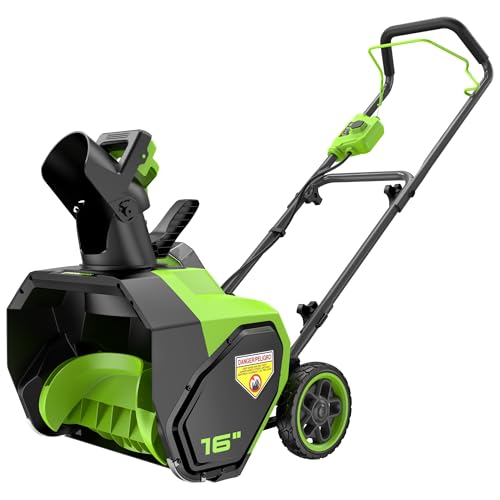
Greenworks 40V 16-inch brushless snow blower, tool only
40V16 in path10 in depth25 ft throw
Check price on Amazon
Best for: Small drives and walks, especially for owners of 40V packs. Pick it if you want the narrowest machine.

This compact 40V single-stage clears 16 inches wide and 10 inches deep with a brushless motor. It is a tool-only listing, so the battery and charger are extra.

The narrow body suits sidewalks, patios and small drives, and it is the lightest machine in this group. It is a smart purchase if you already own 40V Greenworks packs.

Check whether you have a pack before buying. If you do not have a pack, price a kit from the same family before buying, since the battery is the main cost.

What works

  • Compact 16-inch body
  • 10-inch clearing depth
  • Fits the 40V tool family
  • Brushless motor

Watch out for

  • Battery and charger not included
  • Narrow path needs more passes

Spec sheet

Design
Single-stage battery
Clearing width
16 in
Snow depth
10 in
Max throw
25 ft
Battery
Not included

Spec sheet decoder

What the numbers on the box really mean

The specs manufacturers lead with, translated into what they tell you about real-world performance.

cc displacement

Engine volume. Larger means more torque. It also affects fuel use.

Watch forThe Husqvarna and PowerSmart both use 212cc engines. Engine brand matters as much as displacement for long-term service.

Ah and volts

Battery capacity and pressure. Multiply to compare packs.

Watch forCompare watt-hours, not just volts. Always check whether the listing includes batteries and a charger.

Intake height

The tallest pile the housing can take. Taller is better for drifts.

Watch for21 inches on the Husqvarna. A tall intake also means a taller housing, which matters for storage.

Pounds per minute

A maker-rated capacity. Use it only to compare siblings.

Watch for2,400 on the PowerSmart; compare siblings only. Capacity ratings assume ideal snow and a fully loaded machine.

Ribbon auger

A spiral auger that blends air into the snow. It helps with wet snow.

Watch forHusqvarna uses it to reduce packing. It is less useful on dry powder than on wet snow.

Methodology

How We Evaluated These Snow Blowers

Design type

We split the lineup into gas two-stage, battery two-stage, battery single-stage and corded. Design decides what each can handle. Design is the first filter because a single-stage has a hard depth ceiling. Within each design we then compared engine or pack size, width and throw. A fair comparison needs the same class of machine on both sides, which is why we do not rank a corded shovel against a gas two-stage.

Power source

We compared fuel, battery and cord, since each has different limits and upkeep. Fuel, battery and cord each have a different ceiling on runtime. Gas gives unlimited runtime if you keep a can of fuel handy, battery gives a quiet start but a fixed runtime, and corded gives unlimited runtime within cord reach. Which of those matters most depends on how long your usual clear takes.

Width and depth

We compared path widths of 16 to 24 inches and intake heights of 10 to 21 inches. Intake height mattered more than path width for deep snow. A 24-inch path with a 21-inch intake is a very different tool from a 16-inch path with a 10-inch depth, even though both are sold as snow blowers.

Ownership burden

Based on the spec sheet and owner feedback patterns, we weighed fuel, pack and cord care. Pack care replaces fuel care, but it does not disappear. Gas machines ask for oil, plugs and stabilizer. Battery machines ask for warm storage and a charging routine. Corded machines ask for a good cord and a dry shelf.

Fit to driveway

We matched each model to a driveway length and snow depth. This is an editorial assessment, not a measured score. We recommend buying for your worst storm. If the drive is short, a small machine is the better buy; if it is long, spend on the two-stage once rather than replacing a small machine twice.

Decision guide

How to Choose the Right Snow Blowers

By Driveway Length

Driveway length is the best first filter, because it decides whether a two-stage is worth the weight.

SituationPickWhy
Sidewalk or patioGreenworks 40V 16-inchCompact
Short paved drive, outlet nearWestinghouse WSnow20Corded
Medium paved driveEGO SNT2122Cordless single-stage
Long drive, deep snowHusqvarna ST124Gas two-stage
Long drive, fuel-freeEGO SNT2425Battery two-stage
Long drive, budgetPowerSmart 24-inchValue gas two-stage
Steep driveHusqvarna ST124Snow tires and wheel drive

Gas also copes better with a very long drive in one sitting.

By Budget

Machine types span a wide cost range, so compare within a type first.

Budget tierPickWhy
LowestWestinghouse WSnow20Corded
Low to midGreenworks 16-inchTool only, owner of packs
MidPowerSmart 24-inchValue gas two-stage
Upper midEGO SNT2122Cordless
HighestEGO SNT2425Battery two-stage

Prices move, so compare current listing prices for kits, tool-only versions and extras like covers.

Gas vs Battery

Gas

The Husqvarna and PowerSmart run until the tank is empty. They need oil, plugs and stabilizer.

Battery

The EGO machines start with a button and are quiet but limited by packs and the cold. Choose the machine before the brand.

Choose gas for marathon clears; choose battery for convenience on shorter jobs.

Single-Stage vs Two-Stage

Design decides depth, so match it to your deepest storm.

PreferencePickWhy
Light and simpleEGO SNT2122Single-stage
Deep snow and bermsHusqvarna ST124Two-stage
Two-stage, no fuelEGO SNT2425Battery two-stage

For Deep Snow Specifically

Look for

A two-stage with a tall intake and wheel drive. Single-stage machines bog in deep snow.

In this comparison

The Husqvarna ST124 has a 21-inch intake, and the EGO SNT2425 matches it in a battery format. Both options suit long drives. A battery model also removes the need to store fuel.

When to Spend More

Spend more if

Your drive is long or the snow is deep. A two-stage saves time every storm. Check that the machine fits through your garage door before you commit.

Save if

Your drive is short. The WSnow20 or Greenworks does the job. A smaller machine costs less to store.

Ownership

Maintenance schedule

The upkeep that decides whether this machine lasts two seasons or ten.

TaskIntervalWhy it matters
Change engine oilStart of each seasonFresh oil flows in cold starts. Check the level after the first run. Warm oil also makes the pull easier on a manual start. Check the oil level before each storm.
Stabilize or drain fuelEnd of seasonStale fuel clogs the carburetor. Use fresh fuel with stabilizer. A full tank with stabilizer stores better than a half-empty one.
Charge and store packs indoorsAll winterCold reduces output. Keep packs in a warm closet. Never charge a frozen pack.
Check shear pins and beltsBefore each seasonPins protect the gearbox. Carry spares of each. Spare pins are cheap and save a storm.
Inspect auger and scraperEach seasonWorn parts leave a layer behind. Replace in pairs. Look for cracks as well as wear.

FAQ

Frequently Asked Questions

What size snow blower do I need?

A single-stage handles a short paved drive. A two-stage handles long drives and deep snow. Match the machine to your longest drive and your deepest storm, not the average. If your drive is longer than about 60 feet, lean toward a two-stage. A narrow gate may limit you to 22 inches.

Gas or battery?

Gas runs as long as you have fuel. Battery is quieter and simpler but limited by packs. Many owners keep a gas unit for the worst storms and a battery unit for light ones. Think about how much time you want to spend on upkeep.

How much snow can a single-stage handle?

About 8 to 10 inches on paved surfaces. Deeper snow needs a two-stage. Wet snow weighs more, so lift less per pass. A single-stage works best in thin layers. Settled snow is heavier than it looks.

Do I need electric start?

It helps in deep cold. Most gas models here include it. Electric start needs an outlet. Pull-start is a backup if the cord is not available. It also saves your shoulder in the cold.

Will it work on gravel?

A two-stage with raised skid shoes can. A single-stage throws stones. Break the berm first with a shovel. Raising the skid shoes keeps stones out of the auger.

How do I store it?

Drain fuel or store packs indoors, and keep the housing dry. A clean housing prevents rust. Store it with the chute pointing down so water drains.

Bottom line

The short version

Browse more snow blowerson Amazon →
James Miller, Lead Machine Editor

About the author

James Miller

Lead Machine Editor, MachineFanatic

James Miller leads MachineFanatic's buying guides, turning spec sheets, manuals and owner feedback into clear verdicts on power tools, outdoor power equipment, shop machines and kitchen machines.

More from James →

Keep reading

Related guides